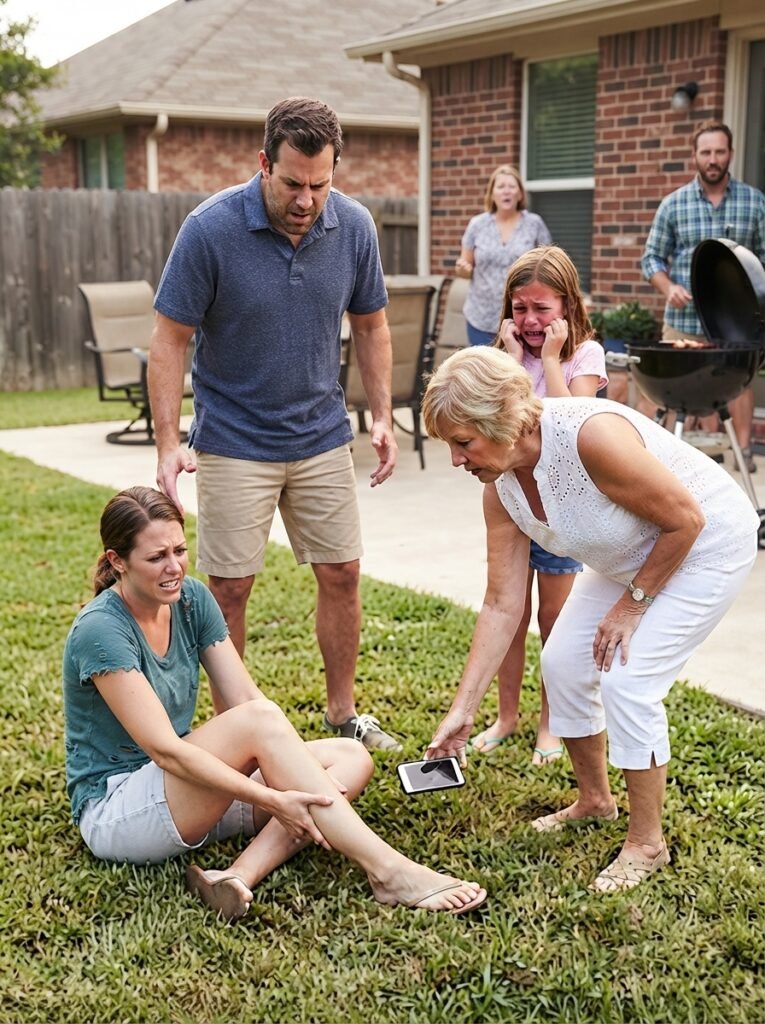
My brother crushed my leg with a concrete block after I refused to give him $25,000, and my mother knocked away my phone, screaming, “You’ll ruin his future.” My eight-year-old daughter saw everything. Then a neighbor’s camera revealed who my family had been protecting—and what they tried to hide.
Three minutes before my brother shattered the last normal afternoon my daughter and I would have for a long time, eight-year-old Emma was teaching my mother how to braid a friendship bracelet on the patio. Burgers hissed on the grill, relatives talked over one another, and I was answering an email about the rehabilitation clinic I had spent nearly ten years preparing to open.
Then Derek walked into the backyard and demanded $25,000. When I refused, he grabbed a heavy concrete landscaping block, and before anyone could fully understand what he intended, I was on the grass with Emma screaming beside me and my brother running toward his truck.
I reached for my phone to call 911. My mother slapped it from my hand and shouted, “It’s just a leg! You’ll ruin his future!” By the time the ambulance arrived, she was already telling relatives a different version of what they had just watched happen.
My name is Ava Sinclair. I was thirty-four, a physical therapist, a single mother, and six months away from opening the rehabilitation clinic I had spent most of my adult life building toward. I had worked extra shifts, covered holidays nobody wanted, postponed vacations, and saved aggressively because I wanted a place where patients recovering from serious injuries could receive coordinated therapy without being shuffled through disconnected offices. The construction loan had finally been approved, architectural plans were complete, and for the first time the future felt less like an idea and more like something with walls, doors, and a scheduled opening date.
My older brother Derek hated hearing about it. At thirty-seven, he had spent years chasing shortcuts that were always supposed to become his breakthrough: a landscaping venture, an online resale business, two questionable investments, and a contracting partnership that lasted less than a year. Every failure had a different villain. A partner betrayed him, the economy turned, a lender misunderstood him, customers were cheap, or somebody in the family had failed to support him enough.
My mother, Gloria, translated every disaster into sympathy. If Derek borrowed money and did not repay it, he was struggling. If he lied about where money went, he was embarrassed. If he exploded when someone told him no, he was under pressure. By thirty-four, I had stopped expecting her to treat us equally, but I had not stopped hoping she might eventually recognize the difference between helping her son and protecting him from every consequence.
The barbecue was supposed to be uncomplicated. Emma drew pictures beside my lawn chair while cousins chased each other near the fence, and Mom sat at the patio table sorting colored embroidery thread into little piles while Emma patiently explained which strands should cross. I had just read the email confirming the next stage of my clinic financing when Derek came through the side gate.
He did not greet anyone. His face was tense, and every movement looked clipped and impatient as he crossed the lawn directly toward me. “Need to talk,” he said.
I locked my phone and put it down. “About what?”
“Money.”
Of course it was.
“How much?”
“Twenty-five thousand.”
I laughed once because the number sounded absurd enough to be a joke. Derek did not smile.
“No.”
His jaw tightened. “What do you mean, no?”
“I mean I’m not giving you twenty-five thousand dollars.”
“You have it.”
“It’s committed to the clinic.”
“You can replace it.”
“No, Derek. I can’t.”
His voice rose. “You’re choosing some stupid clinic over family?”
Conversation around us began dying away. Emma stopped drawing and looked from him to me.
“I’m choosing not to give you money I need for my business.”
“You think you’re better than everybody now.”
“I didn’t say that.”
“You don’t have to.”
He stepped closer. I stood, partly because I did not want him towering over me and partly because Emma’s expression had changed. She knew enough about adult voices to hear danger before adults admitted it.
“Back up,” I said.
Mom moved beside Derek.
Not between us.
Beside him.
“Your brother is struggling, Ava.”
“He has been struggling for fifteen years.”
Her face hardened immediately. “Watch your tone.”
There it was. Derek could arrive demanding twenty-five thousand dollars, but my tone was the emergency.
“I said no. This conversation is over.”
Derek looked around the yard, and then his eyes moved toward the landscaping materials stacked near the property line. My uncle had been rebuilding a retaining wall, leaving several concrete blocks piled near the fence. Each one weighed close to forty pounds.
Derek looked at them.
Then at me.
Something cold moved through my stomach.
I reached for Emma’s hand. “Come on, sweetheart. We’re leaving.”
Derek stepped in front of us.
“You’re not walking away.”
“Move.”
“No.”
“Derek.” I lowered my voice. “Move away from my daughter.”
Instead, he turned toward the blocks.
People began standing. Someone called his name. I remember watching him bend and still believing, for one impossible second, that he only wanted to frighten me.
Then he lifted one with both hands.
Several relatives shouted at once.
I pulled Emma behind me.
Derek came forward.
The block struck my lower leg hard enough to drop me instantly. Pain tore through me, and the world reduced itself to grass, noise, Emma’s scream, and the inability to make my leg respond. Someone pulled Emma back while relatives rushed toward us.
Derek stood there staring down as if he had surprised himself.
Then he dropped the block and ran.
I found my phone in the grass. My hands shook so badly that I nearly dropped it again, but I unlocked the screen and started dialing 911.
A hand struck the side of my face.
The phone flew away.
I looked up.
Mom stood over me.
“It’s just a leg!” she shouted. “You’ll ruin his future!”
For several seconds, the entire yard seemed silent.
Emma was crying so hard she could barely breathe.
“Grandma, Mom needs help!”
Mom looked toward Derek’s truck instead.
That was the moment something inside me changed permanently. My brother had attacked me, but my mother had been given a choice in the seconds afterward, and she used it to protect him.
Neighbors were coming through side yards because they had heard the screaming. Someone else had already called emergency services. As those unfamiliar faces appeared, Mom’s anger shifted into panic.
She began talking immediately.
“It got out of hand.”
“Ava was yelling.”
“They were both upset.”
I stared at her from the ground while she constructed the first version of the lie before paramedics had even arrived.
Derek’s truck was gone by the time the sirens reached the street.
The ambulance crew stabilized my leg, started an IV, and asked what happened. I answered through clenched teeth while Emma held my hand.
“My brother hit me with a concrete block.”
Mom was standing twenty feet away speaking to relatives.
She never came to the ambulance.
At the hospital, surgeons worked late into the night. When I woke, my leg was immobilized and a detective named Reynolds sat near the foot of my bed waiting until I was fully alert.
“Ms. Sinclair,” he said, “your injuries are serious, but there’s something you need to see.”
He placed a tablet on the tray.
A neighboring home had a security camera facing part of my parents’ backyard.
The footage began before Derek approached me.
It showed the argument.
It showed him moving toward the blocks.
It showed the attack.
It showed me reaching for my phone.
And it showed my mother knocking it away.
The audio was clear enough to preserve her words.
“It’s just a leg. You’ll ruin his future.”
I stared at the frozen image of Gloria standing over me.
For the first time since Derek walked into that yard, I understood something with complete certainty.
They could tell whatever story they wanted.
But this time, the truth had been recording them.
Chapter 2: Hospital footage made my mother’s first lie impossible to defend
Emma slept curled in a hospital chair the next morning, one hand resting against my blanket. I watched her for a long time because the doctors had already told me my recovery could take months and might never restore my old mobility, but what frightened me most was what my daughter had learned about our family in one afternoon.
Derek had vanished. His phone was off, his apartment was empty, and police later found his truck abandoned in another county. Mom stayed exactly where she was and began working on something else: the story.
Messages arrived from relatives by my third hospital day. “Are you sure Derek attacked first?” one cousin asked. Another said Mom had told people I threatened him. Aunt Gloria heard I had “emotional problems,” which would have been almost funny if I had not been staring at surgical dressings while reading it.
Detective Reynolds brought printed screenshots. Mom claimed I fell, exaggerated the injury, and blamed Derek because he asked for money. Another version said the argument became physical on both sides.
“The footage is clear,” Reynolds said.
“I know.”
“The problem isn’t proving what happened. It’s finding him.”
I looked toward Emma.
“And what about my mother?”
“We document what she did. We follow the evidence.”
A week after surgery, my business mentor, Dr. Nathan Cole, entered my room holding a folder and looking more worried than I had ever seen him.
“What happened?” I asked.
He handed me copies of my clinic proposal, architectural layouts, financing documents, and business plans.
Then I saw my signature.
Except I had never signed them.
Someone had submitted my work as part of a new financing application.
Nathan sat down.
“Who did this?” I asked, although something in my stomach already knew.
“Derek.”
I turned another page.
There was a second questionable signature.
Gloria Sinclair.
My mother was no longer merely lying about what happened in the yard.
Someone was trying to use the future I had built while I was still lying in a hospital bed.
And this time, Derek had apparently brought her with him.
Chapter 3: While Derek hid, someone began stealing the future I built
Nathan explained that the lender had frozen the application immediately. The paperwork was sloppy, several authorizations did not match previous records, and no funds had been released. That relief lasted only a moment because the attempted fraud itself opened an entirely new investigation.
Breaking my leg had not been enough. Derek had apparently decided my clinic plans could become his opportunity if my injury kept me from using them.
The following afternoon, Emma visited after school. She sat beside my bed unusually quiet, twisting one backpack strap between her fingers.
“Mom, I need to show you something.”
She removed her tablet.
“What is it?”
“I was recording at Grandma’s.”
My pulse changed.
Emma had been making a little video about the friendship bracelets before Derek arrived. When the shouting began, she lowered the tablet but never stopped recording.
The image became mostly grass and shoes.
The audio was nearly perfect.
Derek’s voice filled the hospital room.
“You owe this family.”
Then mine.
“No.”
Mom defended him. Derek shouted about the clinic. Chairs moved and relatives spoke over one another.
Then came a sentence I did not remember hearing clearly in the moment.
“If I can’t have what you built, maybe you shouldn’t have it either.”
Emma flinched when the words played.
I stopped the recording.
“You did nothing wrong, sweetheart.”
“I should’ve called somebody.”
“You are eight. The adults were supposed to protect you.”
Detective Reynolds arrived within the hour and listened three times. His posture changed with every replay.
“Can we copy this?”
“Yes.”
At the door, I stopped him.
“Is it enough?”
“It helps a lot.”
Then he added, “We’re requesting a warrant.”
Two months after the attack, police found Derek hiding in a rented cabin nearly three hundred miles away. He surrendered as soon as officers surrounded the property.
He denied everything.
He claimed I had destroyed his life.
Meanwhile, forensic accountants kept examining the clinic applications. They discovered forged financial statements, fake partnership documents, altered business licenses, false projections, electronic signatures, and communications connecting Derek to the attempted financing.
Several connected directly to Mom.
Then Reynolds showed me an email Gloria had sent Derek four days after the attack, while I was still hospitalized.
“If Ava can’t run the clinic, someone should benefit from all that work.”
I read it three times.
That was the day I stopped waiting for my mother to become horrified by what she had helped create.
She had already decided my injury was an opportunity.
Nathan called me into his office shortly afterward. I arrived expecting more damage and found clinic funding confirmations instead.
Construction was still moving forward.
“The attack delayed things,” he said. “It didn’t destroy them.”
Then he offered me something I had not expected.
Partnership.
I stared at him.
“Your brother damaged your leg, Ava. He didn’t damage your dream.”
For the first time in months, I cried because something good had survived.
Chapter 4: My daughter’s recording turned one brutal attack into something larger
The charges expanded quickly after Derek’s arrest. Investigators were no longer looking only at the assault. Fraud, forgery, identity misuse, false financial submissions, and related offenses were being added as the paper trail widened.
Family members who had repeated Gloria’s version became quieter. Some apologized. Others simply stopped calling her.
My rehabilitation moved much more slowly.
Three braces stabilized my leg through different stages, and every new milestone seemed absurdly small compared with the life I had before. Standing for thirty seconds became a victory. Six steps with support could exhaust me for an afternoon.
Emma changed too. She became wary at gatherings and watched adults’ faces whenever voices rose. One evening she asked, “If Grandma loved you, why did she help him?”
I could not give an eight-year-old the full answer.
“Sometimes people protect the wrong things,” I said. “That doesn’t mean what happened was your fault or mine.”
Before trial, Gloria tried helping Derek from the witness stand.
The prosecutor asked ordinary questions. Where had she been standing? Did she help me call police? Did she attempt to stop Derek? Mom answered confidently, repeating pieces of the story she had spent months telling relatives.
Then the security video played.
The courtroom watched her knock my phone away.
It heard her scream about Derek’s future.
The prosecutor paused the footage.
“Mrs. Sinclair, would you like to revise your testimony?”
Mom stared at the screen.
“I don’t remember it that way.”
Then came deleted text messages recovered from her phone.
One, sent shortly after my surgery began, read, “Don’t worry. I’ll make everyone believe her leg broke another way.”
For the first time, Derek looked uncomfortable with his mother’s help.
The same protection that had insulated him for years was now creating evidence.
Gloria later left me a voicemail saying, “Ava, this has gone too far.”
I deleted it.
Apparently the concrete block had not been too far. Blocking my emergency call had not been too far. Trying to use my clinic plans while I recovered had not been too far.
Consequences were where she finally discovered limits.
Construction on Sinclair Rehabilitation Center continued while I learned to walk farther with a cane. Equipment arrived. Hiring began.
Then prosecutors offered Derek a plea agreement.
His attorney advised him to consider it.
He refused.
He still believed a trial might somehow rescue him.
The prosecutor closed her folder and said, “Then we’ll proceed.”
As I left the courthouse, I saw Mom standing alone near the entrance.
For decades she had protected Derek from consequences.
Now both of them were about to meet twelve jurors who owed their comfort nothing.
Chapter 5: Nine months later, every lie finally collapsed before the jury
The trial began nine months after the barbecue. By then I could walk with a cane, though long days made my reconstructed leg ache badly enough that I sometimes had to stop halfway across the courthouse hallway. Derek looked smaller than the man who had crossed my parents’ backyard demanding $25,000.
The prosecution began with the neighboring security footage.
The courtroom watched the argument, Derek moving toward the landscaping blocks, the attack, my attempt to call 911, and Gloria striking the phone from my hand. Her voice filled the room.
“It’s just a leg. You’ll ruin his future.”
Several relatives who had once defended her looked away.
Paramedics testified. Surgeons explained my injuries without dramatizing them. Reynolds described the search for Derek and the financial investigation that followed.
Then Emma testified through a protected child-witness setup.
I hated that she had to participate at all, but she answered simply.
“What happened when your mother tried to call for help?” the prosecutor asked.
“Grandma hit the phone.”
“What did she say?”
“She said Uncle Derek’s future mattered.”
Then prosecutors played Emma’s recording.
“If I can’t have what you built, maybe you shouldn’t have it either.”
The defense argued Derek had acted impulsively during an emotional confrontation. The recording made that explanation much harder. His resentment toward my clinic had been spoken aloud before the attack, and the later forged applications tied that resentment to a financial motive.
The fraud evidence followed.
My clinic proposals.
Fake signatures.
False business records.
Financial submissions.
Emails.
Gloria’s assistance.
What had begun as one violent afternoon became a documented pattern of entitlement: Derek believed my work should become available to him because he wanted it, and Mom believed protecting him justified almost anything.
Closing arguments ended after two weeks of testimony.
Three days later, the jury returned.
Guilty on the felony assault count.
Guilty on fraud-related charges.
Guilty on forgery and financial misconduct counts.
Derek did not move.
Mom began crying behind him.
The civil proceedings followed. The judgment covered medical expenses, future treatment, lost income, and additional damages connected to the fraud. Derek could not satisfy it without losing assets. His savings and investments were examined, and an investment property he had once bragged about as his future was ordered sold as part of the financial recovery process.
The irony was difficult to miss.
Mom had struck a phone from my hand because she was terrified I would ruin Derek’s future.
In trying to protect him from one consequence, she had helped build many more.
Outside the courthouse, reporters crowded the exit. I moved slowly toward my car with my cane and felt something quieter than victory.
Relief.
The facts were public.
The central fight was finished.
Derek had been convicted, the fraud exposed, and my clinic remained mine.
Nothing could return the months Emma and I had lost.
But nobody could rewrite what happened anymore.
Chapter 6: My clinic opened while their protected future kept falling apart
One year after Derek struck my leg, I unlocked the front doors of Sinclair Rehabilitation Center.
For several seconds, I stood in the lobby before anyone else arrived. New therapy tables lined the treatment rooms, computers glowed behind the reception desk, and sunlight stretched across flooring I had chosen before the barbecue changed everything.
Nathan joined me as a business partner. Our first weeks filled quickly with patients.
My injury changed the clinician I became.
Before, I understood rehabilitation professionally. Afterward, I understood what it meant to celebrate standing, to resent a walker, to fear that improvement had stopped, and to answer the same impossible question every morning: Will I ever be who I was?
I never fully returned to my old mobility. Cold weather made the leg ache, and I carried a slight limp. Some long days still required a cane.
But I was working.
The clinic existed.
Emma did homework in the waiting room after school and gradually became more like the child she had been before the attack. Therapy helped her trust adults again. Distance from Gloria helped even more.
Derek’s life moved in the opposite direction. His conviction followed him professionally, the investment property was gone, savings disappeared into legal and civil obligations, and former business contacts wanted nothing to do with him.
Gloria lost something less measurable.
Her credibility.
Court records had exposed the cover story, her recovered messages, and her role in the fraudulent paperwork. Friends withdrew. Relatives stopped allowing her to explain Derek’s behavior into harmlessness. The family audience she once controlled had finally seen the evidence for itself.
I did not celebrate her isolation.
I simply stopped rescuing her from it.
At the clinic, my world filled with other concerns: staffing schedules, insurance authorizations, patient outcomes, equipment repairs, and whether Emma had remembered her math worksheet.
Ordinary life became precious.
Several months after opening, I realized I had gone an entire day without thinking about Derek.
Then two days.
Then almost a week.
The future he wanted to take had become too busy to revolve around him.
Almost exactly one year after the trial, my office phone rang late in the afternoon.
I recognized the number.
Gloria.
I watched it ring twice.
Then, for reasons I still cannot completely explain, I answered.
“Hello?”
Silence.
Then my mother said my name in a voice I barely recognized.
“Ava.”
She sounded frightened.
And for the first time in my life, Gloria Sinclair was calling me because she needed something from the daughter she had once left on the grass.
Chapter 7: One final phone call ended thirty-four years of family control
“What do you want?” I asked.
Mom breathed shakily.
“We need help.”
We.
Even after everything, she still spoke about herself and Derek as a single emergency.
“What kind of help?”
“The judgments. The debts. Collections. Everything.”
I leaned back in my office chair and looked through the glass wall toward the waiting area. Emma sat with her backpack open, working on homework beneath the sign bearing my clinic’s name.
Mom started crying.
“We can’t keep up. Please.”
Please.
For years, Derek demanded and Gloria defended. Neither had been particularly interested in asking.
Now the person they had tried to take from was supposed to relieve the consequences.
Mom began talking quickly, mixing apologies with explanations. She had been scared. Derek had always needed more help. Things had gotten out of control. She never meant for my injury to be so serious.
I barely listened.
Instead, I remembered the lawn.
Emma screaming.
The phone leaving my hand.
“It’s just a leg. You’ll ruin his future.”
“Mom.”
She stopped.
“When I was lying there hurt, did you care what happened to me?”
Silence.
“When Emma was begging for help, did you care what that was doing to her?”
Her crying returned quietly.
I took a breath.
I was surprised to realize I was not angry.
Anger had required too much energy and had finally burned itself out. What remained was clarity.
“You taught me something that day.”
“What?”
“Family isn’t defined by blood. It’s defined by who stands beside you when you actually need them.”
She whispered, “We’re still family.”
I looked at Emma.
“No. Family doesn’t help someone crush your daughter’s mother and then ask the daughter to finance the consequences.”
Neither of us spoke.
Then I ended the call.
No screaming.
No threat.
No revenge speech.
Just an ending.
I never heard from Gloria again.
Months later, the clinic held its first anniversary gathering. Staff brought food, former patients returned to visit, and Nathan gave a speech I repeatedly threatened to interrupt if he became sentimental.
Near the end of the evening, Emma slipped her hand into mine.
“Mom?”
“Yeah?”
“Do you ever wish it never happened?”
I looked around the lobby.
At therapists laughing beside the reception desk.
At patients whose recovery had become part of mine.
At the daughter who was smiling more easily again.
“Honestly? Yes. I wish it had never happened.”
Emma nodded.
Then I squeezed her hand.
“But I’m proud of who we became after it did.”
She smiled.
Derek believed breaking my leg would make me dependent enough to surrender my future.
Gloria believed protecting him would preserve his.
They were both wrong.
My leg healed as far as it could. My clinic opened. Emma recovered. The truth survived every version Gloria tried to replace it with.
And the future they worked so hard to protect became the very thing Derek lost.
The future they tried to take from me became stronger than either of them imagined.
The End