They thought I had nothing but a bruised cheek and a frightened son upstairs.
They did not know my camera had recorded everything—or that the folder my mother left behind contained the mistake that would destroy their plan.
Three days earlier, my mother had posted a photograph of my younger sister, Melanie, crying beneath the stone archway of her new home outside Raleigh.
The caption read: “This is what parents do for children they believe in.”
My parents had sold their own house and used the money to help buy Melanie an $860,000 property with five bedrooms, imported lighting, and enough land for the horses she kept saying she would own someday.
I learned about it on Facebook.
They never called me.
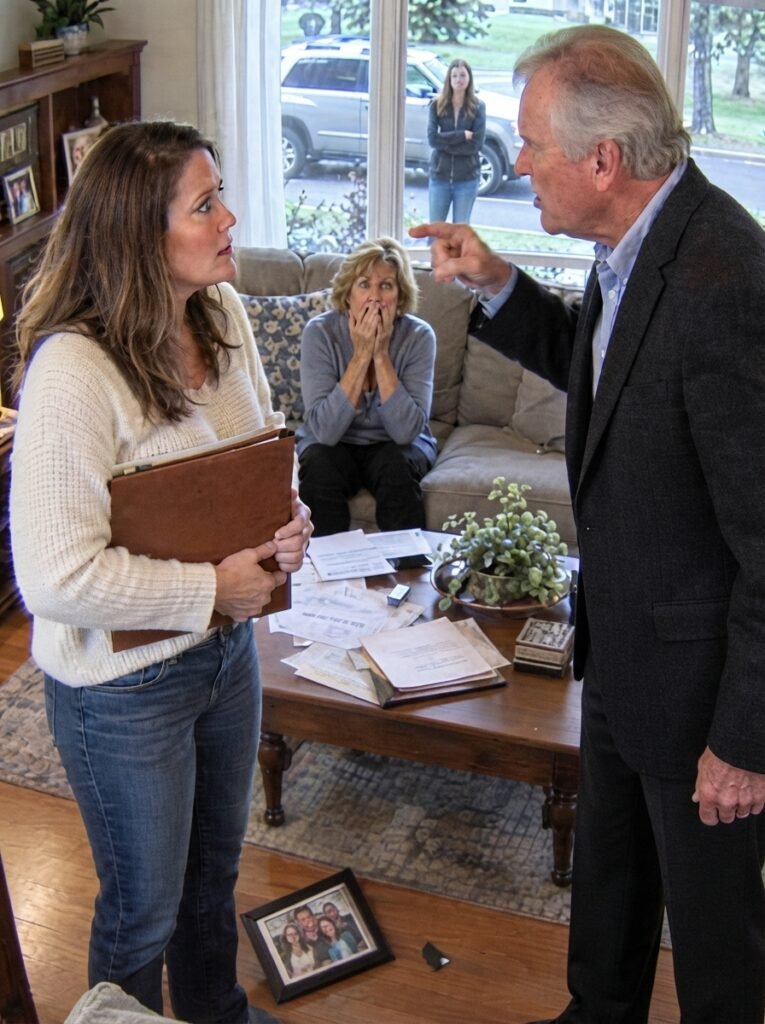
That Tuesday afternoon, my father walked into my house carrying a leather folder. My mother followed him. Melanie remained outside beside a silver SUV, pretending to study her phone.
A woman I did not recognize waited in the passenger seat with a notary bag on her lap.
My father looked around the living room I had paid for after my divorce and said, “This house makes the most sense.”
I thought I had missed part of the conversation.
“For what?”
My mother sat on my sofa and folded her hands.
“Melanie’s new home is expensive to maintain. Your layout is better for the children, and you only have Owen.”
Only.
My twelve-year-old son was upstairs doing homework.
My father placed the folder on my coffee table.
“You can rent somewhere smaller. Sign the transfer today, and we can keep this from becoming unpleasant.”
I opened the folder.
Inside was a quitclaim deed transferring my house to a company called Donnelly Family Holdings LLC. The legal description of my property was already typed in. Yellow tabs marked the places where I was expected to sign.
On the final page was a notary acknowledgment with a blank date.
“You sold your house and gave Melanie an $860,000 home,” I said. “Now you want mine too?”
My mother gave me the wounded expression she used whenever my boundaries inconvenienced her.
“Your sister has a family to protect.”
“So do I.”
My father pushed a pen toward me.
“Do the right thing.”
I closed the folder.
“No.”
His jaw tightened.
“Watch your tone.”
“This is my house. You are not taking it.”
My mother stood.
“Stop being hysterical. Melanie is already under enough pressure.”
Outside, Melanie finally looked up from her phone.
My father stepped around the coffee table.
“After everything this family has done for you, this is how you repay us?”
I almost laughed. They had paid Melanie’s bills, vacations, legal fees, fertility treatments, furniture, and now her mansion.
When I divorced, they told me adulthood meant solving my own problems.
I had worked sixty-hour weeks to keep my son stable. I had rebuilt my credit, saved every bonus, and bought that house without one dollar from them.
“You did not buy this house,” I said. “You have no claim to it. Leave.”
My father hit me.
The slap cracked through the room. My head snapped sideways, and my shoulder struck the bookcase hard enough to knock down a framed photograph of Owen.
My mother gasped.
Then my father said, “You made me do that.”
I heard movement upstairs.
I did not cry.
I picked up the fallen photograph, placed it facedown on the shelf, and looked toward the staircase.
“Owen,” I called calmly, “lock your bedroom door.”
My father’s confidence flickered.
Only for a second.
Then he pointed at the folder.
“You have until Friday. After that, we handle this without your cooperation.”
My mother grabbed his arm and pulled him toward the door. Melanie stepped aside as they left. The notary in the SUV avoided my eyes.
My mother forgot the folder.
That was their first mistake.
Their second was assuming the small black camera above my front window only faced outside.
It recorded the entryway, the living room, my father’s demand, my refusal, the slap, and his promise to take the house without my cooperation.
Ten minutes after they drove away, I saved the footage in three places.
Then I photographed every page in the folder.
The company named on the deed had been created eleven days earlier. Its registered manager was my father. Attached to the back was a financing summary showing a large payment due in ninety days.
Beneath it, in my mother’s handwriting, were six words:
“Claire’s property covers the remaining balance.”
I called a real-estate attorney named Nora Patel.
She listened without interrupting. Then she asked one question.
“Did they ever have access to your signature or identification documents?”
I remembered the paperwork from my divorce. My father had helped me carry boxes from my old apartment. One folder containing copies of my driver’s license, tax returns, and closing documents had disappeared for two weeks before he claimed to find it in his trunk.
“Yes,” I said.
Nora told me not to contact my parents again.
By sunset, she had placed a fraud alert on my property title, filed a notice with the county recorder, preserved the video, and contacted an investigator.
On Friday, nobody came back.
Instead, a document appeared in the county records eleven days later.
Someone had filed a deed claiming I had already transferred my house to Donnelly Family Holdings.
My signature was on it.
I had never signed it.
For three months, my parents acted as though nothing had happened. My mother posted photographs from Melanie’s pool. My father attended church. Melanie announced plans for a Christmas fundraiser at her new home.
Then my phone rang.
It was my aunt.
“Claire,” she whispered, “your parents are in big trouble.”
I looked at the courthouse doors ahead of me and adjusted the folder under my arm.
“I know.”
Twenty minutes later, my parents entered the emergency hearing with Melanie between them. My father still looked certain that one raised voice would make everyone obey.
Nora placed the original folder on the evidence table.
The judge compared it with the deed filed under my name.
Then she lifted one page and looked directly at my father.
“Mr. Donnelly,” she said, “would you like to explain why the only witness to your daughter’s signature died two years ago?”
My father opened his mouth, but no sound came out.
Melanie shot to her feet.
“This is Claire’s fault. She promised us that house.”
I had never made that promise.
Nora did not argue. She placed a phone on the evidence table and pressed play.
Melanie’s recorded voice filled the courtroom:
“Dad still has the signature pages from your divorce. If you won’t sign the new deed, we’ll use those and fix the dates later.”
My mother’s face collapsed. My father gripped the table so hard his knuckles turned white.
Then he pointed at me.
“She recorded us illegally. None of this counts.”
The judge stared at him.
“Your daughter recorded an assault inside her own home.”
A deputy moved closer.
Nora handed the clerk a sealed drive.
“Your Honor, the recording also shows who delivered the forged documents to the notary.”
The clerk rolled a monitor into place.
The first frame showed my father in my living room, his hand already raised.
Nobody in the courtroom moved.
Then the video continued.
My father’s palm struck my face. My body staggered against the bookcase. Owen’s photograph fell to the floor.
For a moment, I could hear nothing except the sound of my own heartbeat.
Then my father’s voice came through the speakers.
“You made me do that.”
The judge paused the recording.
“Mr. Donnelly, is that you in this video?”
My father swallowed.
“It was a family disagreement. She was being disrespectful.”
“That wasn’t my question.”
His attorney leaned toward him and whispered something. My father stared at the table.
“Yes,” he finally muttered.
The judge instructed the clerk to continue.
The next clip showed my mother collecting her purse while my father pointed at the deed. Melanie’s voice came from the open doorway.
“Just make her sign it, Dad. We don’t have time to start over.”
My stomach tightened.
Then came the conversation that changed everything.
My mother turned toward the camera, unaware it was recording her.
“If Claire refuses, the bank will take Melanie’s house. We’ve already used the money from our sale, and the final payment is due in ninety days.”
My father answered, “That’s why we need Claire’s property. Once the deed is transferred, the lender won’t have anything to worry about.”
The courtroom fell silent.
They hadn’t simply wanted my house.
They had planned to use it to rescue the mansion they had bought for my sister.
And if I had signed that document, I might have spent years fighting to recover the home where my son and I had finally found peace.
The recording continued.
Melanie stepped into the room, holding a set of papers.
“What about the old signature pages?” she asked.
My father glanced toward the front window.
“We’ll deal with that if we have to.”
The judge stopped the video.
She removed her glasses and looked at Melanie.
“Miss Donnelly, did you know that a deed bearing your sister’s signature had been filed with the county?”
Melanie’s face had gone pale.
“I thought she had agreed.”
“Your voice on this recording suggests otherwise.”
“I was just trying to save my family!”
I finally spoke.
“What about mine?”
Melanie turned toward me.
“What?”
“My family. My son. The home where he sleeps every night. Did you ever think about what would happen to us if you took it?”
She opened her mouth, but no answer came.
I had spent my entire childhood listening to my parents explain why Melanie needed more than I did.
She needed the better school because she was sensitive.
She needed the expensive car because she was more responsible.
She needed help with her wedding because her future mattered so much.
When I struggled, they called me independent.
When Melanie struggled, they called her deserving.
I had convinced myself that if I worked hard enough, stayed quiet enough, and asked for little enough, someday they might treat us equally.
That day never came.
But sitting in that courtroom, I finally understood something.
Their favoritism had never been my failure.
It had been their choice.
And I was done paying for it.
The judge ordered the disputed deed preserved as evidence and referred the suspected forgery and related financial conduct for further investigation.
She also issued an order preventing any further transfer of my property while the case proceeded.
My father stood abruptly.
“You can’t do this to us! That’s our family!”
The judge’s expression hardened.
“Your family relationship does not give you ownership of another person’s home.”
A deputy approached him.
For the first time in my life, my father looked at someone who wasn’t afraid of him.
He looked at someone who didn’t care how loudly he spoke.
His attorney pulled him back into his seat.
My mother began to cry.
Not quietly, either.
She sobbed into a tissue, shaking her head as though she were the victim of something terrible.
When she noticed me watching, she reached for my hand.
“Claire, sweetheart. Please. Tell them we were only trying to help Melanie.”
I moved my hand away.
“You brought a deed to my house and told me to sign it. Dad hit me when I refused. Then you used my stolen signature to file a fraudulent transfer.”
Her lips trembled.
“We never wanted to hurt you.”
I looked directly at her.
“Then why didn’t you stop him?”
She had no answer.
Because the truth was simpler than any excuse she could offer.
My mother had watched my father strike me, and her first concern had been whether they could still get the house.
The hearing continued for another hour.
Nora presented copies of the original deed, the county filing, the company’s registration records, and the financing summary.
The investigator had also obtained communications showing that my father had discussed using my property to secure the debt connected to Melanie’s mansion.
One message from my mother read:
“Claire won’t cooperate unless we make her understand she owes us.”
Another, sent by Melanie, said:
“Once it’s transferred, she can’t do anything about it.”
I stared at those words on the monitor.
They had mistaken my patience for weakness.
They had mistaken my independence for loneliness.
Most of all, they had mistaken my love for my family as permission to destroy my future.
The judge scheduled further proceedings and warned everyone involved not to interfere with the investigation.
As we left the courtroom, my father called after me.
“Claire! You are destroying this family over a piece of property!”
I stopped.
Nora touched my arm, silently reminding me that I didn’t owe him another conversation.
But I turned anyway.
“No, Dad. You destroyed this family when you decided my son and I were worth less than Melanie’s mortgage.”
His face twisted with anger.
Then I walked away.
The next several weeks were difficult.
The county investigation uncovered evidence that the deed had been prepared using information taken from my old divorce documents.
The notary who had accompanied my parents eventually cooperated with investigators. She explained that my father had presented the paperwork as a transaction I had already approved and told her the missing details would be completed later.
She had not witnessed me sign the deed.
She had also failed to verify the circumstances surrounding the documents properly.
The investigation revealed that Donnelly Family Holdings LLC had been created to handle the property transfer and support the financial arrangement my father had negotiated.
The company had no meaningful assets of its own.
My house was supposed to become its greatest asset.
And my parents had planned to use that asset to secure financing connected to Melanie’s mansion.
They had built an elaborate plan around one assumption: that I would eventually give in.
They never imagined I would keep the recording.
They certainly never imagined a judge would watch it.
As the evidence accumulated, my father faced criminal scrutiny over the suspected forgery, while the assault was investigated separately. The final legal outcomes would depend on the evidence and the proceedings still ahead.
My mother was also questioned about her role in the plan.
Melanie hired an attorney of her own.
For the first time, the three of them stopped presenting a united front.
Each wanted to save themselves.
And each had something to say about the others.
My mother claimed my father had organized everything.
My father insisted Melanie had pressured him because she was terrified of losing the mansion.
Melanie said our parents had promised her the property arrangement was legal.
None of them seemed particularly interested in explaining why they had thought it was acceptable to take my home.
Meanwhile, Nora helped me challenge the fraudulent deed and protect my ownership rights.
The legal process was exhausting, but I had something I hadn’t possessed during my childhood.
Evidence.
Not promises.
Not excuses.
Evidence.
Three months after the hearing, Melanie showed up at my front door.
I saw her through the security camera before opening it.
She was wearing jeans and an oversized sweater. Her eyes were red, and she looked nothing like the confident woman who had stood outside my house while our father tried to force me to sign away my future.
I opened the door but kept the security chain fastened.
“What do you want?”
She looked down at the porch.
“Can we talk?”
“No.”
“Claire, please. Just five minutes.”
I studied her face.
Once, I would have opened the door immediately. I would have invited her inside, made coffee, and listened while she explained why everything had happened to her rather than because of her.
But I had learned that sympathy without boundaries could become another way of being used.
“You can talk from there,” I said.
She nodded, swallowing hard.
“The bank is threatening foreclosure proceedings. Mom and Dad can’t cover the payments. They’ve spent everything they had.”
I said nothing.
“They’re blaming each other. Dad says Mom knew about the deed. Mom says he planned the whole thing. I don’t even know what to believe anymore.”
“You knew enough to tell him to use my old signature.”
She flinched.
“I didn’t think he would actually do it.”
“You told him to fix the dates later.”
“I know.”
“Then you knew it was wrong.”
Tears rolled down her cheeks.
“I was scared.”
“So was I.”
She looked up.
I continued before she could interrupt.
“I was scared when Dad hit me. I was scared when I realized someone had filed a deed using my name. I was scared every time Owen asked if we were going to lose our home.”
My voice shook, but I didn’t look away.
“You were scared of losing a mansion. I was scared of losing the only home my son had left after his father and I divorced.”
Melanie covered her mouth.
“I never thought about it that way.”
“That’s the problem, Melanie. You never thought about me at all.”
She began crying harder.
For a moment, I remembered the little girl who used to crawl into my bed during thunderstorms. I remembered sharing my birthday cake with her when our parents bought her a present on my birthday and forgot mine.
I remembered loving her long before I understood what our parents were teaching us.
Part of me still wanted to comfort her.
But loving someone didn’t mean I had to let them hurt me again.
“Can you help us?” she whispered. “Just this once?”
I shook my head.
“I won’t give you my house. I won’t pay your mortgage. And I won’t lie to protect you from what you did.”
“I am your sister.”
“And I was your sister when you helped them try to take my home.”
She stared at me as though she had never considered that our relationship could have consequences.
Then she asked the question I had been waiting to hear.
“Do you hate me?”
I thought about it carefully.
“No. But I don’t trust you.”
Somehow, that answer hurt her more than anger would have.
She wiped her face and stepped away from the door.
“I’m sorry, Claire.”
I believed she felt sorry.
I just didn’t know whether she was sorry for what she had done or for the fact that it hadn’t worked.
“I’m glad you said that,” I replied. “But an apology doesn’t erase what happened.”
She nodded.
Then she walked back to her car.
I watched her leave through the camera.
For the first time, I didn’t feel guilty about letting her go.
The following spring, the legal fight over my house finally reached a resolution.
The fraudulent deed was set aside, and my ownership was restored in the county records. The court also confirmed that Donnelly Family Holdings had no valid claim to my property.
The criminal investigation continued separately, and the evidence from the recordings and financial documents became central to the authorities’ case.
My father eventually accepted a plea agreement related to the forged property documents and the assault, avoiding a full trial on those charges. The sentence included probation, financial penalties, and a court order prohibiting him from contacting me directly or interfering with my property.
My mother faced consequences for her involvement in the scheme, including financial penalties and restrictions connected to the case.
Melanie was not spared simply because she was my sister. Her recorded statements and messages remained part of the evidence, and she had to answer questions about her role in the attempted transfer.
Their mansion was eventually sold after they could no longer maintain the payments.
I didn’t celebrate when I heard.
I didn’t post about their downfall on Facebook.
I didn’t send my mother a photograph of my house with a caption about children who deserved better.
I simply continued living.
Because my victory wasn’t watching them lose the things they had once used to make themselves feel superior.
My victory was knowing they could never use those things to control me again.
On a warm Saturday afternoon, Owen and I sat on the back porch eating pizza.
He was thirteen now, taller than he had been when my father struck me. His schoolwork was spread across the table, and a basketball rested beside his chair.
For months, he had asked very few questions about what happened that afternoon.
I had told him the truth in an age-appropriate way. I explained that his grandfather had hurt me, that the adults involved had made serious mistakes, and that none of it was his fault.
I had also promised him that no one was going to take our home away from us.
That afternoon, he looked across the yard and asked, “Mom, are we ever going to see Grandpa and Grandma again?”
I set down my slice of pizza.
“I don’t know, sweetheart.”
“Do you miss them?”
The question caught me off guard.
I watched the wind move through the trees beyond our fence.
“Sometimes,” I admitted. “I miss the family I thought we had.”
He considered that for a moment.
“Does that mean we have to forgive them?”
I reached across the table and took his hand.
“No. Forgiveness is something you choose when you’re ready. It doesn’t mean you have to trust someone again, and it doesn’t mean you have to let them hurt you.”
He nodded slowly.
“Good. Because I don’t want anyone hitting you again.”
My throat tightened.
I pulled him into a hug.
“No one is going to get away with that again,” I whispered.
He rested his head against my shoulder.
Then, after a moment, he asked, “Can we paint my room blue?”
I laughed.
“What happened to the gray you wanted?”
“Blue is better.”
“Then blue it is.”
And just like that, we started talking about paint samples, new curtains, and whether his basketball posters would look better above the desk or beside the closet.
Ordinary things.
Beautiful things.
The kind of things my parents had nearly taken from us because they believed their desires mattered more than our security.
A year after the assault, I received a letter from my mother.
It arrived in a plain white envelope with my name written in her familiar handwriting.
For several minutes, I left it on the kitchen counter.
Then I opened it.
She wrote about regret, about how quickly everything had fallen apart, and about how she wished she could return to the afternoon when she had walked into my house believing she could convince me to surrender it.
She admitted that she had spent years treating Melanie’s needs as more important than mine.
She admitted that she had allowed my father to control the family because challenging him would have meant confronting the things she had spent her life avoiding.
And she wrote one sentence that made me stop reading.
“I thought you were strong enough to survive being treated unfairly, so I never considered how much it was hurting you.”
I read that sentence twice.
It explained so much.
My parents had mistaken my ability to survive their behavior for permission to continue it.
Because I worked hard, they assumed I didn’t need help.
Because I rarely asked for anything, they assumed I deserved nothing.
Because I kept rebuilding my life, they assumed they could keep knocking it down.
I folded the letter and placed it in a drawer.
I didn’t respond.
Maybe one day I would.
Maybe I wouldn’t.
For the first time, that decision belonged entirely to me.
On the anniversary of the day my father struck me, I stood in the living room and looked at the bookcase.
I had repaired the damaged shelf months earlier. Owen’s photograph stood in its original place, this time inside a new frame he had chosen himself.
The little black camera remained above the front window.
Not because I lived in fear.
Because protecting my home had become an ordinary part of protecting my peace.
I walked upstairs and found Owen sitting at his desk, working on a school project.
“Hey, Mom,” he said without looking up. “Do you know where the blue markers are?”
“Kitchen drawer.”
“Thanks.”
I watched him for a moment.
This was what I had fought for.
Not a mansion.
Not revenge.
Not the satisfaction of watching powerful people lose their influence.
I had fought for a home where my son could close his bedroom door without fearing what was happening downstairs. A home where nobody had to earn the right to feel safe. A home where love wasn’t measured by how much a person was willing to sacrifice.
My father had once stood in my living room and told me I had until Friday to surrender everything I had built.
He believed his authority was permanent.
He believed my silence meant obedience.
He believed family gave him the right to take whatever he wanted.
He was wrong.
My name was back on my deed.
My son was safe.
And the people who had tried to take everything from me no longer had the power to decide what happened next.
Sometimes, the strongest thing you can do for your family is stop protecting the people who keep hurting it.
I turned off the hallway light and went downstairs.
Then I locked the front door.
Not because I was afraid of who might come back.
But because, for the first time in my life, I understood that I didn’t have to open it for anyone I didn’t want inside.
And that was the moment I finally felt at home.