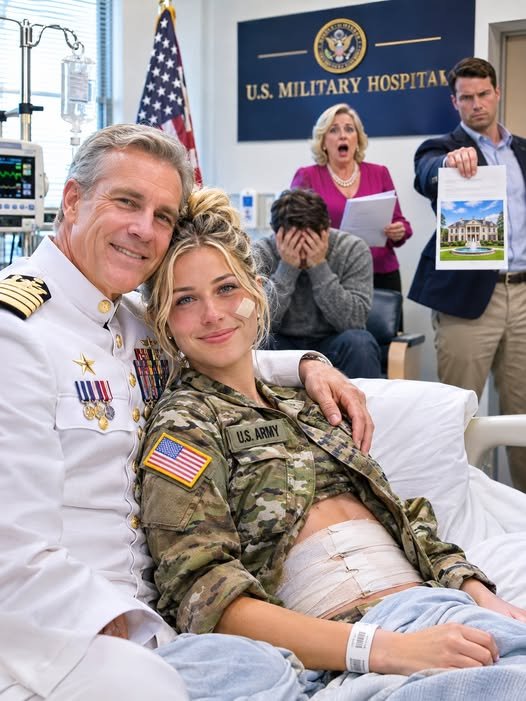
My husband laughed and added, “And I’ll finally be free to marry my mistress!” I stayed completely still, pretending to be unconscious until they left the room. Then I reached for my phone and quietly called my father. “Dad… it’s time.” After a brief pause, he replied, “I’ve been waiting for you to say that.”
PART 1
The steady beeping of the heart monitor and the soft mechanical sounds of the IV pump filled the military hospital room. My name is Meredith, I’m thirty-nine years old, and I serve as a Captain in the United States Army. After sustaining serious injuries during a dangerous mission, I had been evacuated by helicopter with a severely injured shoulder and several broken ribs.
Although strong pain medication left my body weak and nearly motionless, my mind remained surprisingly alert. Almost twenty years of military training had taught me how to stay focused under extreme pressure, even when my physical condition was deteriorating.
Shortly after two in the afternoon, my husband of nine years, Brent, entered the room carrying a small bouquet of daisies from a grocery store. The orange discount sticker was still attached to the plastic wrapping, and my mother-in-law, Gloria, followed closely behind him.
Gloria carried an expensive designer handbag and looked around the room with obvious irritation. Her expression suggested that my hospitalization was an inconvenience rather than a frightening situation involving someone in her family.
I kept my eyes closed as the attending physician explained my condition to them. He warned that my injuries had created serious complications and that the next seventy-two hours would be critical in determining whether I survived.
After the doctor left, Brent and Gloria moved toward the window, apparently believing that the medication had rendered me unconscious. They began speaking quietly, unaware that I could hear every word in the otherwise silent room.
“Three days? That’s perfect. The house will finally belong to me.”
For a moment, I wondered whether the medication had distorted what I was hearing. Gloria was talking about the home I had purchased and personally renovated before Brent and I were even married, treating my possible death as an opportunity to claim it.
Then Brent gave a quiet laugh that sounded disturbingly relieved. What he said next was even more devastating than his mother’s excitement over my property.
“And once she’s gone, I’ll finally be able to marry Kristen.”
Hearing Kristen’s name immediately brought everything into focus because Brent had mentioned that coworker countless times throughout the previous year. I had never imagined that his frequent references to her concealed a relationship serious enough for him to plan a future with her.
I wanted to open my eyes and confront them immediately, but years of military discipline helped me resist the impulse. Instead, I remained motionless and concentrated on keeping my breathing slow and steady, even as the heart monitor began registering my rising pulse.
Gloria continued discussing the house as though my death had already been confirmed. She seemed particularly interested in making changes to the property and ensuring that the necessary legal documents would be handled.
“The house needs a complete renovation anyway. We’ll take care of all the paperwork when the time comes.”
Listening to them discuss my possessions while I lay critically injured was almost impossible to comprehend. They were already planning how to benefit from losing me, without showing the slightest concern for whether I might recover.
A few moments later, Brent approached my bedside and gently kissed my forehead. The familiar scent of his cologne, once comforting to me, now made me feel sick.
“Get some rest, sweetheart. I’ll see you later.”
I waited until their footsteps disappeared and the door closed before attempting to move. Pain spread through my chest as I reached toward the phone resting on the nearby tray table, but my injured body made even that small movement difficult.
Nurse Patrice noticed my struggle and quietly moved the table closer to my bed. Without asking unnecessary questions, she placed the phone directly into my hand and allowed me the privacy I needed.
I opened my contacts and scrolled past Brent’s name until I found my father, Walter Doyle. He answered after the second ring, immediately recognizing that something was wrong from the sound of my voice.
“Meredith? What’s happening?”
My throat was dry, and speaking required more effort than I expected. Nevertheless, I managed to tell him what I had just discovered about my husband.
“Dad… it’s time. Brent isn’t the man we thought he was.”
There was a long silence on the other end of the line, and I could almost imagine my father processing the meaning behind those words. When he finally responded, his voice was calm but unmistakably serious.
“I’ve been waiting a long time for you to say that.”
Tears slipped down the sides of my face as I realized that my father had suspected something about Brent that I had refused to acknowledge. Before I could ask him to explain, another notification appeared on my phone.
It was a text message from Brent, sent only minutes after he had left my hospital room.
“Just met with a realtor friend about some investments. Thinking about our future, sweetheart. See you tonight.”
I stared at the message, stunned by how easily he could pretend to care about our future after discussing his plans to marry another woman. His words confirmed that the affectionate husband I thought I knew had been hiding a completely different side of himself.
I slowly wiped the tears from my cheek and tightened my grip on the phone. Brent and Gloria believed they had only seventy-two hours to wait before gaining everything they wanted, but they had no idea that I had heard their conversation.
They were counting down the hours until my life might end. What they didn’t realize was that their own carefully planned future was about to fall apart…
PART 2
Eighteen months earlier, I would have dismissed my father’s concerns as the unnecessary worries of an overly protective parent. Back then, Brent and I appeared to have a stable, happy marriage, and I had no reason to believe that the man I trusted was hiding anything from me.
We lived in a modest brick house outside Clarksville, where our daily routine seemed perfectly ordinary. We spent quiet Sundays running errands together, watched more true-crime documentaries than we probably should have, and playfully argued about whose responsibility it was to empty the dishwasher.
During my previous military deployments, Brent had always presented himself as a supportive and devoted husband. He greeted me at the airport with handmade welcome-home signs and frequently prepared buttermilk pancakes on relaxed weekend mornings, making me feel fortunate to have someone who understood the demands of military life.
Those affectionate gestures had convinced me that our marriage was secure, which was why I reacted so defensively when Dad first questioned Brent’s intentions. I couldn’t imagine that the husband who appeared so thoughtful and dependable might have reasons for being unusually interested in my finances.
The conversation happened one Sunday while we were having lunch at a crowded Cracker Barrel restaurant. Brent excused himself from the table, claiming that several urgent work emails required his immediate attention.
As soon as Brent walked away, Dad poured maple syrup over his pancakes and looked at me with an unusually serious expression. His pale blue eyes remained fixed on mine as he asked a question I hadn’t expected.
“Meredith, why does your husband keep asking me how much your house is worth?”
I stopped eating and stared at him, surprised that he considered such a question suspicious. As far as I was concerned, Brent was simply showing an interest in the local real estate market.
“Dad, he’s only asked you a couple of times. Maybe he’s just curious about property values.”
My father gave me the familiar, weary look he used whenever he believed I was overlooking something obvious. He wasn’t satisfied with my explanation and immediately mentioned another question Brent had asked him.
“He also wanted to know whether you’d refinanced the house and taken any money out of the equity.”
I felt my patience slipping because I believed Dad was reading too much into an ordinary financial conversation. Brent was my husband, and I thought it was natural for him to ask questions about our financial situation.
“Dad, please stop. Brent is my husband.”
Dad placed his fork on the table with a sharp clink and leaned forward slightly. His expression remained serious as he tried to make me understand why those questions concerned him.
“Being your husband doesn’t automatically mean every question he asks is innocent, Meredith.”
I refused to continue the discussion because I felt that Dad was unfairly questioning the man I loved. By the time lunch ended, I was angry and convinced that my father was allowing his protective instincts to create problems where none existed.
I drove home that afternoon determined to put the conversation behind me. I wanted to believe that my marriage was strong enough to withstand the challenges of military service, and I resented the suggestion that Brent might be interested in something other than our future together.
Looking back, however, I couldn’t deny that Brent had recently become increasingly curious about my financial arrangements. He had asked about updates to my life insurance policy, the precise conditions of my military survivor benefits, and whether I had made any changes to my will.
At the time, I had explained away those conversations as normal discussions between married partners. I believed that sharing financial information demonstrated trust and that Brent was simply trying to make responsible plans for our future.
Whenever something about his questions made me uncomfortable, I reminded myself that successful marriages required honesty and cooperation. Rather than investigate his sudden interest in my assets, I chose to believe the explanations that allowed our relationship to remain peaceful.
I had mistaken my husband’s questions for concern about our future, never considering that he might be planning a future in which I was no longer part of it.
But my father had never stopped watching.
Two weeks after that lunch, before my next deployment, Dad drove to Clarksville with a folder and a request. He was a retired Army CID investigator who had spent thirty years learning how people lie about money, and he asked me for one thing: sign my house into a revocable trust, with him as successor trustee, and update my beneficiary forms to require a second verification. I thought it was overkill, but I signed. It was easier than fighting, and he had never once asked me for anything.
“Humor an old man,” he said, sliding the last page toward me. “And Meredith, one more thing. If the day ever comes that you look at that husband of yours and think something’s wrong, you call me and say it’s time. Those two words. I’ll do the rest.”
“Nothing is going to be wrong, Dad.”
“Then it costs you nothing.”
What I didn’t know was that he’d already hired a private investigator. He didn’t tell me, because he knew I would have refused to look at the results.
By the time I stood in a dusty compound overseas, the thought of his folder was the farthest thing from my mind. And by the time a roadside blast flipped our vehicle, I had forgotten the promise entirely.
PART 3
Dad arrived at the hospital in under four hours. He had driven through the night from Tennessee with a leather briefcase and a man I had never met, a gray-haired attorney named Raymond Pierce who shook my good hand with great care.
Dad pulled the chair close to my bed and took my hand. For a moment he said nothing, and I saw how tired he looked.
“I should have made you look at the photographs,” he said at last.
“I wouldn’t have.”
“No. You wouldn’t have.” He opened the briefcase. “Now you will.”
There were dozens of them. Brent at a restaurant in Nashville, his hand resting on the back of a blonde woman’s neck. Brent and Kristen leaving an apartment complex on a weeknight when he claimed to be working late. Brent and Kristen standing in front of a jewelry store window. The dates stretched back fourteen months.
I looked at every one. I didn’t cry. The tears had been used up in the first hour, and what remained felt colder and more useful.
“That’s the affair,” Dad said. “It’s ugly, but it isn’t a crime. This is the part that is.”
Mr. Pierce laid out a second set of documents. A home equity line of credit application for $180,000 against my house, submitted online three months earlier, bearing a signature that was a decent imitation of mine. A request to change the beneficiary on my private life insurance policy. And a draft durable power of attorney, already filled in, with Brent’s name as my agent and a blank line where a notary would stamp.
“The house is in the trust,” Mr. Pierce said. “Your signature on that HELOC application is a forgery, and the bank flagged it when we called. The insurer froze the beneficiary request on the same day, because your father’s secondary verification was triggered. Mr. Brent has been trying for months and has been stopped by the paperwork every time. What he needs is you, either dead or signing.”
“Or unconscious,” Dad said quietly, “and a doctor willing to sign a letter saying you can’t speak for yourself.”
I thought of Gloria by the window. We’ll take care of all the paperwork when the time comes.
“Seventy-two hours,” I said. “They think they have seventy-two hours.”
“They have until tonight,” Dad said. “He texted you that he’d be back.”
I looked at my father, this man I had once accused of poisoning my marriage with suspicion. He had spent a year and a half collecting proof of a betrayal he hoped he would never have to show me.
“Dad, I’m sorry I didn’t listen.”
“You’re a soldier,” he said, squeezing my hand. “You believed in your people. That’s not a flaw. It’s just that he wasn’t one of yours.”
We planned it the way I had planned operations my whole career. Special Agent Tom Reyes from Army CID arrived within the hour, along with a detective from the Clarksville police and a hospital administrator who had gone pale at the word fraud. They wired the room. Nurse Patrice, who had quietly slid my phone into my hand that morning, volunteered to stay close. Nobody asked her to, and she refused to leave.
At seven that evening, Brent walked into my room with Gloria on his arm and a man in a cheap navy suit carrying a notary stamp. Brent had a clipboard in one hand and a fresh bouquet of grocery store daisies in the other. The discount sticker was gone this time. I noticed that. He’d learned something.
I lay with my eyes half closed, as limp as I could manage.
“Honey?” Brent said softly. “It’s me. The doctors say you’re doing a little better, so I brought something to help us protect ourselves. Just a formality. If something happens, I need to be able to make decisions for you.”
Gloria touched the edge of my blanket with two fingers, as if it might stain her. “Just sign where Brent shows you, dear. Then you can rest.”
He lifted my good hand and pressed a pen between my fingers. The notary shifted his weight, uneasy, looking at the monitors.
“Mr. Brent,” he began, “is she able to understand what she’s signing?”
“She’s fine,” Brent said. “She’s just tired.”
I opened my eyes.
I looked directly at my husband, and I watched the color leave his face in one slow wave.
“Seventy-two hours,” I said, my voice rough but clear. “I’m sorry to disappoint you. I’m still here.”
The pen fell out of my fingers. The bouquet hit the floor.
“Meredith,” Brent whispered. “Sweetheart, you’re awake. That’s… that’s wonderful.”
“The house will finally be mine,” I said, turning slightly toward Gloria. “I believe that’s how you put it. And you, Brent. Something about being free to marry Kristen?”
Gloria’s mouth opened, but no sound came out. The designer handbag slid off her arm and thumped onto the linoleum.
“You were drugged,” Brent said, his voice climbing. “You couldn’t have heard anything. You’re confused.”
“Then maybe you’ll explain this.”
Dad stepped out from behind the privacy curtain, followed by Special Agent Reyes, the Clarksville detective, and Mr. Pierce. Dad was holding the folder of photographs against his chest like a shield.
“Hello, Brent,” he said.
The notary was already backing toward the door. “I didn’t know,” he stammered. “He said she gave consent. I don’t want any part of this.”
“You may want to stay for a statement,” Agent Reyes said without raising his voice. “Sit down, sir.”
Brent tried the angle he had always used when cornered: wounded outrage. “This is insane. I’m her husband. Her father has been trying to turn her against me for years. I came here with nothing but concern.”
“Concern,” Dad repeated. “Is that why your mother said the house would finally be hers, in this room, this morning? We have a witness.”
“I’m that witness,” said Nurse Patrice from the doorway, arms folded. “And I heard every word before I left to get her phone.”
“And I was awake for every one of them,” I said. “Every word, Brent.”
Reyes read out the list in a flat, even tone: forgery in the first degree, attempted fraud against a federal beneficiary, and conspiracy, with attempted insurance fraud to follow. Gloria shrieked that it was a misunderstanding and that she had only come to visit her daughter-in-law. Mr. Pierce calmly handed the detective a copy of the HELOC application and the draft power of attorney with Brent’s fingerprints all over it.
Brent looked at me one last time. I had expected anger or pleading. Instead I saw something smaller: a man who had always assumed I would be forgiving, because I always had been.
“Meredith, please,” he said. “We can fix this. Kristen means nothing.”
“You told your mother she was the woman you wanted to marry,” I said, “while I was lying here not breathing right. I heard it. I don’t think there’s anything to fix.”
They led him out in handcuffs. Gloria followed, protesting, her heels clicking down the hallway. Her voice carried long after she was out of sight, still insisting that none of this was her fault.
When the room finally went quiet, I felt the exhaustion crash over me. Dad sat on the edge of my bed and held my good hand in both of his. He didn’t say I told you so. He never would.
“The house?” I asked, almost a whisper.
“Still yours. Always was.”
I laughed, and then it hurt, and then I was crying. This time I let myself.
Recovery took eight months. The shoulder required two surgeries and the ribs healed slowly, and for a long time I couldn’t lift my left arm above my head. I spent most of that time in the brick house outside Clarksville, on the couch where Brent and I used to watch true-crime documentaries. Dad moved into the guest room without asking and made terrible coffee every morning.
The legal process moved faster than I expected. The evidence was overwhelming: the forged signature, the digital trail from the HELOC application, the notary’s statement, the recorded confrontation, Nurse Patrice’s testimony. Gloria took a plea deal for conspiracy. Brent fought it for four months, then accepted a plea of his own when his attorney showed him what a jury would hear. He was sentenced to six years, with restitution. Kristen, I later learned, had no idea he was married in any way that mattered. She had been told I was a bitter, estranged soldier who had already agreed to a quiet divorce. She wrote me a short, awkward letter of apology, and I never answered it, but I didn’t hate her. She was another person Brent had managed.
The divorce was final before his sentencing. I kept my name, my house, and the small stack of wedding photographs I burned in the backyard fire pit one October evening while Dad watched and pretended not to be moved.
I returned to duty the following spring. When people ask me about that hospital room, they always want to know what it felt like to lie there and hear it. They expect me to say betrayal, or rage.
Mostly I remember the quiet. The beep of the monitor, the hum of the IV pump, and my own breathing, slow and steady, because I knew that whatever came next, I wasn’t alone. The man who had loved me the right way for thirty-nine years was one phone call away.
I called him on a Wednesday afternoon, in a room full of people who thought I wouldn’t live to Saturday. I said two words, and my father said he had been waiting.
He had been. He always was.
On the first Sunday after I came home, I took him to Cracker Barrel. I ordered pancakes and poured the maple syrup myself.
“You were right,” I said.
“I know.” Dad grinned over his coffee. “Pass the butter.”