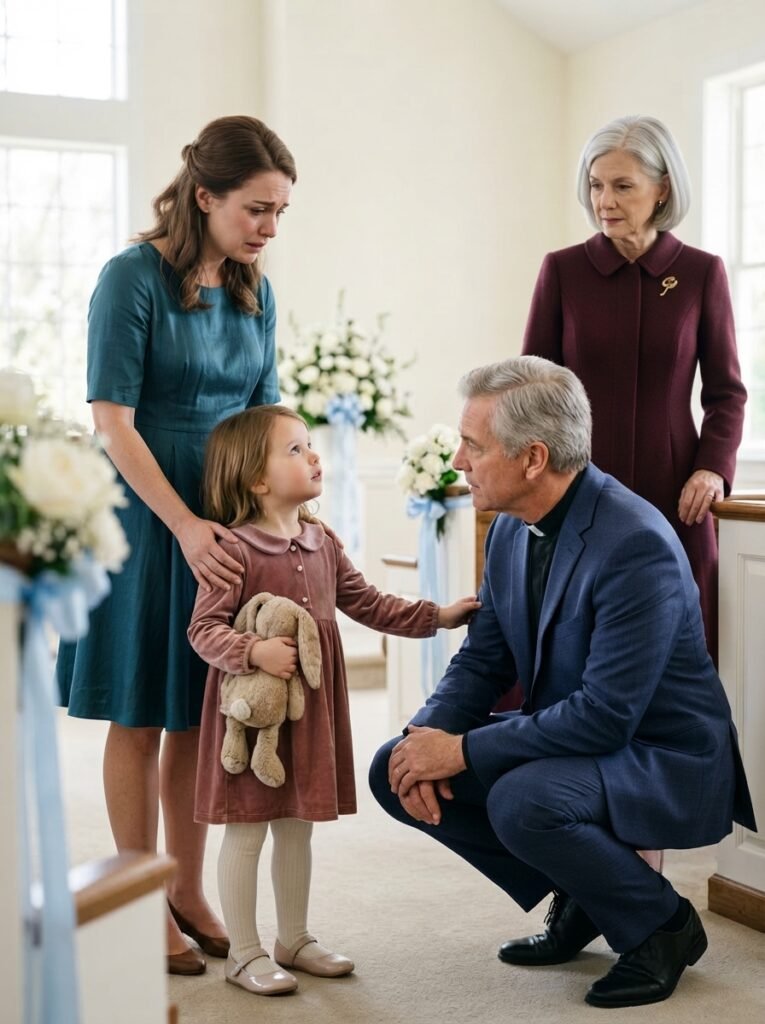
Part 1: The Question at the Funeral
My mother-in-law blamed me for my sons’ deaths while I was standing beside their coffins.
“God knew what kind of mother they had,” Miriam said.
For a moment, I thought I had misunderstood her.
There were flowers behind her shoulder. White roses, pale blue ribbon. Someone had tucked a small stuffed bear beneath each arrangement, and I had spent the previous ten minutes trying not to look at them.
My daughter, Emma, stood against my leg.
She was four. Her tights had slipped at one knee, and she kept rubbing the velvet hem of her dress between her fingers.
“Mommy,” she whispered, “why is everybody talking quiet?”
I smoothed her hair.
“Because everybody’s sad, sweetheart.”
Across the room, my husband was accepting a hug from someone who worked with him. Trevor looked exhausted. We both did.
Eleven days earlier, we had still been parents of three children.
Our twins, Owen and Luke, were five months old.
Owen wrapped his whole hand around my finger while he ate. Luke stopped crying whenever Emma sang the first two lines of “You Are My Sunshine.” She never remembered the rest, so she sang those lines again.
Their names were printed on the little cards near the flowers.
I could read them.
I still couldn’t understand why they were there.
Miriam moved closer.
“I told Trevor those babies needed someone who knew what she was doing.”
I looked toward my sister, Rachel. She was near the doorway, speaking with the funeral director.
“Please stop,” I told Miriam.
“You were always tired. Always complaining.”
I had once admitted, at her kitchen table, that I sometimes cried in the shower because it was the only place nobody needed anything from me.
She had saved that confession.
Now she was using it beside my children.
“You need to step away from me,” I said.
Her hand struck my cheek before I finished.
Emma screamed.
Miriam caught a handful of my hair when I turned away, but the funeral director was already between us. He caught her wrist, firmly telling her to let go.
Rachel reached Emma first.
Then Trevor was beside me, his fingers closing around my upper arm.
“Clara. Calm down.”
I stared at him.
His mother had hit me.
His daughter was crying.
And he was telling me to calm down.
“Mom,” he said over his shoulder, “sit down. Please. You’re upset.”
I pulled my arm out of his hand.
There were people staring now. Someone offered me a chair. Someone else said they were calling for help.
I heard all of it from a distance.
Then Emma slipped away from Rachel just far enough to touch Pastor Daniel’s sleeve.
He had baptized her. Every Sunday, he let her choose which basket to carry during the children’s collection.
He bent down.
“What is it, Emma?”
She glanced at Miriam.
“Can I tell you something Grandma said not to tell?”
His expression changed, but his voice stayed gentle.
“You can tell me.”
Emma twisted the hem of her dress.
“It’s about the babies’ bottles.”
Miriam stood so suddenly that her chair scraped the floor.
“She’s confused.”
The funeral director stepped into her path.
Pastor Daniel looked toward Rachel.
“Let’s find somewhere quiet.”
He didn’t ask Emma to say it louder. He didn’t turn her toward the room.
Rachel took her hand, and the three of them went into the small sitting room beside the chapel.
I started after them.
Behind me, Miriam said, sharply, “Clara, that child makes things up.”
I stopped.
The night before the twins died, Miriam had insisted I go upstairs and sleep.
For once, she had offered to help without telling me what I was doing wrong.
She had prepared the bottles.
And until that moment, I had remembered it as kindness.
Part 2: What the Adults Had to Find Out
Rachel drove us to her house that evening.
An officer had taken my statement about the assault. A nurse had checked my cheek and the tender place beneath my hair.
None of those things felt as urgent as the little girl sitting beside me, holding a stuffed rabbit by one ear.
Emma had spoken briefly with Pastor Daniel before he contacted the officers.
She said she had seen Grandma put something into a bottle.
Something that hadn’t come from the container Mommy used.
Grandma had told her it was their secret.
That was what she had said.
It was not an explanation of what had happened to my sons. It was something a four-year-old remembered seeing, and something the adults now had a responsibility to examine.
Detective Alvarez made that distinction when she came to Rachel’s house.
The investigation into the twins’ deaths was already underway. There had been preliminary examinations, questions about feeding and sleep, and tests whose results we were still waiting for.
“What Emma said matters,” she told me. “But we need to establish what happened. We won’t ask you to guess.”
I sat at Rachel’s kitchen table and told her everything I could remember.
Miriam arriving before dinner.
Trevor going out to pick up groceries.
Luke fussing through his bath.
Miriam telling me I looked terrible and should go upstairs.
I told Alvarez which memories were clear and which had blurred together.
When I wasn’t certain, I said so.
The remaining feeding supplies were still at our house. I hadn’t been able to touch them. Alvarez arranged for investigators to follow up.
“Please don’t have anyone sort through things for us,” she said.
Trevor called six times before I answered.
“My mother shouldn’t have hit you.”
I closed my eyes.
“No. She shouldn’t have.”
“But Emma could have seen formula. Or something else. Mom says—”
“I am not going to argue about what Emma saw.”
“I’m trying to understand.”
“Then let the investigators do their work.”
He was quiet.
I could hear his father speaking somewhere behind him.
“Are you coming home?” Trevor asked.
I looked into Rachel’s living room.
Emma was on the floor beside her aunt, lining up wooden animals. Every few seconds, she looked toward the kitchen to make sure I was still there.
“We’re staying here.”
“For how long?”
“I don’t know.”
Before we hung up, I told him that Miriam was not to approach Emma.
There would be no visit to explain herself. No phone call asking what Emma meant. No family gathering where adults tried to help her remember.
Alvarez had explained how important it was not to question her repeatedly. A specialist would handle the necessary interview.
My job was to be her mother.
That night, Emma stood in the bathroom doorway while I brushed my teeth.
“Did I make Grandma go away?”
I set the toothbrush down.
“No, honey.”
“She was mad when I told.”
I sat on the closed toilet lid so she could see my face.
“Grown-ups are finding out what happened. You don’t decide what happens to Grandma.”
“But I told the secret.”
“You’re allowed to tell me things. Even when someone says not to.”
She leaned into me.
I held her without asking another question.
Later, after she fell asleep, I sat at Rachel’s table with a cup of tea I couldn’t drink.
My phone rang.
The name on the screen was Elaine.
Miriam’s younger sister.
We had exchanged birthday cards and polite conversations for years. She lived three hours away and had missed the funeral because she was recovering from surgery.
Her voice trembled.
“Clara, I need the detective’s number.”
I sat straighter.
“Why?”
She took a breath.
“Because Miriam asked me something before the boys died. And I should have called you.”
Part 3: The Things They Had Called Nothing
Elaine did not come to me with a theory.
She had messages.
She gave them to Detective Alvarez before she asked to speak with me again.
Several days before the twins died, Miriam had asked about giving the babies a product that was not prescribed for them, to make them sleep longer.
Elaine had told her not to do it.
She had told her to speak to their pediatrician if there was a problem.
Then Miriam had changed the subject.
Elaine had let her.
“I thought she was complaining,” she told me over the phone. “She complains about everything.”
I looked at the refrigerator.
Rachel had put one of Emma’s drawings beneath a magnet shaped like Ohio. Five people stood outside a purple house.
Emma had drawn it before the twins died.
“Why didn’t you tell me?”
Elaine began to cry.
“I didn’t want to start another fight with her.”
I had heard versions of that sentence for years.
At Thanksgiving, when Miriam criticized what Emma ate.
After Luke’s birth, when she complained that we had used my father’s name as his middle name.
When she told Trevor that I had trapped him with too many responsibilities.
Nobody wanted to start a fight.
So the rest of us made adjustments.
We changed subjects. Shortened visits. Smiled through dinner.
I had done it too.
I had learned to mention Miriam’s behavior carefully, gently, at the right moment, so Trevor wouldn’t hear it as an attack on his mother.
Now Elaine was crying, and I felt the familiar urge to make the conversation easier for her.
I didn’t.
“Please give the detective everything,” I said.
“I have.”
“Then that’s what you need to keep doing.”
Trevor came to Rachel’s house three days later.
Rachel stayed in the next room with Emma while we sat on the back porch.
He looked at the empty chair between us.
“I gave Alvarez my messages.”
I waited.
His mother had been writing to him for weeks.
The babies had ruined his life.
He was exhausted.
He never came to see her anymore.
He needed his wife to get control of the house.
He showed me some of his replies.
I know, Mom.
Please don’t start with Clara.
We’ll figure it out.
Once, after I had asked him to speak to her about criticizing me in front of Emma, he had written:
Just keep the peace until things settle down.
I handed the phone back.
“You told her to keep the peace with me.”
“I was trying to stop the arguments.”
“I was asking you for help.”
He rubbed his face.
“I didn’t know she would do something to them.”
I believed that.
Believing it did not make me feel safe beside him.
“You didn’t have to predict this,” I said. “You had to stop telling me that what was already happening didn’t matter.”
He bent forward, elbows on his knees.
For once, he didn’t defend her.
His father took longer.
David called the messages frustration. He said Miriam loved her grandchildren. He suggested that whatever she might have done, she must have meant well.
Eventually, Alvarez asked him to describe what he had actually seen and heard.
Not what he believed his wife intended.
Not what he hoped was true.
Facts.
Over the following weeks, the investigation moved through a world I could barely tolerate.
Appointments. Reports. Phone calls I was afraid to answer and afraid to miss.
The laboratory findings identified a medication that should not have been in the boys’ bodies. Testing of retained feeding materials supported that finding.
Investigators traced access to the same medication and checked the messages against the timeline.
No single sentence from Emma explained everything.
Adults collected records. Specialists examined evidence. People who had kept quiet were finally required to answer questions.
When Alvarez told me Miriam had been arrested, I was sitting in my car outside the grocery store.
There was milk in the passenger seat.
A box of the cereal Emma liked.
Ordinary things.
I listened, thanked her, and stayed in the parking lot until Rachel came to get me.
That evening, Trevor asked if we could begin talking about coming home.
“Emma needs stability,” he said.
I watched our daughter carefully peel the wrapper off a crayon.
“I know.”
“Then we should try.”
I looked at him.
“Right now, stability means she can go to bed without hearing someone explain why Grandma didn’t mean it.”
He opened his mouth.
Then closed it.
Part 4: What the Verdict Couldn’t Return
The criminal case took more than a year.
During that time, Emma started kindergarten.
I returned to work part time at the dental office where I had worked before the twins were born.
Rachel helped me find a small rental fifteen minutes from her house.
I bought three kitchen chairs.
For weeks, I hated myself every time I looked at them.
Grief made ordinary decisions feel like betrayals.
Packing away the boys’ clothes.
Changing the emergency contacts at Emma’s school.
Buying a car seat that would fit in the middle of the back seat, where she wanted to sit.
A counselor helped me understand that continuing to care for Emma did not mean I was leaving her brothers behind.
Some days I believed her.
Some days I went because I needed somebody else to believe it for me.
As the case approached trial, the people working with our family explained what would happen next. Emma had her own support. I followed their guidance and kept conversations about the evidence away from her.
At home, she needed to know who was picking her up and whether her favorite pajamas were clean.
She did not need to prepare me for court.
In the courtroom, I learned more than I ever wanted to know about the last night of my sons’ lives.
The evidence was presented piece by piece.
The medical findings.
The feeding materials.
The messages Elaine had preserved.
Miriam’s access to the medication.
The timeline that placed her with the bottles.
Her explanations had changed as investigators confronted her with information. Those changes were documented long before the trial.
There was no sudden confession.
No moment when she stood up and told the room why.
Her defense described an overwhelmed grandmother who had been trying to help.
I listened to people discuss my children using words that belonged in reports.
Then I looked down at the photograph I carried inside my notebook.
Owen was staring at the ceiling fan.
Luke was looking at Emma.
One of her hands rested gently on each of their stomachs.
I needed to remember that they had existed beyond the way they died.
When I testified, I told the truth.
I said that I had been exhausted.
I said I had accepted help.
I said I had trusted their grandmother to feed them.
For months, those admissions had felt like evidence against me.
Speaking them aloud was painful.
It was also the first time I understood how ordinary they were.
A tired mother had gone upstairs while another adult cared for her children.
That was what I had done.
The jury found Miriam guilty in both boys’ deaths.
There was a separate finding for the assault at the funeral.
I heard the decisions with my hands folded so tightly that my fingers hurt.
Beside me, Rachel began to cry.
I didn’t.
Not until we reached her car.
Then I bent over and made a sound I hadn’t made since the morning we lost them.
The verdict had answered a question.
It had not given me anybody to buckle into the two empty car seats.
Trevor met me several days later at a coffee shop.
By then, we had been living apart for months. He was seeing a therapist. He had stopped passing along messages from his parents.
He had cooperated with the investigation, even when his father accused him of betraying the family.
I could recognize those things.
I could also remember his hand on my arm at the funeral.
“Is there any chance for us?” he asked.
I had thought about my answer carefully.
“I’m going to continue with the divorce.”
He looked at the table.
“I know I can’t fix it.”
“No.”
“I want to be a good father to Emma.”
“Then keep doing the work that helps her.”
We handled the parenting arrangements through our attorneys and the court, with attention to Emma’s safety and the professional guidance available to us.
I did not promise him forgiveness.
He did not ask me to give Emma a message explaining his pain.
That was a small change.
At that point, small changes were the only ones I trusted.
Part 5: Something She Didn’t Have to Hold
Two summers after the funeral, Emma learned to ride a bicycle without training wheels.
She was six.
Her helmet was purple, and she insisted that the straps were trying to choke her even when two of my fingers fit beneath her chin.
Trevor came for his scheduled afternoon with her carrying a small bicycle pump.
He knelt beside the back tire.
“Ready to try again?”
“Only if you don’t let go without telling me.”
He looked up at her.
“I’ll tell you.”
And he did.
Their relationship was being built through things like that.
Showing up when he said he would.
Listening when she said no.
Answering her questions without asking her to take care of his feelings.
Our marriage was over. His responsibility to her was not.
Inside our house, there was a photograph of the twins on the bookshelf beside Emma’s school picture.
I talked about Owen and Luke.
Sometimes I told Emma that Owen had once startled himself with a sneeze. Sometimes she reminded me that Luke liked her singing best.
We could say their names without turning every conversation into a memorial.
Other days, saying their names hurt too much.
I had people to call on those days.
Rachel.
My counselor.
A woman from my grief group who understood why I sometimes left birthday parties early.
One Saturday morning, Emma found me sitting on the edge of my bed with one of Luke’s small socks in my hand.
She stopped in the doorway.
“Are you sad?”
“Yes, sweetheart.”
She came closer.
“About the boys?”
I nodded.
She studied my face, then looked toward the hallway.
Her sneakers were waiting by the front door. We had promised to meet her friend at the park.
“Do we have to stay home?”
I set the sock in its box.
“No. We can still go.”
She didn’t move.
“Mommy?”
“What is it?”
“I knew Grandma said it was a secret.”
I felt my breath catch.
These thoughts did not arrive on a schedule. They surfaced while she was brushing her teeth, choosing cereal, getting ready for the park.
I made room beside me.
She sat.
“Sometimes I think I should’ve told you before.”
I turned toward her.
“Emma, listen to me. You were four.”
Her eyes stayed on the floor.
“It wasn’t your job to understand what you saw. And it was never your job to save anyone.”
“But—”
“You did nothing wrong.”
I waited until she looked at me.
“If something frightens you or confuses you, you can tell me. Even if a grown-up says to keep it secret. And if you don’t know how to tell me right away, you are still not in trouble.”
She leaned against my shoulder.
We sat quietly for a while.
Then she asked whether there might be ducks at the pond.
“Probably.”
“Can we look?”
“Absolutely.”
At the park, she stayed close to me at first.
I sat on a bench while she picked at a loose thread on her sleeve.
Across the playground, her friend Sophie waved from the climbing frame.
“Emma! Come see!”
Emma looked at me.
I recognized the question she hadn’t spoken.
For a long time, she had checked my face before letting herself enjoy anything.
I took my water bottle from my bag and settled against the bench.
“Go ahead, honey. Rachel’s meeting me here.”
She glanced toward the parking lot.
My sister was walking toward us with two coffees.
Emma’s shoulders relaxed.
Then she ran.
Halfway across the grass, she turned to tell me something about the slide. I waved to show I had heard her.
Rachel sat beside me and handed me a cup.
For a moment, we watched in silence.
I missed Owen.
I missed Luke.
On the climbing frame, Emma laughed so hard that Sophie started laughing too.
When she looked back again, she found me talking with her aunt.
She turned toward her friend and kept playing.