My 8-year-old asked me at breakfast if she could bring her goldfish to “the bunker.” “Daddy says when the bad day comes, we go there,” she said. “Me and Otis and Daddy. You can’t come. Daddy says you’re not one of us.” Two nights later, I woke up at 4 a.m. Both kids’ beds were empty. So was the fishbowl.
My name is Abby Kerr. I’m 39. I’m a speech therapist for children in Coeur d’Alene, Idaho.
My husband, Garth, and I have two kids. Clara is eight. Otis is five.
Last year, Garth lost his job at the lumber mill. He got depressed. He started spending hours online. Then he started driving up into the mountains on weekends to meet a group he called “the Remnant.”
Their leader called himself Brother Ezekiel.
Garth came home with new ideas. The government was collapsing. A “bad day” was coming. Only the prepared would survive.
At first, I thought it was harmless. Canned food in the garage. A generator. Water jugs.
Then he stopped going to church with us. He said our church was “for the lost.”
Then he started calling me “the outsider” when he thought I couldn’t hear.
That Tuesday, Clara asked me about the bunker.
“Daddy took us there two Saturdays ago,” she said, while she ate her cereal. “It’s underground. There are bunk beds. Brother Ezekiel gave us candy. He said when the bad day comes, the children go first.”
“And me?”
She looked down at her bowl.
“Daddy says you’re not one of us. He says you can’t come because you don’t believe. Can I bring Bubbles? Fish don’t need to believe, right?”
My hands were shaking under the table. I smiled. I told her she was a good girl for telling me.
That night, I asked Garth.
He didn’t deny it.
“You’ll understand when it happens,” he said calmly. “The children belong to the Lord. Not to a nonbeliever.”
“They’re my children too.”
His eyes went flat.
“Brother Ezekiel says the law of man won’t matter soon. If you try to stop us, you’ll be standing on the wrong side.”
I didn’t argue.
I didn’t call him crazy. I didn’t scream.
I work with children who can’t always say what’s wrong. My job is to listen to the things they say without saying them.
And Clara had told me everything.
The next morning, after Garth left, I went through his truck. Under the back seat, I found two folded forms. Withdrawal forms from the kids’ elementary school. Already filled out. My signature forged at the bottom.
Then I checked our phones.
Years ago, Garth and I had turned on location sharing for each other. He’d forgotten. I hadn’t.
Every Saturday for six weeks, his phone had gone to the same spot. Forty miles north. Up a dirt road in the national forest. A dead end.
I called a family lawyer. She told me to come in Friday morning. She’d file for an emergency custody order.
Friday was two days away.
That night, I locked my bedroom door. I set an alarm for every two hours.
At 4:02 a.m., I woke up without the alarm.
The house was too quiet.
I walked down the hall to the kids’ room.
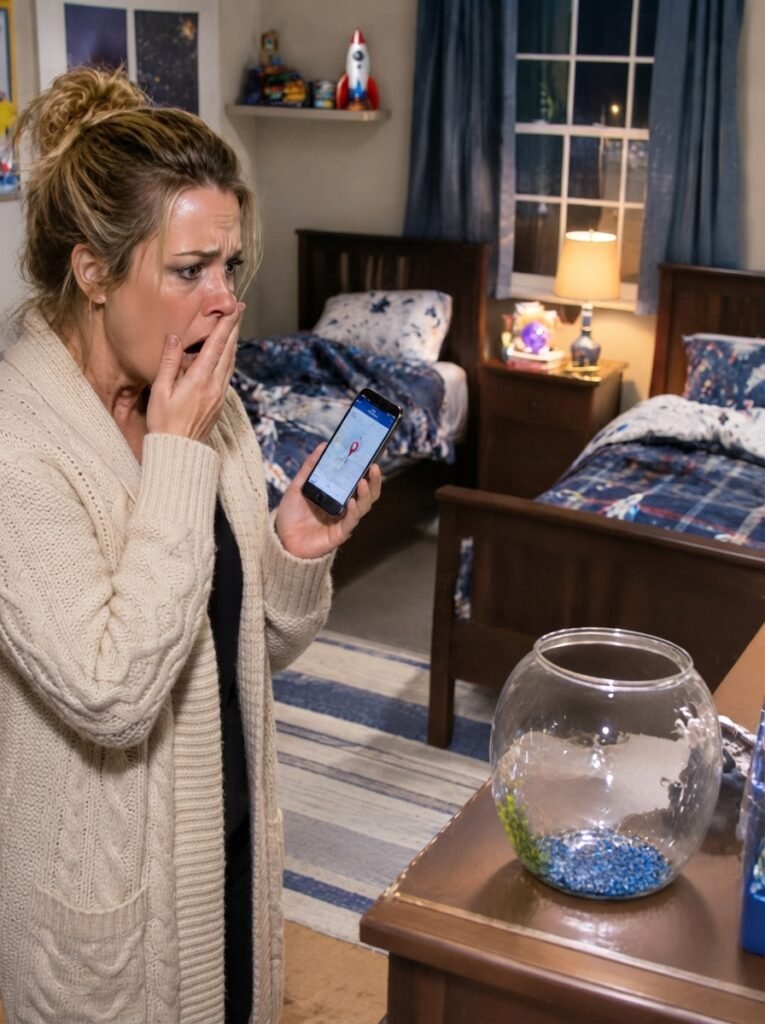
Clara’s bed was empty. Otis’s bed was empty. Their blankets were gone. Their winter coats were gone from the hooks.
On the dresser, the little round fishbowl was empty too. Just a ring of water where it had been.
I ran to the window.
The driveway was empty.
I grabbed my phone and opened the location app with shaking hands.
Garth’s blue dot was moving.
North.
Up the dirt road into the national forest.
Toward the dead end.
PART 2
I called 911 from the driveway in my pajamas.
The dispatcher stayed on the line while I gave her every turn of that blue dot.
Then she connected me to a county sheriff’s sergeant.
“Ma’am, do you know how many people are at that compound?”
“No. But my daughter said there are bunk beds. And other children.”
There was a long pause.
“Stay where you are,” he said. “We’re going up.”
I didn’t stay where I was. My neighbor drove me to the bottom of the forest road, and I waited there with a blanket around my shoulders, watching the dot stop at the end of the road.
At 6:40 a.m., four sheriff’s trucks went up the dirt road. Then two more. Then a van from the state police.
I waited three hours.
At 9:52 a.m., the first truck came back down.
Clara was in the back seat. She was holding the fishbowl in her lap with both hands. Bubbles was swimming in circles.
Otis was asleep against her shoulder.
When she saw me, she pressed her face to the window and screamed, “MOMMY!”
I’ve never run so fast.
The deputies told me what they’d found. A compound hidden in the trees. Two old shipping containers buried under the ground. Bunk beds. Months of food. Weapons.
And eleven children from five families. Some of them hadn’t been to school in a year.
Brother Ezekiel had told the fathers that “the bad day” was coming that Sunday. The children had to be brought in before dawn. The mothers were to be left behind, because they were “unbelievers.”
Three other mothers had reported their children missing that same morning. None of them knew where to look.
Mine was the only phone with a blue dot.
Brother Ezekiel, whose real name was Harlan Moss, had been convicted of fraud twice in Oregon. He’d collected thousands of dollars from every family who joined.
He was arrested at the compound for illegal weapons and child endangerment. More charges came later.
Garth was arrested too. For interfering with custody and child endangerment. He’d forged my signature on the school forms.
In the back of his truck, deputies found a letter addressed to me. He planned to leave it on the kitchen table.
“Abby. The children are safe now. Don’t look for us. When it’s over, you’ll understand.”
The judge gave me emergency custody that Monday. Then full custody in the spring.
Garth took a plea deal. He’s on probation and in court-ordered counseling. He’s allowed supervised visits once a month. At the last one, he cried and told Clara he was sorry.
She told him she forgave him. Then she asked if he’d stopped believing in “the bad day.”
He said he didn’t know yet.
We’re working on it. All of us.
Clara and Otis went back to school the next week. The other eleven children from the compound were placed with their mothers or grandparents.
Two of those mothers came to my house in December. They brought a casserole and a card.
“Thank you for the blue dot,” it said.
Bubbles is still alive. He lives on Clara’s dresser in a bigger bowl now, with a little castle in it.
Last week, Clara asked me if Bubbles knew he’d been in a bunker.
“Probably not,” I said.
“Good,” she said. “I don’t want him to be scared.”
Then she looked up at me.
“Mommy, I’m glad I told you.”
“Me too, baby.”
“Even though Daddy said not to.”
“Especially because Daddy said not to.”
THE END.