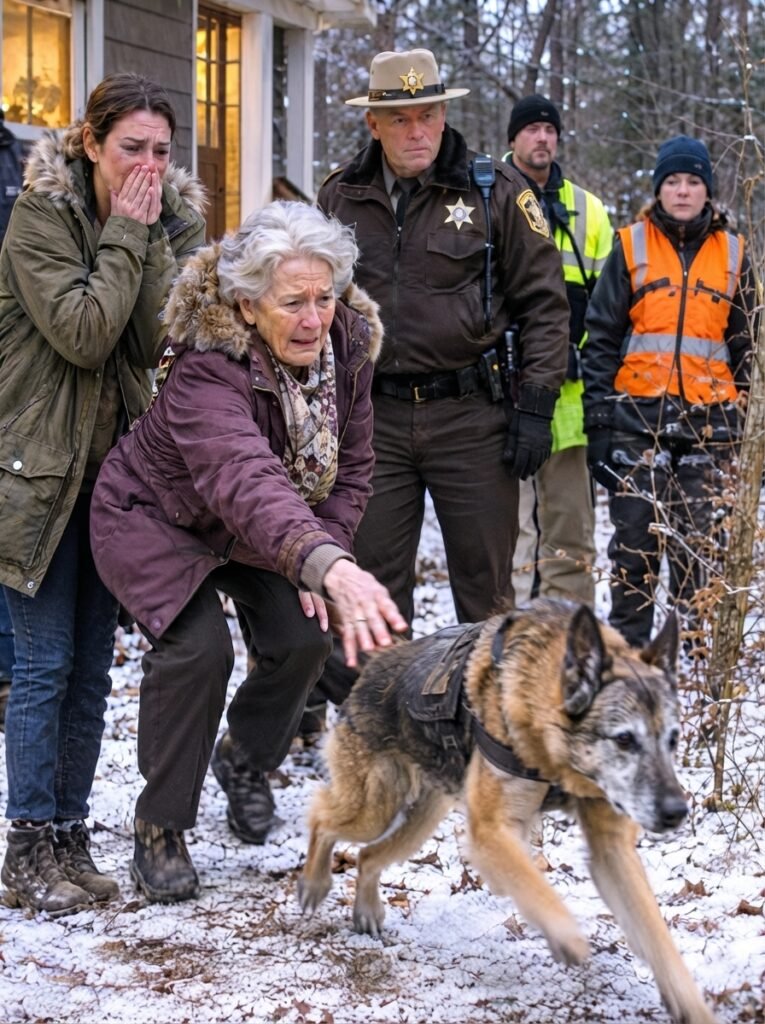
For 2 years, I walked an old retired police dog at the shelter every Tuesday. The manager laughed at me. “Nobody adopts a 10-year-old dog, Hester. He goes down Friday.” So I took him home. 3 weeks later, my autistic grandson vanished into the woods at 18 degrees. And the old dog put his nose to the ground.
My name is Hester. I’m seventy years old, a retired school librarian, and I live alone in a small town in Vermont.
After my husband passed, the house got too quiet. So I started volunteering at the county animal shelter. Every Tuesday morning, I walked the dogs.
That’s where I met Viggo.
He was a big German shepherd with a gray face and a stiff back leg. He’d been a police dog for eight years. A tracker. He’d found missing hikers, lost children, and runaway prisoners.
When his handler died of a heart attack, nobody claimed him. The police department sent him to the shelter.
He was ten years old.
People walked right past his kennel. They wanted puppies. Small dogs. Young dogs.
Not an old police dog with a limp.
Every Tuesday, I walked him. Slowly. Around the field behind the shelter. He’d sniff every blade of grass like he was solving a mystery.
For two years, I walked him.
Then, one Tuesday in November, I saw a red card clipped to his kennel door.
I knew what that meant.
I found the shelter manager, a young man named Uriah.
“Why is there a red card on Viggo’s kennel?”
He didn’t even look up from his computer.
“He’s scheduled to be put down Friday. We need the space.”
“He’s a hero. He was a police dog.”
“He’s a ten-year-old dog with arthritis, Hester. Nobody adopts a ten-year-old dog. He’s been here two years. He’s had his chance.”
“I’ll take him.”
Uriah laughed.
“You? You’re seventy. You live alone. He’s ninety pounds. He’ll pull you over.”
“I’ve been walking him for two years. He’s never pulled me once.”
He shrugged.
“Fine. Your funeral. But if you bring him back, he goes straight to the red list.”
I didn’t argue. I just said, “Okay.”
And I signed the papers.
Before I left, I asked for one more thing. Viggo’s file from the police department. Uriah handed me a folder he’d never bothered to open.
Inside were Viggo’s training certificates. Search and rescue. Tracking. Missing persons. Eight years of commendations.
I took him home that day.
For three weeks, Viggo slept on a rug by my woodstove. He followed me from room to room. He was gentle and quiet.
Then came the Saturday after Thanksgiving.
My daughter came up from Boston with her son, Lennie. He’s seven. He has autism. He doesn’t speak much. He loves rocks, trains, and the color blue.
He also wanders. If something catches his attention, he walks toward it. And he doesn’t stop.
That afternoon, we were in my backyard. My daughter went inside to get Lennie’s coat. I turned around to pick up a log for the fire.
When I turned back, Lennie was gone.
I screamed his name. My daughter came running.
The woods behind my house go on for miles. Pine trees. Rocky hills. Streams. A frozen pond.
It was 3:30 p.m. The sun sets at 4:15 in November.
The temperature was eighteen degrees. Lennie was wearing a sweatshirt. No coat. No hat.
We called 911. The sheriff came. Then the fire department. Then volunteers with flashlights. A helicopter was on its way from Burlington, but it would take an hour.
“Lennie doesn’t answer when people call his name,” my daughter sobbed to the deputy. “He won’t come out. He’ll hide.”
As the sky turned dark, the deputy looked at his watch and frowned.
“Ma’am, in this cold, without a coat, we’ve got maybe two hours.”
That’s when I heard Viggo whining at the back door.
He was standing with his nose pressed against the glass. Staring at the woods. His whole body was shaking.
I opened the door. I grabbed Lennie’s blue knit hat from the porch railing and held it in front of Viggo’s nose.
“Find him,” I whispered. “Viggo, find him.”
The old dog put his nose to the ground.
And he ran.