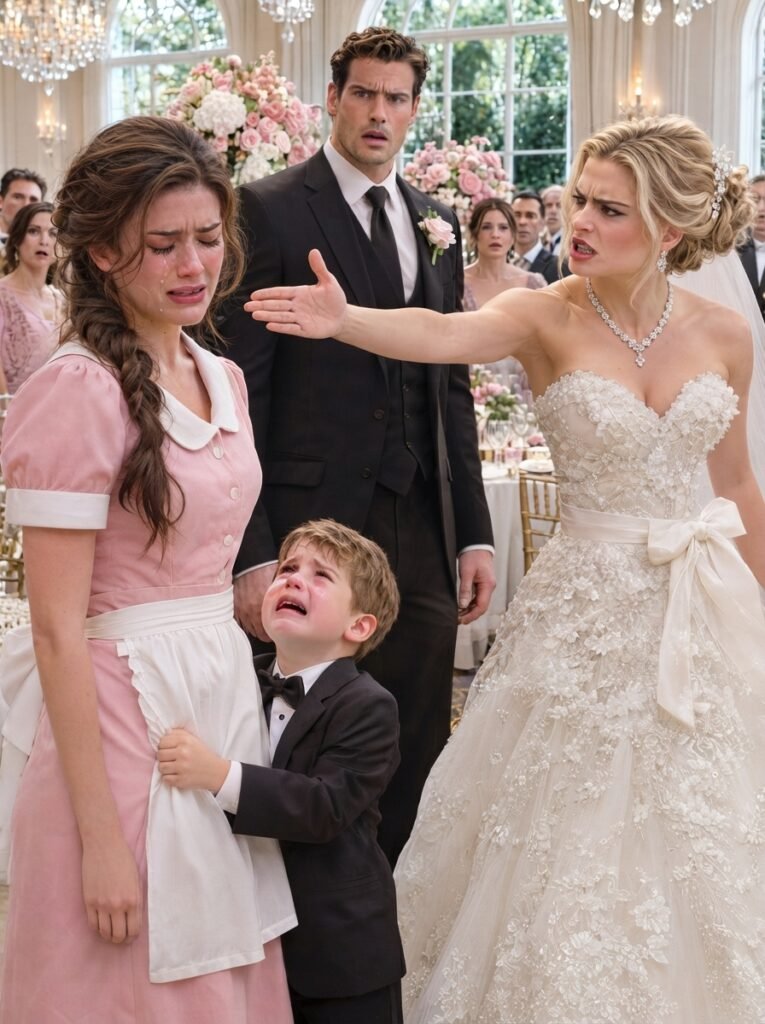
I was standing just inside the doorway of the private bridal lounge when I saw the woman I was supposed to marry raise her hand against the person my three-year-old son had come to regard as his mother. There were less than two hours remaining before our wedding ceremony, the guests were beginning to arrive, and somewhere beyond the tall French windows, a string quartet was rehearsing beneath an arch covered in white roses.
My fiancée, Natalie, had no idea I was there, but my little boy, Oliver, spotted me almost immediately.
“Daddy! Daddy, help Mommy!” he cried, running toward me with tears streaming down his cheeks.
Rebecca, the woman who had cared for him since infancy, stood beside a velvet armchair with one hand against her cheek, looking more concerned about my son’s distress than about what had just happened to her.
When Natalie finally turned around and discovered me standing there, the expression on her face changed so completely that I hardly recognized the woman with whom I had spent the previous several months planning a future.
In that moment, I understood that I had come dangerously close to making the greatest mistake of my life, although the circumstances that had brought us to that room had begun three years earlier, on a quiet morning in Charleston, South Carolina, when everything I believed about happiness had changed.
The Morning Everything Changed
My name is Andrew Bennett, and before my son was born, I believed I was one of those fortunate men who had somehow managed to build the life they had always imagined.
I owned a successful commercial construction company, lived in a beautiful house overlooking the water, and was married to a wonderful woman named Emily, whose warmth and quiet humor made even the most ordinary days feel special.
We had spent seven years together, and when we discovered that we were expecting our first child, Emily began preparing for motherhood with an enthusiasm that made everyone around her smile.
She painted the nursery a gentle shade of blue, collected children’s books from little shops around town, and purchased a stuffed rabbit with long floppy ears that she insisted would become our baby’s favorite companion.
Neither of us imagined that I would eventually carry our newborn son through the front door alone.
Complications following Oliver’s arrival took Emily from us before the morning sun had risen, leaving me with a beautiful little boy whose tiny fingers curled around mine while I struggled to comprehend how a single night could bring both the greatest blessing and the deepest sorrow I had ever known.
In the months that followed, my house became a place where everything appeared perfectly maintained, yet nothing felt right.
There were fresh flowers on the dining room table, clean clothes folded in the nursery, and expensive equipment designed to make caring for an infant easier, but none of those things could comfort Oliver when he cried for hours in the middle of the night.
I hired experienced caregivers, consulted specialists, and rearranged my working hours, believing that if I approached fatherhood with the same determination that had helped me build my company, I would eventually discover what my son needed.
By the time he was four months old, I was exhausted, discouraged, and quietly afraid that I was failing him.
Then Rebecca Lawson arrived for an interview.
She was twenty-nine, with soft brown hair, kind blue eyes, and the unassuming confidence of someone who had no interest in impressing people with appearances. She had previously worked as a family support coordinator at a community childcare organization and had excellent references, although what convinced me to hire her had nothing to do with her résumé.
Oliver was crying when she entered the living room, and instead of immediately introducing herself, she asked whether she might sit beside him.
“Hello, sweetheart,” she whispered, extending her hand toward his tiny fingers. “You’ve had quite a morning, haven’t you?”
Within minutes, he was resting against her shoulder, his little body gradually relaxing until his eyes closed.
I watched from across the room, scarcely believing what I was seeing.
“How did you manage that?” I asked.
Rebecca smiled without looking away from him.
“Sometimes children need us to be comfortable with their sadness before they’re ready to let it go.”
It was such a simple observation, yet it reached a part of me that months of well-intentioned advice had never touched.
I offered her the position that afternoon.
The Little Things That Made Us a Family
Rebecca never attempted to erase Emily’s presence from our home, which was something I came to appreciate more deeply as the months passed.
She kept Emily’s photograph beside Oliver’s crib, told him stories about the mother who had prepared his nursery, and made sure the stuffed rabbit was tucked beside him whenever he went to sleep.
When Oliver began walking, Rebecca recorded his first uncertain steps so that I could watch them during a business meeting, and when he discovered that strawberries were his favorite food, she planted a small patch of them in the garden.
Gradually, our home began to recover its familiar warmth.
I started returning from work earlier, not because anyone had asked me to, but because I found myself looking forward to the sound of Oliver’s laughter and the conversations Rebecca and I shared while preparing dinner.
One Saturday morning, shortly after Oliver’s first birthday, I heard him call her something that made both of us stop what we were doing.
“Mama Becca.”
Rebecca looked at me with immediate concern.
“Andrew, I’ve been trying to teach him my name. I don’t want you to think I’ve encouraged this.”
I glanced at my son, who was reaching toward her with the uncomplicated certainty of a child who knew exactly where he felt safe.
“You haven’t done anything wrong,” I assured her. “He’s expressing what you mean to him.”
That evening, after Oliver was asleep, I opened a wooden keepsake box containing several letters Emily had written during her pregnancy.
Among them was a note addressed to me, which I had somehow overlooked during those difficult early months.
Emily had written about her hopes for our son’s future, about the importance of surrounding him with kindness, and about her wish that, should life ever take an unexpected direction, I would never allow sorrow to prevent our family from welcoming happiness again.
Near the bottom of the page, she had written that if another woman ever became important in our child’s life, she hoped I would recognize that woman’s love as a blessing rather than a betrayal.
I remained seated on the nursery floor for a long time, holding the letter while Oliver slept peacefully nearby.
Although I did not share those words with Rebecca then, they changed the way I understood the relationship growing between the three of us.
The Feelings I Was Afraid to Acknowledge
My mother, Patricia, was the first person to recognize that my appreciation for Rebecca had developed into something more complicated.
One Sunday afternoon, after watching Rebecca and Oliver decorate cookies in the kitchen, she asked to speak with me privately.
“She’s a remarkable young woman, Andrew, and I’m grateful for everything she’s done for Oliver, but you need to think carefully about what happens next.”
I assumed she was concerned about my son’s attachment to his caregiver, although her expression suggested there was more to the conversation.
“Rebecca won’t necessarily want to spend the rest of her life working in your house,” she continued. “She deserves a future of her own, and Oliver deserves to know that the people he loves aren’t going to disappear without explanation.”
Her concern was reasonable, but what unsettled me was the possibility of Rebecca leaving.
I had grown so accustomed to sharing my everyday life with her that I could scarcely imagine walking into the kitchen and finding her chair empty.
That realization forced me to confront feelings I had carefully avoided examining.
Over the following weeks, I began asking Rebecca about her ambitions, discovering that she had long dreamed of establishing an early childhood development center where families facing difficult circumstances could receive practical assistance and emotional support.
She spoke about the idea with such enthusiasm that I wondered why I had never asked her about it before.
“I’d love to create somewhere children feel understood, especially when their families are going through changes,” she explained one evening. “But it’s something I want to build through my own experience, not simply something someone gives me.”
I admired her determination, and although I wanted to offer financial assistance immediately, I sensed that doing so would undermine the independence she valued.
Eventually, I gathered enough courage to invite her to dinner, making it clear that I was asking as a man who enjoyed her company rather than as her employer.
Rebecca was quiet for several moments before answering.
“Andrew, I care about you more than I’ve allowed myself to admit, but Oliver depends on me, and I work for you. If we misunderstand what we’re feeling, there are consequences for all three of us.”
Her honesty made me respect her even more, although I lacked the courage to work through the complications she had raised.
Instead, I convinced myself that maintaining our existing arrangement was the safest choice.
It was a decision I would later regret.
A Future That Looked Perfect on Paper
I met Natalie Pierce at a fundraising dinner hosted by one of my company’s business partners.
She was an accomplished luxury real estate consultant, beautifully dressed, socially confident, and accustomed to moving comfortably among people whose lives resembled mine.
Natalie understood the demands of my work, enjoyed the same restaurants and social gatherings, and seemed genuinely interested in building a family.
My mother welcomed the relationship, believing that marrying someone outside my household would allow me to establish clearer boundaries while giving Oliver the stability he needed.
For a while, I persuaded myself that she was right.
Natalie was attentive during our early dates, and whenever she visited the house, she brought Oliver little presents, asked about his favorite activities, and complimented Rebecca on how well she cared for him.
Nevertheless, there were moments when her pleasant expression changed whenever Oliver called Rebecca Mommy.
The first time she mentioned it, I dismissed her concern as an understandable discomfort.
“Once we’re married, we should probably encourage him to use her proper name,” Natalie suggested. “Otherwise, people might get the wrong impression.”
“He’s three years old, Natalie. He’s not worried about impressions.”
She smiled, but the subject continued returning in increasingly uncomfortable ways.
When we became engaged, Natalie began discussing changes to the household, including enrolling Oliver in a private preschool and reducing Rebecca’s responsibilities.
She presented these ideas as practical preparations for married life, and because some of them sounded reasonable in isolation, I failed to recognize the resentment connecting them.
Rebecca, meanwhile, received an opportunity to pursue a leadership position at a childcare organization in Raleigh, North Carolina.
When she told me about the offer, I struggled to express the mixture of pride and disappointment I felt.
“It’s exactly the kind of work you’ve wanted,” I said.
“It is, although accepting it would mean leaving Charleston.”
She looked toward the garden, where Oliver was arranging his toy trucks beside the strawberry plants.
“I haven’t made a decision yet. Whatever happens, I want to make the transition as gentle as possible for him.”
I wanted to ask her to stay, but with my wedding approaching, I knew I had no right to make such a request.
Instead, I told her that I would support whatever decision she made, while privately wondering why the future I had chosen was beginning to feel so empty.
What Happened Behind the Bridal Suite Door
Our wedding was scheduled for a beautiful spring afternoon at a historic estate outside Charleston, where the gardens were filled with flowering azaleas and enormous oak trees.
Rebecca had agreed to attend primarily because Oliver was participating in the ceremony, and I wanted him to have someone familiar nearby throughout the day.
He wore a little cream-colored suit and carried his beloved stuffed rabbit, which he had insisted was coming to the wedding because it belonged to his first mommy.
Shortly before the ceremony, I went looking for him after discovering that he was no longer with my mother.
As I approached the bridal lounge, I heard Natalie’s voice through the partially open door.
“I’ve explained this to you already, Oliver. After today, Rebecca isn’t going to be your mommy anymore.”
My son’s response was immediate.
“But she’s my Mommy Becca.”
Rebecca spoke gently, attempting to reassure him without challenging Natalie.
“Sweetheart, nobody needs to worry about that right now. Let’s go find your daddy.”
Natalie moved between them.
“You need to stop encouraging him, Rebecca. You’re an employee, and after today, you’ll need to remember that.”
“I’ve never asked him to call me anything. He’s upset, and I think we should give him a moment.”
What followed happened so quickly that I scarcely had time to process it.
Natalie reached out and struck Rebecca across the cheek, apparently unaware that I had entered the doorway.
Oliver began crying, calling for me as he ran across the room.
I lifted him into my arms before turning toward Natalie, who had suddenly become very still.
“Andrew, please let me explain. She was undermining me, and I’ve been dealing with this for months.”
I looked at Rebecca, whose eyes were filled with tears, and then at my son, who was holding my jacket so tightly that his little knuckles had turned pale.
“Nothing Rebecca said could justify what I just witnessed.”
Natalie began insisting that the situation had been misunderstood, reminding me that our families were waiting and that hundreds of details had been arranged for the ceremony.
But as I listened, I realized that the wedding itself had become more important to her than the frightened child standing before us.
“There isn’t going to be a ceremony today,” I told her.
For the first time since I had met her, Natalie seemed unable to find anything to say.
I asked Rebecca to accompany me and carried Oliver out of the room, knowing that whatever embarrassment or inconvenience followed would be far easier to live with than allowing my son to grow up believing that such treatment was acceptable.
The Apology I Owed
The wedding coordinator handled the cancellation with remarkable professionalism, while my mother helped explain to our relatives that the ceremony would not proceed.
There were uncomfortable conversations, disappointed guests, and arrangements that needed to be settled, but none of those things mattered as much as making sure Oliver and Rebecca were all right.
When we returned home, Oliver refused to leave Rebecca’s side until she had read him three bedtime stories and promised that he would see her in the morning.
After he fell asleep, I found her sitting on the back porch, watching the evening light disappear across the water.
“I’m so sorry, Rebecca,” I said, taking the chair beside her. “I should have recognized what was happening long before today.”
She was silent for a while.
“I never wanted to interfere with your relationship, Andrew. I thought that if I stepped back gradually, everyone would find their place.”
“You already had a place. I was the one who failed to acknowledge it.”
Rebecca wiped her eyes.
“I love Oliver, but I can’t spend my life wondering whether someone else will decide that loving him is inappropriate. And I can’t remain here simply because you’re afraid of losing another person.”
Her words were difficult to hear because they were true.
I had relied upon her kindness without properly considering what that reliance had cost her, and I had chosen a relationship that appeared uncomplicated rather than confronting the feelings that genuinely mattered.
“I don’t want you to give up your future for us,” I told her. “Whatever you decide about Raleigh, I want it to be your decision.”
For the first time, I understood that loving Rebecca meant being willing to respect a choice that might take her away from me.
Learning to Make Room
In the weeks following the canceled wedding, Natalie contacted me several times, eventually acknowledging that her insecurity about Rebecca had influenced her behavior.
She also sent Rebecca a written apology, which Rebecca accepted without feeling obligated to restore their relationship.
My mother had her own regrets to confront.
One afternoon, she arrived carrying a collection of Emily’s photographs and asked Rebecca whether they might look through them together.
“I spent so much time worrying about protecting Emily’s memory that I overlooked the wonderful things you were doing for her son,” she admitted. “I should have made you feel welcome instead of making you question whether you belonged.”
Rebecca reached for her hand.
“I never wanted Oliver to forget Emily.”
“I know that now, and I think Emily would have been grateful that he found someone like you.”
Around the same time, Rebecca learned that a local nonprofit organization was considering opening a family development center in Charleston.
She prepared a detailed proposal, drawing upon her previous experience and the ideas she had been developing for years, and presented it to the organization’s independent board.
I offered encouragement when she requested it, but I deliberately avoided involving myself in the selection process.
Several weeks later, she returned from a meeting with a smile I had not seen in months.
“They offered me the director’s position,” she announced. “They want me to oversee the entire program.”
I could hardly contain my happiness for her.
“Is it what you really want?”
“More than anything I’ve wanted professionally. And I get to stay here, which means I don’t have to choose between meaningful work and the people I love.”
She eventually declined the opportunity in Raleigh and began preparing for her new responsibilities.
As our relationship developed beyond the arrangement that had originally brought her into my home, we discovered how much we enjoyed one another’s company when neither of us was operating within the boundaries of employer and employee.
We went to little bookstores, took walks along the waterfront, and spent long evenings discussing everything from childhood memories to our hopes for the future.
There was no urgency to make promises before we understood what they meant.
For the first time in years, I was building a relationship without trying to protect myself from every possible uncertainty.
The Wedding That Finally Felt Right
Nearly a year after the ceremony that never happened, Rebecca and I stood in the garden of her newly established childcare center, admiring the little raised beds where children would soon learn to grow vegetables and flowers.
The building behind us was modest, with bright classrooms, comfortable reading corners, and wide windows overlooking the garden, but to Rebecca, it represented years of determination.
I had been carrying an engagement ring in my pocket throughout the afternoon, waiting for a moment that felt natural rather than carefully arranged.
“Rebecca, you’ve taught me that loving someone doesn’t mean asking them to arrange their entire life around yours,” I began. “I want to share your future, not decide what it should look like. I want to celebrate your accomplishments, support your dreams, and build a family where every person has room to grow.”
Her eyes filled with tears as I took her hand.
“Will you marry me?”
She smiled, and the expression on her face reminded me of all the ordinary mornings when I had watched her make our house feel like home.
“Yes, Andrew. As long as we remember that we’re choosing each other, not simply trying to complete something that was missing.”
We were married in that same garden several months later, surrounded by a small gathering of relatives and close friends.
Rebecca wore a simple ivory dress, and Oliver walked beside her, carrying his stuffed rabbit with the seriousness of a little boy entrusted with an important responsibility.
My mother sat in the front row, holding a photograph of Emily inside her handbag.
After the ceremony, Oliver looked up at Rebecca with an expression of thoughtful curiosity.
“Does this mean you’re really my mommy now?”
Rebecca knelt beside him and straightened his little bow tie.
“It means we’re going to keep loving each other, just like we always have. And your Mommy Emily will always be part of our family, too.”
Oliver considered this for a moment before wrapping his arms around her neck.
“Then I have two mommies.”
Watching them together, I finally understood that our happiness did not require us to leave our earlier life behind.
We could carry it forward with gratitude.
A Home With Room for Every Kind of Love
Years later, during an anniversary celebration at Rebecca’s childcare center, I stood beneath the shade of an oak tree while families explored the classrooms and children played in the garden.
Rebecca had become a respected director whose programs supported dozens of local families, and my mother volunteered every Wednesday, reading stories to the younger children and helping them choose books to take home.
Oliver was growing into a thoughtful, affectionate young boy, although he still kept his mother’s stuffed rabbit on a shelf beside his bed.
That afternoon, a visiting family approached him while Rebecca was speaking with several parents.
Their little daughter pointed toward Rebecca and asked whether she was his teacher.
Oliver smiled.
“That’s my mom. She started this place because she wanted children to have somewhere they could feel safe.”
Then, with the comfortable honesty of a child who had never been taught that one kind of love must compete with another, he added something that I knew I would remember for the rest of my life.
“I have two moms. One brought me into the world, and the other helped me find my place in it.”
Rebecca turned toward us just as he finished speaking, and when Oliver ran into her arms, I thought about Emily’s letter, which remained carefully folded inside the wooden keepsake box at home.
For so long, I had believed that honoring the woman I had lost meant protecting the space she had once occupied, as though welcoming someone else would somehow diminish everything we had shared.
But Emily had understood something long before I did.
The heart is not a house with a limited number of rooms, where someone must leave before another person can enter. It is something that grows through kindness, patience, forgiveness, and the courage to welcome happiness even after life has taken an unexpected turn.
Rebecca had never replaced Emily, nor had she ever asked to.
She had simply brought her own love into our lives, and through the countless ordinary moments that followed, we had become a family whose story was richer because neither woman had been forgotten.
And whenever I watched Oliver reach for Rebecca’s hand, I was reminded that sometimes the greatest gift we can give the people we love is the freedom to discover that there is still more love waiting for them in the world.