For 9 years, I rocked abandoned babies in the NICU every Tuesday night. Then my kidneys failed, and the new administrator laughed at my volunteer badge. “You’re 74, Ida. Nobody’s coming to save you.” Three weeks later, a young man I didn’t know knocked on my door, humming a lullaby only I should know.
My name is Ida Fairweather. I live alone in a small brick house in Dayton, Ohio.
My husband, Osgood, passed eleven years ago. We never had children. We tried for a long time, and then we stopped trying, and then we just loved each other instead.
After Osgood died, the house got very quiet. So I signed up to volunteer at the hospital.
They put me in the NICU. The newborn intensive care unit.
My job was simple. Some babies there had nobody. Their mothers had left, or were sick, or were gone. The nurses were too busy to hold them for long. So every Tuesday night, from 8 p.m. to midnight, I sat in a wooden rocking chair and held them.
And I sang.
I never knew the words to real lullabies, so I made one up. Osgood used to call me “his little lantern” because I always left the porch light on for him. So the song was about a lantern.
It was a silly little song. Just four lines. A lantern in the window. A light for someone small. Stay until the morning. I’m here, that’s all.
I sang it to hundreds of babies.
But I remember one more than all the others.
He was born at 26 weeks. Two pounds, one ounce. His mother left the hospital the night he was born and never came back. The nurses called him Baby Boy 14, because of his bed number.
He cried all the time. He didn’t like the machines. He didn’t like being touched.
But when I sang the lantern song, he stopped crying. Every time.
For four months, I held him every Tuesday. Sometimes I came on Thursdays too, even though it wasn’t my shift.
When he was finally strong enough to leave, a foster family came for him. I wasn’t allowed to know their names. That’s the rule.
I kissed his forehead and sang the song one last time.
Then he was gone.
That was eighteen years ago.
I kept volunteering. Year after year. Baby after baby.
Then last spring, I started feeling tired. My ankles swelled. I couldn’t climb the hospital stairs anymore.
The doctor said my kidneys were failing. Stage five. I needed dialysis three times a week, and I needed a transplant.
“Do you have any family who could be tested?” she asked.
“No,” I said. “Nobody.”
I still went to the hospital on Tuesdays. Dialysis took my mornings, but my nights were still mine.
Then the hospital hired a new administrator. His name was Mr. Prescott Klein.
He called all the volunteers into a meeting room in September.
“We’re cutting the cuddler program,” he said. “Liability. Old people in a NICU are an infection risk.”
I raised my hand.
“Mr. Klein, I’ve been here nine years. The babies sleep better. The nurses will tell you.”
He looked at my volunteer badge. Then at the dialysis bandage on my arm.
He laughed.
“Mrs. Fairweather, with respect, you can barely walk down the hallway. You should be worrying about yourself. You’re 74. Nobody’s coming to save you.”
Some of the younger volunteers gasped.
One of the night nurses, Coralee, stood up.
“That’s not fair. Ida is the best we have.”
“Sit down, Coralee,” Mr. Klein said. “Or you can join her on the way out.”
Then he held out his hand.
“Your badge, please.”
I unclipped it slowly. My hands were shaking. I put it on the table.
Nine years. Hundreds of babies. Gone in thirty seconds.
I didn’t cry in front of him. I just said, “Thank you for the time I had.”
Then I walked to my car very slowly and cried in the parking lot for an hour.
The next three weeks were the hardest of my life.
No Tuesdays. No babies. Just dialysis, and the transplant waiting list, and a quiet house.
The doctor told me the wait for a kidney could be five years.
“I don’t have five years,” I said.
She didn’t argue.
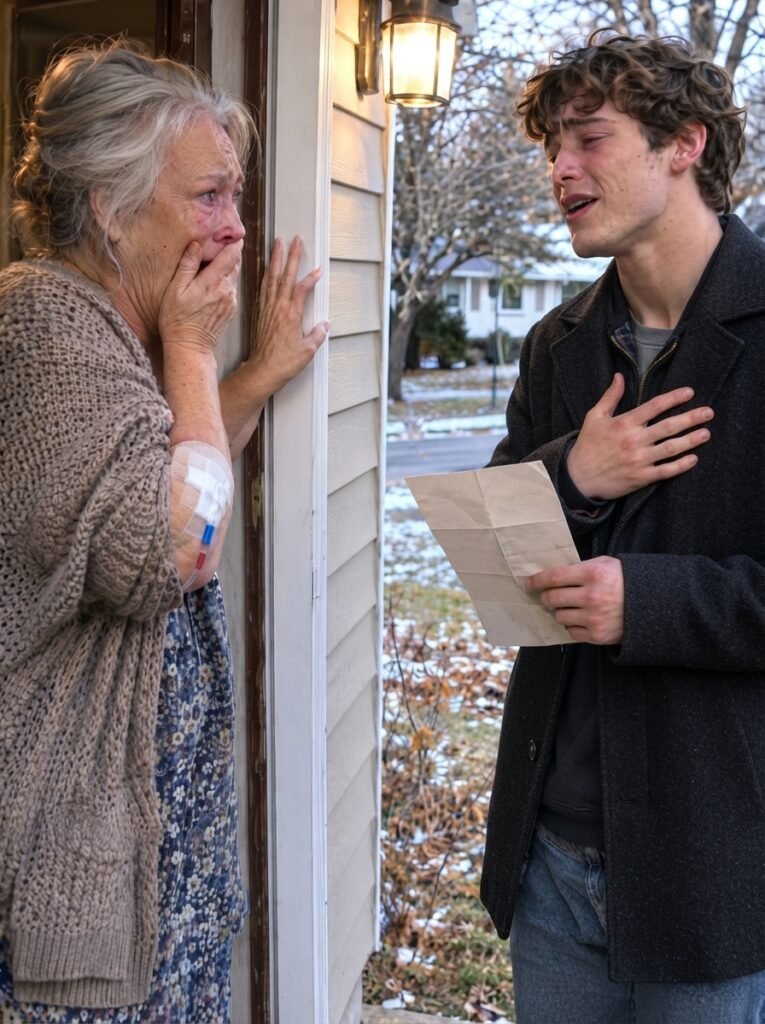
Then, on a cold Saturday morning in October, someone knocked on my door.
I opened it.
A young man stood on my porch. Tall. Maybe eighteen. Dark hair. Nervous hands.
He was holding a folded piece of paper.
“Are you Ida Fairweather?” he asked.
“Yes.”
He swallowed hard. Then, very softly, he started to hum.
Four lines. A lantern in the window. A light for someone small.
My knees almost gave out. I grabbed the doorframe.
“Where did you learn that song?” I whispered.
He held up the paper with shaking hands.
“I’ve been looking for you for a year,” he said. “And I think I’m a match.”
PART 2
I let him in. I made tea, because that’s what you do when your hands don’t know what else to do.
He sat at my kitchen table and unfolded the paper.
It was a page from a NICU discharge file. Old and creased. At the bottom, in a nurse’s handwriting, someone had written:
“Only calms for the Tuesday volunteer. Mrs. F. She sings him a lantern song.”
“My name is Ansel,” he said. “I was Baby Boy 14.”
I put my cup down before I dropped it.
“My foster mom adopted me when I was two,” he said. “She used to hum me to sleep, and one night I hummed back a song she’d never taught me. She asked where I learned it. I didn’t know.”
He smiled a little.
“I kept humming it my whole life. When I turned eighteen, I asked for my hospital records. That note was in them. Mrs. F. Tuesday. It took me a year to find you.”
“How did you find me?” I asked.
“Coralee,” he said. “The night nurse. She still had your address on an old Christmas card list.”
Then his face got serious.
“She told me you were sick. That you need a kidney. And that you have nobody.”
“Ansel, no. You’re a child. You have your whole life.”
“I’m eighteen,” he said. “And I already got tested. Last week. Coralee helped me.”
He slid another paper across the table.
Blood type: O positive. Same as mine. Tissue match: strong.
“You held me for four months when nobody else would,” he said. “Let me hold on to you now.”
I couldn’t speak. I just reached across the table and held his hand.
The surgery was in December.
The news got out, the way news does in a hospital. A nurse told a doctor. A doctor told the board.
And the board found out that Mr. Prescott Klein had cut the cuddler program without asking anyone. And that the “infection risk” he talked about didn’t exist. The NICU’s infection rate had actually gone up after the volunteers left, because the nurses were stretched too thin.
Mr. Klein was let go two weeks before Christmas.
The new administrator came to see me in my recovery room. She brought my volunteer badge back.
“We’d like you to come home,” she said. “When you’re ready. And we’re naming the program after you. The Lantern Program.”
Ansel was in the next room. When they wheeled me past his door, he was awake, and he was humming.
I hummed back.
It’s spring now. My new kidney works perfectly. The doctors say Ansel’s single kidney is strong and healthy.
He comes over every Sunday. He’s studying to be a nurse. He wants to work in the NICU.
And every Tuesday night, I’m back in my wooden rocking chair, holding a baby nobody came for.
Sometimes, now, Ansel sits beside me.
And we sing it together.
THE END.