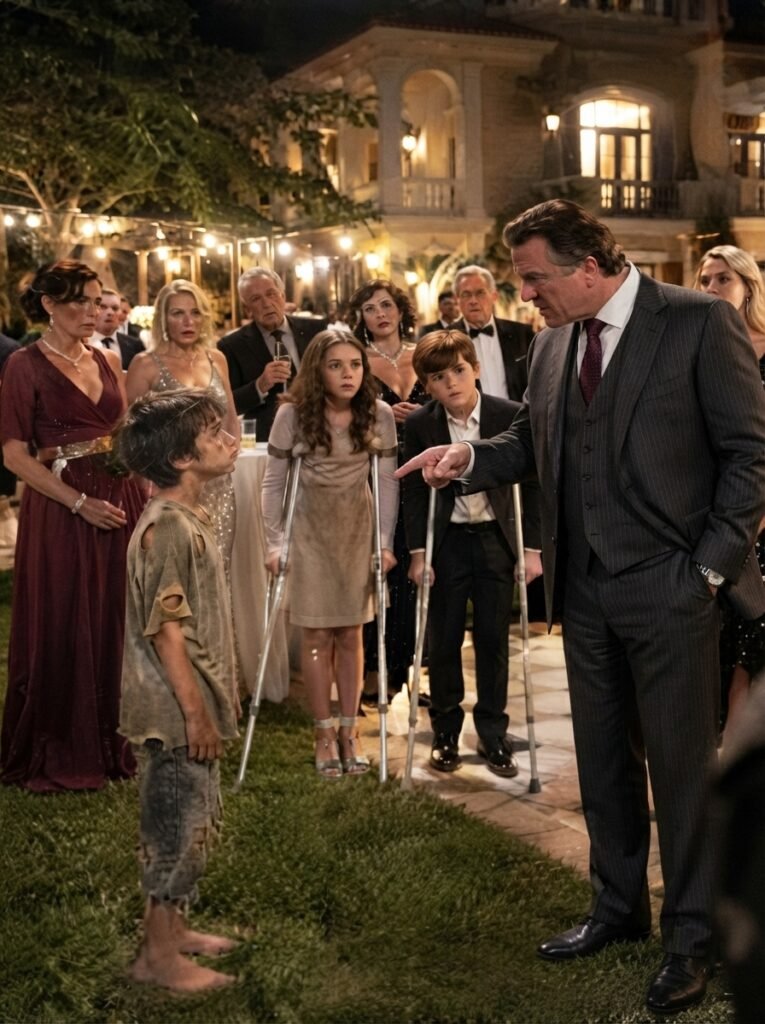
He Mocked a Barefoot Street Boy in Front of the Richest People in Town and Promised to Adopt Him If He Could Heal His Children—Then the Whole Room Watched Two Crutches Hit the Floor
“Move.”
That was the first thing Grant Holloway said when he saw the boy standing near the iron gates of his estate.
The band was playing.
Champagne glasses were clinking.
Women in satin gowns and men in dark suits drifted across the lawn like they didn’t have a single broken thing in their lives.
And there, just outside the glow of the party lights, stood a skinny little boy in a torn T-shirt, bare feet dirty from the street, holding himself upright like hunger had never beaten him.
Grant barely looked at him.
Then the boy said, in a voice so soft it should’ve been swallowed by the music, “Your children are going to be okay.”
Grant stopped cold.
For one second, it felt like the world had slipped sideways.
Nobody said things like that to him.
Nobody.
Not his doctors.
Not the surgeons he had flown in from three states away.
Not the private therapists.
Not the specialists with their polished voices and expensive watches and careful words.
They only ever said things like maybe, unlikely, long-term, permanent.
Never okay.
Grant stared at the boy.
The child looked no older than seven.
Maybe eight if life had been kind to him once and then changed its mind.
His cheeks were hollow. His arms were too thin. But his eyes were clear. Calm. Almost unsettlingly calm.
“Get him out of here,” Grant muttered.
His sister, Diane, was already moving.
Diane never missed a chance to protect the Holloway name, especially in front of donors, board members, and every polished soul in Greenville who loved being seen at Grant’s annual charity event.
She stepped toward the gate with that cold smile she wore when she wanted to look gracious and cruel at the same time.
But before she got there, two voices cut across the yard.
“Wait.”
It was Emma.
Then Caleb.
Grant turned so fast his drink nearly slipped from his hand.
His twins had come out onto the terrace.
Both were eleven.
Both leaned hard on crutches.
Both moved with the careful, practiced pain that had become the rhythm of their lives.
Three years earlier, Grant had been behind the wheel when a moment of distraction turned into twisted metal, broken glass, and a long scream he still heard in his sleep.
He had survived with bruises.
His children had not been so lucky.
Now every step they took was a reminder.
Every flinch.
Every pause.
Every sharp breath.
Every staircase in the house had become an insult.
Grant had built a fortune in commercial real estate. He could buy private planes, lake houses, and entire blocks of downtown property.
But he could not buy back his children’s legs.
Emma looked straight at the boy.
“What’s your name?” she asked.
“Eli,” he said.
Caleb took one more step closer, squinting like he was trying to understand something nobody else could see.
Grant felt exposed.
The music.
The lights.
The donors.
The pity.
The memory of that voice saying your children are going to be okay.
And then the whiskey in his blood did what grief had been doing to him for years.
It made him mean.
He gave a short, bitter laugh.
“All right,” he said loudly, enough for the people nearest the terrace to hear. “I’ll make you a deal, kid.”
His wife, Julia, turned toward him sharply.
“Grant—”
But he kept going.
“If you can heal my kids, I’ll adopt you.”
A few people gave uneasy little laughs.
The kind rich people use when they are terrified something ugly is happening in front of them and they don’t know where to look.
Diane smiled tightly, clearly expecting the boy to shrink back.
But Eli didn’t.
He just tilted his head and asked, “Can I try?”
Silence spread.
Even the band seemed to fade.
Julia’s hand flew to her mouth.
Grant could feel every eye on him now.
He should have stopped it.
Should have waved the boy off.
Should have said enough.
But something stubborn and broken inside him needed to see this through, maybe because humiliation felt easier than hope.
He gave one sharp nod.
Eli walked toward the twins.
No swagger.
No performance.
No wild speech.
He moved like a child who had learned how to step carefully in a world that had never made room for him.
When he reached Emma and Caleb, he looked up at them first.
Not like they were damaged.
Not like they were fragile.
Just like they were kids.
“Is it okay if I touch your legs?” he asked.
Emma nodded first.
Caleb did too.
Eli knelt on the stone terrace.
The knees of his pants were worn nearly white.
He put one small hand on Emma’s shin, the other on Caleb’s.
Then he closed his eyes.
That was it.
No shouting.
No shaking.
No spectacle.
Just a dirty, hungry little boy kneeling under the soft light of expensive lanterns while half the city held its breath.
Grant felt ridiculous for even allowing it.
Then Emma gasped.
Not loudly.
Just one sharp inhale.
Caleb’s eyes widened.
“I feel…” he whispered.
Emma gripped her crutch so hard her knuckles turned pale. “Dad.”
Grant moved forward without realizing it.
“What?”
“My legs,” she said, voice trembling. “They’re warm.”
Julia began to cry before anyone else understood why.
Eli kept his hands where they were and whispered something too low to hear.
Caleb shifted his weight.
Then froze.
Then shifted again.
One crutch slipped.
It hit the stone with a crack so loud it sliced the night in half.
Nobody moved.
Nobody breathed.
Emma stared at her brother.
Then at her own feet.
Then, slowly, like she was afraid the moment would vanish if she went too fast, she let go of one crutch.
It fell too.
Julia sobbed.
Diane took a step backward.
Grant felt the blood drain from his face.
Emma was standing.
Not leaning.
Standing.
Caleb let go next.
He wobbled once.
Emma grabbed his arm.
And there they were.
His babies.
His two children who had not walked without pain in three years.
Standing on their own legs beneath strings of party lights while the richest people in town stared like they had just watched the sea split open.
Emma took a step.
Then Caleb took one too.
And then both of them were crying and laughing and clinging to each other so hard it looked like they were trying to hold the whole world together with their arms.
Julia dropped to her knees.
Grant couldn’t.
He couldn’t move at all.
He looked at Eli.
The boy had opened his eyes now.
He looked tired.
Not triumphant.
Just tired.
Like kindness cost him something.
Grant’s voice cracked when he finally managed to speak.
“What did you do?”
Eli looked up at him and said, “I asked God to be kind to them.”
No one laughed after that.
Not one person.
The party ended in confusion.
Phones came out.
Guests whispered.
Some cried.
Some left early, too rattled to stay.
Diane cornered Grant before midnight.
“This is insane,” she hissed. “You cannot bring some random street child into this family because of one shocking moment.”
Grant looked past her, through the open doors, where Emma and Caleb were walking across the living room rug with Julia trailing behind them in tears.
For the first time in years, his house did not sound like mourning.
It sounded alive.
“I made a promise,” he said.
Diane’s eyes hardened. “A drunken promise.”
“A promise.”
She folded her arms. “You know nothing about him.”
Grant turned and looked toward the foyer, where Eli sat quietly in a chair too big for him, holding a plate of food like he still couldn’t believe anyone meant for him to keep it.
“No,” Grant said. “I know one thing.”
Diane waited.
“He didn’t ask me for money.”
That shut her up for all of five seconds.
Then the war began.
Not in the street.
Not in the tabloids.
In court.
Quiet, expensive, vicious war.
Diane claimed Grant had been manipulated.
She said the boy was dangerous, unstable, planted by someone looking to exploit the family.
Old socialites nodded along.
Men who had once begged for Grant’s favor suddenly had opinions about “protecting the children.”
People always get brave when compassion starts costing something.
The court appointed interviews.
Social workers came.
Lawyers asked questions in careful voices.
Where had Eli come from?
Who were his parents?
How long had he been homeless?
Why had nobody claimed him?
The answers came slowly.
A mother dead from illness.
No father anyone could name.
A motel room lost when the money ran out.
A shelter.
Then another.
Then the street.
A church pantry when he got lucky.
Public fountains when he didn’t.
A park bench near the bus station.
That was where he slept most nights.
Seven years old.
Sometimes eight, depending on which paper you believed.
Grant listened to it all and felt something hot and ugly rising in his chest.
He had spent years living inside his own guilt.
Meanwhile, a child had been starving in the same city where people spent twelve hundred dollars on a fundraiser ticket.
Julia testified too.
She had been fading for years, dulled by grief and medication, moving through the house like a woman who no longer expected joy to return.
But in court, her voice came back steady.
“That little boy did not trick my family,” she said. “He brought my children back to life. And maybe the rest of us too.”
Emma and Caleb asked to speak.
The judge allowed it.
Emma sat upright and said, “He doesn’t act like he wants anything from us.”
Caleb added, “He only asks if everybody ate.”
There were tears in the room after that.
Even the judge blinked hard.
Eli himself spoke the least.
When asked what he wanted, he shrugged a little and said, “I just wanted them to stop hurting.”
“And do you want to be adopted by Mr. Holloway?” the attorney asked.
Eli was quiet for a long time.
Then he said, “Only if they really mean it.”
That nearly broke Grant where he sat.
Because no child should know the difference between being invited in and being kept.
The final hearing came on a Thursday morning.
Grant did not wear the mask he used for business deals.
No polished detachment.
No cold control.
When he took the stand, he told the truth.
The whole ugly truth.
“I was driving the night my children were hurt,” he said. “I was on the phone arguing over land I didn’t need to buy. I chose work over a moment that changed my family forever.”
The courtroom was silent.
“I spent three years believing punishment would somehow balance the scale. It didn’t. It only made me cruel. This child did not manipulate me. He reminded me that mercy still exists, even for people who don’t deserve it.”
His voice shook.
“And whether anybody in this room believes in miracles or not, I know what I saw. More than that, I know who he is in my home. He is gentle. He is honest. He is brave. My children love him. My wife loves him. And I love him.”
Julia cried openly.
Emma reached for Caleb’s hand.
Even Eli looked startled.
Grant looked at the judge and said, “I am not rescuing him. He rescued us.”
The ruling was brief.
Petition granted.
Adoption approved.
Julia bent over and wept into both hands.
Emma let out a sound halfway between a laugh and a sob.
Caleb threw both arms around Eli so fast the bailiff almost smiled.
Eli just stood there for a second, stunned.
Like nobody had ever told him he could stay and he was afraid moving too quickly might wake him up.
Then he smiled.
Small.
Real.
Enough to change the whole room.
Life after that did not become perfect.
That’s the part people always get wrong.
Miracles do not erase ordinary pain.
Grant still woke some nights hearing the crash.
Julia still had bad days when grief sat on her chest like wet concrete.
Emma and Caleb still needed therapy for more than their bodies.
And Eli—sweet, solemn Eli—still hid bread rolls in his bedroom drawer for months, just in case the food disappeared again.
But the house changed.
It laughed again.
The kitchen stayed warm late into the evening.
The twins ran now—really ran—through the backyard until Julia yelled for them to slow down.
Grant started coming home before dark.
He sat on the porch with all three children and listened to cicadas instead of conference calls.
He missed meetings.
Ignored deals.
Let properties go that once would have consumed him.
He found out none of those things were worth what they had cost him.
One night, near the end of summer, Grant found Eli in the backyard looking up at the stars.
The grass was cool. The house behind them glowed soft and golden.
Grant sat beside him.
For a while, neither of them said anything.
Then Eli spoke.
“When I slept outside,” he said, “I used to tell the sky good morning.”
Grant turned to look at him.
Eli kept his eyes on the stars.
“I’d say thank you for not leaving me alone.”
Grant swallowed hard.
“Were you alone?”
Eli thought about that.
Then he shook his head.
“No,” he said softly. “I always felt like somebody was walking with me.”
Grant looked toward the house.
At the window where Julia stood drying dishes.
At the blur of Emma and Caleb racing past the hallway.
At the life inside those walls.
And for the first time since the crash, he understood something that no doctor, no priest, no therapist, and no amount of money had been able to teach him.
The greatest miracle was never just that two children stood up.
It was that a little boy with nothing touched a ruined family and taught them how to live again.