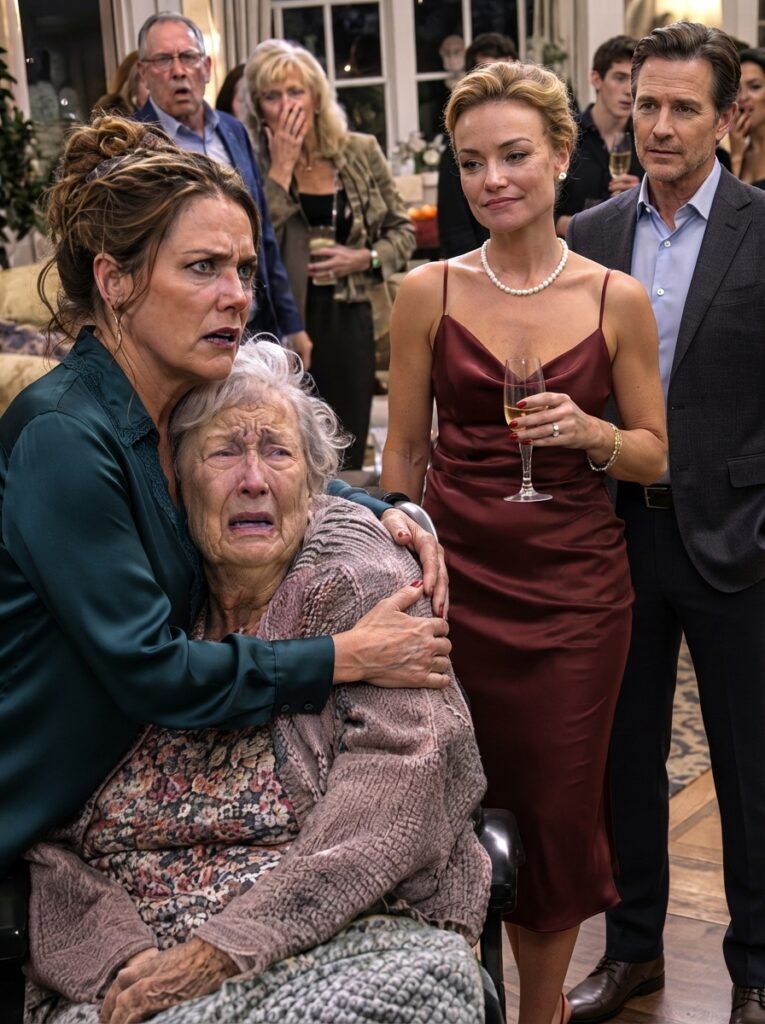
I came home 2 days early from a nursing conference and found a party in my house. Twenty strangers. Music shaking the windows. And my 78-year-old mother locked in her bedroom with no dinner, crying for help. Her caregiver just laughed. “Relax, Cleo. Old people go to bed early.” Then Mom whispered what Belinda made her sign.
My name is Cleo Dunbar. I’m a hospice nurse in Savannah, Georgia.
My mother, Edna, has Alzheimer’s. She’s seventy-eight. Some days she knows exactly who I am. Some days she calls me by her sister’s name.
Two years ago, I moved her into my house so I could take care of her. When I work long shifts, I hire help.
Last spring, an agency sent me Belinda.
She was twenty-six. Cheerful. Organized. She called my mother “Miss Edna” and brushed her hair every morning. Mom loved her.
I trusted her completely.
In October, I went to a four-day nursing conference in Atlanta. Belinda agreed to stay with Mom around the clock.
“Don’t worry about a thing,” she said. “We’ll have a girls’ weekend.”
The conference ended two days early because of a storm warning. I didn’t call ahead. I just drove home.
It was 10:40 p.m. on a Friday when I turned onto my street.
I could hear the music from three houses away.
Cars were parked all over my lawn. Every light in my house was on. Through the front window, I saw people dancing in my living room. Somebody was smoking on my porch.
I walked in.
Nobody even noticed me.
There were about twenty people inside. Red plastic cups everywhere. Someone had spilled beer on my mother’s white armchair. My kitchen counters were covered with bottles and pizza boxes.
I pushed through the crowd.
“Where is my mother?”
Nobody answered.
Then I heard it.
Underneath the music, from the hallway, a thin voice.
“Help me. Somebody, please. Help me.”
I ran.
My mother’s bedroom door was closed. Someone had tied a scarf from the doorknob to the bathroom doorknob across the hall, so it couldn’t be opened from the inside.
I tore the scarf off and opened the door.
Mom was sitting on the floor next to her bed in the dark. She was still in her clothes from that morning. She’d wet herself. Her dinner tray was on the dresser, untouched and cold, out of her reach.
When she saw me, she reached up with both hands.
“Ruthie? Ruthie, is that you? I’ve been calling and calling.”
“It’s Cleo, Mama. It’s me. I’m here.”
I held her. She was trembling all over.
That’s when Belinda appeared in the doorway, holding a drink. She was wearing my mother’s pearl necklace.
“Oh. Cleo. You’re home early.”
“You tied my mother in her room.”
Belinda shrugged.
“She kept wandering out and bothering my friends. I put her to bed. Relax, Cleo. Old people go to bed early.”
“She’s sitting on the floor in the dark. She hasn’t eaten. She’s soaked.”
“I was going to change her after everyone left.”
“That’s my mother’s necklace.”
Belinda touched it and smiled.
“She gave it to me. She said I could have it. Didn’t you, Miss Edna?”
My mother looked confused.
“I don’t know,” she whispered.
Belinda laughed.
“See? She doesn’t even remember. Honestly, you’re lucky I put up with her. Do you know how hard she is? You leave her with me for four days and come home acting like I’m the bad guy.”
Behind her, a man in a baseball cap yelled from the kitchen.
“Bel! Is this the daughter? Tell her to chill out!”
I wanted to scream at all of them.
But my mother was shaking in my arms. She needed me calm.
So I just said, “Okay.”
I closed the bedroom door. I gave Mom a warm bath. I changed her into a clean nightgown and gave her crackers and water. She ate like she hadn’t eaten all day.
Then I tucked her into bed, sat beside her, and called the police on speakerphone so she could hear me say she was safe.
While we waited, Mom grabbed my wrist.
“Cleo,” she whispered. For a moment, her eyes were completely clear. She knew me. “That girl made me sign papers today. She said it was for my medicine. But there was a man with a stamp.”
My whole body went cold.
“Where are the papers, Mama?”
She pointed at her nightstand.
I opened the drawer. Inside was a manila envelope.
It was a brand-new will. Typed. Signed with my mother’s shaky signature that afternoon.
It left my mother’s house in Macon, her savings, and her jewelry to “my devoted caregiver, Belinda.”
It was notarized. There was an official stamp at the bottom.
I read the notary’s name. Then I walked to the bedroom door and looked down the hall.
The man in the baseball cap was standing in my kitchen, holding a beer.
He was wearing a name badge from the bank on a lanyard around his neck.
It was the same name.
PART 2
The police arrived eleven minutes later.
His name was Rollo Gaspard. He was Belinda’s boyfriend. He worked at a local bank branch as a notary.
I handed the officer the envelope.
“My mother has Alzheimer’s,” I said. “She was diagnosed three years ago. I have the medical records. She can’t legally sign a will. And this man notarized it in my house while she was confused, and then threw a party.”
The officer read the will. Then he looked at Rollo.
“Sir, did you notarize this document today?”
Rollo’s face went red. “She signed it herself. She seemed fine to me.”
“Did you ask her what she was signing?”
He didn’t answer.
Belinda started crying. “Miss Edna wanted me to have it! She told me I was like a daughter to her!”
Then my mother spoke up from the hallway. She’d come out of her room in her nightgown, holding on to the wall.
“Who are all these people?” she asked softly. “Cleo, is it Christmas?”
The officer looked at her. Then back at Belinda.
He didn’t say anything. He didn’t need to.
Belinda and Rollo were both arrested that night.
The investigation took two months. Here’s what the detectives found.
Belinda had been doing this before. My mother wasn’t the first. She’d worked for two other elderly clients through the agency. One of them, a ninety-year-old man in Pooler, had changed his will to leave her his car and twenty thousand dollars, three weeks before he died. Rollo had notarized that one too.
The agency never checked.
Belinda was charged with elder abuse, exploitation of a vulnerable adult, and theft. Rollo lost his notary license and his job at the bank, and he was charged as well.
The fake will was thrown out by the court.
My mother’s pearl necklace came back to me in a plastic evidence bag. It had belonged to my grandmother.
I put it back around Mom’s neck the day it came home.
“Oh,” she said, touching it. “I’ve missed this.”
After that night, I made changes.
I cut back my hours at the hospice. I found a licensed adult day program for Mom, with nurses and cameras and a long waiting list. I put a lock on her bedroom that only opens from the inside.
And I report every caregiver agency I come across that doesn’t do proper background checks.
The other families found me, too. The daughter of the ninety-year-old man in Pooler called me in December. We cried on the phone together for an hour.
“Thank you for coming home early,” she said. “Nobody came home early for my dad.”
Mom doesn’t remember the party. Some days, she doesn’t remember me.
But every evening, when I sit beside her bed, she touches her pearls and asks the same question.
“You’ll stay, won’t you?”
And every evening, I give her the same answer.
“I’m not going anywhere, Mama.”
THE END.