“My Parents and Sister Took My SUV to the Park and Left My Six-Year-Old Locked Inside During a Heatwave — What I Found When I Got There Changed Everything Between Us” The ER report said Ellie was found locked alone in that car; the safety case could end every family visit. Rachel laughed, “She’s not family today. She’s your burden.” Officer Grant played the call, and my mother froze.
The call came while I was in a work meeting, staring at a spreadsheet I had stopped understanding ten minutes earlier. My phone lit up with an unknown number, and some deep part of me already knew not to send it to voicemail. When I answered, a man asked if I was Maya Collins, then told me my daughter Ellie had been transported to St. Mary’s Hospital.
He said she was stable, but stable is not a comforting word when it comes before hospital. I stood so fast my chair hit the wall behind me, and I remember every face in that conference room turning toward me. Officer Grant said the vehicle involved was registered to me, and that was when my stomach dropped through the floor.
That morning, I had handed my keys to my sister Rachel because she said her van was “acting weird again.” My parents were with her, and they had promised me Ellie would have the best day at Lakeside Park with her cousins. I had packed her little purple backpack, kissed her forehead, and ignored the small twist in my gut because my family had trained me to feel guilty for having boundaries.
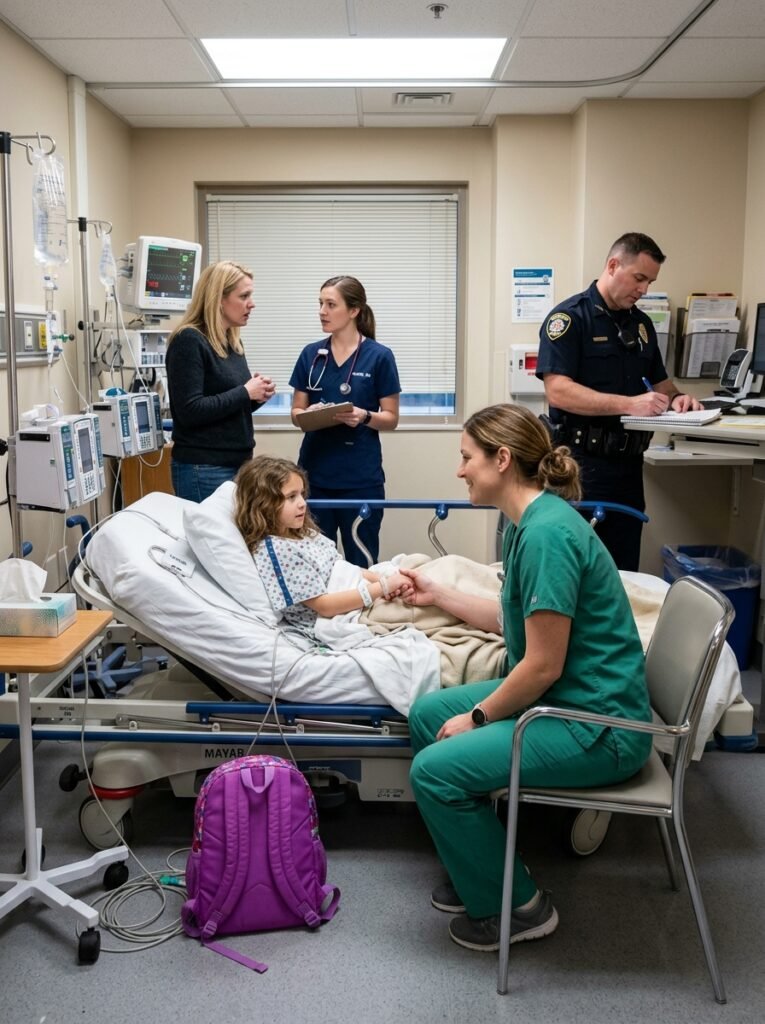
By the time I reached the hospital, my hands were shaking so badly I could barely sign my name at the desk. A nurse led me into a curtained room where Ellie lay under a thin blanket with a paper wristband on her tiny wrist. Her cheeks were flushed, her hair was damp, and she looked smaller than she had that morning, like the heat had taken something from her that I could not put back with a kiss.
Officer Grant stood near the foot of the bed with a folder in his hand. He did not raise his voice. He only said, “Your daughter was found locked inside your SUV in the east lot near the park entrance.”
For a second, I could not hear anything except the monitor beside Ellie’s bed. I asked where Rachel was, and he looked at me carefully, the way people look at you when they already know the answer will break something. He said my sister, my mother, and my father had been contacted but had not arrived yet.
So I called Rachel myself. She answered on the fifth ring, laughing at something in the background, and I could hear music, ice, and children talking. When I said Ellie’s name, she sighed like I had interrupted a vacation.
“She’s fine, Maya,” Rachel said. “You always make everything dramatic.”
I told her Ellie was in the hospital. I told her the police had called me. I asked her what happened to my daughter, and there was one second of silence before she laughed again.
“Honestly?” she said. “We had such a nice day without her.”
The nurse looked up at me. Officer Grant’s face changed, not loudly, not theatrically, but enough that I understood he had heard every word. I did not scream at Rachel. I did not beg my mother to explain. I looked at my daughter asleep under that hospital blanket and felt something old and obedient in me finally go cold.
Twenty minutes later, Rachel walked into the ER with my parents behind her. My mother rushed in first, all perfume and panic, asking why I had let Ellie get dehydrated in my own car. My father muttered that this was exactly why I should not work so much. Rachel stood in the doorway with sunglasses on her head and said, “Maybe now you’ll stop dumping your kid on everyone.”
Officer Grant opened the folder in his hand. The first page was the ER report, and the line was clean enough for any stranger to understand: Ellie Collins, age six, found locked alone in a registered vehicle during a heat advisory. Under that was the phrase that made my mother grab the rail of the bed: child safety investigation opened.
Rachel’s smile stayed in place for about three seconds. Then Officer Grant held up his phone and said there was a call I needed to hear before anyone made another statement. My mother’s fingers tightened on the bed rail, and Rachel finally stopped laughing.
He pressed play.
The first voice on the recording was not a stranger’s.
The call came at 2:17 on a Wednesday afternoon, right when the office had settled into the fake calm of spreadsheets, cold coffee, and people pretending their lives were manageable.
Maya Collins almost let the unknown number go to voicemail.
She had been in the middle of a quarterly budget meeting, nodding at numbers she had stopped hearing, when her phone lit up beside her keyboard.
Unknown number.
She stared at it through one ring, then two.
By the third, something in her chest had already started pulling tight.
“Is this Maya Collins?” a man asked when she answered.
Maya stood before she knew she was standing.
“Yes.”
The call came at 2:17 on a Wednesday afternoon while I was sitting through a quarterly budget meeting, surrounded by spreadsheets, cold coffee, and coworkers pretending everything in their lives was under control. My phone lit up beside my keyboard with an unknown number, and although I nearly ignored it, by the third ring something in my chest told me to answer.
“Is this Maya Collins?”
“Yes.”
“This is Officer Grant. Your daughter, Ellie Collins, has been transported to St. Mary’s Hospital. She is stable, but you need to come immediately.”
I was already standing before he finished speaking. Six-year-old Ellie had left that morning with my sister Rachel and our parents, Linda and Dennis, for a family outing at Lakeside Park, so I couldn’t understand why a police officer was calling me from the hospital.
“What happened?”
“We will explain when you arrive.”
Then Officer Grant added the detail that made my stomach drop.
“The vehicle involved is registered under your name.”
Only then did I remember that my parking space downstairs was empty because Rachel had borrowed my SUV. She had arrived at my house that morning insisting her car wasn’t big enough for everyone, while Mom had gently pressured me into letting Ellie spend the day with her cousins.
“Come on, Maya. We’re taking the kids to Lakeside Park, and your SUV fits everybody.”
“Ellie needs time with her cousins.”
I had eventually handed Rachel the keys, buckled Ellie into her booster seat myself, and kissed my daughter goodbye. Ellie had happily shown me the purple backpack containing her favorite stuffed rabbit before they drove away.
“I packed Bunny too.”
Now my SUV was somehow involved in an emergency, Ellie was at St. Mary’s, and none of the three adults I’d trusted with her would answer my calls.
When I reached the hospital, I found Ellie lying beneath a thin white blanket with an IV attached to her arm. Her cheeks were unnaturally red, damp hair clung to her forehead, and her lips were painfully dry, but the moment I touched her hand, her fingers weakly closed around mine.
“Mommy?”
“I’m here, baby.”
The nurse explained that Ellie had dangerously overheated but was responding to fluids and cooling treatment. Then she told me a passerby had heard crying coming from a parked vehicle, and Officer Grant opened the folder he was carrying.
“Your daughter was found locked alone inside your SUV in the east lot near Lakeside Park.”
I couldn’t immediately process what he’d said. Rachel had my car, and both my parents had been with her, yet somehow my six-year-old daughter had been abandoned inside it during a heat advisory.
“Where was my sister?”
“That is what we are trying to establish.”
“She had my car. My parents were with her.”
“We have contacted them.”
“They did not come?”
“Not yet.”
I called Rachel again, and this time she finally answered. Music, children, and the noise of the park filled the background, making it obvious she hadn’t rushed to the hospital after learning what had happened.
“Maya, I’m busy.”
“My daughter is in the hospital.”
“She’s fine.”
“You knew?”
“Mom said someone overreacted and called an ambulance.”
Something inside me went completely still. I looked at Ellie lying beneath the blanket and asked Rachel exactly what had happened.
“Honestly, we had such a nice day without her.”
The nurse immediately looked up, and Officer Grant shifted his attention toward my phone. I switched the call to speaker and asked Rachel to repeat herself.
“Say that again.”
“Do not start. Ellie whines, Maya. She makes everything about her. She is not family today. She is your burden.”
“Come to the hospital.”
“Why?”
“Because the police are here.”
The noise on Rachel’s end suddenly vanished, and I ended the call before she could respond. Twenty-three minutes later, Rachel arrived with Mom and Dad behind her, but when Linda rushed toward Ellie’s hospital bed, my daughter visibly flinched at the sound of her grandmother’s voice.
Dad immediately told me to calm down, following the same family pattern I’d lived with for years: they created the problem, I repaired it, and then everyone criticized my reaction.
“My daughter was locked in my car.”
“Your car, exactly.”
“Rachel.”
“Do not look at me like that. You left the car seat in there. You packed her bag. You are her mother.”
Rachel became bolder when Officer Grant remained silent. She accused me of working too much and claimed Ellie had ruined the outing by upsetting her son Tyler, kicking Mom’s seat, and complaining about water.
“Maybe if you did not work so much, you would know your own kid cannot handle a normal outing.”
“Do not talk about her like that.”
“She made Tyler cry. She kicked the back of Mom’s seat. She screamed over a water bottle. We needed five quiet minutes.”
Officer Grant finally opened his folder.
“The ER report says she was inside the vehicle significantly longer than five minutes.”
He placed the report on the rolling tray beside Ellie’s bed and read the most important line aloud.
“Ellie Collins, age six, found locked alone in a vehicle during a heat advisory.”
Then he continued.
“Child safety investigation opened.”
Mom immediately protested that an investigation wasn’t necessary, while Rachel insisted they had only stepped away briefly and were already returning from the splash pad. Officer Grant calmly revealed that investigators had a café receipt proving they had actually been inside eating lunch when the emergency call was made.
“We were coming back.”
“From where?”
“The splash pad.”
“The splash pad is across the lot.”
“So?”
“The receipt from the cafe puts you inside for lunch. And the 911 call came before you left the cafe.”
Rachel suddenly stopped talking.