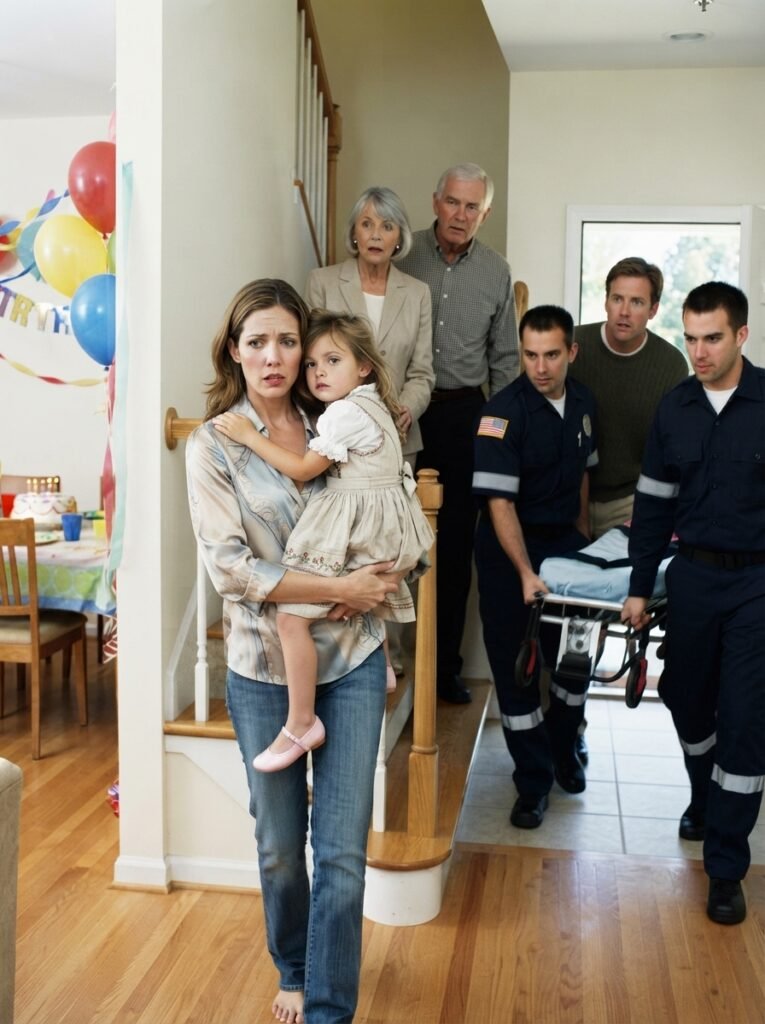
My own parents beat my sleeping six-year-old and smashed her face for my niece’s birthday photos. They clinked glasses and laughed, “Finally she’ll look as worthless as she is.”
I didn’t argue — I called 911 while their perfect front lawn filled with sirens.
The champagne flutes made a bright little sound in my parents’ kitchen, too clean for what it meant.
It should have belonged to cake candles, pink balloons, and Madison twirling in glitter shoes under a gold birthday banner.
Instead, that sound was my warning.
My daughter Lily was upstairs in the guest room, six years old, still wearing her yellow unicorn dress. She had fallen asleep with a glitter barrette in her brown hair and her stuffed rabbit tucked under one arm.
I had left the door open.
I remember that because I had looked back twice before going downstairs.
My mother, Patricia, had already made a face when Lily walked in.
“You let her wear that?”
Lily’s little fingers tightened around mine.
My father, Robert, glanced past us toward my old SUV and asked if it still ran, like poverty was something I had dragged into his driveway.
I swallowed every answer I wanted to give.
I told myself we would eat cake, smile for one photo, and leave before anyone could make my child feel smaller than she already did in that house.
But the whole party was built to measure her.
Madison had a three-tier cake, a rented balloon arch, and a photographer my mother kept calling “necessary.” Lily had a paper plate and a chair near the wall.
When Lily got sleepy, I took her upstairs myself.
The guest room smelled like old perfume and dust. The blanket was stiff, the curtains too white, the air too still.
“Don’t let them start without me,” Lily whispered.
“I won’t,” I said.
I kissed her forehead and left her there because I still believed even cruel grandparents had a floor.
Twenty minutes later, the kitchen went quiet in the strange way rich houses go quiet when everyone decides not to hear something.
Then my father’s voice came through.
“Finally she’ll look as worthless as she is.”
The glasses tapped.
My mother laughed.
For one second, I could not move.
David, my brother, stood near the cake with his fork in the air. His wife, Karen, stared at the ribbon on a balloon. Madison stopped smiling.
No one asked what he meant.
No one ran.
So I did.
I hit the stairs so fast my palm burned against the banister.
The guest room door was closed.
I had left it open.
Inside, Lily lay too still on the pillow. Her rabbit was trapped under one limp arm. Her small face was swollen, and there was blood where her cheek had touched the white cotton.
I touched her shoulder.
“Lily. Baby. Wake up.”
She did not answer.
Her breath was there, faint and shallow, but it did not feel like enough to keep the world standing.
I called 911 with fingers that could barely find the numbers. The operator asked me the address, her age, whether she was breathing, and whether I could see an injury.
“Six,” I kept saying. “She’s six. Please. She’s six.”
Then I lifted my daughter as carefully as I could and carried her down those polished stairs.
The party had not moved.
The cake still glittered. The balloons still bobbed. My parents still stood in the hallway with champagne in their hands.
I looked at every adult in that room.
“They did this,” I said. “They hurt her while she was sleeping.”
My father straightened his shoulders.
“That’s absurd.”
My mother sighed like I had stained the rug.
I looked at her, then at Madison, then at the whole family that had heard the clink and chosen silence.
“You could have told me not to bring her,” I said. “She is a child. I would have kept her home.”
My mother’s smile turned small and satisfied.
“What fun would that be?” she said. “I wanted the whole family to know only my real grandchild matters.”
That was when the sirens reached the end of the driveway.
My father’s face changed before the front door even opened.
The front door swung open so hard the birthday banner trembled.
Two EMTs stepped inside first, carrying a medical bag and a folded stretcher. Behind them came a police officer whose eyes went straight to Lily in my arms, then to the champagne flutes in my parents’ hands.
My father tried to recover before anyone else could speak.
“There has been a misunderstanding,” he said. “My granddaughter fell.”
The officer did not look away from him.
“Which granddaughter?”
That one question cracked something in the room.
My mother lowered her glass. David finally moved, but not toward me. He stepped between my parents and the door, like some old loyalty had just burned out of him.
Karen covered Madison’s ears, but Madison pulled her hands away.
“Grandma said Lily had to stop being pretty in my pictures,” Madison whispered.
The room went dead.
My father turned on her so fast the officer’s hand lifted.
“Madison,” he warned.
But my niece was already crying.
“She told Grandpa not to wake her up first.”
The EMT touched my elbow and said they needed to take Lily now. I climbed into the ambulance still holding her rabbit, still hearing Madison’s voice break behind me.
At the hospital, while doctors worked behind a curtain, the officer came back with one question.
“Mrs. Cooper, who closed the guest room door after you left it open?”
Before I could answer, my phone buzzed.
It was a video from Karen.
The thumbnail showed my mother’s hallway.
Part 2: The Video That Destroyed My Parents
The thumbnail showed my mother’s hallway.
For several seconds, I couldn’t bring myself to press play.
My hands were still shaking. Through the narrow window in the hospital room, I could see nurses moving quickly past the nurses’ station. Somewhere behind the curtain, doctors were fighting to stabilize my six-year-old daughter.
My little girl had gone to sleep believing she was safe.
And while she slept, the people who were supposed to love her had hurt her.
The police officer, whose name was Detective Miller, pulled a chair closer to my bed.
“Mrs. Cooper, I need you to watch that video before you decide whether to tell me anything else.”
I looked at him.
“Why would Karen have a video of my mother’s hallway?”
“That’s what we’re going to find out.”
I pressed play.
The footage was shaky at first. It showed my mother’s hallway from the angle of a small security camera mounted near the ceiling. I recognized the floral wallpaper, the antique mirror, and the white door leading to the guest room.
The timestamp showed that the recording had begun nineteen minutes after I left Lily upstairs.
My mother appeared first.
She was carrying a small cosmetic bag.
She looked up and down the hallway before entering the guest room.
A minute later, my father followed her.
He was holding his phone, apparently checking whether the photographer had arrived.
Then I heard my mother’s voice.
“She’s still sleeping?”
My father answered, “Like a rock.”
“Good. We need to get this done before the photographer leaves.”
My stomach tightened.
My mother disappeared into the room.
My father stood in the doorway, glancing toward the stairs.
Then came a sound that made me drop the phone.
A sharp cry.
Lily.
I covered my mouth.
Detective Miller paused the video.
“Do you want to continue?”
I couldn’t speak, so I nodded.
The footage resumed.
My mother emerged from the room carrying her cosmetic bag. She looked irritated, not frightened. My father followed, adjusting his shirt.
Neither of them called for help.
Neither of them checked whether Lily was breathing.
My mother turned toward the camera.
And she smiled.
Then she reached back and closed the guest room door.
I stared at the screen, unable to understand how someone could walk away from a hurt child and still have the strength to smile.
The video continued.
Three minutes later, my mother returned with Madison’s birthday banner tucked beneath her arm. She walked past the guest room and went downstairs.
My father followed.
Then the hallway remained empty.
Detective Miller took a slow breath.
“Who installed this camera?”
“Karen,” I whispered. “She and David had a disagreement with my parents last Christmas. Karen said she wanted proof of how my mother treated Madison when nobody was watching.”
“Does your mother know about it?”
“I don’t think so.”
He nodded.
“Mrs. Cooper, this footage may be important evidence. I’m going to have our digital forensics team preserve the original recording. Please don’t delete the message or forward the video to anyone.”
I nodded, but my mind was already somewhere else.
My daughter.
I looked toward the curtain.
“Is she going to be okay?”
Detective Miller’s expression softened.
“I don’t have that answer yet. The doctors are working on her.”
For the first time since the ambulance arrived, I let myself cry.
Not quietly.
Not politely.
I cried for the little girl who had begged me not to let the family start her niece’s birthday party without her.
And I cried because I had brought her into that house believing that blood meant something.
I would never make that mistake again.
At 11:47 p.m., a doctor finally came out.
I stood so quickly that the chair fell backward.
“How is my daughter?”
The doctor, a woman in her forties named Dr. Harris, removed her glasses.
“Lily is stable. She has significant facial injuries and a concussion. We are keeping her under close observation, and she will need follow-up care.”
I pressed my hand against my chest.
“Can I see her?”
“Of course. But please speak softly. She’s exhausted.”
When I entered the room, Lily looked impossibly small beneath the hospital blanket.
Her stuffed rabbit rested beside her pillow.
I sat down and brushed a strand of hair away from her forehead.
Her eyes fluttered open.
“Mommy?”
“I’m here, baby.”
She looked around the room, confused.
“Did I miss Madison’s cake?”
My heart broke all over again.
“No, sweetheart. You didn’t miss anything that matters.”
Her lower lip trembled.
“Did I do something bad?”
I leaned forward and kissed her forehead.
“No. No, Lily. You did absolutely nothing wrong.”
“But Grandma was mad at me.”
I held her hand.
“Sometimes grown-ups do terrible things, and they try to make other people believe it’s their fault. But it’s not your fault, baby. Not even a little.”
She was quiet for a moment.
Then she whispered something that would haunt me for years.
“Mommy, I tried to be good.”
I lowered my head over our joined hands.
“You don’t have to be good enough to deserve love,” I told her. “You already deserve it just because you’re you.”
Her eyes filled with tears.
“Will you stay?”
“Every second.”
She fell asleep holding my finger.
And I made a promise to her that night.
No one would ever get another chance to hurt my child and call it a family matter.
At 1:15 a.m., Detective Miller returned.
“We’ve spoken to your brother’s wife. She has agreed to give us the original recordings from the house.”
“What about my parents?”
“They’re being questioned.”
I looked at him.
“Are they going to jail?”
“That depends on the evidence, the investigation, and the prosecutor’s decisions. But I can tell you this: the footage raises serious concerns, especially because it appears they left your daughter injured without seeking medical assistance.”
I nodded.
Then I remembered something.
“The photographer.”
Detective Miller paused.
“What about the photographer?”
“My mother kept calling her necessary. She wanted pictures of Madison with the entire family. She was obsessed with making everything look perfect.”
I swallowed.
“If my parents planned this, they may have told someone what they intended to do.”
He wrote something in his notebook.
“We’ll follow up.”
After he left, I called Karen.
She answered on the first ring.
“I’m so sorry,” she whispered.
I closed my eyes.
“Why did you send me that video?”
“Because I couldn’t keep protecting them.”
Her voice shook.
“For years, Patricia has treated Lily like she was an inconvenience. She made comments about your clothes, your car, your apartment. She told David that you were embarrassing the family.”
I said nothing.
“Today, when I saw you carrying Lily downstairs, I knew something had happened. Your mother was acting like everything was normal. Robert was telling people Lily had fallen. And then Madison started crying.”
Karen took a breath.
“I checked the footage. When I saw what they had done, I couldn’t pretend anymore.”
“Why didn’t you tell me sooner how badly they treated Lily?”
“I should have. I was afraid of losing my husband, of tearing the family apart. I kept telling myself that if I stayed quiet, things would eventually improve.”
She began to cry.
“But today, your daughter paid the price for my silence.”
I looked at Lily sleeping beside me.
“Karen, I don’t know if I can forgive you for not speaking up earlier.”
“I understand.”
“But you did the right thing tonight. Keep telling the truth, even when it hurts.”
“I will.”
Before we hung up, she told me something that changed everything.
“There is another recording.”
My grip tightened around the phone.
“What recording?”
“The living room camera. It caught your parents talking before the party started.”
“What did they say?”
Karen hesitated.
“Your mother was talking about Lily’s dress. She said the family needed to learn that there was a difference between a grandchild who represented them and a child who embarrassed them.”
My throat tightened.
“And Robert?”
“He laughed. Then he said something about making sure Lily wouldn’t ruin Madison’s pictures.”
I stared at the wall.
They hadn’t simply lost control in a moment of anger.
They had discussed my daughter as if she were an object they could damage to improve a photograph.
“Give everything to the police,” I said.
“I already have.”
“Good.”
I hung up.
For the first time that night, my tears stopped.
I was done begging my parents to treat my daughter like a human being.
Now, they would have to answer for what they had done.
The next morning, my phone began vibrating at 6:30 a.m.
My father called first.
Then my mother.
Then David.
I ignored all three until a text appeared from Patricia.
You need to stop this nonsense immediately. The police are humiliating us. Think about what this will do to the family.
I read it twice.
Not once did she ask how Lily was feeling.
Not once did she ask whether her granddaughter could see properly, whether she was in pain, or whether she had slept through the night.
All she cared about was the family’s reputation.
I typed one sentence.
You should have thought about the family before you hurt a sleeping child.
Then I blocked her number.
A minute later, my father sent a message from an unfamiliar number.
Your mother is devastated. We made a mistake. Don’t destroy our lives over one incident.
One incident.
I looked at the bruises on Lily’s face.
One incident.
I remembered the sound of champagne glasses touching while my daughter lay injured upstairs.
I remembered my mother’s smile.
I blocked that number, too.
Then I called my attorney.
Her name was Rebecca Collins. She had handled my divorce three years earlier and had been one of the few people who never treated me as though being a single mother made me less worthy of respect.
I explained everything.
When I finished, she was silent for a moment.
Then she said, “First, focus on Lily’s recovery. Second, preserve every message and let the police handle the criminal investigation. Third, if your parents have any legal access to your daughter, we need to address that immediately.”
“They don’t have custody or guardianship.”
“Good. Do not allow them unsupervised contact. We can also discuss a protective order if the facts and applicable law support one.”
I glanced at my daughter.
“Rebecca, they keep telling everyone that I’m trying to ruin them.”
“People who are accustomed to controlling the story often call accountability an attack.”
Her voice sharpened.
“Don’t get distracted by their excuses. Let the evidence speak.”
For the first time since the party, I felt something other than fear.
I felt steady.
Three days later, my parents held a family meeting.
I wasn’t invited, of course.
But David sent me a message asking whether I would attend.
“They want to explain their side,” he wrote. “Mom says everyone is making assumptions.”
I almost laughed.
Explain their side?
They had a video.
They had witnesses.
They had a six-year-old girl in a hospital bed.
Still, I agreed to attend, but only after speaking with my attorney. She advised me not to meet them alone, not to sign anything, and not to allow them to pressure me into withdrawing my cooperation with the investigation.
The meeting was held at my parents’ house, the same house where Lily had been hurt.
When I arrived, the birthday decorations were gone.
The cake had been thrown away.
The champagne glasses had disappeared.
But the hallway camera remained.
I noticed it immediately.
Patricia sat on the sofa wearing a cream-colored blouse. Robert stood beside the fireplace. David and Karen sat opposite them, with Madison pressed against her mother’s side.
My mother looked at me as though I had arrived to apologize.
“Finally,” she said. “We can settle this privately.”
I remained standing.
“There’s nothing private about what happened to Lily.”
Robert sighed.
“You’re being emotional.”
“My six-year-old daughter was injured while she was sleeping.”
“She fell,” he snapped.
Karen stood up.
“Stop lying.”
My father turned toward her.
“Stay out of this.”
“No,” Karen said. “I’m done staying out of it.”
She pulled a tablet from her bag and placed it on the coffee table.
“I gave the original recordings to the police. This is a copy of the footage from the living room.”
Patricia’s face drained of color.
“How dare you?”
Karen pressed play.
My mother’s voice filled the room.
If she shows up in that ridiculous dress, she’ll ruin every photograph.
Then my father’s voice.
We can’t have her making Madison look bad.
My mother answered.
Then make sure she doesn’t.
The recording ended.
Nobody moved.
I looked at my parents.
“Tell me what you meant.”
Patricia stood abruptly.
“That recording is being taken out of context!”
“Then explain the context.”
She opened her mouth.
Nothing came out.
Robert stepped forward.
“You have no idea how difficult it has been raising a family. Your mother has done everything for you.”
I stared at him.
“I raised myself. And now I’m raising Lily. You didn’t do everything for me. You taught me that love was something I had to earn.”
His jaw tightened.
“After everything we’ve done, this is how you repay us?”
I felt a strange calm settle over me.
“No. This is what happens when you hurt my child.”
Patricia began to cry.
But I recognized those tears.
They were the same tears she had used when I was a teenager and refused to apologize for something I hadn’t done. The same tears that had always forced me to comfort her, even when she was the one who had hurt me.
This time, I didn’t move.
“You need to understand something,” I said. “Lily will never again have to sit at the edge of a room hoping you decide she deserves a place at your table.”
My mother wiped her cheeks.
“She’s our granddaughter.”
“Then you should have acted like grandparents.”
David lowered his head.
I turned to him.
“You were standing beside the cake. You heard Dad. You heard Mom. Why didn’t you come upstairs?”
His eyes filled with tears.
“I froze.”
“You had time to eat cake. You had time to stand there. You had time to let my daughter be carried out of this house.”
“I know.”
“No, David. You know now because there are consequences. That is not the same as knowing when it mattered.”
He covered his face.
For a moment, I almost felt sorry for him.
Almost.
Then Madison slipped off the sofa.
She approached me slowly, clutching the hem of her pink dress.
“Auntie?”
I knelt.
“Yes, sweetheart?”
“Is Lily going to hate me?”
My heart ached.
“No, Madison. None of this was your fault.”
“But Grandma said it was my birthday, so everyone had to do what she wanted.”
I took her little hands.
“Your birthday should have been a happy day. You didn’t ask anyone to hurt Lily. And you don’t have to accept something bad just because an adult tells you it’s okay.”
Madison began to cry.
“I wanted Lily in my pictures.”
Karen wrapped her arms around her daughter.
“I know, baby.”
I stood and looked at my parents one final time.
“The police have the evidence. My attorney has everything she needs to protect Lily. From now on, any communication about my daughter goes through her.”
Robert’s face hardened.
“You would cut off your own parents?”
I paused at the doorway.
“No. You did that yourselves when you decided my child wasn’t worth protecting.”
Then I left.
I did not slam the door.
I didn’t need to.
The following weeks were difficult.
Lily had nightmares. Sometimes she woke up crying and asked whether Grandma knew where we lived.
I moved us temporarily to a small apartment near the hospital so she could attend her follow-up appointments without having to drive across town.
I took time off work.
We watched cartoons, colored pictures, and read the same bedtime stories until she could recite them by heart.
Some nights, she slept with the lights on.
I never told her she was being silly.
I never told her to get over it.
I simply sat beside her until she felt safe enough to close her eyes.
One evening, she drew a picture of our little family.
There were two figures holding hands beneath a yellow sun.
One was tall.
One was small.
Both had enormous smiles.
At the top, she wrote in uneven letters:
MOMMY AND ME. SAFE TOGETHER.
I framed it and hung it beside her bed.
It was the most important thing I owned.
Meanwhile, the investigation continued.
Detective Miller informed me that the video footage, witness statements, and medical records had become central to the case. The authorities were examining the circumstances surrounding Lily’s injuries and the failure to seek medical help immediately afterward.
My parents’ attorney contacted Rebecca several times.
First, they offered to pay Lily’s medical expenses.
Then they offered money for counseling.
Finally, they offered a substantial settlement in exchange for a written statement saying that I believed the incident had been an accident.
Rebecca rejected the proposal.
She explained that any civil settlement could be considered separately from the criminal investigation, but I would not be pressured into making a false statement.
I didn’t want their money.
I wanted my daughter to grow up knowing that what happened to her was wrong, that the truth mattered, and that no amount of wealth could buy permission to hurt someone.
David eventually contacted me again.
This time, he didn’t make excuses.
He wrote:
I should have stopped them. I should have gone upstairs. I should have protected Lily. I have no excuse for what I did.
I read the message several times.
Then I replied:
You cannot change what happened. You can only decide what kind of person you become after it.
I didn’t promise to forgive him.
I didn’t promise to let him see Lily.
That decision would depend on her safety, her needs, and the advice of the professionals helping us.
For once, I refused to let another adult’s feelings become my child’s responsibility.
Four months later, I sat in a courtroom with Lily’s small hand wrapped around mine.
She wasn’t required to be there for every proceeding, and her care team had helped me decide what was appropriate for her. That morning, she had asked to come with me because she wanted to know whether the judge would make the bad people stop.
I told her the truth.
“The adults in the courtroom will decide what happens next. My job is to keep you safe.”
She nodded and held her stuffed rabbit tighter.
My parents sat at the opposite table.
Patricia wore a dark blue suit. Robert had his hands folded in front of him, his expression rigid.
They looked smaller than I remembered.
Not because they had lost their money.
Not because their reputation had begun to crumble.
But because, for the first time in my life, they could no longer control what everyone believed about them.
The evidence was presented.
The recordings were authenticated.
Witnesses described the party and the events that followed.
Medical professionals explained Lily’s injuries.
My parents’ attorney argued that the recordings did not tell the entire story. But the prosecution focused on what the evidence showed, including the actions captured before and after Lily was hurt.
When Patricia was given the opportunity to address the court, she turned toward me.
“I never intended for things to go this far,” she said, her voice breaking. “I was angry. I made a terrible mistake.”
I looked at her.
I remembered the way she had smiled in that hallway.
I remembered the champagne glasses.
I remembered Lily asking whether she had done something bad.
My mother lowered her eyes.
For the first time, I realized I no longer needed her to admit what she had done before I could move forward.
The court proceedings continued, and the legal consequences were determined through the proper process. My parents were held accountable for their actions, and restrictions were put in place to protect Lily.
There was no magical moment when every wound disappeared.
There was no single verdict that erased the nightmares or returned the childhood innocence Lily had lost that afternoon.
But the truth was no longer something I had to defend alone.
And my daughter was safe.
That was what mattered.
Six months after the birthday party, Lily celebrated her seventh birthday.
We didn’t rent a ballroom.
We didn’t hire an expensive photographer.
We didn’t build a towering balloon arch or order a three-tier cake.
Instead, we invited five children from her class to our little backyard.
Karen came with Madison.
She asked permission before bringing her daughter, and she understood when I explained that the girls would need to rebuild their friendship slowly.
Madison arrived carrying a small gift bag.
She stood nervously beside the garden gate.
Lily saw her and looked at me.
I didn’t tell her what to do.
It was her choice.
After a moment, Lily walked over.
Madison held out the bag.
“I made you something,” she said.
Inside was a handmade picture frame decorated with tiny yellow stars.
A photograph of the two girls sat inside it.
They were standing together at a park, laughing with ice cream dripping down their hands.
“I wanted you in my pictures,” Madison whispered. “I always did.”
Lily looked at the photograph.
Then she hugged her cousin.
I turned away for a moment, blinking back tears.
Not because everything had been forgiven.
Not because the past no longer mattered.
But because two children had been caught in the cruelty of adults, and at least one of them was finally learning that love did not have to be a competition.
The party continued.
The children played in the grass.
Karen helped serve lemonade.
And when it was time for cake, Lily stood beside the table in her favorite yellow dress.
She looked at me.
“Mommy, can I make a wish?”
“Of course, baby.”
She closed her eyes.
Then she blew out the candles.
Later that night, after everyone had gone home, I tucked her into bed.
She placed her stuffed rabbit beside her pillow and reached for my hand.
“Mommy?”
“Yes?”
“Will we ever go to Grandma’s house again?”
I took a breath.
“Not unless it’s safe for you, sweetheart. And you never have to go somewhere that makes you afraid.”
She thought about that.
Then she smiled faintly.
“Good. I like our house better.”
I kissed her forehead.
“So do I.”
After she fell asleep, I went downstairs and stood in the quiet kitchen.
There were paper plates in the sink, crumbs on the counter, and a crooked birthday card leaning against a glass of water.
Our home was small.
The furniture didn’t match.
I couldn’t afford the things my parents had spent their lives using to impress other people.
But there was something in that house I had never felt in theirs.
Peace.
I thought about the champagne glasses that had started everything.
About the laughter that had followed.
About the people who had stood in a beautiful kitchen and mistaken cruelty for power.
My parents had believed that wealth made them untouchable, that a perfect lawn and an expensive house could hide anything ugly that happened behind closed doors.
They were wrong.
Because the moment I heard those glasses clink, I stopped protecting their reputation.
And the moment I called 911, I started protecting my daughter.
I never got an apology that could undo what happened.
I never received an explanation that made their behavior understandable.
And I never returned to the family I had spent years trying to please.
But I gained something far more valuable than their approval.
I learned that being a good daughter did not require me to sacrifice my child.
I learned that silence can protect the people causing harm, even when it feels easier than confrontation.
Most importantly, I learned that my little girl would never have to earn her place in my life.
She already had it.
Every single day.
And if anyone ever tried to make her feel worthless again, they would have to go through me first.
THE END