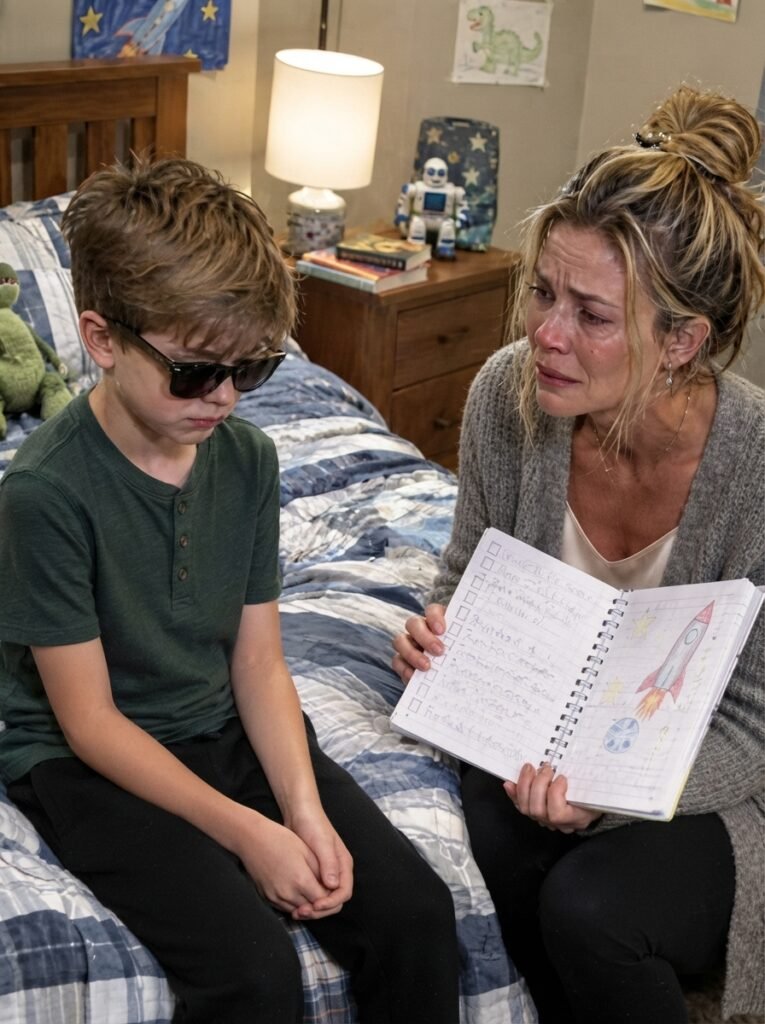
My 9-year-old started wearing sunglasses inside. His teacher made him sit in the hallway for 6 days. “He’s being defiant, Mrs. Valdez.” My husband agreed. Then I found a notebook under Atticus’s pillow. The title, in shaky pencil, said: “Things I want to see before it all goes dark.”
My name is Shawna. I’m a hairdresser in Tucson, Arizona.
My son, Atticus, is nine years old. He loves comic books, desert lizards, and drawing. He draws all the time. Spaceships, dragons, our dog, our house. He wants to be an artist when he grows up.
In September, he started acting strange.
He asked to sit closer to the TV. He walked into the edge of the kitchen table twice. He stopped drawing.
Then he started wearing his sunglasses everywhere. In the car. At dinner. In his bedroom with the lights off.
“Atticus, take those off. It’s dark in here.”
“I like them,” he mumbled.
My husband, Leander, thought it was a phase.
“He saw some YouTuber do it,” he said. “He’s trying to look cool. Ignore it.”
Then his teacher, Mrs. Maude Pruett, called me.
“Mrs. Valdez, Atticus refuses to take his sunglasses off in class. It’s disruptive. He also refuses to read out loud. He says the words are ‘swimming.’ I’m not going to tolerate that kind of excuse.”
“Maybe he can’t see the board. Can we get his eyes checked by the school nurse?”
“His eyes were checked in first grade. They were fine. This is defiance. Some boys just don’t want to work.”
The next week, she made him sit at a desk in the hallway. Alone. Every day. For six days.
“Until he decides to follow the rules,” she wrote in an email.
When I told Leander, he shrugged.
“Good. Maybe he’ll learn. You baby him too much, Shawna.”
“Something’s wrong with him, Leander.”
“What’s wrong with him is that he knows you’ll fall for it. Kids make stuff up to get out of school.”
That night, I asked Atticus why he wouldn’t take the sunglasses off.
He looked at the floor.
“The light hurts, Mom. Bright light makes everything go fuzzy and sparkly. The glasses help a little.”
“Why didn’t you tell me, baby?”
“I did,” he said quietly. “I told Mrs. Pruett. She said I was lying. I told Dad. He said to stop being dramatic.”
He looked up at me through those dark lenses.
“I didn’t want you to be mad too.”
I made an appointment with an eye doctor. The earliest one was in two weeks. I took it.
Then, on a Saturday morning, while I was changing his sheets, I lifted his pillow.
There was a small spiral notebook underneath it.
I almost put it back. It was his private notebook. But something made me open it.
On the first page, in large, wobbly pencil letters, it said:
“THINGS I WANT TO SEE BEFORE IT ALL GOES DARK.”
My hands started shaking.
I turned the page.
“1. A real shooting star.
2. The Grand Canyon.
3. Noodle’s face when she gets a bone.
4. The ocean.
5. Mom’s face when she smiles. I need to remember it really good.”
Under the list, he’d drawn a picture of me. Smiling. He’d pressed so hard that the pencil almost went through the paper.
And under that, in smaller letters:
“The dark spot in my eye is getting bigger every week. Don’t tell Mom. She’ll cry.”
I sat down on his bed and cried anyway.
I didn’t wait two weeks.
I called every eye doctor in Tucson until one agreed to see him that same afternoon. Her name was Dr. Ferdinand. She was kind and quiet, with gray braids.
She shined a light into Atticus’s eyes for a long time. She looked in the right eye. Then the left. Then the right again.
She didn’t say anything.
Then she turned off the light, took off her glasses, and looked at me. Her face had changed.
“Mrs. Valdez,” she said gently. “Has anyone ever looked at the back of his eyes?”
“No. His teacher said he was just being defiant.”
Dr. Ferdinand closed her eyes for a second.
Then she picked up her phone and started dialing.
“I’m calling the children’s hospital,” she said. “I need you to take him there right now. Don’t go home first. Don’t stop for anything.”
Atticus squeezed my hand.
“Mom? Is it the dark spot?”
PART 2
“I don’t know yet, baby,” I said. “But we’re going to find out together.”
We drove straight to the children’s hospital. I ran two red lights. I didn’t care.
That night, Atticus had an MRI.
At 11 p.m., a neurosurgeon named Dr. Valencia sat down with me in a small room with no windows. Leander was there too. He’d driven over from work, still in his work clothes.
“Your son has a tumor,” the doctor said gently. “It’s not cancer. It’s benign. But it’s growing right behind his eyes, pressing on the nerves that carry vision to his brain.”
I couldn’t breathe.
“The pressure is why bright light hurts him. It’s why words look like they’re swimming. It’s why he has a dark spot. If it keeps growing, he will lose his sight completely.”
“How long?” Leander asked. His voice was shaking.
“Weeks,” the doctor said. “Maybe less. We need to operate as soon as possible.”
Leander put his face in his hands.
“He told us,” he whispered. “He told us the light hurt. I said he was being dramatic.”
The surgery was two days later. It took nine hours.
I sat in the waiting room holding that little spiral notebook the whole time.
When Dr. Valencia came out, she was smiling.
“We got it,” she said. “All of it.”
Atticus woke up the next morning with a bandage around his head. The nurse opened the blinds. Sunlight poured into the room.
He didn’t flinch.
He looked at me for a long time.
Then he smiled.
“Mom,” he said. “You’re not fuzzy anymore.”
He lost some of the vision in his left eye. The doctors said that part won’t come back. But his right eye is almost perfect. With glasses, he can see nearly everything.
Including the board at school.
When Mrs. Pruett found out, she called me in tears.
“I’m so sorry, Mrs. Valdez. I made him sit in the hallway while he was going blind. I’ll never forgive myself.”
She asked the school to add a full eye exam for any student who complains about vision. Not just the old chart on the wall. They call it the Atticus Check.
Leander changed too. He took two weeks off work. He sat with Atticus every day in the hospital, reading him comic books out loud.
“I should have listened to you, buddy,” he said. “From now on, I always will.”
That summer, we did everything on Atticus’s list.
We drove to the Grand Canyon. He stood at the edge and couldn’t stop smiling.
We went to the beach in San Diego. He ran into the waves screaming.
We gave Noodle a giant bone and took a hundred pictures of her happy face.
And one night in August, lying on a blanket in the desert outside Tucson, we saw a shooting star.
Atticus pointed at it and laughed.
“That’s all of them, Mom! That’s the whole list!”
“Not the last one,” I said. “Number five.”
He rolled over and looked at me.
I was smiling. I couldn’t help it.
He looked at my face for a long time, the way he does when he’s drawing something.
“Got it,” he said. “I’ll remember it forever.”
THE END.