The envelope arrived early on a cold Tuesday morning, slipped quietly beneath my apartment door before sunrise. At first, I almost ignored it. But the moment I saw the return address, my stomach tightened.
Riverside Memorial Hospital.
My name was written neatly across the front in handwriting I didn’t recognize. The paper felt formal and strangely delicate in my hands, as if it carried something far heavier than words.
Inside was a short note explaining that my ex-wife, Rebecca, had been admitted to the hospital unexpectedly and had listed me as her primary emergency contact.
She was asking for me.
I read the letter three times before I could even process it.
Ninety days earlier, our divorce had officially ended a marriage that had been falling apart for years. By the time we walked out of the courthouse, we were emotionally exhausted, carrying more resentment than love. I truly believed that chapter of my life was over.
But standing there in my apartment holding that letter, I realized the past wasn’t finished with me yet.
The drive to the hospital felt unreal. Every traffic light dragged me deeper into memories I had spent months trying to bury. I remembered Rebecca laughing on our first date, singing badly in the kitchen while making coffee, and falling asleep on my shoulder during late-night movies.
Then the harder memories came.
The silence during the last year of our marriage.
The distance.
The arguments that never really solved anything.
The growing feeling that no matter how hard I tried, I couldn’t reach her anymore.
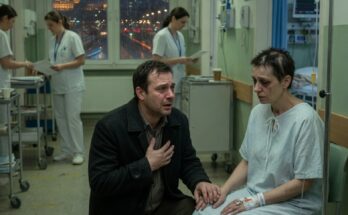
When I arrived at the cardiac unit, I barely recognized her.
Rebecca looked painfully small sitting in that hospital bed wearing a pale gown. Her dark hair rested loosely around her shoulders, and the bright confidence I once loved so much had been replaced by complete exhaustion.
When she saw me standing in the doorway, her eyes filled immediately.
“You came,” she whispered.
I stayed near the door for a moment because suddenly I didn’t know what I was supposed to be anymore. I wasn’t her husband anymore. Legally, emotionally, everything between us was supposed to be finished.
But seeing her like that broke something in me.
Rebecca looked down quietly and admitted she didn’t know who else to call. Her parents were gone, her sister lived across the country, and despite everything, my name was still the only one that felt safe to her in a crisis.
The silence between us felt heavy.
We had once shared a home, a future, and years of our lives together. Now we struggled just to share a conversation.
Finally, I asked her what happened.
She took a shaky breath and told me her heart had stopped.
The doctors believed the emergency was connected to complications involving the way she had been taking her prescription medications.
Over the next hour, Rebecca told me things I had never known during our entire marriage.
She explained that she had been silently struggling with severe anxiety since college. What started as occasional panic slowly became overwhelming over the years. She described sleepless nights, panic attacks at work, mornings where she physically couldn’t get out of bed, and the crushing fear that controlled almost every part of her life.
The medication helped at first.
But eventually she became desperate for stronger relief while hiding everything from everyone around her.
Including me.
What nearly destroyed her wasn’t one dramatic moment. It was years of quiet suffering hidden beneath normal routines and forced smiles.
Then she admitted something that completely shattered me.
On the morning she collapsed, she believed our divorce proved she had failed at the most important relationship in her life.
I asked her the question I had carried for years.
“Why didn’t you tell me?”
Rebecca looked at me with tears in her eyes and said something I will never forget.
“Because I was terrified you would leave me… or worse, stay because you felt sorry for me.”
The moment she said that, our entire marriage changed in my mind.
The mornings I thought she was lazy or distant suddenly looked different.
The canceled plans.
The days she stayed in bed.
The way she slowly pulled away from friends and family.
I thought she had stopped caring.
In reality, she had been drowning quietly while trying to survive her own mind.
And I never truly saw it.
Later that evening, her doctor explained that Rebecca was lucky to be alive. Recovery would take time, therapy, medical supervision, and a strong support system.
Then the doctor asked if she had family nearby.
That question hit me harder than anything else that day.
Because during our marriage, Rebecca had slowly isolated herself from almost everyone due to shame and fear. And despite our divorce, I realized she was facing all of this almost completely alone.
That night, I stayed in the hospital waiting room.
Part of me kept wondering if I should leave. Technically, I no longer had any obligation to stay beside her.
But another part of me remembered the woman I once loved deeply.
And I couldn’t walk away from her pain.
Over the following weeks, we began having the honest conversations we should have had years earlier. Rebecca opened up about her first panic attack during our second year of marriage and how everyday tasks slowly became overwhelming for her.
I even attended therapy sessions with her so I could better understand what she had been experiencing.
And honestly, I had to face painful truths about myself too.
My frustration had slowly turned into criticism.
My criticism made her more afraid to speak openly.
Without realizing it, both of us had built a marriage where silence felt safer than honesty.
Six months later, something unexpected happened.
We didn’t fall back in love.
We didn’t rebuild our marriage.
That story had already ended.
But we built something different instead — a genuine friendship based on truth, healing, and understanding.
Rebecca slowly found stability through treatment, therapy, and support groups. Over time, pieces of the woman I remembered began returning, but she was stronger now, more honest, and no longer pretending to be okay just to make other people comfortable.
And the experience changed me too.
I listen differently now.
I pay attention to silence.
I no longer assume someone is “fine” simply because they say they are.
Rebecca has now been in recovery for over a year, and while our marriage could not be saved, the experience taught me something I will carry forever:
Sometimes understanding comes too late to save the relationship you once wanted.
But it can still arrive in time to save your humanity, your compassion, and your ability to care for someone without needing the old version of your life back.