Bank transfers. Audio clips. Camera logs. Stills from the alley. Julian’s signed statement. A copy of the draft report claiming Mason carried narcotics, complete with a timestamp proving it was created while Mason lay unconscious in ICU.
Chief Darden’s face went loose.
Judge Wexler whispered, “Victor, what is this?”
Voss looked at me with the first honest expression I had seen from him.
Hatred.
“You think stolen files save you?”
“No,” I said. “I think panic makes guilty men call each other.”
His phone rang again.
He didn’t answer.
I did.
I reached into my pocket, held up my own phone, and played the live call Victor had quietly forced open through one of Voss’s assistants. Not magic. Not a trick I would explain. Just enough pressure in the right place.
A voice crackled from the speaker.
Sergeant Kyle.
“Victor, we have a problem. Julian talked. The Reed guy has people. I need money and a clean route out.”
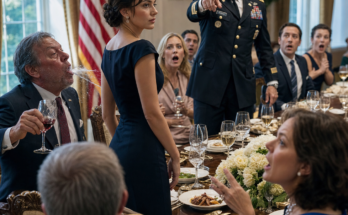
The dining room went dead silent.
Voss slowly closed his eyes.
Chief Darden said, “Turn that off.”
I didn’t.
Kyle continued, frantic now. “And that backpack thing? It’s done, but if state cops look too close, it won’t hold. You said this was contained.”
Marjorie Ellis stood so fast her chair fell backward.
I stopped the playback.
Rain hammered against the roof.
Voss whispered, “You have no idea what you’ve started.”
“I know exactly what I’ve started.”
“You’ll destroy families.”
“No. I’ll expose the people who used families as cover.”
The sirens came then, faint at first, rising from the bottom of the hill. Not local cruisers. Different pitch. More of them.
Blake had delivered the second packet to state investigators and federal agents already watching Voss for construction fraud. Mason’s case had not created the fire. It had opened a locked door in a burning house.
Voss looked toward the windows, then back at me.
For a moment, I thought he might attack me.
Instead, he smiled.
That scared me more.
“You think Hunter is the weak point,” he said softly. “You think this ends with my son in cuffs.”
“Doesn’t it?”
His smile widened.
“My father built this town before I ever sat on a council. You’ve been fighting the branch, Mr. Reed. Not the root.”
The sirens grew louder.
Police lights splashed across the foyer walls.
Behind me, tires crunched over wet gravel as state vehicles entered the drive.
Voss leaned close enough that only I could hear him.
“And roots,” he whispered, “go underground.”
The front door burst open behind me.
Agents shouted.
Darden raised his hands. Wexler cursed. Ellis began crying. Voss remained perfectly calm as they turned him around and cuffed him beneath his own chandelier.
I watched without satisfaction.
Because Hunter was missing.
Because Voss had smiled.
And because for the first time that night, I understood there was someone older, richer, and crueler waiting below the surface.
Councilman arrested in corruption probe.
Police chief placed in custody.
School board chair resigns amid cover-up allegations.
Local teen assault investigation linked to wider criminal network.
The news vans arrived before the school buses. Reporters stood outside Oak Haven High under umbrellas, their hair sprayed stiff against the rain. Parents parked in strange places, climbed out, and shouted questions at anyone wearing a badge. Students gathered in nervous knots, staring at their phones, whispering Hunter’s name like it had changed flavor in their mouths.
Power looks permanent until cameras turn toward it.
Then it looks surprised.
I watched all of it from the hospital cafeteria with a paper cup of coffee cooling between my hands. The television in the corner played footage of Voss being led from his house. He kept his chin up. That bothered me. Innocent men looked confused. Guilty men looked angry. Men with backup looked patient.
Layla sat across from me, her hands wrapped around a tea she had not touched.
“I saw the news,” she said.
I nodded.
“Did you send everything?”
“Enough.”
“Will it hold?”
“Some of it. Some will be fought over. Some will be called illegal. But once people see the shape of a thing, they can’t unsee it.”
She looked older than yesterday. Shame does that. It carves shadows around the mouth.
“I told the doctor I want to speak with a victim advocate,” she said. “And a lawyer. A real one. Not anyone Voss recommends.”
“That’s good.”
She waited, maybe hoping I’d say more.
I didn’t.
Finally she looked down. “You meant what you said. About us.”
“Yes.”
A small nod. “I deserved that.”
“No,” I said. “You deserve accountability. Not cruelty. There’s a difference.”
Her eyes filled, but she held it together. “Do you hate me?”
I thought about lying. Then I thought about Mason.
“I don’t trust you.”
That hurt her more than hate would have.
Before she could answer, my phone rang.
Blake.
I stood and walked toward the vending machines.
“Talk.”
“Hunter’s gone,” Blake said.
The cafeteria noise faded.
“What does gone mean?”
“He wasn’t at the Voss house during the arrest. Not at the lake property. Not with friends. His phone is off. His social accounts went dark. Last known sighting was a service road behind the estate twenty minutes before state police arrived.”
“Who helped him?”
“Unknown. But there’s another problem.”
“There always is.”
“Voss’s father, Arthur Voss, flew in last night.”
I closed my eyes.
Arthur Voss. The root.
I remembered the name from old newspaper plaques around town. Industrialist. Philanthropist. Founder of half the buildings with brass nameplates. He had donated to police charities, school expansions, hospital wings. Men like that don’t buy influence. They install it and call it generosity.
“Where is Arthur now?” I asked.
“At his private lodge outside North Ridge. Big property. Private security. No official warrants yet.”
“And Hunter?”
“Likely with him.”
I looked through the cafeteria glass toward the ICU elevators.
“How’s Mason?” Blake asked.
“In surgery recovery. Stable, but not awake.”
“Stay there, Logan.”
I almost laughed. “You know I won’t.”
“I know. That’s why I’m asking.”
A code chime sounded somewhere overhead. Nurses moved quickly but calmly past the cafeteria doors. The hospital kept functioning because it had to. Pain checked in every hour and nobody got to close.
“Find Hunter,” I said.
“We’re trying.”
“No. Find the person moving him.”
There was a pause.
“You think Arthur won’t protect him?”
“I think Arthur protects the family name. Hunter is becoming a liability.”
Blake understood immediately. “I’ll dig.”
I hung up and returned to the table.
Layla stood. “What happened?”
“Hunter ran.”
Fear crossed her face. “Will he come here?”
“No.”
“Logan.”
“He won’t get near Mason.”
She grabbed my sleeve as I turned. “Please don’t disappear into this. Mason needs you alive, not legendary.”
I looked at her hand until she let go.
“I was legendary for strangers,” I said. “For Mason, I’m just late.”
I went upstairs before she could answer.
Mason’s room was quieter now. The ventilator was gone. A clear tube still rested under his nose, and machines still watched every heartbeat, but his chest rose on its own.
That almost broke me.
I sat beside him and touched his hand.
“Hey, kid,” I whispered. “You’re doing your part. I’m doing mine.”
His fingers didn’t move.
On the rolling table beside the bed sat a plastic bag with his personal effects. Wallet. Keys. Broken phone. One blue sneaker.
The other was still missing.
Trophy.
I stared at that single shoe until the room blurred around it.
A soft knock came from the door.
Evan stood there holding a manila envelope. He looked like he hadn’t slept in days.
“May I come in?”
I nodded.
He stepped inside and saw Mason. His face collapsed for half a second before he forced it back into place.
“I resigned,” he said.
That surprised me.
“I don’t want praise,” he added quickly. “I should have done more before this. I brought copies of everything. Not just Hunter. Other incidents. Emails from parents. Pressure from the board. Calls from Voss. All of it.”
He placed the envelope on the chair.
“Why now?” I asked.
He looked at Mason. “Because courage that arrives late is still better than cowardice that stays forever.”
It was a good line. Maybe one he had practiced. Maybe one he needed to hear himself say.
“I’m giving it to state investigators,” he said. “But I wanted you to know first.”
“Good.”
He turned to leave, then stopped. “Mason once told me he wanted to design a school where there were no blind corners. I thought he meant architecture.” His voice shook. “I think he meant something else.”
After he left, I opened the envelope. The first document was a printed email from Victor Voss to the school board chair.
Control the Reed boy situation before it attracts attention. Hunter cannot be connected to prior complaints.
Prior complaints.
I flipped to the next page.
There was a name I didn’t expect.
Harper Voss.
Arthur Voss’s granddaughter.
A student. A witness in an older incident. Withdrawn from Oak Haven High last year. Transferred out of state.
A note in Evan’s handwriting was clipped to the page.
She tried to report Hunter once. Arthur buried it.
I stood so fast the chair scraped the floor.
This wasn’t just Mason.
Hunter had been protected before.
And somewhere, a girl with the Voss name might be the only person alive who knew what Arthur was willing to do to his own blood.
Victor found her through public enrollment records and a scholarship announcement Arthur had failed to scrub from an old foundation page. He didn’t break into anything to contact her. He didn’t need to. Blake found a faculty advocate who had once served with a friend of ours, and by late afternoon, my phone buzzed with an unknown number.
I answered in the hospital stairwell.
A young woman’s voice said, “Are you Mason Reed’s father?”
“Yes.”
“My name is Harper.”
I looked through the narrow window at the parking lot below. News vans still lined the curb. “Thank you for calling.”
“I almost didn’t.”
“I wouldn’t have blamed you.”
She was silent for a few seconds. When she spoke again, her voice was steady in the way people sound when they’ve spent years practicing not to shake.
“Hunter hurt people before your son. Not like that, maybe. Not hospital bad. But bad enough.”
“What happened?”
“He and his friends cornered a sophomore after a party. A boy named Miles. Broke his wrist. Made him say things on video. Humiliating things.” She breathed in sharply. “I saw it. I told my grandfather.”
“Arthur.”
“Yes. I thought he’d stop it. Instead, he asked if anyone else knew.”
The stairwell smelled like damp concrete and cigarette smoke from some old maintenance worker’s habit.
“What did he do?”
“He sent Miles’s family money. Then threats. He sent me away two weeks later. Told everyone I needed a better academic environment.”
“Why are you telling me now?”
Her laugh was short and bitter. “Because I saw Hunter on the news, and for the first time, he looked scared. I didn’t know that was possible.”
I leaned against the wall.
“Harper, do you know where Arthur would take him?”
Silence.
Then, softer: “The concrete plant.”
“Not the North Ridge lodge?”
“That’s where he wants people to look. The plant is old Voss property outside town. My grandfather used to take us there when we were little and tell us everything in Oak Haven was built from what men were willing to bury.”
A chill moved through me.
“Would he hurt Hunter?” I asked.
Another silence.
This one was answer enough.
“My grandfather doesn’t love people,” Harper said. “He loves legacy. If Hunter threatens that, then Hunter becomes something to manage.”
I thought of Hunter laughing in the school parking lot. Hunter holding Mason’s shoe. Hunter telling me my son made funny sounds.
I did not pity him.
But there is a difference between justice and disposal.
And I would not let Arthur Voss murder his grandson just to tidy up a family scandal.
“Harper,” I said, “would you be willing to give a statement?”
“I already recorded one. I sent it to the advocate. She’ll send it to investigators.”
“That was brave.”
“No,” she said. “Brave would have been doing it sooner.”
I thought of Evan. Layla. Julian. The town was full of people arriving late to the truth, each carrying their own excuse like a cracked bowl.
“Late still matters,” I said.
She sniffed once. “Mr. Reed?”
“Yes?”
“Don’t let my grandfather turn Hunter into a victim. Hunter deserves prison. Not a martyr story.”
That young woman understood the battlefield better than most adults in Oak Haven.
“I won’t,” I said.
When the call ended, I stood there for a moment listening to the building breathe. Then I called Blake.
“Concrete plant,” I said.
“We’re already moving.”
“No police until we confirm.”
“Logan—”
“Arthur has people inside every system. We confirm first.”
Grant came with me.
We drove east as the sky turned the color of old steel. The road out to the plant cut through fields gone brown with winter. Rainwater sat in the ditches. A dead billboard advertised a luxury subdivision that had never been built: Voss Ridge Estates. Future of Oak Haven Living.
Future, my ass.
The concrete plant rose from the weeds like a dead animal.
Broken silos. Rusted conveyors. Long sheds with shattered windows. Puddles reflected the last light in pieces. The place smelled of wet cement, oil, and rotting leaves.
We parked behind a line of abandoned trucks.
Grant checked the area through binoculars. “Two SUVs. Three guards visible. Maybe more inside.”
“Hunter?”
“No visual.”
Blake’s voice came through my earpiece. “State units are staged ten minutes out. Federal team twenty. Say the word.”
“Hold.”
Grant looked at me. “You sure you don’t want to wait?”
I watched a guard smoke near the loading bay, the ember bright in the dusk.
“My son waited for adults to help him,” I said. “I’m done waiting on the wrong ones.”
We moved.
Not like in movies. No dramatic music. No flying kicks. Just rain-soft steps, shadows, patience. The plant offered plenty of cover if you understood angles. Most men hired for money watch roads and doors. They forget darkness has depth.
We reached the main structure and heard voices.
Arthur Voss spoke first.
His voice was old, dry, and irritated, like a man scolding a waiter.
“You embarrassed us.”
Hunter answered, high and broken. “Grandpa, please.”
“You embarrassed us,” Arthur repeated. “Do you understand? Not with the beating. Boys have always been stupid. You embarrassed us by being caught.”
Grant’s eyes met mine.
We moved closer.
Through a crack in the wall, I saw them near a black pool of rainwater below a loading pit. Hunter knelt on the concrete, hands bound. His face was bruised, probably from a fall or from someone deciding rich boys bruise too. Arthur stood in front of him in a dark coat, white hair combed back, cane in one hand.
Two guards waited nearby.
One held Mason’s missing blue sneaker.
My vision tunneled.
Arthur took the sneaker, examined it, and tossed it into the black water.
“Evidence is only sentimental when fools keep it,” he said.
Hunter started crying.
I had wanted him afraid.
I had not expected him to look so young.
Arthur lifted his cane and rested the silver tip under Hunter’s chin.
“You are going to disappear for a while,” he said. “Rehab, perhaps. A breakdown. Something tragic enough to soften the story.”
Hunter shook his head. “No.”
“And if that fails,” Arthur said, “then grief will do what lawyers cannot.”
Grant whispered, “Now?”
I watched the sneaker drift in the water, blue against black.
“Now,” I said.
And I stepped into the open, letting Arthur Voss see exactly who had come to pull his family’s rot into the light.
Arthur Voss did not look surprised when he saw me.
That told me he was dangerous.
The guards reacted first. One reached under his jacket. Grant moved from the shadows, and the guard stopped moving as soon as he realized he was no longer the biggest threat in the room. The second guard shifted toward Hunter, maybe to grab him, maybe to use him.
“Don’t,” I said.
The word cracked across the concrete.
He froze.
Arthur looked from me to Grant, then smiled faintly.
“Logan Reed,” he said. “The soldier.”
“Former.”
“No such thing.”
He wasn’t wrong.
Rain dripped through the broken roof in cold silver threads. Somewhere in the plant, loose metal tapped against metal with a hollow, irregular sound. Hunter knelt near the pit, shaking so hard his bound hands trembled behind him.
Arthur rested both hands on his cane. “You’ve caused a great deal of trouble.”
“You built a great deal of rot.”
“I built this town.”
“You bought its silence.”
“Same result, most days.”
There it was. The naked truth old men sometimes reveal because they think age has made them untouchable.
Grant moved to Hunter and cut the restraints. Hunter scrambled away from everyone, including me, rubbing his wrists and sobbing under his breath.
I felt no softness toward him. Not after what he did to Mason. But I would not let Arthur decide the ending. That right belonged to the law, to the truth, and to the boy whose body Hunter had broken.
Arthur watched Grant free him with mild annoyance.
“You think saving him makes you noble?” Arthur asked. “That boy is a disease.”
“He’s your grandson.”
“He is a liability.”
Hunter made a wounded sound.
For the first time, I saw the inheritance clearly. Hunter had not been born a monster. He had been raised in a house where love came with usefulness, where mercy was weakness, where hurting people only mattered if witnesses survived.
That did not excuse him.
But it explained the smell of the room.
“You taught him,” I said.
Arthur’s eyes sharpened. “I taught him the world as it is.”
“No. You taught him your fear.”
He laughed softly. “My fear?”
“You’re terrified of being ordinary. Terrified the town will learn it never needed you. Terrified your name is just paint on buildings other people poured with their hands.”
The smile disappeared.
There.
Every man has a door.
Arthur’s was vanity.
“You trained killers,” he said, voice colder now. “Do not lecture me on morality.”
“I trained men to survive war.”
“You trained men to become war.”
For a second, the old man’s words found the places I don’t show people.
I thought of faces I remembered only in flashes. Sand. Snow. Blood on gloves. Men I made harder because hard men came home more often than soft ones. I thought of Mason, soft in all the best ways, lying under hospital lights because I had taught him decency but not danger.
Maybe Arthur saw something move in my face, because his smile returned.
“There it is,” he said. “The truth. You and I are not opposites, Mr. Reed. We are consequences.”
“No,” I said. “You hurt the weak to protect power. I became violent so others could come home.”
“And yet here we stand in the same ruin.”
The plant seemed to hold that sentence.
Then Hunter spoke.
“Grandpa.”
Arthur turned, irritated. “Be quiet.”
Hunter stood unsteadily. His face was wet from rain and tears. “You were going to kill me.”
Arthur sighed. “Don’t be dramatic.”
“You were.”
“Because you made yourself dangerous to this family.”
Hunter looked at me then. Not with arrogance. Not with hatred. With something stripped bare.
“I don’t want to be him,” he whispered.
I did not answer.
Because the truth was, wanting not to be something is only the first inch of a long road. Most people stop there and call it redemption.
Arthur lifted his cane slightly, and one of the guards shifted.
Grant moved faster than the guard understood. No flourish, no cruelty, just control. The man hit the concrete hard enough to empty his lungs and stayed there groaning.
The other guard raised both hands.
Arthur’s face tightened.
Sirens sounded in the distance.
Blake’s voice came through my earpiece. “State units moving in. Federal five minutes behind.”
Arthur looked toward the broken wall, then back at me. “You think courts can hold me?”
“No,” I said. “Evidence can. Witnesses can. Your granddaughter already spoke.”
That name hit him.
Harper.
His face went white around the mouth.
Good.
“You dragged children into your legacy,” I said. “Now children are dragging it into court.”
Arthur’s hand trembled on the cane. “Ungrateful girl.”
“No,” Hunter said suddenly.
We all looked at him.
He swallowed, voice shaking. “No. Harper was right. I hurt Miles. I hurt Mason. You covered it. Dad covered it. Kyle covered it. Everybody covered it.”
Arthur stared at him with pure disgust. “Pathetic.”
Hunter flinched, but kept going. “Maybe. But I’m done lying.”
It should have felt satisfying.
It didn’t.
Real confession rarely looks clean. It looks like a frightened boy realizing the people who protected him were only protecting themselves.
State troopers flooded the plant moments later, weapons drawn, voices sharp. Grant stepped away from the guards. I raised my hands slowly. Hunter dropped to his knees and cried until an officer helped him up.
Arthur did not cry.
Even in cuffs, he stood straight. When they led him past me, he leaned close.
“This town will forget your son in a year,” he whispered.
I looked at him, and for once, I let him see the full depth of what lived behind my eyes.
“No,” I said. “Because I won’t.”
They took him into the rain.
I walked to the edge of the pit. Mason’s sneaker floated near a chunk of broken concrete. I reached down with a piece of rebar and dragged it close enough to pull out.
It was soaked, stained, heavier than it should have been.
Grant stood beside me.
“You okay?”
I held the shoe in both hands.
“No.”
Above us, the storm began to thin. Through a break in the clouds, a pale strip of morning light touched the ruined plant.
My phone rang.
Layla.
I answered with wet fingers.
Her voice was breathless. “Logan. Mason’s awake.”
For one heartbeat, the whole world stopped.
Then the sneaker slipped from my hands and hit the concrete with a soft, final sound.
Mason looked smaller awake.
That was the first thing that hurt.
When people are unconscious, you can pretend they are somewhere else. Dreaming. Resting. Hidden behind the machines. But when Mason opened his left eye and tried to focus on me, he was there completely, and so was everything they had done to him.
His voice came out rough. “Dad?”
I sat beside him so fast the chair skidded. “I’m here.”
His lips were cracked. A yellow bruise spread down his neck. His right eye was still swollen shut under bandages, and wires ran from his chest to the monitor. But he was breathing on his own.
That sound was better than music.
Layla stood on the other side of the bed, one hand over her mouth, crying silently. She reached for Mason, then stopped herself like she was afraid even love might hurt him.
Mason looked at her, then back at me.
“What happened?” he whispered.
“You were hurt,” I said.
His good eye filled with panic. Memory came at him in pieces. I saw it land. The alley. The laughter. The hands holding him. The moment he realized help wasn’t coming.
“Hunter,” he breathed.
“He’s in custody.”
Mason’s fingers twitched against the blanket. “He took my shoe.”
I held up the plastic hospital bag. Inside was the wet blue sneaker, cleaned as well as I could manage but still marked by the black water of the plant.
“I got it back.”
His eye fixed on it, and his face twisted.
Not because of the shoe.
Because proof has weight.
“I couldn’t stop them,” he said.
I leaned closer. “Listen to me. This is important. Surviving is not failing.”
His throat worked.
“I tried to talk.”
“I know.”
“I didn’t want to fight.”
“I know.”
He looked ashamed, and that almost undid me.
The world is cruel in many ways, but one of its ugliest tricks is making gentle people feel responsible for violence done to them.
“Mason,” I said, keeping my voice steady, “what happened in that alley is not a test you failed. It’s a crime they committed.”
A tear slid from his good eye into his hair.
Layla sobbed once.
He looked toward her. “Mom?”
She stepped forward. “I’m here, baby.”
He closed his eye. “Were you scared?”
She broke. “Yes.”
He tried to move his hand, and she took it carefully.
The room settled into a fragile quiet.
For a few minutes, none of us talked. The monitor beeped. A cart rattled past in the hall. Somewhere a nurse laughed softly at something, and that ordinary sound felt impossible.
Then Mason opened his eye again.
“Did everyone know?”
I knew what he meant.
Did everyone see me on the ground?
Did everyone hear me beg?
Did everyone know I was helpless?
I hated Hunter all over again for giving my son that question.
“Some people saw the video,” I said. “The right people. Investigators. Lawyers. The people who needed to know the truth.”
His jaw tightened under the wires. “Other kids?”
“Not if I can help it.”
He breathed shallowly. “I don’t want to go back.”
“You won’t have to until you’re ready. Maybe not there at all.”
His gaze drifted toward the window. Morning sun lay across the blinds in pale stripes. “I liked that school once.”
“I know.”
“I liked being normal.”
That sentence hurt more than the bruises.
I took his hand. “Normal can be rebuilt.”
He looked at me with that one tired eye. “Can people?”
I thought of Julian writing through tears. Harper calling from Vermont. Evan resigning. Layla drowning in shame. Hunter crying in the plant. Arthur in cuffs but still proud.
“Yes,” I said slowly. “Some people. But rebuilding doesn’t erase what they broke.”
Mason absorbed that.
“Do I have to forgive them?”
Layla looked at me.
Maybe she wondered if the answer included her.
I did not soften it.
“No,” I said. “Forgiveness is not rent you owe for surviving. Anyone who tells you that wants something from you.”
Mason’s mouth moved in what might have become a smile if his face didn’t hurt. “That sounds like you.”
“Good.”
The doctor came in after that, then nurses, then a specialist who explained recovery in careful sentences. Surgery, swelling, vision checks, breathing exercises, therapy. Mason listened with the serious focus he used to give assembly instructions for model kits.
When the room cleared, he was exhausted.
“Dad?”
“Yeah.”
“Stay?”
“I’m not going anywhere.”
Layla looked down.
I saw her hear the words and understand they no longer included her the way they once had.
Later, when Mason slept, she and I stepped into the hallway. The floor smelled freshly mopped. Sunlight bounced off the white walls hard enough to make my eyes ache.
“I want to tell him,” she said.
“Not now.”
“I know. When he’s stronger.”
“Yes.”
She nodded. “I’ll tell him I was threatened. And that I stayed quiet too long.”
“Don’t make him comfort you.”
Her face tightened, but she accepted it. “I won’t.”
I looked through the glass at our son. His chest rose and fell. Alive. Hurt, but alive.
“Layla,” I said, “we will co-parent. We will sit in the same rooms. We will make decisions together when Mason needs us. But I am not coming back.”
She closed her eyes.
“I know.”
“And I am not carrying your guilt for you.”
A tear ran down her cheek. “I know that too.”
This time, I believed she did.
My phone buzzed.
Blake sent a message.
Arthur’s lawyers already moving. Media war starts tonight.
Of course.
Men like Arthur do not surrender. They change battlefields.
I slipped the phone into my pocket and looked back at Mason.
For the first time since the hospital called, I felt something like fear return.
Not fear of Arthur.
Fear that my son’s healing would become another public battlefield before he could even stand.
The media war began with a photograph.
Not of Hunter. Not of Arthur. Not of Sergeant Kyle or Councilman Voss.
Mason.
A blurry still from the attack video, cropped just enough to show my son on the ground with one hand raised, his face turned away, his body folded around pain. The caption appeared on an anonymous account that night.
There are two sides to every story.
By morning, it had spread.
I saw it in the hospital family lounge on a muted TV while a woman in a pink cardigan stirred sugar into her coffee. The image appeared for half a second before the network blurred it, but half a second is enough when the face belongs to your child.
My hand closed around the paper cup until hot coffee spilled over my fingers.
Arthur had made his move.
If he could not bury the evidence, he would poison the victim.
Blake called before I could call him.
“We’re tracing the leak,” he said. “Likely Voss legal team using a proxy account. They’re pushing a narrative that Mason was involved in drugs, that Hunter intervened, that the video lacks context.”
“Context,” I said.
The word tasted like rust.
Victor came on the line. “We can counter-release.”
“No.”
Blake paused. “Logan.”
“I won’t turn Mason’s suffering into ammunition unless he chooses it.”
“They’re already doing that.”
“Then we win another way.”
I hung up and went to Mason’s room.
He was awake, watching raindrops crawl down the window. The TV was off. Thank God.
He looked at my hand. “You burned yourself.”
“Coffee disagreed with me.”
His eye studied me. “Something happened.”
I sat.
For a while, I considered lying. Parents call it protection when they do it gently. But lies had built every wall around this case.
“A photo leaked,” I said. “From the video.”
He turned his face toward the window.
I waited.
His voice was very quiet. “Do people think I’m weak?”
“No one who matters.”
“That’s not what I asked.”
The room smelled like saline and the chicken broth he hadn’t touched.
“Yes,” I said. “Some people will. Because some people need victims to look weak so they can pretend cruelty is strength.”
His fingers tightened on the blanket.
“I hate them,” he whispered.
I nodded. “That makes sense.”
“I never hated anyone before.”
“I know.”
“Do I become like Hunter if I hate him?”
That question was too big for a hospital room.
“No,” I said. “Hunter enjoyed hurting someone. You hate what was done to you. Those are not the same.”
He breathed through it.
“What can we do?”
“We can let lawyers handle it. We can let investigators speak. Or, if you want, someday, you can tell people who you are in your own words. Not today. Not because you’re pressured. Only if you choose.”
He stared at the rain.
“What if I choose now?”
I leaned forward. “Mason.”
“I don’t want that picture to be the story.”
His voice shook, but underneath the shaking was something I recognized. Not my violence. Not my coldness.
His mother’s stubborn hope.
His own courage.
Two hours later, with doctors approving only because it would be brief and controlled, Mason recorded a statement from his hospital bed.
No dramatic lighting. No music. No anger polished for public use.
Just my son, bruised and bandaged, speaking in a raspy voice.
“My name is Mason Reed. I was attacked outside school. I didn’t start a fight. I tried to walk away. I don’t want the video shared. I don’t want anyone else who’s been hurt to feel ashamed because somebody made them look helpless. Being hurt is not the same as being weak.”
He paused there, breathing carefully.
Then he added, “And I don’t forgive Hunter Voss. Maybe someday I won’t think about him. But forgiveness is mine, and he hasn’t earned it.”
That line traveled farther than any file I had sent.
Not because it was vengeful.
Because it was clean.
By evening, the narrative turned. Students began posting stories. Parents came forward. A former teacher admitted complaints had been buried. Harper Voss’s recorded statement reached investigators and then the public record. Miles’s family, silent for a year, hired a lawyer.
Oak Haven cracked open.
And inside, people found more rot than even I expected.
Three days later, Hunter was formally charged. He appeared in court wearing a navy suit that did not fit him anymore. Fear had taken weight off his face. His lawyer tried to argue for release to family supervision.
The judge, a woman named Elena Morris, looked over her glasses.
“Which family member not currently under investigation did you have in mind?”
No one answered.
Bail was denied.
I sat in the back row beside Blake. Layla sat two seats away. She had asked whether she should sit next to me. I told her she should sit where she could live with herself.
Hunter turned once and saw me.
There was no smirk now.
Good.
But then his eyes moved past me to the doors, searching for someone who wasn’t there. His father. His grandfather. The machinery that had always arrived when he broke something.
For the first time, nobody came.
After the hearing, Julian’s mother approached me in the hallway. She looked exhausted, her nursing badge still clipped to her coat.
“My son wants to apologize to Mason,” she said.
“No.”
She blinked.
“Not now,” I said. “Maybe not ever. Mason doesn’t owe him the chance to feel better.”
She swallowed. “I understand.”
I hoped she did.
Justice creates new wounds when people confuse confession with absolution.
Weeks passed.
Mason came home with a walker first, then a cane, then just a limp when he was tired. Physical therapy hurt. Nightmares came harder. Some mornings he sat at the kitchen table staring at nothing while cereal went soggy in the bowl.
We rebuilt slowly.
I learned the names of his medications. I learned how to change bandages without making him feel fragile. I learned that silence beside your child can matter more than advice.
One night, after a nightmare, he found me in the garage.
The bridge model still sat on the workbench.
“I don’t know if I want to build things anymore,” he said.
I handed him a sanding block. “Then tonight we just smooth edges.”
He sat beside me.
For an hour, we worked without speaking.
Near midnight, he picked up a thin strip of wood and held it against the sketch.
“This part needs support,” he said.
I looked at him.
He looked back, tired but steady.
Outside, winter wind moved through the trees.
Inside, my son began building again.
And for the first time, I believed Arthur Voss had already lost the only battle that mattered.
Oak Haven changed in ways people could measure and ways they couldn’t. The police chief resigned before conviction, then took a plea when the recordings surfaced. Sergeant Kyle tried to claim he had been pressured by powerful men, which was true and useless. He had still watched a bleeding boy on the ground and chosen the boys standing over him.
The school board was replaced. Evan testified publicly and did not ask anyone to call him brave. Harper came back to Oak Haven once, not to reconcile with her family, but to sit in court and say what Arthur Voss had taught her: that silence was a family tradition and she was ending it.
Arthur listened without blinking.
That old man had control over his face until the very end.
Councilman Victor Voss received the kind of sentence that made reporters speak in serious tones outside courthouse steps. Fraud, obstruction, bribery, conspiracy. The words sounded polished and legal, too clean for what he had done. There should be a charge for teaching a child he can destroy another human being and call it inconvenience.
Hunter’s hearing came last.
By then Mason could walk without a cane most days. His jaw had healed enough for soft food, then real food, though apples still annoyed him. His right eye would need another surgery later. His nightmares came less often, but when a locker slammed on TV, his shoulders still jumped.
He chose to attend sentencing.
I asked him twice if he was sure.
The second time, he said, “Dad, I survived it. I can sit in a room.”
So we went.
The courthouse smelled like old paper, floor polish, and wet wool coats. Hunter stood beside his lawyer, thinner now, hair cut short, eyes down. His mother sat behind him crying into a tissue. Arthur was not there. Victor was not there. The family machine had finally stopped sending parts.
The judge asked if Mason wanted to speak.
He stood slowly.
I wanted to help him, but I didn’t. That was its own kind of discipline.
He walked to the front with a folded page in his hand. His voice shook at first, then steadied.
“You hurt me because you thought I was alone,” he said. “I wasn’t. I had people. Some came late. Some made mistakes. Some were afraid. But I was not alone.”
Hunter began crying silently.
Mason continued.
“I don’t forgive you. I’m saying that because people keep acting like forgiveness is the happy ending. It isn’t mine. My happy ending is that I’m still here, and you don’t get to decide what my life becomes.”
He folded the paper and looked at the judge.
“That’s all.”
I had trained men who walked into gunfire with calm hands. None of them ever looked braver to me than Mason did walking back to that bench.
Hunter received eight years, with additional conditions, counseling, and no contact with Mason ever again.
People later asked if that felt like enough.
Enough is a fantasy.
No sentence could give Mason back the weeks of pain, the old ease in his body, the simple belief that school hallways were safe places. No courtroom could rewind the laugh in that alley.
But prison took Hunter’s reach.
Truth took his legend.
Mason took back his story.
That had to be the shape of enough.
After sentencing, Layla waited near the courthouse steps. Spring rain misted her hair. She had been showing up for Mason in steady, quiet ways. Appointments. Therapy rides. Insurance calls. Nights when he wanted his mother and not me.
That mattered.
But it did not erase.
She looked at me with careful eyes. “Do you want to get coffee?”
I knew what she was asking under the question.
I looked toward Mason, who stood by the curb texting a friend from his new school. He was smiling faintly at whatever appeared on the screen.
“No,” I said.
Layla nodded as if she had expected it and still needed to hear it.
“I’m not angry like I was,” I added. “But I’m not going back.”
Her eyes shone. “I understand.”
“I hope you build something good from here.”
“You too, Logan.”
We walked to separate cars.
That was the cleanest ending we were going to get.
Three months later, Mason and I moved into a smaller house near the river. Not because we were running. Because we wanted fewer ghosts in the walls. The place had a crooked porch, a stubborn kitchen window, and a garage just big enough for tools and one workbench.
Mason set his bridge model there on the first night.
The bridge was different now. Stronger. Less delicate. He had added supports under the arches, not ugly ones, just honest ones. You could see how the weight moved. You could see what held.
On a warm June evening, we carried it to the riverbank behind the house and set it on a flat stone for photos. Fireflies blinked in the grass. Somewhere across the water, kids shouted around a grill. The air smelled like cut grass, mud, and charcoal.
Mason crouched beside the model, studying it.
“What do you think?” he asked.
“I think it stands.”
He smiled. “That’s kind of the point.”
We sat on the bank until the sky turned purple.
After a while, he said, “Are you still the instructor?”
I thought about that.
I thought about dark rooms, old phones, men arriving in black SUVs because I called. I thought about everything I had done right, and everything I might have done wrong if Mason had not kept breathing.
“No,” I said. “Not like before.”
“What are you now?”
The river moved slowly past us, carrying little flashes of sunset on its back.
“Your dad,” I said.
He nodded. “That’s better.”
Yes, I thought.
It was.
Later, after Mason went inside, I stayed on the porch. The night was quiet except for crickets and the old house settling. My phone sat on the railing. Blake had messaged earlier, asking if I wanted to consult on a private security job out west. Good money. Clean work. Familiar shadows.
I deleted the message.
Then I looked at the porch light, the fireflies, the window where Mason moved around the kitchen looking for ice cream he was absolutely not supposed to eat before dinner.
For years, I had believed protection meant becoming more dangerous than whatever might come through the door.
Maybe sometimes it does.
But that night, protection meant staying. Listening. Making dinner. Driving to therapy. Letting my son be angry without correcting him. Letting peace feel strange until it became familiar.
Oak Haven did not become perfect. Towns don’t. People still lied. Money still talked. Cowards still found reasons to wait.
But Hunter Voss no longer walked those halls.
Arthur Voss no longer owned the silence.
Layla no longer held my future in her apologies.
And Mason Reed, the boy they tried to turn into a warning, became something else entirely.
A builder.
I went inside and found him at the counter, spoon in hand, freezer open.
He froze.
I looked at the ice cream.
He looked at me.
For the first time in months, we both laughed without pain hiding inside it.
That was the victory no headline could explain.
Not revenge.
Not fear.
Not even justice.
A father and son, standing in a small kitchen near the river, alive in the warm light, with the whole broken world outside and the door locked behind us.