“He already has a story ready,” I said. “You know that, don’t you? When this breaks, he’ll say you panicked. You hit Mason hardest. You lied to him. He’ll let you drown if it buys him one more breath.”
Julian’s lips parted. He wanted to deny it, but memory beat him to it.
“What happens if I write it?” he asked.
“You face what you did. That part doesn’t go away. But you stop being useful to monsters.”
The house creaked softly around us. Somewhere upstairs, a pipe knocked in the wall.
Julian picked up the pen.
His hand shook so badly the first line came out crooked.
I walked to the window while he wrote. Across the street, a sedan idled with its lights off.
Too clean. Too still.
Someone was watching the house.
My phone buzzed once. Grant.
Three words appeared.
Kyle is outside.
I looked back at Julian, bent over the paper, crying while he wrote.
Then headlights flashed across the curtains, and a car door opened in the dark.
Sergeant Kyle hadn’t come to protect Julian.
He had come to make sure the boy never finished that statement.
I turned off the living room lamp.
Julian looked up, pen frozen above the page. “What are you doing?”
“Teaching you the difference between fear and danger.”
Outside, the sedan door closed. Footsteps came up the walkway, slow and heavy. Kyle wasn’t trying to sneak. Men like him preferred people to hear them coming. It gave fear time to spread.
“Take the statement,” I whispered. “Go to the kitchen. Stand behind the island. Don’t move unless I tell you.”
Julian grabbed the papers with both hands and stumbled away.
The doorbell rang.
A friendly sound.
That made it worse.
I opened the door before Kyle could ring again.
He stood on the porch in plain clothes, rain beads shining on his leather jacket. His hair was damp. His smile was hard and dead.
“Logan,” he said. “Funny finding you here.”
“I was invited.”
“No, you weren’t.”
Behind him, Grant stood in the shadows near the garage, invisible unless you knew how to see stillness. Kyle didn’t.
Kyle leaned slightly to look past me. “Julian home?”
“He’s busy.”
“With what?”
“Remembering.”
The smile vanished.
Kyle stepped closer. “You’re interfering with an investigation.”
“You had an investigation?”
His eyes went flat. “Move.”
“No.”
For half a second, he considered pushing past me. I saw it in the shift of his shoulder, the tightening around his mouth. Then he remembered where we were. Suburban porch. Neighbors. Doorbell camera glowing blue above my head.
He looked up at it.
I smiled.
Kyle took a step back. “You think you’re clever.”
“No. I think you’re sloppy.”
His jaw worked.
“You were at the alley,” I said.
“I responded after.”
“You were there before Mason stopped moving.”
Kyle’s nostrils flared. “Careful.”
“Or what?”
The night held its breath.
Then Kyle’s phone rang.
He glanced at the screen, and whatever he saw made his face change. Not fear exactly. Alarm. He answered, turned slightly away, and lowered his voice.
I caught only pieces.
“No, I handled—”
“Not possible—”
“Who has it?”
His shoulders stiffened.
Victor had started the music.
From inside Kyle’s sedan, a muffled sound began to play. Voices. Laughter. A boy begging for air.
Kyle spun toward the driveway.
His own car speakers grew louder.
Mason’s beating filled the quiet street.
Porch lights clicked on one by one. A curtain moved across the road. A dog started barking.
Kyle ran down the steps, fumbling with his keys. Grant appeared behind him like a wall given human shape.
“Evening, Sergeant,” Grant said.
Kyle froze.
I walked down the porch steps, slow.
The video continued playing from his car, louder now. Hunter laughing. Colin shouting. Mason gasping. Then Kyle’s own voice, clear enough to cut glass.
Turn the camera away. You idiots want to go to prison?
A woman across the street opened her front door. “What is that?”
Kyle looked around wildly. “Technical issue.”
“Sounds like evidence,” I said.
He lunged toward the car.
Grant moved one step.
That was all it took. Kyle stopped.
His face had gone shiny with sweat.
“What do you want?” he hissed.
“Your fear,” I said. “For now.”
My phone buzzed. Victor again.
Statement secured?
I glanced back through the window. Julian stood in the kitchen, pale as milk, clutching the pages to his chest.
Almost.
Kyle followed my gaze.
“You little punk!” he shouted toward the house.
That broke Julian’s last hesitation.
He ran to the front door and shoved the papers into my hand. “I wrote it. All of it. Hunter had the knuckles in his gym bag. Kyle told us to say Mason swung first. He told Hunter’s dad he could make it go away.”
Kyle’s eyes turned murderous. “You stupid kid.”
“No,” I said, sliding the statement into my jacket. “For the first time this week, he’s being smart.”
Sirens sounded in the distance.
Not close yet, but coming.
Kyle heard them too. His mouth opened slightly.
“Those aren’t yours,” I said. “State police. Anonymous welfare call. Concerned neighbors heard disturbing audio.”
He looked at the houses, the porch lights, the phones now pointed toward him from windows and doorways.
Power hates witnesses.
Kyle backed toward his sedan. Grant let him. There are moments when catching a man matters less than watching him choose the wrong exit.
Kyle pointed at me. “You have no idea how deep this goes.”
“I’m counting on deep.”
He got into his car and tore away from the curb, tires squealing against wet asphalt.
Grant watched the taillights vanish. “We letting him run?”
“For now.”
Julian stepped onto the porch behind me, shaking so hard the screen door rattled against his shoulder.
“Is he going to kill me?”
I turned to him. “He’s going to try to save himself. That may look the same for a while.”
His mother’s car turned onto the street, headlights sweeping across the scene: neighbors outside, Grant by the driveway, me holding her son’s confession, Mason’s pain still echoing faintly from Kyle’s abandoned fear.
Julian looked twelve years old when he saw her.
“I don’t want to be like them,” he whispered.
“Then start by not asking forgiveness before you’ve earned accountability.”
His mother slammed her car door and ran toward him.
I left before the state troopers arrived. Grant followed in my truck. For several blocks, neither of us spoke. Rain ticked softly against the windshield.
“You okay?” he asked finally.
“No.”
“Good.”
I glanced at him.
He shrugged. “Means you’re still his father and not just the instructor.”
At the motel, Blake was waiting with new files spread across the table. His expression told me the night had gotten worse.
“We found why Layla backed down,” he said.
I went still.
“What?”
“Voss has leverage on her.”
The room seemed to tighten.
Victor looked uncomfortable, which was rare. “Private photos. Messages. Old affair stuff. He collected it through a fixer. Threatened to ruin her if she pushed charges.”
I stared at the stained motel carpet again.
Layla hadn’t just been afraid of influence.
She had been cornered by shame.
For a moment, I felt pity.
Then I remembered Mason lying under a ventilator while his mother repeated a councilman’s threats like they were reasonable concerns.
Pity hardened into something else.
I picked up my keys.
Blake stepped aside. “Where are you going?”
“To ask my ex-wife,” I said, “how long she was planning to let our son pay for her secrets.”
And as I walked into the rain, I knew the next betrayal would hurt in a way Hunter never could.
Layla lived in a small blue house north of downtown, the kind with wind chimes on the porch and flower boxes she always forgot to water. When we were married, she used to say she wanted a house that looked gentle. After the divorce, she got one.
That night, it looked like it was holding its breath.
A single lamp glowed behind the living room curtains. Rainwater ran down the porch steps in thin silver lines. I knocked once.
Layla opened the door wearing sweatpants and Mason’s old debate team hoodie. Her eyes were swollen. For a second, she looked relieved to see me.
Then she saw my face.
“What happened?” she asked.
“We need to talk.”
She stepped back.
Inside, the house smelled like lavender candles and old coffee. A framed photo of Mason at thirteen sat on the entry table, holding a science fair ribbon and grinning with too many teeth. Next to it was a bowl of keys, loose change, and a folded hospital parking receipt.
I didn’t sit.
Layla wrapped her arms around herself. “Is Mason worse?”
“No. This is about you.”
Her eyes closed briefly.
That was my answer before she spoke.
“How much does Voss have on you?” I asked.
She sat slowly on the couch, as if her legs had stopped trusting her.
“You know.”
“I know enough.”
“It was before the divorce was final.”
“It was the reason for the divorce.”
She flinched.
I didn’t enjoy saying it. That surprised me. A younger version of myself might have wanted the blade to twist. But the man standing in that lavender-scented room was too tired for cruelty.
“Voss threatened to release photos,” I said. “Messages. Details.”
Tears slid down her face. “Yes.”
“And you let that keep you quiet after Mason was attacked.”
“I didn’t know they would protect Hunter like this.”
“You knew enough to be scared.”
Her hands shook in her lap. “He called me before I even got to the hospital. Victor Voss knew before I knew. He said if I made accusations, if I spoke to reporters, if I pushed the police, he would make sure Mason saw everything. He said college boards would see me as unstable. He said you would use it against me in custody hearings.”
“I never would have used Mason like that.”
“No,” she whispered. “But he made me believe everyone would.”
I stared at her, and for a moment the room folded backward in time.
Layla laughing barefoot in our first kitchen, flour on her cheek.
Layla asleep with newborn Mason on her chest.
Layla crying at the dining room table, saying she was lonely all the years I was gone and didn’t know how to be married to a ghost.
Pain has layers. Some are fresh. Some wait years for the right weather.
“I was alone, Logan,” she said. “You came home from wars, but you never really came home. I made a terrible mistake. I know that. But when Victor threatened me, all I could think was that Mason would hate me.”
I looked toward the photo on the table.
“Mason is in a hospital bed because boys learned they could hurt people and adults would protect them,” I said. “You were one of the adults.”
She covered her mouth.
“I was scared,” she said.
“So was Mason.”
That ended the argument.
She broke then, bending forward, crying into both hands. I stood there and let her. Comfort would have been dishonest.
After a while, she looked up. “Can you stop him? Victor?”
“Yes.”
“The photos?”
“Gone by morning.”
Her face crumpled again, but this time from relief.
I held up a hand. “Don’t mistake this for forgiveness.”
She went still.
“I’m doing it because Mason should never be used as a weapon in your shame,” I said. “But you and I are not going backward. There is no late love story here. No reunion built on fear and hospital rooms.”
“I know.”
“No, you don’t. Not yet.” I kept my voice calm because if I didn’t, it would shake. “When Mason wakes up, we tell him the truth in a way that doesn’t make him carry our failures. You can earn back trust as his mother. With time. With work. But not with tears in my living room.”
She nodded, crying silently now.
I turned toward the door.
“Logan?”
I stopped.
“I did love you.”
The rain tapped the windows.
“I believe you,” I said. “That doesn’t change what you did.”
Outside, the air felt colder.
In the truck, I sat for a minute with both hands on the steering wheel. I wanted to feel clean anger, the kind that points in one direction. Instead I felt grief, guilt, pity, disgust, and the deep exhaustion of a man who had been carrying too many versions of himself.
My phone buzzed.
Victor.
“I removed the files Voss had on Layla,” he said. “Replaced the folder with something he’ll hate.”
“What?”
“His own financial records. Offshore transfers, shell companies, payments to Kyle, payments to Chief Darden. Blake says it’s enough to open federal interest.”
“Send it.”
“There’s more. Voss is hosting that private dinner in ninety minutes. Chief Darden, Judge Wexler, school board chair, Kyle if he makes it back. They’re not just covering this up. They’re planning to frame Mason.”
I felt the world narrow.
“How?”
“Claim drug deal gone bad. Plant something in his backpack. Say Hunter intervened.”
I closed my eyes.
Mason, with his bridge sketches and clean blue sneakers and terrible habit of apologizing to furniture when he bumped into it.
“They’re going to turn my son into the criminal.”
“That’s the plan.”
“Where’s Mason’s backpack?”
“Evidence locker at Oak Haven PD.”
“Can they still plant it?”
“Maybe already did.”
I started the engine.
“Logan,” Victor said, “there’s a right way to handle this.”
“There is.”
“Tell me we’re doing the right way.”
I backed out of Layla’s driveway.
“We’re doing the effective way.”
Blake came on the line. “Instructor, listen to me. If you hit the police station, they’ll bury you.”
“I’m not hitting the station.”
“Then what?”
I drove through the wet streets toward the bright hill where the Voss estate overlooked Oak Haven like a crown.
“I’m going to dinner,” I said.
And in the distance, lightning opened the sky like a warning.
Even in the rain, it looked expensive enough to make decency feel underdressed. White columns. Tall windows. Warm golden light. A fountain in the circular drive with three stone horses rearing up like they were trying to escape their own owner.
I parked two streets down and walked.
No tactical gear. No mask. No weapon. Just jeans, boots, a dark jacket, and the kind of calm that makes people nervous before they know why.
Grant wanted to come through the back.
Blake wanted more time.
Victor wanted another hour to secure clean copies of everything.
I gave them all one answer.
“No.”
Sometimes waiting is wisdom. Sometimes it is permission.
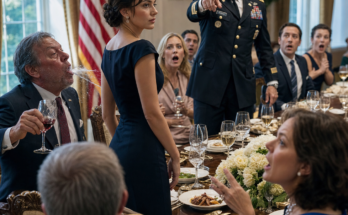
Through the tall dining room windows, I could see them gathered around a long table. Councilman Victor Voss sat at the head, silver hair perfect, smile polished. Police Chief Darden leaned back with a wine glass in one hand. Judge Wexler, thin and hawk-faced, spoke with his fork raised. Marjorie Ellis from the school board dabbed her lips with a cloth napkin.
Hunter wasn’t there.
That bothered me.
I rang the front bell.
A housekeeper opened the door and blinked at the rain dripping from my jacket.
“Can I help you?”
“I’m here to see Councilman Voss.”
“Do you have an appointment?”
“No.”
Behind her, voices continued in the dining room. Laughter. Glasses. Silverware.
“I’m sorry, sir, but—”
Voss appeared in the foyer before she finished. He was broader than he looked on campaign posters, with the confident belly of a man who had never missed a meal or a chance to be photographed giving one away.
His eyes recognized me instantly.
The smile stayed.
“Mr. Reed,” he said. “This is private property.”
“My son’s hospital room was private too. Your people still found their way inside his life.”
The housekeeper looked between us.
Voss’s voice softened into public-performance mode. “I understand you’re grieving. But this is not appropriate.”
“No,” I said. “Framing my son isn’t appropriate.”
Something flickered behind his eyes.
Small, but there.
He turned to the housekeeper. “Marta, give us a moment.”
She disappeared down the hall.
Voss stepped closer. He smelled like scotch and cedar soap.
“You’re emotional,” he said quietly.
“You’re repetitive.”
His smile faded. “Let me explain something. Oak Haven is a delicate machine. Men like me keep it running. Men like you break things because you mistake force for justice.”
“I’ve known men like you in a dozen countries,” I said. “Different flags. Same rot.”
He sighed as if disappointed in a child. “Your son got into a fight. My son made a mistake. Boys do foolish things.”
“My son’s lung collapsed.”
“And yet he lives.” Voss tilted his head. “Be grateful. A lawsuit could be arranged. Medical bills handled. Perhaps Mason transfers schools, starts fresh. Quietly.”
There it was. The velvet glove.
“What about Hunter?”
“Hunter will receive guidance.”
“From whom? The men at your table?”
His eyes hardened.
I looked past him toward the dining room. The laughter had stopped. Chief Darden was standing now, one hand near his belt even though he was out of uniform.
Voss followed my gaze. “You are outnumbered.”
“No,” I said. “I’m early.”
The front gate buzzed in the distance.
Then again.
Voss frowned.
His phone began to vibrate.
Then Darden’s.
Then Wexler’s.
Then Ellis’s.
One by one, the powerful people of Oak Haven looked down at their screens and watched their evening change.
Victor Reyes had sent the first packet.
Not to the internet. Not yet.
To them.