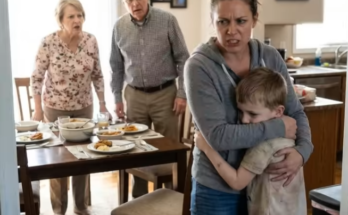
They refused to feed my son for 2 days. “He’s not our family,” my mother said. “Why waste food on him?” I found my child starving on the floor, and after that, I took back every single thing they thought they could keep.
I knew something was wrong the second my son stopped running to me.
He was usually all motion when I came back from work, shoes slapping against the hallway, little arms already reaching before I got my bag off my shoulder. That evening, the house was quiet. Too quiet. My parents were in the kitchen eating stew like nothing in the world had shifted, my mother talking about grocery prices and church gossip while my father chewed slowly and watched television over her shoulder. I asked where my son was, and my mother gave the kind of shrug people use when they are trying to make cruelty sound ordinary.
“In the den,” she said. “He’s sulking again.”
I found him on the floor behind the old armchair, curled into himself with his knees tucked up, too tired even to stand properly when he saw me. His face looked drained. His lips were dry. When I touched his hair, he leaned into my hand with that weak, automatic trust children have before they understand how badly adults can fail them. Then he whispered the sentence that turned my stomach cold.
“I was trying not to be hungry.”
I carried him straight to the kitchen.
My mother actually looked annoyed when I set him down in a chair and opened the fridge. Empty shelf where the leftovers had been. Soup pot scraped nearly clean. No plate saved. No sandwich made. Nothing. When I asked when he had last eaten, my father muttered, “He had crackers yesterday.” My mother corrected him without even looking ashamed. “Two days ago, maybe. He’s just visiting. He’s not our responsibility every second.”
I stared at her.
She kept going because people like that always do once they think their logic sounds practical. “He’s just a visitor,” she said. “Not our family the way you think. Food costs money. It’s wasteful to feed a child who’ll be gone in a few days.”
My son was sitting right there.
He wasn’t crying. That made it worse. He just looked at the table like he had already learned silence was safer than asking again.
I heated whatever I could find, fed him in small bites because he was eating too fast, and said almost nothing while my mother defended herself and my father avoided my eyes. Inside, something had already locked into place. Not rage. Rage is noisy. This was cleaner.
They had let my son go hungry for 2 days under their roof and called it reasonable.
By the time he fell asleep against my shoulder that night, I knew one thing with absolute certainty.
I was done leaving anything I loved in their hands.
The next morning, I took my son to the pediatrician before I took him anywhere else.
I wanted a record. That was the first thing people like my parents never expect. They expect tears, shouting, dramatic exits, maybe a family argument they can retell later with themselves as the victims. What they do not expect is paperwork. Notes. Dates. Weight checks. Clinical language. The doctor documented dehydration, lethargy, and a pattern consistent with food deprivation severe enough to require immediate monitoring. She asked quiet questions in front of a nurse. I answered every one of them calmly.
Then I called my lawyer.
My parents had spent years tying me to them with convenience dressed up as generosity. The house I was staying in after my divorce? Still in a family trust my father controlled. The small rental property my mother bragged about? Purchased years earlier using money my grandmother intended for all the grandchildren, including me. The joint business account they once pressured me to sign onto “for tax flexibility”? I had access to records they had clearly forgotten about. They thought keeping me close made me dependent. What it really did was leave a paper trail.
I spent that afternoon gathering everything.
Trust documents. Transfer records. Old emails. Bank statements. Probate letters. My grandmother’s handwritten note attached to a distribution memo that specifically mentioned equal support for descendants, a phrase my father had quietly routed around through a “temporary management structure” that somehow became permanent the minute he could control it. My lawyer read in silence for twenty minutes, then looked up and said, “They made this easier than they should have.”
My mother started calling by evening. First offended, then emotional, then righteous. She said I was overreacting. She said children exaggerate. She said she “never meant literally not feed him,” as if language could soften an empty stomach. My father left one voicemail, low and stern, warning me not to create legal problems “over family misunderstandings.” That line almost made me smile. Men only call it a misunderstanding when the facts are impossible to survive.
I did not argue with them. I filed.
Emergency custody protections regarding contact. Civil action tied to misused trust distributions. A petition to freeze disposition of certain family-held assets pending review. My lawyer moved fast because the child welfare documentation changed the temperature of everything. What had once looked like private family cruelty now sat next to medical records and financial irregularities. Judges do not enjoy either. Together, they become very hard to explain away.
By the end of the week, my parents were no longer speaking like people in control. They were speaking like people suddenly discovering that a child they dismissed as ungrateful had grown into an adult who understood process better than guilt.
They thought starving my son would remind me who had power in that house.
What they actually did was hand me the cleanest reason I had ever been given to take theirs apart piece by piece.
The hearing lasted less than an hour.
That was the humiliating part for them. Not drama. Not shouting. Just the speed. My mother arrived dressed like sympathy itself, soft colors, trembling voice, tissues already in hand. My father came in wearing the same expression he used at church fundraisers, the one meant to suggest steady moral disappointment. They expected a messy family dispute. Instead, they got a judge with a file tabbed in three colors and very little patience for adults who let a child go hungry under their roof.
My son’s doctor’s notes went in first. Then the timeline. Then the messages. My mother’s own words read back in plain language looked uglier than she imagined they would. “He’s just a visitor.” “Not our family.” “Waste of food.” There is something brutal about hearing your private cruelty repeated in a courtroom where no one is invested in protecting your image.
Then my lawyer moved to the money.
The trust structure my father had manipulated. The rental income diverted through accounts he controlled. The family property expenditures that somehow benefited everyone except the daughter he kept pressuring into gratitude. He tried to interrupt twice. The judge cut him off both times. My mother cried. Real tears, I think. But they were late tears, the kind people find only after consequences arrive.
Protective orders were entered. Contact was restricted. The trust issue was set for deeper review with interim controls that immediately blocked them from moving certain assets around the way they had for years. The rental property income was frozen pending accounting. The house they loved using as leverage over me was no longer a comfortable weapon. For the first time in my life, they had to ask permission where they used to simply assume obedience.
Outside the courthouse, my mother finally said the thing she should have said on day one. “We made a mistake.”
I looked at her and understood that she still did not get it. A mistake is forgetting juice at the store. A mistake is burning dinner. Letting a child go hungry for 2 days and calling him waste is not a mistake. It is a revelation. It tells everyone exactly who you are when kindness costs something.
My father tried one last time. “You’re tearing this family apart.”
“No,” I said. “I’m ending the part where you thought my son could be punished for not belonging to you.”
Then I got in the car, buckled my son into the backseat, and drove toward the apartment I had leased that morning with money they could no longer touch. Small place. Clean light. Safe kitchen. Enough groceries for weeks.
My parents loved control. They loved the house, the accounts, the story where I always came back because I had nowhere else to go. I took all of it from them the only way that mattered. Not by smashing things. Not by screaming. By removing access, freezing leverage, and making sure the law saw them exactly as they were.
They left my son hungry on the floor because they thought he was powerless.
What they lost after that was every illusion that they still were not.