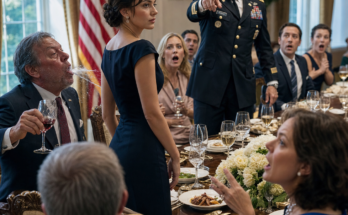
Not the soft garden kind, but the expensive funeral-home kind—thick, sweet, and almost rotten under the heat of two hundred bodies, crystal chandeliers, and too many glasses of champagne. They were arranged in tall glass cylinders on every table in the Lake Tahoe ballroom, white petals floating above us like little flags of surrender.
My sister Vanessa had chosen them, of course.
Vanessa never picked anything because she liked it. She picked things because they photographed well.
I sat near the back, at a table with a retired dentist from Sacramento, two of my father’s business partners, and a woman who kept asking the waiter whether the salmon was wild-caught. My charcoal dress was simple, floor-length, and forgettable. That was intentional. I had spent years learning how to make myself small around my family, and tonight I treated the wedding like a field operation: keep my head down, avoid unnecessary contact, leave once the cake was cut.
My father, Douglas Bennett, was at the center of the room.
He moved through the reception like he owned not just the ballroom, but the mountain it sat on. Silver hair combed back, black tux fitted over his broad shoulders, one hand always holding a glass of something amber. He laughed too loudly. He slapped backs too hard. He introduced Vanessa to guests who already knew her, just so he could say the words “Stanford Law” one more time.
“She’s the sharpest mind in San Francisco,” I heard him say near the bar. “Youngest partner track her firm has seen in years. That’s Bennett blood.”
Vanessa tilted her head and smiled like she was embarrassed, but I saw the small satisfied crease at the corner of her mouth. She liked being worshipped. She had been raised on it.
Then my father’s eyes found me.
It was quick, just a glance over the rim of his glass, but my shoulders tightened before I could stop them. Some people hear an old song and remember summer. I saw my father’s expression and remembered every dinner table where my name had been turned into a joke.
Rachel, still figuring things out.
Rachel, not exactly ambitious.
Rachel, poor thing, she never had Vanessa’s drive.
A waiter passed with a silver tray of champagne, and I took a flute mostly to give my hands something to do. The glass was cold and damp against my fingers. Outside the tall windows, Lake Tahoe was black and still, reflecting the resort lights in broken gold lines. Snow clung to the pines on the far slope, faintly blue under the moon.
I told myself to breathe.
Vanessa’s new husband, Mark Whitaker, seemed decent enough. Polite. Nervous. He had the clean-cut posture of a man who grew up being told to stand straight. His family had military roots so deep they probably measured time in campaigns instead of years. His father, General Harold Whitaker, sat at the head table in a dark dress uniform covered with ribbons that caught the chandelier light.
I had noticed him earlier.
Or more accurately, he had noticed me.
During cocktail hour, while Vanessa floated between guests in her lace gown, General Whitaker had looked across the room at me twice. Not in a creepy way. Not even curious, exactly. More like he was trying to match my face to a memory he couldn’t quite place.
I turned away both times.
I had become good at avoiding recognition.
“Rachel.”
Vanessa’s voice slid over my shoulder, smooth as the satin sash around her waist. She stood behind me holding a glass of sparkling water, her diamond earrings glittering every time she moved.
“You came,” she said.
“I said I would.”
“I know. I just wasn’t sure.” Her smile stayed gentle, but her eyes traveled over my dress, my hair, my bare wrists. “You look nice. Simple.”
There it was. The tiny knife wrapped in tissue paper.
“You look expensive,” I said.
Her smile twitched.
Before she could answer, our father appeared beside her. The smell of bourbon reached me before his hand landed on Vanessa’s shoulder.
“My girls,” he announced, though he was looking only at her. “One bride, one mystery.”
The retired dentist at my table chuckled.
I kept my face still.
Dad leaned toward the others as if sharing a family secret. “Rachel works in logistics. Government work, I think. She’s always been vague about it.”
“Supply stuff?” one of his partners asked.
“Something like that.” Dad laughed. “Moving boxes from one place to another. Not glamorous, but honest work.”
My fingers tightened around the champagne flute. The glass gave a faint squeak under my grip.
Vanessa gave me a pitying look, the kind she had practiced since middle school. “Rachel likes privacy.”
“No,” my father said, loud enough for the nearby tables to hear. “Rachel likes low expectations.”
A few people laughed.
Not many. Just enough.
The lilies smelled stronger.
I looked past my father, past Vanessa’s veil, past the gold-rimmed plates and polished silverware, and saw General Whitaker watching us from the head table. His brow had drawn down. His hand rested beside his water glass, perfectly still.
For one second, something passed across his face.
Recognition.
Then my father lifted his champagne and smiled at the room like he had just delivered a harmless joke.
I felt the old humiliation rise in my throat, hot and bitter, but beneath it was something else. Something colder. Something that had waited a long time.
Because General Whitaker had not just recognized my face.
He had remembered where he had seen it.
And I knew, before he stood up, that the lie my family had lived inside for thirteen years was about to crack wide open.
I did not grow up in a house where people asked questions.
We had a long cedar dining table in Helena, Montana, polished every Sunday until it smelled like lemon oil and discipline. My father sat at one end, my mother at the other, Vanessa on his right, me somewhere down the side depending on how many relatives were visiting. The table was always full of heavy food—pot roast, potatoes, green beans cooked until they surrendered—but the air stayed hungry.
Hungry for praise.
Hungry for approval.
Hungry for the next person to bleed.
My father ran Bennett Construction, a mid-sized company with glossy brochures and a reputation he guarded like a bank vault. In Helena, men like Douglas Bennett mattered. They sponsored charity auctions, shook hands with mayors, sat on boards, and acted like every sidewalk they poured was a monument.
He believed children were part of that monument.
Vanessa understood this before she lost her baby teeth. She brought home perfect grades, smiled at donors, learned which adults liked firm handshakes and which liked compliments about their summer homes. She was sharp, bright, and mean in a way adults mistook for confidence.
I was quieter.
I liked hiking the dry hills behind our house, where the wind smelled like sage and sun-baked dirt. I liked maps. I liked figuring out how one trail connected to another, how weather moved over ridgelines, how long water lasted if you drank in small, measured swallows. My father called it wandering.
At fifteen, I won a state orienteering competition. I came home with sunburned cheeks, muddy socks, and a cheap medal on a blue ribbon.
Dad looked up from his newspaper and said, “That’s nice, Rachel. Vanessa got invited to a leadership program.”
The medal went into my dresser drawer.
At sixteen, I rebuilt the carburetor on our old snowblower because I wanted to understand why it kept flooding. Dad told his friends I was “good with little mechanical chores,” like I was a ranch hand he had accidentally fathered.
At seventeen, when a spring storm washed out a trail during a school camping trip, I was the one who got six students and one panicked teacher down the safer ridge route before dark. The principal called our house.
My father listened, thanked him, hung up, and said, “Try not to make a habit of being dramatic.”
Vanessa had been studying for mock trial at the kitchen island. She did not even look up.
My mother, Elaine, was not cruel in the obvious way. She did not shout. She did not insult. She simply disappeared from every moment that required courage. When Dad mocked me, she rearranged napkins. When Vanessa copied his tone, Mom cleared plates. Her silence was soft, but it cut deeper than noise.
By the time I was nineteen, I had learned the rules.
Do not correct the story.
Do not ask for fairness.
Do not expect rescue from people who benefit from your drowning.
The night I left, it was snowing hard enough that the porch light looked wrapped in gauze. Dinner had gone badly from the first sip of my father’s bourbon. Vanessa had just received another scholarship offer, and Dad spent forty minutes describing her future like he had personally drafted it.
Then an uncle asked me, “So, Rachel, what’s your plan?”
I opened my mouth.
Dad answered for me.
“Rachel doesn’t do plans. She drifts.”
The table laughed, not because it was funny, but because he expected laughter and people like my father trained rooms to obey.
“I’ve been thinking about the Army,” I said.
That stopped the forks.
My father slowly turned his head. “The Army?”
“Yes.”
“For what? You think they need someone to take long walks and avoid conversation?”
Vanessa made a small choking sound into her napkin.
My face burned, but I kept going. “Logistics. Supply. Movement coordination.”
Dad leaned back. His chair creaked. “You have no value in this family, Rachel. Do you understand that? None. Vanessa builds things. I build things. Your mother keeps this home respected. You take up space and call it a personality.”
The room went quiet.
My mother stared at her wineglass.
Outside, wind pushed snow against the windows with a dry, needling hiss.
I waited for someone to say my name with kindness.
No one did.
So I stood, walked upstairs, and packed one duffel bag. Three pairs of jeans. Two sweaters. A toothbrush. The orienteering medal I had pretended not to care about. I left my phone on the bed because my father paid for it, and I did not want anything with his name attached to mine.
At the front door, my mother appeared in the hallway. Her robe was pale blue, her hair loose around her face.
“Rachel,” she whispered.
I stopped.
For one wild second, I thought she might tell me to stay. Or that she was sorry. Or that she had seen me all along.
Instead she said, “Don’t make your father angrier.”
That was the last thing she gave me before I walked out.
Two days later, I stood in a recruitment office that smelled like burnt coffee, floor wax, and old paper. A sergeant with tired eyes asked if I was sure.
I looked at the flag in the corner. I looked at the maps on the wall. I looked at the door behind me and imagined Helena shrinking until it was just a dot in the snow.
“Yes,” I said. “I’m sure.”
What I did not know then was that the Army would not just give me a career.
It would give me proof.
And one day, that proof would walk into my sister’s wedding wearing three stars on his shoulder.
Basic training did not care that my father had called me useless.
That was the first thing I loved about it.
The drill sergeants yelled at everyone equally. They did not know Vanessa’s LSAT score. They did not know my father’s net worth, or the way his voice could turn a dinner table into a courtroom. They knew whether my boots were tied. Whether my bunk was tight enough to bounce a quarter. Whether I could run until my lungs tasted like pennies and still keep moving.
The first morning, before sunrise, the barracks smelled like sweat, detergent, fear, and cheap soap. Someone was crying in the latrine. Someone else had lost a sock and was whispering prayers like God handled laundry. I stood in formation with my hair scraped tight under my cap and my heart hammering so hard I thought the woman beside me could hear it.
Then a drill sergeant stopped in front of me.
“You lost, Bennett?”
“No, Drill Sergeant.”
“You sure? You look like a deer trying to file taxes.”
A laugh broke down the line.
My old self wanted to shrink.
Instead I stared at the wall behind him and said, “Yes, Drill Sergeant.”
He leaned closer. His breath smelled like coffee and wintergreen. “Then prove it.”
So I did.
Not all at once. Not dramatically. There was no movie montage with swelling music. There were blisters that split open inside my boots. There were nights when my arms shook too badly to lift a spoon. There were obstacle courses where mud got in my teeth and stayed there until evening chow. There were letters I wrote to my mother and never mailed.
But there was also something clean about it.
A task. A standard. A consequence.
If I failed, I knew why. If I improved, no one could erase it by laughing.
I discovered I was good at systems. Not just maps, but movement. Timing. Weight. Fuel. Weather. Human limits. The hidden math behind survival.
A truck was not just a truck. It was capacity, range, maintenance, driver fatigue, road condition, threat level, temperature, terrain. A meal was not just food. It was calories, morale, transport, shelf life, heat source, timing. A convoy was not just vehicles in a line. It was a living thing with bones and blood and weak points.
Logistics made sense to me in a way family never had.
By twenty-four, I had deployed overseas.
The desert was nothing like Montana. It smelled of hot metal, diesel, sand, and the sharp chemical bite of sun-baked plastic. The horizon shimmered until it looked fake. At night, the cold came fast, and generators hummed under a sky so full of stars it felt crowded.
I learned quickly that being quiet could be useful. Men who loved their own voices missed details. I heard them.
A mechanic cursing under his breath near a fuel bladder.
A radio operator repeating coordinates with one number off.
A young private laughing too loudly because he was scared.
I listened, adjusted, planned, and moved supplies through places where maps were suggestions and mistakes became folded flags.
My first real commendation came after a route changed at the last minute because of bad intelligence. We had medical supplies headed to a forward clinic, but the main road had become a trap. Higher command hesitated. The weather was turning. The clinic was low on blood products, and twenty-seven people were waiting on decisions made by men who were not bleeding.
I rerouted the convoy through an old agricultural track I had found in local survey data, split the load into lighter vehicles, staggered departure times, and used a maintenance team as a decoy repair stop without putting them in direct danger. We delivered with nineteen minutes to spare.
My commanding officer told me later, “Bennett, you have ice water in your veins.”
I almost laughed.
It was not ice water.
It was years of being insulted at dinner and learning not to flinch.
My family knew none of this.
When I called home from overseas, the conversations were brief and strange, full of delays and satellite echoes.
“Still doing supply work?” Dad asked once.
“Yes.”
“Moving boxes in the desert. Well, somebody has to.”
In the background, I heard Vanessa say, “Ask her if she gets combat pay for stapling forms.”
They both laughed.
I looked down at my hands. They were cracked from heat, dry air, and loading straps. The nails were short. A healing burn crossed one knuckle from a stove in a field kitchen where I had helped after a mortar alarm.
“Something like that,” I said.
I could have told him about the clinic.
I could have told him about the colonel who requested me by name.
I could have told him about the twenty-seven people who lived because someone had known how to read bad roads.
But he had not called to know me. He had called to confirm his version of me still existed.
So I let him.
Years passed like that. Rank by rank. Assignment by assignment. I became Captain Bennett, then Major Bennett. I learned to brief rooms full of men who underestimated me and watched their faces change when my plan worked. I learned that authority did not always need volume. Sometimes it was a quiet sentence spoken at the right second.
By thirty-two, I was Lieutenant Colonel Rachel Bennett with a security clearance, a staff, and responsibility that would have made my father’s construction schedules look like refrigerator magnets.
Still, at home, I remained “Rachel, who never found her footing.”
The strange thing was, I started to see the advantage.
People showed you who they were when they thought you had no power.
My father showed me every time.
And when Vanessa’s wedding invitation arrived on thick cream paper with gold lettering, I turned it over in my hand and felt a warning move through me.
Not fear.
Recognition.
Because the name Whitaker was printed beneath hers, and I knew that name from a place where snow had screamed sideways across a mountain pass and men had nearly died.
The invitation sat on my kitchen counter for nine days.
I lived then in a small apartment near Rock Island Arsenal, in Illinois, where the Mississippi River moved slow and gray beyond the winter trees. My place was plain by Bennett standards. One bedroom. Secondhand couch. Boots lined neatly by the door. A coffee maker that sounded like it was trying to clear its throat every morning.
I liked it.
Nothing in that apartment existed to impress anyone.
On the tenth day, I opened the invitation again. Vanessa’s name curved across the paper in raised gold script. Mark Whitaker’s name rested beneath it, elegant and heavy. The venue was an exclusive Lake Tahoe resort I recognized from travel magazines in airport lounges.
At the bottom, in smaller print, was his parents’ names.
Lieutenant General Harold Whitaker, U.S. Army, Retired, and Mrs. Anne Whitaker.
My thumb stopped on the paper.
Whitaker.
There are names you forget because nothing attached to them matters. And then there are names that carry the weight of a radio call in a storm.
Two years before that invitation, I had been temporarily assigned to support Exercise Mountain Peak, a large winter readiness operation in the Colorado Rockies. It was supposed to be controlled chaos: cold-weather movement, supply testing, vehicle recovery, command coordination. Difficult, but managed.
Then the weather turned mean.
Not inconvenient. Mean.
The storm came down like it had a personal grudge. Visibility dropped to nothing. Snow hit the command tent in hard, dry bursts that sounded like handfuls of gravel. The generators coughed. Radios cracked in and out. A convoy carrying critical equipment and thirty-six soldiers got trapped near a mountain pass where the road narrowed between a steep drop and a wall of rock.
The official reports later used clean phrases.
Severe weather event.
Communications degradation.
Potential loss of life.
That was not how it felt.
It felt like standing in a tent full of maps while the mountain quietly decided who it wanted to keep.
General Whitaker had been there, still active then. I remembered him as controlled, focused, not easily rattled. But that night, even his staff had begun to fracture. Different teams argued over routes. One map showed a service road that no longer existed. Another system had outdated bridge load limits. The recovery vehicles were too heavy for one approach, too slow for another.
People kept saying what could not be done.
I got tired of hearing it.
I had spent the afternoon reviewing fuel reports and terrain overlays because that was what I did when I was nervous. Details calmed me. Data gave shape to fear. I had noticed a maintenance trail near an old ranger station, mostly dismissed because it was narrow and partially snow-covered. But snow cover was different from structural failure. Narrow was different from impassable. And the wind direction meant the leeward side might have less accumulation than predicted.
I stepped forward with my notebook.
A colonel snapped, “Not now, Major.”
I was a lieutenant colonel select at that point but still wearing major rank. I remember wiping snowmelt from my eyebrow and saying, “Sir, in seventeen minutes we lose the window for a safe thermal drop. In forty, the convoy’s fuel situation gets dangerous. In ninety, this is no longer a recovery operation.”
The tent went quiet.
General Whitaker turned toward me.
“What do you have?”
Not who are you.
Not why are you interrupting.
What do you have?
That question changed my life more than any praise my father never gave me.
I laid out the plan. Light recovery vehicles only. Split teams. Thermal blankets and heat packs dropped first by coordinates adjusted for wind shear. Fuel conservation instructions relayed through a patched civilian repeater near the ranger station. Snowcat support staged at the lower grade. Medical team held back until the road surface was confirmed. No heroic charge. No blind gamble. Just a sequence tight enough that one wrong assumption could kill people.
General Whitaker listened.
Then he said, “Execute.”
For eighteen hours, the storm tried to beat us.
For eighteen hours, we refused to let it.
When the last soldier was pulled clear, his face gray with cold and his lashes crusted white, he gripped my sleeve with a shaking hand and said, “Ma’am, I thought we were gone.”
I remember the smell of diesel, wet wool, and blood from someone’s split lip. I remember hot coffee burning my tongue because I had forgotten to let it cool. I remember General Whitaker standing beside me at dawn, his uniform stiff with frozen snow.
“You saved my convoy,” he said.
“No, sir,” I replied. “The team did.”
He looked at me for a long second. “Good answer. Wrong answer.”
Then life moved on.
Reports were filed. Commendations processed. People rotated out. The mountain became a story told in controlled language.
I never imagined that story would sit at my sister’s wedding table wearing a dress uniform.
I almost declined the invitation.
Not because of General Whitaker. Because of my father.
I knew exactly what the wedding would become. Vanessa’s triumph. Douglas’s theater. My mother’s silence. My assigned role in the corner as the family cautionary tale.
But there was a part of me, small and stubborn, that wanted to go.
Not to prove anything.
To witness the final performance with clear eyes.
So I RSVP’d yes, booked a flight, packed my charcoal dress, and left my uniform hanging in the closet.
At the airport, while snow delayed boarding and children cried near the gate, my phone buzzed with a text from Vanessa.
Please don’t make things awkward with Dad. It’s my day.
I stared at those words until the screen dimmed.
Then another message came in from an unfamiliar number.
This is Anne Whitaker. Mark’s mother. We’re so pleased you’re coming, Rachel. Harold says your name sounds familiar. Have you two met?
My stomach tightened.
I typed three different replies and deleted all of them.
Finally I wrote, I believe we crossed paths professionally once.
A minute later, three dots appeared.
Then vanished.
No reply came.
And as my flight was called, I had the distinct feeling that someone in the Whitaker family had just started asking questions my father would not survive.
Lake Tahoe looked too beautiful for the kind of ugliness my family carried into it.
The resort sat against the mountains like a rich man’s apology to nature—stone walls, enormous windows, fire pits glowing on the terrace, valet attendants in black coats moving through the cold with practiced smiles. Snow clung to the pines, and the lake beyond them was a dark sheet of glass. The air smelled of woodsmoke, expensive perfume, and that clean mineral bite snow gives off before it hardens overnight.
I arrived alone.
That bothered my father immediately.
He found me in the lobby beneath a chandelier shaped like falling ice. His eyes swept over my small suitcase, then my bare left hand, then my dress bag.
“No date?” he asked.
“No.”
“That tracks.”
There it was. Not hello. Not good to see you. Just a quick jab to check whether the old wound still opened.
I gave him a calm smile. “Nice to see you too.”
His mouth tightened. He did not like sarcasm from me. Vanessa could cut a man in half with one sentence and he would call it brilliance. If I returned a pinprick, I was disrespectful.
“You’ll be seated with some family friends,” he said. “Try to mingle. These are important people.”
“I know how to behave in public.”
He laughed. “Do you?”
Behind him, my mother stood holding a garment bag, her pearl earrings trembling slightly as she adjusted them. She looked older than I remembered. Softer around the jaw. Tired in a way makeup could not cover. For one second her eyes met mine, and I saw something like regret.
Then Dad turned, and she looked away.
Of course.
Vanessa appeared at the top of the stairs wearing a silk robe with Bride embroidered across the back in gold thread. Her hair was already pinned, her face half-done, one eye smoky and dramatic while the other was bare. Even unfinished, she knew how to command a room.
“Rachel,” she called, descending carefully. “You made it.”
The photographer followed her like a trained bird.
Vanessa hugged me lightly, avoiding real contact to protect her makeup. She smelled like vanilla, hairspray, and nerves.
“You look tired,” she whispered near my ear.
“You look symmetrical,” I whispered back.
She pulled away, blinking.
For a second, I saw the old Vanessa beneath the bridal polish—the girl who used to steal my sweatshirts and then cry when I asked for them back. Then the smile returned.
“Dad,” she said, “don’t start.”
“I’m not starting anything,” he replied. “I’m simply hoping your sister remembers this is your wedding, not one of her little disappearing acts.”
I looked at him. “I came to support Vanessa.”
That was true, mostly. There had been a time when I loved my sister. Maybe some buried, stubborn piece of me still did. But love, I had learned, did not cancel evidence. Vanessa had watched me be humiliated for years and often sharpened the knife herself.
Still, weddings make people sentimental in ways they later regret.
For half the day, I almost believed we might all survive it.
The ceremony took place in a glass-walled room overlooking the lake. Mark cried when Vanessa walked down the aisle, which surprised me. Not delicate tears, either. Real ones. His mouth trembled. His hands shook. Vanessa saw it and softened in a way I had rarely seen.
Maybe, I thought, she was capable of being loved into something kinder.
Then my father leaned toward the man beside him and whispered, loud enough for me to hear, “She chose well. Whitaker name opens doors money can’t.”
The thought died.
At the reception, every detail was polished to a shine. Gold-rimmed plates. White roses tucked into napkins. A string quartet near the fireplace. Servers gliding between tables with trays of short ribs and tiny crab cakes. The guests were a careful blend of San Francisco law firm power, Montana business respectability, and military formality.
I knew how badly my father wanted in.
His construction empire made him important in Helena. But the Whitakers were a different altitude. Generals. Admirals. Defense advisors. People who had worn responsibility instead of buying it. Dad wanted their respect like a starving man wants bread.
So he performed.
He told stories about Vanessa negotiating against senior partners.
He bragged about the Bennett work ethic.
He called Mark “son” three times before dessert.
And whenever someone asked about me, he smiled that old smile.
“Rachel is our free spirit,” he told a woman in emerald silk.
I watched the woman glance at me with polite pity.
“She works logistics,” he added. “Government side. Paperwork, I imagine. But she’s happy enough.”
The woman said, “That’s nice,” in the tone people use for children’s drawings.
I could have corrected him.
Instead I looked across the room.
General Whitaker was watching again.
This time, his wife Anne leaned close and said something to him. He frowned, not at her, but at me. Then he glanced down at his phone under the table, thumb moving once across the screen.
My pulse stayed steady, but my awareness sharpened.
Someone had checked something.
Someone had found something.
At my table, the retired dentist asked, “So what kind of logistics do you do, dear?”
I opened my mouth.
My father appeared behind my chair as if summoned by the chance to interrupt.
“Rachel moves things around,” he said. “Don’t let her make it sound classified.”
The table laughed.
I looked down at my champagne and saw the chandelier reflected in the bubbles, broken into tiny pieces.
Then the DJ tapped the microphone and announced speeches.
My father straightened his tuxedo jacket.
Vanessa shot him a warning look.
He ignored it.
And as he walked toward the podium with that loose, confident stride I knew too well, I felt the room tilt toward a disaster only I seemed able to hear coming.
My father had not been scheduled to give a second toast.
He had already spoken once during dinner, a polished speech about Vanessa’s childhood ambition and Mark’s excellent judgment. It had been smug, but survivable. He had called himself “a proud father” four times and managed not to mention me at all, which I considered a small mercy.
But after dessert, someone put scotch in his hand.
Then another.
I watched the change happen the way I used to watch storms build over Montana hills. First, the cheeks flushed. Then the laugh got wider. Then the hand gestures grew bigger, slicing the air like he was conducting an orchestra no one else could hear.
By the time the band took a break, Douglas Bennett had decided the room belonged to him again.
He rose from his table and walked toward the microphone.
Vanessa saw him and went pale beneath her bridal makeup.
“Dad,” she mouthed.
He winked at her.
That wink had ruined entire evenings of my childhood.
The speakers gave a sharp squeal when he grabbed the microphone. Several guests flinched. My father laughed.
“Sorry, sorry,” he said. “Construction man, not a sound engineer.”
Polite chuckles.
He looked satisfied.
“I know I already said my piece,” he continued, “but a night like this deserves a little more truth.”
My stomach tightened.
Truth was never truth when my father said it. It was usually punishment with better lighting.
He began with Vanessa. Of course he did. He described her first debate trophy, her Stanford acceptance, the way she once corrected a judge during a mock trial at sixteen. The room laughed warmly. Vanessa lowered her eyes with practiced humility, but her fingers twisted around her bouquet.
Then Dad shifted.
His gaze drifted toward the back of the room.
Toward me.
“And of course,” he said, his voice dipping into mock affection, “every family has contrast.”
The laughter started before the joke did. The room sensed where he was going and followed like dogs hearing a can opener.
I set my champagne down.
Beside me, the retired dentist stared at his cake.
My father pointed at me with the microphone hand. “This is Rachel, my other daughter.”
A few heads turned.
I did not move.
“Rachel has always marched to her own drum,” he said. “Although I use the word marched loosely.”
More laughter.
The military guests did not laugh. I noticed that. General Whitaker sat perfectly still, one hand flat on the table. His wife had stopped smiling.
My father continued, encouraged by the civilian side of the room. “Vanessa was organizing study groups and building a future. Rachel was out in the woods somewhere, probably arguing with a compass.”
A man near the bar laughed too loudly.
I focused on the details to keep my face calm.
Fork resting at four o’clock on the plate.
Water glass half full.
Lily petal fallen onto the tablecloth.
Exit doors twelve steps behind me, then left.
Old habits.
Dad leaned closer to the microphone. “Now, don’t misunderstand me. We love Rachel. Every family needs one person who reminds the rest of us what happens when potential goes unused.”
The first emotional turn came there.
Not anger.
Embarrassment for him.
It hit me suddenly that my father had no idea how ugly he looked. He thought he was charming. He thought the room admired his honesty. He could not feel the discomfort spreading among the Whitakers, the way military spines straightened, the way Mark’s smile vanished.
Vanessa whispered, “Dad, stop.”
He didn’t.
“In fact,” he said, “I sometimes call Rachel my little lost shipment. Always in transit, never delivered.”
That one got a stronger laugh from his business friends.
My father loved that.
He turned it into momentum.
“She works in logistics now, which I suppose is fitting. If you can’t become important, you can at least move important things for important people.”
My hand went still on my lap.
There are insults that bruise because they are new, and insults that bruise because they are old. This one landed in the same place he had been striking since I was fifteen.
The useless daughter.
The background noise.
The mistake.
He lifted his glass.
“So let’s raise a toast,” he said. “To Vanessa, who knew exactly where she was going, and to Rachel—”
He paused.
The room waited.
I knew he felt powerful.
“—my useless daughter, who never quite figured out what to do with her life.”
The laughter came in a wave.
Not everyone. But enough.
It washed over me, warm and dirty. I heard a woman whisper, “Oh my God.” I heard someone else say, “That’s harsh,” and then laugh anyway. I heard my mother’s tiny gasp, followed by nothing.
Always nothing.
I looked at Vanessa.
She was staring at the floor.
Not defending me.
Not stopping him.
Just waiting for the moment to pass so her perfect wedding could continue.
That was when the second emotional turn came.
The last thread snapped.
Not loudly. Not dramatically.
Inside me, something simply set down its burden.
I no longer wanted my father to understand. I no longer wanted my mother to speak. I no longer wanted Vanessa to choose differently.
I was done.
The scrape of a chair cut through the laughter.
It was so sharp, so sudden, that the room went silent in pieces. First the head table. Then the middle tables. Then the bar.
General Harold Whitaker had stood.
Not slowly.
He rose like a man responding to incoming fire.
His eyes were fixed on me.
My father blinked, confused. “Harold?”
The general ignored him.
He took one step away from the head table. Then another. His dress shoes struck the polished floor with clean, measured sounds.
My pulse did not jump.
But every sense in me went bright.
The general stopped in the center of the ballroom, studying my face as if snow and darkness were clearing from it.
Then he said, very quietly, “Wait.”
One word.
One command.
No one breathed.
His gaze did not leave mine.
“You’re Bennett,” he said. “Colorado.”
And in that instant, my father’s smile began to die.
There are different kinds of silence.
There is church silence, soft and reverent.
There is hospital silence, tense and waiting.
Then there is the silence of a room realizing it has laughed at the wrong person.
That silence filled the ballroom so completely I could hear the faint crackle of the fireplace near the terrace doors.
General Whitaker stood beneath the chandeliers, shoulders squared, his medals catching flecks of gold light. His face had changed. During the ceremony he had been a proud father, dignified and warm. Now he looked like the commander I remembered from a frozen operations tent where everyone’s breath had smoked in the air.
My father tried to laugh.
It came out thin.
“Harold, I was just making a family joke.”
The general did not look at him.
“Ma’am,” he said to me.
One syllable. Formal. Clear.
Several military guests turned their heads toward me so fast it was almost synchronized.
I stood because my body knew protocol before my mind caught up. My chair moved softly against the carpet. I smoothed the front of my dress once and met his eyes.
“General Whitaker,” I said. “Good evening, sir.”
His expression tightened with certainty.
“My God,” he said, not into the microphone, but the room heard anyway. “It is you.”
My father’s hand twitched around the microphone.
Vanessa looked from me to the general, her lips parted.
The general took another step closer, then stopped at a respectful distance. He did not salute. Not yet. We were in evening wear, not uniform, and he knew better than to turn a wedding reception into a parade ground without cause. But the way he held himself did the same work. It gave me recognition my own family had denied me for more than a decade.
“You were Major Bennett then,” he said. “Exercise Mountain Peak. Colorado Rockies. Winter sustainment operation.”
The words moved through the room like sparks hitting dry paper.
Major.
Exercise.
Operation.
My father stared as if the language were foreign.
“I was, sir,” I said.
General Whitaker’s eyes flicked briefly over my dress, my bare shoulders, my simple earrings. “Lieutenant Colonel now, unless my memory is failing me.”
A glass dropped somewhere near the bar.
It hit carpet, so it did not shatter. Just a dull thud and a splash of champagne.
My mother raised one hand to her mouth.
Vanessa whispered, “Lieutenant Colonel?”
My father finally found his voice. “No. No, that can’t be right.”
The general turned then.
Slowly.
The room seemed to lean away from that turn.
“Can’t be right?” he asked.
Dad swallowed. “Rachel works in logistics. She never said anything about—”
“Strategic sustainment,” the general said. “Operational movement. Theater-level coordination. And if I recall correctly, one of the finest emergency planning minds I encountered in my last years of service.”
My father’s face flushed darker. “There must be some confusion. Rachel has always been very private. She tends to exaggerate by omission.”
It was such a familiar maneuver that I almost admired the muscle memory.
Caught in a lie? Suggest I had created the misunderstanding.
But General Whitaker was not one of my father’s subcontractors. He was not a nervous cousin at Thanksgiving. He had spent forty years reading men under pressure, and Douglas Bennett was suddenly very easy to read.
“Mr. Bennett,” the general said, and the formal address landed like a demotion, “your daughter did not exaggerate anything. She has said almost nothing.”
That cut deeper than anger would have.
Dad’s eyes darted around the room, searching for allies. His business friends looked down. The lawyer table had gone very still. Mark stood beside Vanessa now, one hand on the back of her chair, his face tight with embarrassment.
General Whitaker turned toward the guests.
“I owe this room context,” he said.
I felt my jaw tighten.
I did not want a speech. Not because I was ashamed, but because some things earned in crisis do not belong under chandeliers beside wedding cake. The memory of Colorado was not a party trick. It had weight. It had faces.
The general looked back at me, asking permission without words.
That surprised me.
My father had never asked permission to make me small. This man asked before making me visible.
I gave one small nod.
He continued.
“Two years ago, during a winter training operation in Colorado, a blizzard trapped a supply convoy in a mountain pass. Conditions deteriorated faster than forecast. Communications were compromised. Fuel was running low. We had soldiers at risk of freezing to death before daylight.”
The room was motionless.
My father’s microphone hung useless at his side.
General Whitaker’s voice sharpened. “While senior officers argued over protocol, Major Bennett walked into my command tent with a plan. Not a suggestion. Not panic. A plan. She had terrain data, vehicle limitations, wind calculations, fuel projections, and a sequence of action that saved lives.”
A murmur moved through the tables.
I saw the retired dentist close his eyes briefly, ashamed.
The general kept going. “Thirty-six soldiers came home because she saw a way through when others saw only obstacles.”
Thirty-six.
There it was.
Not boxes.
Not paperwork.
People.
My mother made a sound like she had been struck. Vanessa’s face crumpled for half a second before she rebuilt it. My father looked at me, and for the first time in my life, he looked unsure of what I was.
That should have felt satisfying.
Instead it felt strangely sad.
How little he had known. How hard he had worked not to know it.
Then General Whitaker did something I did not expect.
He stepped back, brought his heels together, and saluted me.
The ballroom froze.
My breath caught.
Retired or not, three stars or not, he did not owe me that. Not here. Not in front of civilians. Not at his son’s wedding.
But he held the salute, his face solemn.
“Lieutenant Colonel Bennett,” he said, “it remains an honor.”
The room was so silent that I heard Vanessa’s bouquet slip from her fingers and hit the floor.
I returned the gesture as cleanly as I could in a charcoal dress with no uniform, no cover, no rank on my shoulders. My throat burned, but my voice stayed steady.
“Thank you, sir.”
When my hand lowered, I looked at my father.
The microphone had begun picking up his breathing.
For once, every person in the room could hear him panic.
My father had built his life on rooms believing him.
That was his talent.
He could walk into a city council meeting and make a delay sound like strategy. He could turn a construction defect into an “unexpected material behavior.” He could make cruelty sound like honesty, neglect sound like discipline, favoritism sound like high standards.
But there are rooms where reputation is not enough.
That ballroom became one of them.
After General Whitaker’s salute, the first people to move were the officers. Mark’s cousins, two captains and a major, stood from their table. Then an older woman with cropped gray hair and a Navy pin rose near the windows. A retired colonel at the bar set down his glass and straightened his jacket.
No one planned it.
Respect has its own gravity.
They approached me one by one.
“Ma’am,” said the first captain, a young Black woman with sharp eyes and a voice that carried. “Captain Lewis. I’ve heard the Mountain Peak case study. Didn’t know the name was yours.”
She shook my hand firmly.
“Good to meet you, Captain,” I said.
A major with sandy hair nodded. “That route calculation is still used in sustainment training discussions. We argued about it for two hours at Leavenworth.”
I almost smiled. “People usually do.”
He grinned. “For the record, I was on your side.”
The emotional turn hit me there, unexpectedly.
Not pride. Not triumph.
Relief.
For years, my family had treated my life like an empty room. Suddenly, strangers were walking through it and recognizing the furniture.
My father watched from the podium, stranded in his own tuxedo.
He tried to recover.
“Rachel,” he said into the microphone, though his voice cracked on my name. “Well. This is certainly… impressive. I suppose you could have told us.”
The room chilled.
That was the wrong move, and everyone knew it.
General Whitaker’s wife, Anne, stood slowly. She was elegant in navy silk, white hair swept back, pearls at her throat. She did not raise her voice.
“She should not have had to prove she was worthy of basic respect,” Anne said.
I liked her immediately.
My mother looked down at her lap.
Vanessa bent to pick up her bouquet. Her hands were shaking, petals crushed where her fingers gripped too tight. Mark leaned toward her, whispering something. She shook her head once, hard.
Dad cleared his throat. “Of course, of course. I only meant—families tease. Rachel knows that.”
And there it was again.
The invitation to step back into the old role. Smile. Absorb. Protect him. Make his cruelty comfortable for everyone else.
For thirty-two years, I had done exactly that.
I had swallowed words until they turned to stone in my stomach.
This time, I did not.
I walked toward the podium.
Every step was measured. My dress whispered around my ankles. The room smelled of lilies and spilled champagne. Somewhere in the kitchen, a tray clattered, and the sound seemed absurdly normal.
My father watched me approach with visible alarm.
“Rachel,” he said softly, away from the microphone now. “Don’t.”
Interesting, I thought.
When he mocked me, the microphone was fine.
When I moved toward the truth, suddenly privacy mattered.
I stopped beside him and held out my hand.
He did not want to give me the microphone. I saw it in his grip, in the whiteness of his knuckles, in the tiny shake at the corner of his mouth.
But two hundred people were watching.
So he handed it over.
The microphone was warm from his palm.
I looked at the guests first. Not my father. Not Vanessa. The room.
“I’m sorry this became part of tonight,” I said.
Vanessa exhaled sharply, as if she thought I might save her.
I turned slightly toward her. “Vanessa, I did not come here to disrupt your wedding.”
Her eyes filled, but I could not tell whether from shame or fury.
“However,” I continued, “I also did not come here to be publicly humiliated so other people could feel superior.”
The room stayed silent.
My father shifted. “Rachel—”
I looked at him once, and he stopped.
That might have been the first order I ever gave him.
“For most of my life,” I said, “my father has called me useless in private, then disguised it as humor in public. He has told relatives, colleagues, and strangers that I drifted, failed, lacked ambition, and wasted potential. Tonight was not unusual. It was simply louder.”
My mother began crying quietly.
I did not look at her long. Her tears had arrived years late, and I had learned not to confuse timing with courage.
“I never corrected the record because I thought silence was easier,” I said. “I was wrong. Silence protects the person telling the lie more than it protects the person being lied about.”
General Whitaker’s gaze remained steady on me.
I took a breath.
“I am Lieutenant Colonel Rachel Bennett. I serve in strategic sustainment. I have led teams, managed operations, buried mistakes, carried responsibility, and earned every inch of the life my father dismissed as nothing.”
My voice did not shake.
That mattered to me.
Then I turned to Dad.
“You called me useless because you needed me small. You needed Vanessa to be the golden child and me to be the failure because that story made you feel successful as a father. But I was never useless. You were just never interested.”
His face drained.
“Rachel,” he whispered, “please.”
The word please sounded strange from him. Like a borrowed suit.
I gave the microphone back to the DJ, not to my father.
Then I walked away from the podium.
No dramatic exit yet. No slammed door. I returned to my table, picked up my champagne, and sat down.
The room did not know what to do.
That was fine.
For once, managing the discomfort was not my job.
A few minutes later, music resumed in a weak, uncertain way. Conversations returned in fragments. Plates were cleared. But the wedding had changed shape. The center of gravity had moved, and my father could feel it.
I saw him approach General Whitaker near the head table, his smile desperate.
“Harold,” he said, “surely you understand how families can be—”
General Whitaker stepped back before Dad could touch his arm.
“No,” he said. “I understand command climate. And yours was toxic.”
My father looked as if he had been slapped.
Then Vanessa stood.
Her veil trembled behind her shoulders. She looked not at our father, not at her husband, but at me.
For the first time all night, she walked toward my table without a smile.
And I knew by her face that she had not come to apologize.
Vanessa did not cry when she was sad.
She cried when she was cornered.
I learned that when we were kids. If she broke a vase, tears came before blame. If she lost a competition, tears came before excuses. If Dad praised me for anything, which happened maybe three times in our childhood, tears came before he could enjoy it.
Her tears were not fake, exactly. They were tactical.
So when she crossed the ballroom with wet eyes and trembling lips, I did not soften the way I might have once.
She stopped beside my chair. The table went quiet. The retired dentist suddenly became fascinated by his coffee.
“Can we talk?” she asked.
“We are talking.”
“Privately.”
I looked toward the terrace doors. Snow had started again, thin white streaks passing through the dark beyond the windows.
“All right.”
I followed her out to a side hallway lined with framed photographs of the lake in different seasons. Summer kayaks. Autumn aspens. Winter peaks. The carpet swallowed our footsteps, and the music faded behind the ballroom doors into a soft, embarrassed thump.
Vanessa turned on me the moment we were alone.
“How could you do that?”
I almost laughed. “Do what?”
“Make a scene at my wedding.”
The hallway smelled faintly of carpet cleaner and roses from some nearby arrangement. I studied my sister’s face. Perfect makeup, except where tears had carved two thin tracks through the foundation near her nose.
“Dad called me useless in front of two hundred people,” I said.
“And he shouldn’t have,” she snapped. “But you could have handled it later.”
“That’s interesting. He humiliated me publicly, but my response required privacy?”
Her mouth opened, then closed.
She hated when I phrased things clearly.
“This was my wedding,” she said. “My one day.”
“Then maybe you should be angry at the man who turned his toast into an insult.”
“I am angry at him.”
“No,” I said. “You’re embarrassed by him. That’s different.”
Her eyes hardened.
There she was.
The bride mask cracked, and the sister I knew stepped through.
“You always do this,” she said.
“What?”
“Act superior because you’re quiet. Like the rest of us are shallow for wanting normal lives.”
I let that sit for a second.
A server passed at the end of the hall carrying a tray of empty glasses. The ice inside them chimed softly.
“I never thought wanting success was shallow,” I said. “I thought needing someone else to be degraded so your success could shine was cruel.”
Vanessa flinched.
Good.
“I didn’t know,” she said.
“You didn’t know my rank. You knew how he treated me.”
“That was between you and Dad.”
“No. It happened at dinner tables. On vacations. At graduations. In front of cousins. In front of your friends. You laughed plenty.”
Her face reddened. “We were kids.”
“You were thirty-one last Christmas when he told Uncle Ray I probably alphabetized crates for a living, and you said, ‘Only if someone supervises her.’”
She looked away.
I remembered the smell of pine candles from that room. The crackle of wrapping paper. My mother whispering, “Vanessa, be nice,” as if the problem were tone, not rot.
Vanessa crossed her arms over her beaded bodice. “You could have told me.”
“I tried when we were younger.”
“No, you didn’t.”
“I told you I got promoted to captain. You said, ‘That’s cute, does Dad know?’ I told you I was deploying. You said you wished you had my freedom to run away from responsibilities. I told you I couldn’t come to your birthday because I was overseas, and you told everyone I was being dramatic.”
The color left her face in stages.
Memory was inconvenient when spoken aloud.
“I didn’t understand,” she said.
“You didn’t want to.”
For a moment, the only sound was the muffled bass from the ballroom.
Then she said the thing I had expected.
“Are you going to ruin everything now?”
I looked at her. “Everything?”
“Mark’s family is looking at Dad like he’s a monster. Mark is upset. His mother won’t speak to me. Do you understand what this could do?”
There it was.
Not are you okay.
Not I’m sorry.
What this could do.
“To whom?” I asked.
“To all of us.”
I shook my head slowly. “No, Vanessa. To you.”
Her tears came faster then. “That’s not fair.”
“Neither was being your contrast.”
She pressed her lips together. “So what do you want? An apology?”
I thought about that.
The younger me would have wanted one desperately. She would have held it like water in the desert. She would have believed one apology could unlock a different family, one where her mother spoke and her sister reached across the table and her father finally said he was proud.
But I was not that girl anymore.
“No,” I said. “I want distance.”
Vanessa stared at me.
“You don’t mean that.”
“I do.”
“We’re sisters.”
“We were assigned that relationship. We didn’t build one.”
Her face twisted. “That’s cold.”
“No. Cold is watching someone be stripped down for years and calling it family humor.”
The ballroom doors opened behind her. Mark stepped into the hallway. His tie was loosened, his face pale.
“Vanessa,” he said gently. “My dad wants to speak with us.”
She wiped her cheeks quickly. “Now?”
“Yes.”
He looked at me then, and there was something in his expression I had not expected.
Shame.
“I’m sorry,” he said.
Vanessa turned on him. “For what? You didn’t do anything.”
Mark’s jaw tightened. “Exactly.”
That landed harder than anything I had said.
Vanessa stared at him like he had betrayed her.
I almost felt sorry for her.
Almost.
Then my phone buzzed in my clutch.
A message appeared from a number I did not recognize.
Lieutenant Colonel Bennett, this is Captain Lewis. You need to know Mr. Bennett is telling guests you misled the general about your service.
I looked up through the hallway glass toward the ballroom.
My father stood near the bar, surrounded by three men in tuxedos, gesturing with both hands.
Even exposed, he was still trying to rewrite me.
And this time, I was not going to let him finish the sentence.
The old Rachel would have left.
She would have walked to the parking lot, driven through the dark mountain roads with tears drying cold on her face, and spent the next morning convincing herself that escape was victory.
But escape and resolution are not the same thing.
I had learned that in command.
If a supply route was compromised, you did not simply abandon the convoy and congratulate yourself for surviving. You identified the threat, secured the people in your care, and documented the failure so it could not be denied later.
My father had become very comfortable operating without documentation.
That ended in the ballroom.
I walked back in with Vanessa and Mark behind me. The room looked different now, not softer, but sharper. Guests stood in clusters beneath the chandeliers, pretending not to watch the Bennett family fracture in real time. The band played a jazz standard too quietly. At the bar, my father had gathered a small audience of business friends and two older Whitaker relatives.
He was speaking quickly.
“Rachel has always been sensitive,” he said. “I’m proud of her, naturally, but she lets things build up. Military culture, you know. They make everything sound life or death.”
I stopped six feet away.
“Sometimes it is,” I said.
His shoulders jerked.
The men around him went silent.
Dad turned with a smile so strained it looked painful. “Rachel. There you are.”
“Yes.”
“We were just discussing how proud we all are.”
“No, you weren’t.”
The directness stunned him. My father liked arguments with fog in them. He liked implication, tone, plausible deniability. Plain words left him nowhere to hide.
His eyes narrowed. “Don’t start.”
A laugh almost escaped me. “You keep saying that after you start things.”
One of his business partners, a heavy man named Paul who had eaten Thanksgiving at our house twice, cleared his throat. “Maybe this is family business.”
I turned to him. “When he called me useless into a microphone, did you consider that family business?”
Paul looked at his drink.
“No,” I said. “You laughed.”
His face went red.
Dad stepped closer. “That is enough.”
The words were low, meant to trigger old obedience.
They didn’t.
“Actually,” I said, “it’s not.”
By then, people were watching openly. General Whitaker stood near the head table with Anne beside him. Captain Lewis had moved closer, arms folded. My mother sat at the family table with a napkin crushed in her hands.
I looked at her briefly.
She looked terrified.
Still silent.
Always silent.
Dad lowered his voice. “You’re embarrassing yourself.”
“No,” I said. “I’m correcting the record.”
His expression flickered. Fear, then fury, then calculation.
“I never knew,” he said loudly, switching back to public mode. “That’s all I’ve said. My daughter chose not to share her accomplishments with her family. I made a joke based on what I knew.”
“What you knew,” I repeated.
“Yes.”
“Do you remember my college savings?”
That threw him.
“What?”
“My college savings,” I said. “The account Grandma Bennett left for each of us.”
Vanessa froze behind me.
There was the red herring I had carried for years, not because it mattered more than the insults, but because it showed the pattern.
Dad’s jaw tightened. “This is hardly the time.”
“It disappeared when I was eighteen,” I said. “You told me the market crashed. Vanessa’s account didn’t disappear.”
Vanessa whispered, “Rachel.”
Dad’s face hardened. “You had no plan for college.”
“I had a plan. You didn’t like it.”
He laughed once, sharp and ugly. “You wanted outdoor engineering or emergency management or some nonsense like that.”
“Disaster logistics,” I said. “Funny how that worked out.”
A murmur passed through the room.
I continued. “Grandma left us equal money. Vanessa used hers for Stanford expenses. Mine was moved into Bennett Construction during a cash flow problem. I found the bank letter years later in a box Mom mailed me by mistake.”
My mother made a small sound.
There.
New information.
My father’s cruelty had never only been verbal.
Dad’s eyes went black with rage. “You have no idea what you’re talking about.”
“I have the letter.”
Vanessa turned to him slowly. “Dad?”
He ignored her. “This is absurd.”
“Is it?”
I opened my clutch and removed my phone. My hands were steady. I had scanned the letter years ago, not because I planned revenge, but because soldiers learn to keep records.
I pulled up the file and held the screen out.
Dad did not look.
That told the room enough.
Vanessa did.
Her eyes moved across the screen. The blood drained from her face.
“You said Rachel didn’t want school,” she whispered.
Dad’s mouth tightened. “She didn’t.”
“You used her money?”
“I used family resources to protect the family business.”
I slipped the phone back into my clutch. “Thank you for confirming.”
He realized his mistake half a second too late.
The emotional turn in the room was almost physical. Before, guests had seen him as cruel. Now they saw him as something worse.
A thief who had mocked the person he stole from.
My father looked around, panic rising. “That is not what I meant.”
But Vanessa was staring at him with a kind of horror I had never seen on her face.
For the first time, one of his lies had cost her something too.
Mark spoke quietly. “Douglas, I think you should leave.”
Dad blinked. “Excuse me?”
“This is my wedding,” Mark said, voice shaking but firm. “And you have hurt enough people tonight.”
Vanessa grabbed his arm. “Mark—”
He looked at her. “No. I should have said something sooner.”
General Whitaker stepped forward. “Mr. Bennett, I’ll have security escort you out if needed.”
The word security landed like thunder.
My father’s lips parted.
For a moment, I thought he might explode. Shout. Threaten. Drag the room down with him.
Instead, his eyes found mine.
And what I saw there was not remorse.
It was hatred.
Not because he had hurt me.
Because I had made him visible.
He leaned close enough that only I could hear him.
“You’ll regret humiliating me,” he whispered.
I smiled faintly.
“No,” I said. “I already regret letting you do it to me for so long.”
His face twitched.
Then he turned and walked toward the exit, every step stiff with ruined dignity.
My mother rose halfway from her chair, as if she might follow.
Then she sat back down.
I watched the doors close behind him.
For the first time all night, the lilies smelled less suffocating.
But then Vanessa turned toward me with my phone still reflected in her wet eyes, and I realized the wedding was not finished breaking.
After my father left, the reception tried to continue.
That was the strangest part.
Human beings are incredibly committed to pretending disasters are weather delays. The band got louder. Servers brought coffee. Someone announced cake cutting in a voice so bright it bordered on hysterical. Guests clapped too hard, grateful for instructions.
Vanessa and Mark cut the cake with stiff smiles.
The photographer crouched for the shot.
Knife in hand, lace sleeve glittering, Vanessa looked like a woman posing beside the wreckage of a car and hoping the camera would crop out the blood.
I stayed near the terrace doors, where cold leaked through the glass. Outside, snow fell steadily now, whitening the stone steps and the parked cars beyond the valet stand. My champagne sat untouched on a windowsill.
General Whitaker joined me after the cake.
“I’m sorry,” he said.
I looked at him. “For recognizing me?”
“For letting it happen before I spoke.”
“That wasn’t your responsibility.”
He watched the snow for a moment. “Maybe not. But I know what silence costs.”
That made me turn.
He did not elaborate, and I did not ask. People who have commanded long enough carry ghosts in their pauses.
Anne Whitaker approached with two cups of coffee. She handed one to me. It was hot enough to sting my palm through the porcelain.
“You handled yourself with grace,” she said.
“I’m not sure grace was what I felt.”
“Grace rarely feels graceful from the inside.”
I liked that too.
Across the room, Vanessa argued with Mark in low voices near the gift table. My mother sat alone, untouched cake before her, staring at nothing. I felt the old pull toward her, that childlike instinct to comfort the woman who had never protected me.
I hated that the pull still existed.
Anne followed my gaze. “Your mother?”
“Yes.”
“Will you speak to her?”
I took a sip of coffee. Bitter, black, grounding. “I don’t know.”
But I did know.
Some conversations are not chosen because they will heal you. They are chosen because leaving without them lets the other person keep pretending.
I walked to my mother’s table.
She looked up as I approached, eyes red, lipstick faded at the center of her mouth. Without my father beside her, she seemed smaller. Not innocent. Just smaller.
“Rachel,” she said.
“Mom.”
The word felt strange. Not false, but worn out.
I sat across from her. Between us, the centerpiece lilies drooped slightly, petals bruising at the edges.
“I didn’t know about Colorado,” she whispered.
“I know.”
“I didn’t know about your rank.”
“I know.”
Her fingers twisted the napkin. “Your father handled the finances. I didn’t know he used your grandmother’s money until later.”
There it was.
Until later.
Not never.
Later.
“How much later?” I asked.
She closed her eyes.
My chest went cold.
“How much later, Mom?”
“After you enlisted,” she said. “A few months.”
I leaned back.
The room noise faded to a dull underwater roar.
“You knew for thirteen years.”
Tears spilled down her cheeks. “I wanted to tell you.”
“But you didn’t.”
“Your father said it would only hurt you.”
I let out a breath that was almost a laugh. “And you believed him?”
“No,” she said. “I was afraid of him.”
That was honest.
Too late, but honest.
I looked at her hands, thin and pale around the ruined napkin. I remembered those hands braiding Vanessa’s hair for competitions. Adjusting Dad’s tie. Smoothing tablecloths after he stormed away. I could not remember them reaching for me when it mattered.
“Were you afraid when he called me useless tonight?” I asked.
She sobbed once. “Yes.”
“But you still said nothing.”
Her face crumpled. “I’m sorry.”
I had imagined those words for years.
I thought they would crack something open in me.
Instead they landed quietly and changed almost nothing.
Because an apology is not a time machine. It does not stand at the foot of the stairs when you are nineteen with a duffel bag. It does not interrupt the joke. It does not return the money. It does not undo a thousand silences.
“I believe that you’re sorry,” I said.
Hope flashed in her eyes.
I hated what I had to do next, but not enough to avoid it.
“But I don’t forgive you.”
The hope died.
“Rachel—”
“No. You were the adult. You knew what was happening. You let him use me as the family dumping ground because it was easier than becoming his target yourself.”
She covered her mouth.
“I understand fear,” I said. “Better than you think. But fear does not erase consequences.”
My mother cried silently.
For once, I let her.
Behind me, I heard heels approach. Vanessa.
“Mom,” she said, voice tight. “Mark’s family wants to know if we’re doing the first dance.”
My mother wiped her face quickly, grateful for the interruption.
Vanessa looked at me. “Can you not do this right now?”
I stood.
“I’m leaving after the dance.”
Her eyes flashed. “Of course you are.”
“Yes,” I said. “I am.”
Mark appeared behind her. “Rachel, you don’t have to go.”
“I do.”
He looked disappointed, but he nodded. He seemed like a man learning too much about the family he had just married into.
Vanessa pulled him away for the dance.
The DJ announced them with forced cheer. Guests gathered around the floor. Mark held Vanessa carefully, like something fragile and sharp. They moved under warm light while everyone watched, and for one brief moment, they looked almost happy.
Then Vanessa saw her father through the glass doors.
He stood outside on the terrace in the falling snow, phone pressed to his ear, staring directly at me.
Security had not removed him from the property.
He had not gone home.
And from the look on his face, he was not finished.
My father should have looked ridiculous standing in the snow in a tuxedo.
He did not.
He looked dangerous in the way cornered men often do—not because they are strong, but because they are willing to burn down the room rather than admit they lit the match.
Through the glass, his face was pale under the terrace lights. Snow gathered on his shoulders. His phone was pressed to his ear, but his eyes stayed on me. Not pleading. Not ashamed. Calculating.
I moved toward the terrace doors.
General Whitaker stepped beside me. “Want company?”
“No,” I said. “But stay where you can see me.”
He nodded once.
That was another thing I liked about him. He did not mistake support for control.
The cold hit me hard when I stepped outside. It slipped under my dress and bit through the thin fabric at my arms. The air smelled of pine, snow, and cigarette smoke from some guest who had hidden evidence in a planter. Music thumped faintly through the glass behind me.
Dad lowered his phone.
“Rachel,” he said.
“Douglas.”
The name still bothered him. Good.
His mouth tightened. “You’ve made your point.”
“No. You made it for me.”
“You think you’re clever.”
“I think I’m tired.”
Snow melted against my skin. I felt each drop like a small warning.
He stepped closer. “Do you have any idea what you did tonight?”
“Yes.”
“You embarrassed your sister. You humiliated your mother. You damaged my reputation in front of people who matter.”
There it was again.
People who matter.
“I didn’t call myself useless into a microphone.”
“You provoked this.”
I studied him, almost fascinated. Even now, he could not step outside the script. In his world, pain only mattered when it belonged to him.
“By sitting quietly at a table?” I asked.
“By hiding who you were.”
“You mean by not handing you better material to brag about?”
His nostrils flared.
“You owed this family honesty.”
That one made me laugh. It came out small and cold.
“I owed you nothing after the night you told me I had no value.”
His eyes flickered. He remembered. I could tell. Not with guilt, but annoyance at the record being accurate.
“I was trying to motivate you.”
“No, you were trying to break me into something useful to you.”
He looked away toward the lake. In profile, he seemed older than he had inside. Lines cut deep around his mouth. His hair, always perfect, had loosened in the wet snow.
For a second, he almost sounded human.
“I didn’t know how to raise you.”
The sentence landed softly.
It was the kind of line that might fool someone still starving.
I looked at him carefully. “You didn’t try.”
His face hardened again.
There he was.
“I paid for your food, your clothes, your roof.”
“And stole my college money.”
“I saved the company.”
“You chose the company over me.”
“The company fed you.”
“No,” I said. “It fed your ego.”
He stared at me with open contempt now. “You think that uniform makes you better than us?”
“I’m not wearing a uniform.”
“You know what I mean.”
“I know exactly what you mean. You can’t dismiss me anymore, so now you need me arrogant.”
His jaw worked.
Behind the glass, the first dance ended. Guests clapped. Vanessa’s face turned toward the terrace, anxious and furious.
Dad noticed too.
His expression shifted.
“Come inside,” he said. “We’ll tell them emotions ran high. I’ll say I’m proud of you. You’ll say you should have communicated better. We’ll put this behind us.”
I blinked.
There it was.
The offer.
Not apology. Not repair. A press release.
“You want me to lie for you.”
“I want you to act like family.”
“Family would have protected me.”
“Family forgives.”
That word opened something in me, not a wound this time, but a door.
I saw myself at nineteen in the snow, waiting for my mother to say anything that mattered. I saw myself at twenty-four in a desert tent, laughing weakly into a satellite phone while my sister mocked my life. I saw every holiday where I had packed civilian clothes instead of dress blues because some soft, stupid part of me still wanted to be loved without credentials.
Then I saw General Whitaker saluting me under chandeliers while my father’s lie died in public.
Forgiveness, I realized, was not a prize people could demand after losing access to your silence.
“No,” I said.
Dad’s eyes narrowed. “No?”
“I will not help you fix your reputation. I will not say I misunderstood. I will not soften what you did so people can keep liking you.”
His voice dropped. “Be careful.”
“I am.”
“You have no idea what I can do.”
That almost made me smile. “Douglas, I coordinate supply chains across continents. I’ve negotiated with colonels, contractors, foreign officials, and weather systems with worse attitudes than yours. You don’t scare me anymore.”
The words hit him visibly.
Not because they were harsh.
Because they were true.
For the first time, I saw the exact moment my fear stopped feeding him.
He looked past me into the ballroom. “Your mother will suffer for this.”
I stepped closer. “Then everyone will know why.”
His mouth snapped shut.
There are threats that work only in darkness.
I had just dragged his into the light.
The terrace door opened behind me. Mark stepped out, followed by Vanessa, her veil gone now, hair loosening around her face.
“Mr. Bennett,” Mark said, voice tight. “You need to leave.”
Dad ignored him and looked at Vanessa. “Tell your husband to stay out of Bennett business.”
Vanessa flinched at husband, as if the word had become heavy too soon.
Mark did not move. “She is my wife. This is my family now too.”
My father’s lip curled. “Good luck with that.”
Vanessa inhaled sharply.
For one second, I thought she might finally defend someone other than herself.
She did not.
But Mark did.
“Security is on the way,” he said.
Dad looked at him, then at me. Snow slid from his lapel in wet streaks.
“You’ll come back,” he said to me. “People like you always do. You need someone to tell you who you are.”
The last hook.
The oldest one.
I felt nothing.
“I know who I am,” I said. “That’s why I’m leaving.”
Security arrived—two men in dark coats with earpieces and polite blank faces. My father did not resist. Men like him rarely fight when strangers are paid to witness it.
He walked between them toward the side path, back stiff, shoes slipping once on the icy stone.
Vanessa watched him go. Her face was unreadable.
Then she turned to me.
“You’re really leaving?” she asked.
“Yes.”
“After all this?”
“Because of all this.”
Her mouth trembled. “So that’s it? You just cut us off?”
I looked at her, my mother visible through the glass behind her, sitting small and silent under the chandeliers.
“No, Vanessa,” I said. “You all cut me off years ago. I’m just finally walking in the direction you pointed.”
I left her standing there in the snow beside her new husband.
But halfway to the lobby, my phone buzzed again.
This time, the message was from my mother.
Please don’t go. There is something else you need to know.
I stood in the resort lobby with my coat over one arm and my suitcase handle in my hand, staring at my mother’s message until the words blurred.
There is something else you need to know.
For years, that sentence would have pulled me back like a leash.
A secret. An explanation. One more missing piece that might make the cruelty make sense. I had wasted so much of my youth believing there had to be a hidden reason. Maybe my father was harder on me because he saw potential. Maybe my mother stayed quiet because she was protecting me from something worse. Maybe Vanessa acted superior because she was insecure.
Maybe, maybe, maybe.
Hope can become a second prison if you decorate it with enough maybes.
The lobby fire crackled behind me. Guests drifted in and out, wrapped in coats, cheeks pink from the cold. The chandelier above made the marble floor shine like ice. My phone buzzed again.
Please, Rachel.
I could have ignored it.
Part of me wanted to.
But there is a difference between going back for love and going back for the last piece of evidence. I set my suitcase beside a leather chair and walked toward a quiet alcove near the lobby windows. I called her.
She answered on the first ring.
“Rachel?”
“What is it?”
Her breath shook. “Not over the phone.”
“Mom.”
“I found something years ago. Letters from your grandmother. About the account. About what she wanted for you.”
I closed my eyes.
The old ache stirred, but weaker now.
“Why tell me tonight?”
“Because I can’t keep doing this.”
The words were barely audible.
I looked through the window at the valet circle, where snow spun under yellow lights. “Can’t keep doing what? Staying silent, or feeling guilty?”
She started crying.
That answered me.
“Bring whatever you have to my room,” I said. “You have ten minutes.”
My room was on the fourth floor, facing the lake. I had barely used it. The bedspread was still tucked tight. My uniform garment bag, brought only because habit made me prepare for ceremony, hung unopened in the closet. I stood by the window until my mother knocked.
She came in holding a cream envelope with both hands.
No pearls now. No perfect posture. Just a woman who had spent too many years mistaking survival for innocence.
She handed me the envelope.
Inside were three letters from my grandmother, dated before she died. Her handwriting slanted hard to the right, the way I remembered from birthday cards that always smelled faintly of lavender.
Rachel has a mind for crisis, one letter read. Do not let Douglas convince her quietness is emptiness. That child sees what others miss.
I had to sit down.
My mother stood near the door, crying silently.
The second letter mentioned the education account. The third was addressed to me but had never been given.
My dear Rachel,
If you are reading this, I hope you have already learned that your father’s voice is not the voice of God. He fears what he cannot control. You have always belonged more to mountains and maps than drawing rooms, and there is no shame in that. Build a life where your steadiness is valued. Do not spend yourself trying to be chosen by people committed to misunderstanding you.
I read that paragraph three times.
My grandmother had seen me.
Not perfectly. Not enough to save me. But she had seen me.
My mother whispered, “Your father found them after the funeral. He said they would fill your head with nonsense.”
“And you let him keep them.”
“Yes.”
No excuse followed.
That was new.
I folded the letter carefully. “I’m keeping these.”
“Of course.”
I looked at her. “I’m also having an attorney review the account transfer.”
She nodded, crying harder. “I understand.”
“I don’t think you do. This is not revenge. This is record correction.”
“I know.”
“No, Mom. You knew about the money. You knew about the letters. You knew about the way he treated me. You are not outside this story.”
Her face crumpled.
“I’m leaving tonight,” I said. “After that, I don’t want contact for a while. Not calls. Not texts through Vanessa. Not messages about Dad’s health or reputation or feelings. If there is legal information, send it through an attorney.”
She pressed one hand to her chest. “Are you cutting me out?”
I thought about the word.
Cutting sounded violent. Sudden. But this had not been sudden. This had been a long, careful amputation of something already dead.
“I’m choosing peace,” I said.
Her mouth trembled. “Will you ever forgive me?”
I looked down at my grandmother’s letter.
Do not spend yourself trying to be chosen.
“I don’t know,” I said. “But I’m not waiting around for that answer with you.”
She nodded like each word cost her.
At the door, she stopped. “Rachel?”
I waited.
“I was proud tonight,” she whispered. “When he saluted you.”
The sentence came wrapped like a gift, but inside it was another small blade.
Proud tonight.
Not in the years when pride would have fed me.
I said, “I was proud before anyone in that room knew.”
She left without another word.
I changed out of the charcoal dress and into jeans, boots, and a wool sweater. Then, after a long moment, I opened the closet and unzipped the garment bag.
My dress uniform hung there, dark and precise, silver oak leaves polished, ribbons aligned. I had not worn it because I refused to turn my sister’s wedding into a declaration. But alone in that hotel room, I put my hand against the sleeve and felt the weight of every mile between Helena and here.
Not proof for them.
Proof for me.
At midnight, I checked out.
General Whitaker was in the lobby, standing near the fire with his overcoat folded over one arm. Anne sat nearby, reading something on her phone.
He looked up as I approached.
“Leaving?” he asked.
“Yes, sir.”
He nodded, as if he had expected that. “For what it’s worth, my son is a good man. I believe tonight educated him quickly.”
“I hope so.”
“So do I.”
Anne stood and hugged me without asking too much of the moment. She smelled faintly of coffee and clean wool.
“You have somewhere to go?” she asked.
“Yes,” I said.
And I did.
Not a house full of people who confused cruelty with closeness. Not a ballroom where my value depended on public recognition. Not a family table where my chair came with conditions.
I had a life.
A real one.
A staff that trusted me. Friends who knew how I took my coffee. A neighbor who fed my plants badly but enthusiastically when I traveled. Soldiers who called at odd hours because they knew I would answer. A future that did not require Douglas Bennett’s approval to become solid.
The valet brought my rental car around. Snow dusted the windshield. The lake beyond the resort was invisible now, swallowed by dark and weather.
Before I stepped outside, General Whitaker said, “Lieutenant Colonel.”
I turned.
He brought his hand up in a quiet salute, smaller than the one in the ballroom, but no less sincere.
I returned it.
Then I walked into the cold.
Three months later, my father sent flowers to my office.
Not lilies.
Red roses.
Two dozen, arranged in a glass vase so large the front desk had to call Facilities to move it. The card was tucked into a plastic fork-shaped holder, my name written in stiff black ink.
Rachel,
Life is too short for grudges. Your mother misses you. Vanessa is struggling. Let’s put the past behind us.
Dad
No apology.
Not one actual sentence that named what he had done.
Just a demand wearing perfume.
The roses smelled expensive and dead by noon.
My assistant, Keisha, stood in my doorway holding a folder against her chest. “Want me to toss them?”
I looked at the arrangement. “Donate them somewhere.”
“To a hospital?”
“Not the ICU. They’ve suffered enough.”
She grinned. “Yes, ma’am.”
The legal process had already begun by then. Quietly. Methodically. My attorney, a woman named Denise Alvarez who wore red reading glasses and had the calmest voice I had ever heard outside a command center, reviewed the bank transfer from my grandmother’s account. The paper trail was old, but not gone. Money leaves footprints. So do lies.
My father’s attorney replied with predictable outrage.
Misunderstanding.
Family matter.
No malicious intent.
Denise read the email aloud in her office while I sat across from her, drinking bad coffee from a paper cup.
“He’s going to claim you abandoned your educational plans voluntarily,” she said.
“I didn’t.”
“Do you have evidence?”
I slid my grandmother’s letters across the desk, along with scanned emails from an old school counselor who had helped me research disaster logistics programs. Denise read quietly, one page at a time.
When she finished, she looked up.
“I hate men like your father.”
“That seems legally useful.”
“It is emotionally useful. Legally, we proceed with documentation.”
That became the rhythm of my life.
Documentation.
Depositions.
Duty.
I did not fall apart. That surprised some people, especially Vanessa, who sent increasingly dramatic messages from numbers I had not blocked yet.
Dad is under a lot of stress.
Mom cries every day.
Mark barely talks to me about the wedding.
You made your point.
Then one that came at 2:13 a.m.:
Did it feel good taking everything from me?
I stared at that one for a long time.
Then I wrote back.
No. But it felt necessary to stop letting you take from me.
After that, I blocked her too.
People think cutting contact feels like slamming a door.
For me, it felt like turning off a machine that had been humming in the walls my entire life. At first, the silence seemed too large. Then I realized it was not emptiness.
It was space.
Spring came slowly to Illinois. Dirty snow shrank from parking lots. The river thawed at the edges. I started running before sunrise again, the air cold enough to make my lungs work for every breath. I bought a new kitchen table, small and round, because I never wanted to sit at the side of a long table again.
One Saturday in April, Captain Lewis came through Rock Island for training and asked if I wanted coffee. We met at a place downtown with scratched wooden floors and cinnamon rolls the size of helmets.
“You know,” she said, stirring cream into her cup, “half the sustainment school has heard the wedding story now.”
I groaned. “Wonderful.”
“They call it the Tahoe Salute.”
“Please tell them to stop.”
“No chance.”
I laughed despite myself.
It felt good.
Not the sharp laugh I used as armor. A real one.
Captain Lewis smiled. “For what it’s worth, ma’am, people like hearing about someone being seen.”
I looked out the window. A little girl in a yellow jacket jumped over puddles while her father carried two grocery bags behind her.
“Being seen is complicated,” I said.
“Better than being erased.”
That stayed with me.
In June, the legal matter settled before court.
My father repaid the original amount from the account, adjusted with interest. The number was significant, but not life-changing. Not anymore. I had built my life without it.
Still, when the funds cleared, I sat alone in my apartment and cried.
Not because of the money.
Because somewhere in another version of my life, a nineteen-year-old girl had been allowed to choose school without being told she was nothing. She had deserved that chance. Getting the money back did not return her years, but it told the truth about who stole them.
I used part of it to create a small scholarship through a veterans’ education nonprofit. Disaster logistics, emergency management, supply chain resilience—fields my father had once called nonsense. The scholarship was for quiet students with unconventional paths.
I named it after my grandmother.
Not Bennett.
Her maiden name.
By late summer, I received one final letter from my father. Not text. Not email. A real letter on heavy paper, because Douglas Bennett believed presentation could elevate anything, including manipulation.
Rachel,
I have had time to reflect. Mistakes were made on all sides. I was hard on you because I wanted you to be strong. Clearly, you became strong, so perhaps my methods were not entirely wrong. I hope someday you understand that everything I did was for this family.
Your father
I read it once.
Then I walked to my kitchen, turned on the stove burner, and held the corner of the paper to the flame.
It caught slowly, black curling into orange, smoke rising in a thin bitter thread. I dropped it into the sink and watched the words collapse into ash.
Mistakes were made.
Not by me, they weren’t.
A week later, Mark called from an unknown number.
I almost did not answer.
“I’m sorry,” he said immediately. “I know you asked for no contact. Vanessa and I are separated.”
I leaned against the kitchen counter.
“I’m sorry,” I said, and meant it.
“She couldn’t stop defending him. Or blaming you. I realized I had married into a story where truth was treated like betrayal.”
“That’s a hard thing to learn after a wedding.”
He gave a humorless laugh. “Yeah.”
There was a pause.
Then he said, “My father wanted me to tell you he’s proud to have served with you.”
My throat tightened. “Tell him thank you.”
“And Rachel?”
“Yes?”
“I should’ve spoken sooner.”
I closed my eyes.
The apology was simple. Specific. No demand attached.
That was what made it real.
“Yeah,” I said. “You should have.”
He accepted that without arguing.
After we hung up, I stood in my quiet kitchen listening to rain tap the window. The air smelled like coffee, soap, and the basil plant my neighbor had somehow not killed. There was no dramatic music. No family rushing in with perfect remorse. No father on his knees. No sister transformed by a single night of consequences.
Real life rarely gives you clean miracles.
It gives you choices.
I chose not to forgive my father.
I chose not to rebuild with Vanessa.
I chose not to carry my mother’s guilt like luggage just because she packed it carefully.
I chose myself without making a speech about it.
In October, I was promoted into a new strategic coordination role that came with more pressure, more travel, and a windowless office I immediately improved with a map of Montana’s mountain ranges. Not because I missed home, exactly. Because I wanted to remember the girl who learned direction there before anyone believed she had one.
On my first day, a young lieutenant knocked on my door. She looked nervous, clutching a binder to her chest.
“Ma’am,” she said, “I was told you’re the person to ask if a route looks impossible.”
I looked at the map on my wall, then at her.
“Impossible usually means someone stopped looking too early,” I said. “Show me what you’ve got.”
She sat down.
We worked for three hours.
Outside, the world kept moving—trucks, trains, aircraft, people, weather, choices. All the hidden systems that decide whether help arrives in time.
That evening, as I locked my office, my phone buzzed with a calendar reminder.
Vanessa and Mark’s wedding anniversary.
I had forgotten to delete it.
For a moment, I stood in the hallway under fluorescent lights, thumb hovering over the screen. I remembered the ballroom, the lilies, my father’s voice through the microphone. I remembered General Whitaker’s salute. I remembered my mother’s late tears and Vanessa’s furious question.
Are you just cutting us off?
I deleted the reminder.
Then I walked outside into the cool evening, where the sky was turning violet over the river and the air smelled like rain on concrete.
I was not useless.
I had never been useless.
And the people who needed a general to tell them that no longer had a place in my life.