My mother, Eleanor Hayes, had always possessed a profound, almost terrifying love for an audience.
That was the absolute first thing I noticed when I stepped through the heavy, mahogany double doors of the reception hall. It wasn’t the overpowering scent of the imported white roses cascading from the ceiling, nor the glittering crystal chandeliers that refracted light like scattered diamonds. It wasn’t the obscenely expensive silk draped meticulously across the walls of the historic Richmond country club.
It was the audience. And she was holding court.
My mother was already standing dead center in the room, effortlessly collecting attention with that polished, rigid posture she deployed whenever she wanted to remind the room exactly who mattered and, more importantly, who did not. She was a masterclass in passive-aggressive elegance, wearing a smile that never quite reached her eyes.
I should have known she wouldn’t waste the opportunity of a captive crowd.
My younger sister, Chloe, was getting married. The entire venue was a carefully curated exhibition of wealth, designed to look effortless while costing a fortune. It made perfect sense. My parents had spent my entire life treating money not as a utility, but as a language of love. And they had always been exceptionally fluent when speaking to Chloe.
I had not seen any of them in nine years.
Nine years of profound, heavy silence. The only interruptions had been the occasional, distorted family rumor that filtered down to me through distant cousins, passive-aggressive social media tags I ignored, and finally, one stiff, formal wedding invitation printed on heavy cream cardstock with embossed gold lettering.
When the invitation arrived at my base housing, I almost threw it directly into the trash can. I held it over the rim for a long time.
In the end, I slipped it into the top drawer of my desk for a week. Then, I took it back out, laid it flat on the wood, and stared at it until I finally admitted the truth to myself.
I didn’t want to go to celebrate. I wanted to know whether time had changed them. I wanted to know whether distance and age had softened the sharp edges of their judgment. But mostly, I wanted to know whether the things they used to say when I was young, broke, and powerless would still come out of their mouths now that I was none of those things.
The answer arrived within three minutes of my boots hitting the polished marble floor of the ballroom.
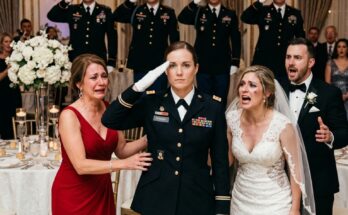
The room was buzzing with the low hum of expensive champagne and polite conversation. I walked in, wearing my Army dress blues. I hadn’t come in civilian clothes; I wore the uniform because it was the armor I had built for myself when they refused to give me any. The brass buttons gleamed, the fabric was perfectly tailored, and the ribbons on my chest spoke of places and situations these people couldn’t even point to on a map.
The crowd parted slightly as I walked, turning their heads. My mother felt the shift in attention before she saw me. She turned, a perfectly rehearsed smile ready on her lips, but it froze the second her eyes locked onto mine.
She let her gaze travel from the polished tips of my shoes, up the dark blue trousers, across the medals pinned precisely to my chest, and finally to my face. Her expression twisted into a mask of theatrical disgust.
“Sarah,” she said, her voice carrying that sharp, aristocratic clip designed to pierce through background noise. “What is a lowly soldier like you doing back here ruining the aesthetic?”
She said it loud. Loud enough for half the surrounding tables to hear.
A few people in her immediate orbit gave that thin, reflexive laugh people always give when cruelty comes wrapped in the certainty of wealth. It’s the laugh of cowards who don’t want to be the next target.
My father, Richard, stood beside her. He didn’t defend me. He simply lowered his gaze into his scotch glass, taking a slow sip, playing the role of the silent enabler he had perfected over three decades.
Chloe froze beside the towering, five-tier wedding cake. The radiant smile on her face tightened instantly, looking like silk pulled too far, right before it tears. She looked beautiful, expensive, and entirely panicked.
And then, there was the groom.
I hadn’t met him yet. I didn’t know his face. But the man standing next to Chloe went so pale, so quickly, that for one impossible second I thought he might actually be having a medical emergency.
He was not looking at my mother. He was not looking at Chloe.
He was looking directly at me. His eyes were wide, fixed on my face, then darting to the name tag pinned above my right breast pocket: BENNETT.
He took a sharp, jagged breath, as if he had just been punched in the stomach. He shoved his heavy wooden chair back so hard it screeched against the marble floor, the sound cutting through the polite chatter like a gunshot.
He stood up, his fists clenched at his sides, and barked, “Enough.”
The room went dead still. The string quartet stopped playing in the middle of a phrase.
My mother drew herself up, deeply offended by the idea that anyone, even the groom, would interrupt her performance. She plastered on a condescending smile. “Liam, really, darling. She’s my older daughter. She’s always loved making dramatic, inappropriate entrances. Let’s not let her ruin your night.”
Liam ignored her completely. He took a step toward me, his eyes never leaving my face.
“Do you even know who she is?” Liam demanded, his voice shaking with a dangerous, barely suppressed fury.
My mother scoffed, waving a dismissive hand. “Of course I know who she is. She’s the daughter who ran away to play in the mud because she couldn’t handle real responsibility.”
“No,” Liam said, his voice dropping to a low, lethal register that made the hairs on the back of my neck stand up. “If she hadn’t played in the mud, Eleanor… I would be dead.”
It is strange how silence behaves when it finally becomes heavier than noise.
It did not just settle over the reception hall. It dropped like a physical weight. I could hear a single glass clink somewhere near the bar in the back. I could hear Chloe’s breath hitch in her throat. I could hear my own pulse, steady, rhythmic, and controlled—the exact way it always became when a situation threatened to tip into absolute chaos.
My father finally looked up from his drink, his brow furrowed in confusion. “Liam, son, what are you talking about?”
“Liam,” Chloe whispered, reaching out to touch his tuxedo sleeve. “Liam, what are you doing? Everyone is staring.”
He shook her hand off without even glancing at her. The gesture was sharp and final.
“What am I doing?” Liam repeated, his voice echoing in the silent room. He turned to look at my parents, his eyes burning with a mix of disbelief and absolute disgust. “I am trying to understand why your family just publicly humiliated the woman I owe my life to.”
No one spoke. The guests were frozen, trapped in a horrifying tableau of high-society drama.
But the truth was, everything that mattered in this room had already started years earlier. Long before this ballroom, long before the white roses, and long before a groom suddenly understood exactly what kind of toxic family he was about to marry into.
It started when I was eighteen years old.
I had come home from high school clutching my college acceptance letter. I had been admitted to a solid state university. I hadn’t asked for the Ivy League treatment my parents were already grooming Chloe for. I had secured a decent academic scholarship—not enough to cover everything, but enough to make the dream feel reachable if my parents were willing to help with the remaining balance.
I remember standing in the pristine, marble-countered kitchen with my paperwork arranged in careful, neat stacks. I acted as if perfect organization could somehow make me easier to support.
My mother was peeling a clementine, not looking at me. My father was answering emails on his phone, scrolling absentmindedly.
I presented the numbers. I told them what I had been awarded, what was still left, and my detailed plan to work part-time in the dining hall to cover my books and living expenses. I laid out a spreadsheet. I asked, respectfully, whether they could help close the gap for tuition.
My mother did not even glance at the paperwork. She popped a piece of fruit into her mouth and sighed.
“You’ll figure it out, Sarah,” she said smoothly. “That’s what being an adult is. Building character.”
I looked at my father because somewhere deep inside me, there was still a child stupid enough to believe he might step in and be a parent.
He did not. He didn’t even look up from his screen.
“Your mother’s right,” he muttered. “It’s a good lesson in financial independence.”
That was the entire conversation. They dismissed my future in less than two minutes.
A week later, sixteen-year-old Chloe complained at dinner that her hand-me-down sedan was “old and embarrassing” because the air conditioning took too long to cool down.
By Friday afternoon, there was a brand-new, metallic silver BMW convertible parked in the driveway with a giant red bow on it.
My mother handed Chloe the keys like she was presenting a royal tiara. “Only the best for our girl,” she cooed.
My father stood there grinning, taking pictures with his phone. Chloe cried theatrical tears of joy, hugged them both, and called them the most amazing parents in the world.
My unpaid tuition bill sat on the kitchen counter the entire time, right next to the gift wrap.
That was the exact moment I finally understood that favoritism did not always need words. In the Hayes household, love didn’t come unconditionally; it came itemized.
I still tried. I was stubborn. I enrolled in the university anyway. I took every shift I could find at a local diner. I skipped meals, rationed gas to the penny, and learned how to live on the sort of razor-thin budget that turns every minor setback—a flat tire, a cold—into a catastrophic financial crisis.
Halfway through the fall semester, a bureaucratic issue with my financial aid hit. Suddenly, I needed three thousand dollars fast, or I would be dropped from all my classes before midterms.
I drove home on a Sunday. I walked into the living room with the revised forms and a tight, desperate knot in my stomach. I swallowed my pride and asked for a loan. Just a loan. I promised to pay it back with interest.
My mother shut me down before I even finished explaining the situation.
“No, Sarah. We told you, you need to manage your own finances.”
I stared at her, the exhaustion and hunger finally breaking my polite facade. “You’re paying for Chloe’s private tutoring, her club soccer, and a luxury car.”
My father answered with the calm, terrifying cruelty of a man who firmly believed his logic could absolve him of his obvious bias.
“We can’t pay for two colleges, Sarah. We have to prioritize our investments.”
I looked straight at him, my voice trembling but gaining strength. “That’s interesting, Dad. Because you never paid for mine to begin with.”
My mother’s face hardened into a mask of cold fury. She stood up, smoothing her designer skirt. Then, she said the sentence that burned itself into my psyche so thoroughly I could still hear it years later in perfect detail.
“Chloe is different, Sarah,” my mother said, her voice dripping with venom. “College actually matters for her. She has potential. You are just… average.”
For her. Not for me. Not for the future I was trying to build one exhausted, grease-stained diner shift at a time.
That night, I packed my things.
I didn’t do it dramatically. There were no slamming doors. No tearful screaming matches. I packed efficiently, like a person who had finally stopped confusing desperate hope with actual evidence.
I packed two plastic bins, one military-surplus duffel bag I bought at a thrift store, and whatever was left of my shattered pride.
When I loaded the last heavy bag into the trunk of my beat-up car, my mother came outside and stood on the porch, folding her arms.
“So you’re just giving up?” she asked, a cruel smirk playing on her lips. “Running away when it gets hard?”
“No,” I said, looking her dead in the eye for the last time. “I’m choosing something that doesn’t depend on you.”
That choice took me to a recruiter’s office in a faded strip mall the very next morning. And from there, into the hardest, most defining years of my life.
Basic training did not care who your parents were. The drill sergeants didn’t care about your zip code or your trust fund. Nobody there cared whether you had been the favored child or the disposable one.
They cared whether you could keep up. They cared whether you could carry the weight of your gear. They cared whether you could stay useful when you were exhausted, terrified, angry, or bleeding.
It was the absolute first environment I had ever known where standards were applied evenly to everyone.
That brutal fairness felt like a physical beating at first. But then, as the weeks wore on, it felt like oxygen.
I enlisted as a combat medic. I chose it because I wanted to become the kind of person who could help others under pressure, instead of being the person who collapsed under it.
The training was relentless. The early mornings were freezing. My feet blistered and bled. My shoulders ached under the weight of the ruck. I learned how to stay perfectly calm when everyone else was shouting in panic. I learned how to move when my body screamed at me to quit. I learned how to make life-or-death decisions with too little sleep and far too much at stake.
And somewhere in all the mud, the sweat, and the firing ranges, I found myself.
I was no longer the girl waiting for permission to exist. I was no longer the daughter desperately hoping to be chosen.
I was a different person. Sharper. Quieter. Stronger. Lethal when necessary, healing when called upon.
The Army paid for the degree my parents said did not matter. I took classes online between deployments and training rotations. I earned every single credit the slow, grueling way. I went to Officer Candidate School.
By the time I pinned on the silver bars of a Captain, there was no one left in my life whose approval I needed less than Eleanor and Richard Hayes.
And then came the deployment to Afghanistan. The deployment that put First Lieutenant Liam Reeves into my story.
Liam was young then. He wasn’t much older than I had been when I packed my car and left Richmond. He was a brand-new lieutenant attached to our convoy team for a regional supply route through terrain that felt endless, hot, and aggressively hostile.
He was smart, eager, too optimistic, and he still carried that specific, untested look some people have right before they understand how quickly a day can violently split in two.
The attack happened fast. They always do.
A massive IED blast detonated directly under the third vehicle in our convoy.
The sound was deafening, a physical force that punched the air out of my lungs. Then came the thick, choking black smoke. Screaming over the radio. A spin of dust and sand so thick it turned the world into jagged, terrifying fragments.
You do not think in cinematic movie scenes when things happen like that. You don’t process the narrative. You think purely in tactical fragments.
Who is moving? Who is trapped? Who is bleeding? What can be reached?
Liam’s vehicle had taken the worst of the blast. The armored transport was flipped on its side, the metal groaning and warping under the intense heat.
I grabbed my aid bag and sprinted through the smoke. By the time I reached the vehicle, the heavy armored door had jammed completely, and flames were rapidly building along the undercarriage, threatening the fuel lines.
I remember Liam’s face more than anything else from that day.
It wasn’t fear, exactly. It was absolute, paralyzing shock. The kind of shock that makes people go perfectly still at the exact moment stillness will kill them. He was trapped in the passenger seat, his leg pinned under the crushed dashboard, blood pouring from a shrapnel wound in his shoulder.
“Lieutenant!” I screamed over the roar of the fire, smashing the cracked window with the butt of my rifle to get access. “Liam, look at me! Look at me!”
His eyes found mine, glassy and unfocused.
I got him out. It took the jaws of life, three other soldiers, and me applying a tourniquet in a space so tight I could barely breathe, but I got him out. I got his driver out too.
We dragged them behind the cover of a rocky berm. But Liam was the one who kept drifting in and out of consciousness while we waited for the medevac helicopters. His blood pressure was tanking.
I stayed beside him in the dirt. The firefight was still echoing in the distance, but my entire world narrowed down to keeping his heart beating. I kept my hands pressed hard against his wounds, and I talked to him the whole time.
Because consciousness is a fragile thread. And sometimes, when the body wants to quit, a steady voice is all you have to keep someone holding on to it.
“Stay with me, Liam,” I ordered, my voice hard but steady. “You don’t get to quit today. Do you hear me? You stay awake.”
He survived.
Months later, while he was still stateside in a military rehab facility learning how to walk without a limp, he sent a short letter through official channels. It arrived on my desk in a plain manila envelope.
Three lines of messy handwriting.
Captain Bennett, Thank you for not leaving me in that truck. I don’t remember enough to say this properly, but I know I’m alive because you stayed in the dirt with me. I owe you my life. – Liam Reeves
I wrote back once.
Lieutenant Reeves, You did the hard part. You survived. Keep going. Make it count. – CPT Bennett
That was it. That was the entirety of our interaction.
Life kept moving. Mine did, anyway.
New assignments. New, heavier responsibilities. Promotions. More schooling. I moved further and further away from the house in Richmond where I had once stood with a tuition bill and two parents who acted like I was a bad investment.
I did not hear Liam Reeves’s name again for five years.
Until the heavy cream wedding invitation arrived in my mail. Chloe Hayes to wed Liam Reeves.
I had almost ignored it.
But standing here now, in the middle of this opulent ballroom, listening to the deafening silence, I knew exactly why I had come. I had wanted the answer to a question I had carried for too long: If I stood in front of them now, as the person I had built entirely without them, would they still try to make me smaller?
They did. They couldn’t help themselves.
But the one thing they hadn’t counted on was that Liam saw it too.
Back in the present, inside the ballroom, my mother tried to recover first. Because that was what Eleanor Hayes always did. She controlled the narrative.
She let out a high, nervous, tinkling laugh that sounded like breaking glass. “Liam, darling, you’re making this sound absurd,” she said, waving her hand as if trying to physically brush the tension away. “Sarah always loved attention. She probably exaggerated whatever happened over there to make herself look like a hero.”
Liam took one slow, deliberate step toward her. The raw fury radiating from him made my mother physically flinch backward.
“Attention?” Liam repeated, his voice dangerously quiet. “My fiancée has listened to me talk for two years about the combat medic who saved my life. About Captain Bennett. About the woman who sat in the burning dirt with one hand on my bleeding shoulder and kept me awake while the world exploded around us.”
He turned slowly, his eyes locking onto Chloe, who looked like she wanted the floor to open up and swallow her whole.
“And none of you,” Liam said, his voice rising, carrying to the very back of the hall, “None of you thought to mention that my commanding officer, my savior, was your own flesh and blood?”
Chloe’s face changed then. It didn’t change into shock. It changed into something infinitely worse.
Recognition. Guilt.
She knew.
I saw it instantly. I saw the slight drop of her eyes, the guilty swallow.
Liam saw it too.
“You knew,” he said, the betrayal heavy in his voice.
Chloe swallowed hard, tears finally spilling over her perfectly applied makeup. “Liam, I… I knew you had some Army story about someone named Bennett. I didn’t connect the dots! I didn’t know it mattered this much!”
He stared at her as if he had never seen her before. As if the woman in the white dress was a complete stranger.
“It mattered this much,” Liam said, his voice cracking with emotion, “because I am only standing here today because she didn’t leave me behind.”
“Liam, please, don’t do this here,” my father, Richard, finally spoke up, attempting to use his ‘patriarch’ voice. “Let’s take this to a private room.”
Liam rounded on him with terrifying speed. “Where would you prefer it, Richard? Somewhere quieter? Somewhere behind closed doors where you can continue to insult her without witnesses to judge you?”
My mother’s face flushed a violent, mottled crimson. Her pristine image was shattering in real-time. “This is our daughter! Our family! You are our guest of honor, but you have no right to speak to us this way!”
Liam laughed once. It was a harsh, humorless sound. “That’s exactly the problem, Eleanor. She is your daughter. And you treat her like garbage.”
People were openly staring now. Whispers were breaking out like a contagion across the tables. The bridesmaids looked trapped between acute embarrassment and outright panic. An older aunt had gone motionless with a champagne glass halfway to her mouth, the liquid spilling slightly onto her dress.
I should have said something sooner. I should have de-escalated the situation. It was my training. But I stood there, rooted to the spot.
I could feel the room tipping. Not into physical danger, but into truth. And truth can be just as destructive as a bomb when people have spent years building their entire lives on lies.
“Liam,” I finally said, my voice cutting through the rising murmur. “Let it go. It’s not worth it.”
He turned to me. And for a second, looking into his eyes, I didn’t see the wealthy groom in the tuxedo. I saw the young, terrified lieutenant beneath it. The one blinking through smoke and dust, refusing to disappear into the dark.
“Ma’am,” he said quietly, addressing me with military respect, his eyes shining. “With respect… no. Not this time.”
Liam turned slowly back to Chloe. She was trembling now, her hands clutching the skirt of her expensive gown as if it could protect her.
“Did you know why I specifically asked for your estranged sister to be invited?” Liam asked her, his voice low but carrying an undeniable edge.
Chloe’s mouth opened. Nothing came out. It closed again.
He answered for her. “I told you I wanted to find the woman who saved my life. I wanted to thank her if she ever showed up. Do you remember what you told me, Chloe?”
Chloe shook her head frantically, tears ruining her mascara. “Liam, stop…”
“You told me,” Liam continued, addressing the silent room as much as her, “that she probably wouldn’t come because she was bitter. That she was unstable. That she had a toxic habit of making everything about herself out of jealousy.”
He pointed a shaking finger at my mother. “Your mother just called her a ‘lowly soldier’ in front of two hundred people. And you, Chloe? You stood there and let her.”
Chloe went paper-white. She reached out for him. “Liam, please. We can fix this. I’m sorry.”
“No,” he said, stepping back from her touch as if she burned him. “Do not ask me for grace while she is still standing right there getting absolutely none from any of you.”
My mother, sensing the complete loss of control, tried one last, desperate angle. Because people like Eleanor Hayes always mistake attempted control for recovery.
“You’re ruining your own wedding over ancient family issues you don’t understand!” my mother shrieked, her veneer of elegance entirely gone. “You are embarrassing yourself!”
Liam’s expression went completely flat. The anger drained away, leaving only a cold, hard clarity.
“I understand enough,” he said quietly. “I understand that the best, most honorable person in this room has spent the last ten minutes being treated like a stain by the people who should have been the proudest of her.”
Then, he reached up to the knot of his expensive silk bow tie.
With a swift, decisive motion, he pulled it loose.
The room actually gasped. A collective intake of breath that sucked the oxygen out of the hall.
Chloe grabbed his wrist, panic finally overriding her embarrassment. “Liam! What are you doing?!”
He gently, but firmly, removed her hand from his arm.
“I’m not marrying into this,” Liam said. “I can’t.”
No one moved at first. Some moments are simply too large, too catastrophic, for the human body to catch up to immediately.
Then, everything broke at once.
My mother started shouting, her voice shrill and hysterical, demanding someone call security. Chloe collapsed into a chair, sobbing uncontrollably, her perfect day ruined. My father was loudly demanding calm from a room he had never once had the courage to calm when it actually mattered—when I was eighteen and begging for his help.
Guests were whispering frantically. Phones were sliding discreetly into hands to record the fallout. The fragile, expensive machinery of a perfect high-society wedding was violently grinding itself to pieces under the weight of one single, honest reaction.
I didn’t stay to watch the rest.
I left before the worst of the screaming started. I had not come for revenge, and I did not need front-row seats to their collapse. I had my answer.
I turned on my heel, the brass buttons of my uniform catching the chandelier light one last time, and walked out the heavy mahogany doors, my head held high.
By the time I reached the grand stone steps of the country club, the night air hit me. It felt incredibly cool, clean, and so much lighter than anything inside that toxic room.
“Captain Bennett!”
I stopped and turned.
Liam had followed me out. His tuxedo jacket was unbuttoned, his bow tie hanging loose around his neck. His face was drained, exhausted, but his eyes were steadier now.
“You don’t owe me this, Liam,” I told him, my voice soft. “You didn’t have to blow up your life for me.”
He shook his head, walking down the steps to stand beside me in the cool night air.
“Maybe not,” he said. “But I owe you a hell of a lot more than silence.”
For a long second, neither of us spoke. The crickets hummed from the manicured hedges. Through the heavy, closed doors of the club, I could still hear the muffled, chaotic roar of consequences beginning to tear my family apart.
“I’m sorry,” Liam said finally, looking down at the pavement. “I had no idea. Chloe told me you were estranged because you hated the family and looked down on everyone. She made it sound like you cut them off out of pure spite.”
I smiled, but there was no warmth or joy in it. “That is certainly one version of the story. The one that lets them sleep at night.”
He looked up at me, his face tight with shame. “I should have asked more questions. I should have dug deeper.”
“Maybe,” I said. “But tonight wasn’t just your lesson to learn. Sometimes, people show you exactly who they are, and you just have to believe them.”
He nodded slowly. Then, he did something I did not expect.
He reached into the inner pocket of his tuxedo jacket and pulled out a small, folded note card. It was meant for his wedding toast.
“This was supposed to be about gratitude,” he said, staring at the card. “Funny, I guess. I was going to talk to the room about second chances. About people who save you from the dark. I genuinely thought I was marrying into a family that understood that concept.”
He looked at me, and for the first time that night, I let myself believe he really remembered what happened years ago. Not just the physical rescue, but the feeling of being seen at your absolute worst, bleeding in the dirt, and not being abandoned.
“You were the first person who ever made me feel like surviving was something honorable,” Liam said, his voice thick with emotion. “I’m so sorry the people who raised you never understood what they had in you.”
That simple statement landed harder than any hollow apology my parents could have ever offered.
Because he was right. They never understood.
My father called me three weeks later.
I was back on base. I almost did not answer the unknown number, but human curiosity still has incredibly sharp teeth.
When I picked up, Richard Hayes sounded smaller than I remembered. The booming patriarch voice was gone, replaced by a hesitant, elderly rasp.
He said he had made mistakes. He said maybe they had expected too much “toughness” from me because I had always seemed so capable on my own. He said Chloe had simply “needed more support” because she was fragile.
There it was.
The exact same old logic, just dressed up in the clothing of regret this time. It wasn’t cruelty, exactly. It was just cowardice translated into justification.
Then, he told me my mother would not be apologizing. She firmly believed Liam had humiliated the family over a “misunderstanding” and that I should have stopped him.
I laughed at that. A real, genuine laugh that startled me.
“No, Dad,” I said, my voice ringing with absolute finality. “He didn’t humiliate the family. He just humiliated the lie you all built to protect yourselves.”
My father went dead quiet on the other end of the line.
Before hanging up, he cleared his throat and said he wanted to send me a check. He said he wanted to send enough money to cover what they had never given me for school, plus interest. He framed it as “making things right.”
I told him to send it if it helped him sleep at night, but that it wouldn’t change the past.
When the massive cashier’s check arrived a week later, I looked at the string of zeroes for a long time. It was enough money to change a life.
Then, I did not deposit it into my own account.
I drove to the bank and used it to start a foundation. I set up a scholarship fund specifically for young women entering college or military service without family financial support. Girls who had been told to be “independent” by people who actually meant “abandoned.”
I named the scholarship after one of the medics I had served with who didn’t make it home. I named it after nobody in my family.
A few months after the check cleared, I received a handwritten note from Liam Reeves.
It was short. Respectful. He wrote that he had ended the engagement with Chloe for good, moved out of their shared apartment, and started a new job in a different city. He also mentioned he had made a significant matching donation to the new scholarship fund I had set up.
At the bottom of the stationary, he added a single, final line.
Thank you, again, for not leaving me behind. In the desert, and in that ballroom.
I pinned that note on the corkboard inside my office, right beside the very first one he had ever sent me years ago.
People in my unit who heard the story ask me sometimes whether I regret going to that wedding. Whether opening that old wound was worth the drama.
I don’t regret it for a second.
I did not get a repaired family out of it. My mother stayed exactly who she had always been—proud, bitter, and obsessed with appearances. My father stayed silent, realizing his cowardice years too late to matter. Chloe sent me one vitriolic text message blaming me entirely for the disaster of her life, and then blocked my number before I could even reply.
But that night gave me something infinitely more valuable than a reconciliation.
It gave me proof.
Proof that I had not imagined any of the abuse. Proof that their cruelty looked exactly as ugly and unacceptable from the outside as it had always felt from the inside.
And maybe most importantly, it gave me proof that the life I built entirely without them had weight. Real, undeniable weight. The kind of weight that no one could laugh away or dismiss once the truth walked into the room wearing medals and stood its ground.
My mother had sneeringly asked what a lowly soldier like me was doing back in her pristine world.
The answer was simple, really.
I came back just long enough to watch the people who had underestimated me my entire life finally face someone who knew exactly what I was worth.
After that, I left again.
And this time, I walked away with absolutely nothing left behind.