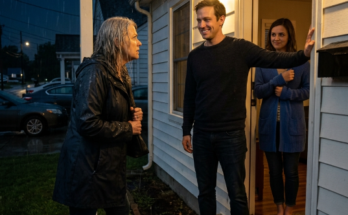
I sat by the window of “The Golden Plate,” an upscale restaurant where the scent of truffle oil and expensive wine hung heavy in the air. It was a cold Tuesday, and the rain had just begun to smear the glass. That’s when I saw her. Through the window, an elderly woman stood huddled under the eaves of the building. Her coat was thin, frayed at the edges, and her hands were trembling as she clutched a small, tattered purse.
She wasn’t begging for money—not exactly. She was just standing there, her eyes fixed on the warm glow of the dining room. Every time the heavy oak doors opened and a gust of warm air escaped, she seemed to lean into it, just for a second of relief.
Suddenly, the door swung open with a sharp thud. It was Sarah, one of the lead waitresses. I knew her by reputation; she was efficient but cold. She didn’t offer a smile to the woman. Instead, she crossed her arms and looked at her with a mixture of disgust and irritation.
“You can’t stay here,” Sarah hissed, her voice cutting through the sound of the rain. “You’re blocking the entrance and making the customers uncomfortable. Move along.”
The old woman, whose name I would later learn was Martha, looked up with watery eyes. “Please, miss,” she whispered, her voice cracking. “I haven’t eaten since yesterday. I was just hoping for a bit of bread, or maybe some leftover soup? Anything you’re going to throw away.”
Sarah scoffed, a harsh, jagged sound. “We don’t give out handouts here. This is a five-star establishment, not a soup kitchen. If you don’t leave right now, I’m calling the police.”
Martha shrank back, her shoulders slumped in defeat. She looked so small, so discarded. She turned to walk back into the rain, her steps slow and heavy.
I couldn’t just sit there. I felt a surge of indignation that bypassed my usual reserved nature. I stood up, tossing my linen napkin onto the table, and walked toward the door.
“Wait!” I called out.
Both Sarah and Martha turned. Sarah’s face immediately shifted into a practiced, professional mask. “Is there a problem, sir? I’m so sorry about the disturbance. I’m taking care of it.”
“No,” I said, looking Sarah directly in the eye. “You aren’t taking care of anything. You’re being cruel.”
I pushed past the waitress and stepped out into the chilly air. I reached out and gently caught Martha’s arm. “Ma’am, please. Come inside. You’ll be my guest today.”
The old woman looked at me in shock. “Oh, no, sir. I couldn’t. I don’t belong in there.”
“You belong anywhere you choose to be,” I insisted, guiding her toward the door.
Sarah stepped in our way, her face flushing a deep red. “Sir, with all due respect, the management wouldn’t approve of this. She isn’t… dressed for our dress code.”
“I am a regular here, Sarah,” I replied, my voice low and firm. “And I am paying for her meal. Are you telling me that my money isn’t good enough today? Or is it that your compassion only extends to people who wear designer suits?”
Sarah opened her mouth to argue, but she saw the look in my eyes and stepped aside, muttering something under her breath about “ruining the atmosphere.”
I led Martha to my table. She sat down gingerly, as if she were afraid the velvet chair might break under her weight. I ordered the most substantial meal on the menu—a thick beef stew, fresh sourdough bread, and a pot of hot tea.
As she ate, I watched the color slowly return to her cheeks. She ate with a quiet dignity that put the rowdy businessmen at the next table to shame. Between bites, she started to talk. She told me about her husband, a veteran who had passed away years ago. She told me about the small apartment she had lost when her medical bills became too much to handle. She wasn’t a “vagrant” or a “nuisance.” She was a person with a history, a life of joys and sorrows that had simply been eclipsed by hard luck.
“I used to be a teacher,” she said, a small spark appearing in her eyes. “I taught literature for thirty years. I loved the poems of Robert Frost.”
I listened, truly listened, for over an hour. Around us, the restaurant continued its frantic pace, but at our table, time seemed to slow down. I noticed Sarah watching us from the bar, her expression shifting from annoyance to something that looked suspiciously like guilt.
When the bill came, I paid it without looking. I also slipped a few hundred dollars into a clean envelope and handed it to Martha.
“This isn’t a handout,” I told her when she tried to protest. “This is a thank you. For reminding me what’s important.”
I walked her to the door. The rain had stopped, and a sliver of sun was breaking through the clouds. Before she left, the restaurant manager, a man who had been watching the scene unfold from his office, stepped out. He walked straight to Sarah.
“Sarah,” he said, loud enough for me to hear. “I saw how you treated this lady. In this business, we serve people. All people. Your behavior today was a disgrace to this establishment. You can pick up your final check at the end of the shift.”
Sarah stood frozen, the consequences of her coldness finally catching up to her.
I watched Martha walk down the street, her head held a little higher than it had been an hour before. I went back to my life, but I never forgot that afternoon. It’s easy to look at the world through a window and judge what we see. But sometimes, you have to open the door, step into the rain, and realize that the person outside is just a version of yourself who ran out of luck.
From that day on, whenever I saw someone struggling, I didn’t see a “problem” to be moved along. I saw Martha. And I remembered that a little bit of bread and a lot of respect can change a person’s entire world.