My 8-year-old had fainted at school 5 times in 3 weeks. Nobody told me. Then I found the nurse’s notes in his backpack. My husband had told the school to stop calling me. “He’s faking to get out of gym, Mireille. Boys don’t faint.” That Saturday, at soccer practice, my son collapsed. And his heart stopped.
My name is Mireille. I’m a dental assistant in Columbus, Ohio.
My son, Ezio, is eight. He’s skinny and shy, and he loves to draw. Dragons. Robots. Spaceships. He carries a sketchbook everywhere.
He’s not very good at sports. He doesn’t really like them.
My second husband, Nikolai, can’t stand that.
Nikolai is a high school wrestling coach. He’s big and loud, and he believes every boy should be tough.
“You coddle him, Mireille,” he says. “All that drawing is turning him soft. He needs sports.”
Last fall, Nikolai signed Ezio up for a youth soccer team. He volunteered to be the assistant coach. Practice was every Saturday morning.
Ezio hated it. But he went.
In October, he started acting strange.
He was tired all the time. He was pale. Twice, I saw him stop on the stairs and put his hand on his chest.
“Ezio, are you okay?”
“I’m fine, Mom,” he said quickly. “Just tired.”
Then one evening, while I was washing his backpack, a folded yellow paper fell out.
It was a note from the school nurse.
“Ezio came to the nurse’s office after fainting during recess. Heart rate irregular. Please follow up with a doctor. This is his fifth visit in three weeks.”
Fifth visit.
I couldn’t breathe.
There were four more yellow notes at the bottom of his backpack. All crumpled. All saying the same thing.
“Fainted in PE.”
“Fainted in the lunch line.”
“Fainted on the playground. Complained of a fluttering in his chest.”
“Please call us.”
I’d never gotten a single call.
The next morning, I called the school nurse.
“Ma’am, I’ve been trying to reach you,” she said. “I called the number on file. Your husband answered. He told me to stop calling. He said Ezio was faking to get out of gym class. He said not to bother you with it.”
My hands started shaking.
That night, I confronted Nikolai.
“The school nurse has been calling about Ezio fainting. Five times. You told her to stop calling me?”
He shrugged.
“He’s faking. He wants out of gym. Boys don’t faint, Mireille. I was going to deal with it myself.”
“His heart rate was irregular.”
“Kids’ hearts do weird things. It’s nothing. He’s soft. That’s the problem.”
Then I went into Ezio’s room.
He was sitting on his bed, drawing. He looked up at me with frightened eyes.
“Mom, are you mad?”
“No, baby. Why didn’t you tell me you were fainting?”
He looked down at his sketchbook.
“Nikolai said if I told you, he’d throw away all my drawing stuff. He said fainting is for babies.”
I held him for a long time.
I didn’t fight with Nikolai that night. I was too scared and too angry to think clearly.
I just said, “Okay,” and I called the pediatrician first thing in the morning.
The earliest appointment was Monday.
Saturday came.
Nikolai insisted Ezio go to soccer practice.
“He’s not missing practice over some stupid note.”
“Nikolai, he’s not going.”
“Yes, he is. I’m his coach. He’s going.”
He took Ezio before I woke up.
I drove to the soccer field as soon as I realized they were gone.
When I pulled into the parking lot, I could hear Nikolai yelling across the field.
“Run, Ezio! Faster! Stop being lazy!”
My son was running laps around the field. His face was gray.
Halfway around the third lap, he stopped.
He put his hand on his chest.
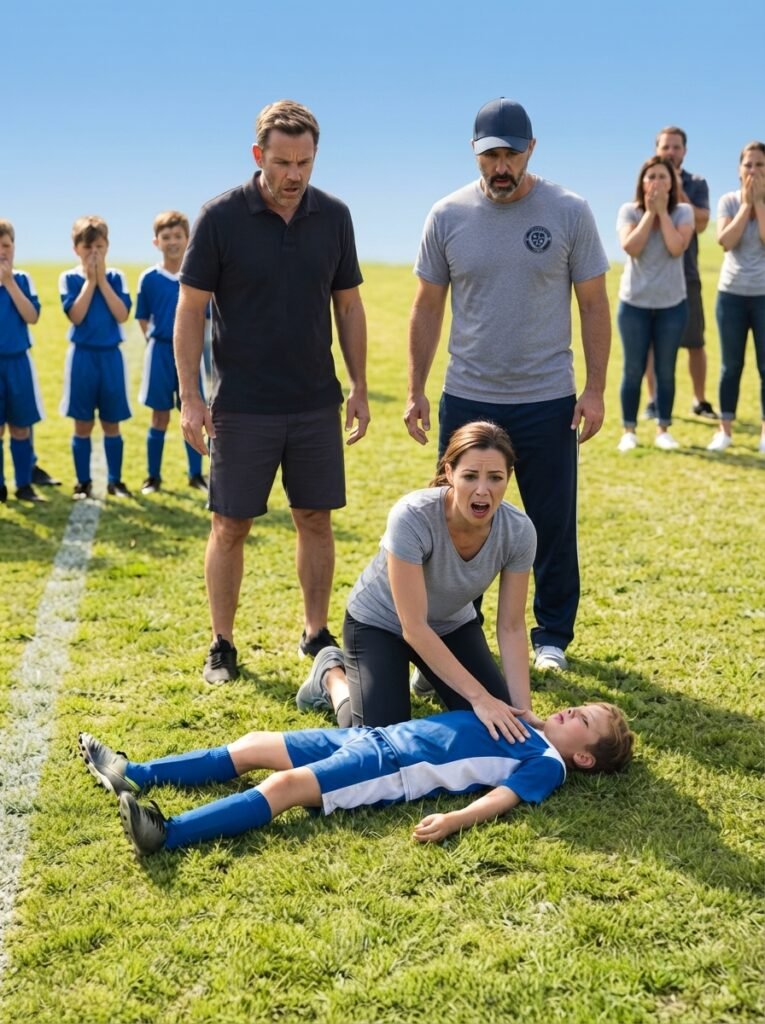
Then he fell face-down into the grass.
I ran across the field.
Nikolai was standing over him.
“Get up! Stop faking! Everybody’s watching!”
I dropped to my knees and turned my son over.
His eyes were open. But they weren’t looking at anything.
I put my ear to his chest.
There was no heartbeat.
PART 2
“CALL 911!” I screamed. “SOMEBODY CALL 911!”
I’m a dental assistant. Every year, we take CPR training. I’d never used it on a real person.
I put my hands in the center of my son’s chest and started pushing.
One, two, three, four.
Nikolai stood there frozen.
“He’s faking,” he said. But his voice was shaking now.
Another soccer dad ran up. He was holding a red case.
“There’s a defibrillator by the concession stand!” he shouted. “I got it!”
He tore it open. The machine started talking in a calm voice.
“Apply pads to patient’s bare chest.”
I ripped Ezio’s soccer shirt open. The dad stuck the pads on.
“Analyzing heart rhythm. Do not touch the patient.”
We pulled our hands away.
“Shock advised. Stand clear.”
The whole field went silent. Twenty kids. Their parents. Everyone watching.
“Press the orange button now.”
The dad pressed it.
My son’s small body jumped.
“Shock delivered. Begin CPR.”
I started pushing again. One, two, three, four.
After thirty pushes, the machine analyzed again.
“No shock advised.”
Then Ezio coughed.
He gasped. His eyes blinked. He looked around, confused.
“Mom?”
I sobbed so hard I couldn’t speak.
The ambulance arrived four minutes later.
At the children’s hospital, a cardiologist named Dr. Galina ran tests. EKGs. An ultrasound of his heart.
She sat down with me that evening.
“Ezio has a condition called long QT syndrome,” she said. “It’s an electrical problem in the heart. It’s often hereditary. It causes dangerous heart rhythms, especially during exercise or stress. The fainting spells were warning signs.”
She looked at me seriously.
“Five fainting spells in three weeks is a medical emergency. If someone had brought him in after the first one, we could have treated him before this happened.”
“My husband told the school to stop calling me,” I whispered.
Dr. Galina didn’t say anything. She didn’t need to.
Ezio had surgery the next week. They put a tiny device in his chest. A defibrillator, like the one on the soccer field, but small enough to live inside him. If his heart ever stops again, it will shock it back.
He also got medicine to keep his heart rhythm steady.
He’ll never play competitive soccer again.
He’s thrilled about that.
Nikolai came to the hospital once. He stood in the doorway of Ezio’s room.
“Buddy, I’m sorry. I didn’t know.”
Ezio looked at him for a long time.
“I told you I was dizzy,” he said quietly. “You said I was a baby.”
Nikolai didn’t have an answer.
I filed for divorce a month later. I told the judge everything. The nurse’s notes. The phone calls he hid. The soccer field.
The judge gave me full custody.
The soccer dad who ran for the defibrillator is named Ivor. He’s a plumber. He has three kids on the team. He comes to visit Ezio every month.
“I’d never even opened one of those boxes before,” he told me. “I just remembered seeing it there.”
Ezio drew him a picture. A superhero in a plumber’s uniform, holding a red box with a lightning bolt on it.
Ivor framed it and hung it in his truck.
Last spring, Ezio’s school installed defibrillators in the gym, the cafeteria, and on the playground. The nurse started a new rule. If a child faints even once, a parent must come in person. No exceptions.
Ezio stood up at the school assembly and told everyone his story.
“If you feel dizzy or your heart feels weird, tell a grown-up,” he said. “And if they say you’re faking, tell another grown-up.”
The whole gym clapped.
Ezio is nine now. He draws every day. He’s in an after-school art class.
His favorite drawing hangs on our refrigerator. It’s a picture of a heart. With a tiny lightning bolt inside it.
Underneath, he wrote:
“MY BRAVE HEART.”
THE END.