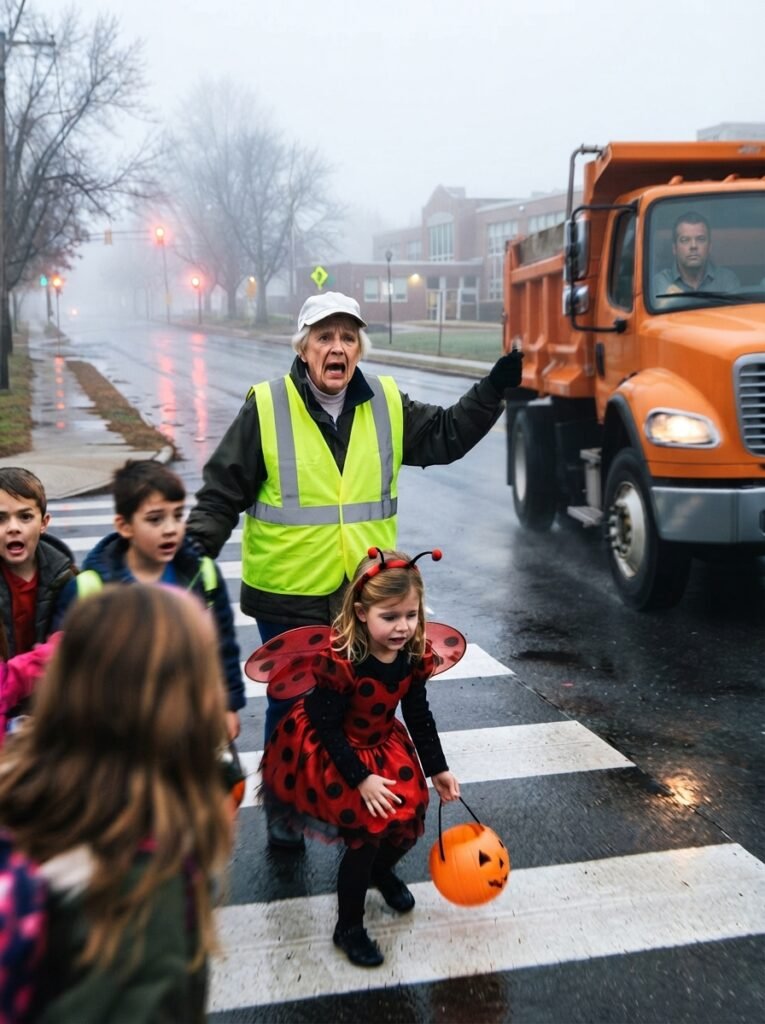
For 22 years, I walked every child across Main Street. Sun, snow, rain. Then the city council cut my job. “You’re 78, Emmeline. A stoplight is cheaper.” On my very last morning, a gravel truck came over the hill with no brakes. 14 children were in the crosswalk. And I was holding a stop sign.
My name is Emmeline. I’m seventy-eight years old. For twenty-two years, I was the crossing guard at the corner of Main Street and Elm, in front of Lincoln Elementary School in Galesburg, Illinois.
Every school morning, 7:30 to 8:15. Every afternoon, 2:45 to 3:30.
I wore a bright orange vest and a white cap. I carried a red stop sign on a long pole.
I knew every child by name. I knew who had a new baby brother. Who lost a tooth. Who was sad because their dog died. I kept a bag of peppermints in my vest pocket for the ones who had a bad morning.
My husband died twenty-three years ago. I didn’t have children of my own.
Those kids became my children. All of them.
Over twenty-two years, I walked more than three thousand of them across that street.
In September, the city council held a budget meeting. A new councilman named Malachi Pryce stood up with a stack of charts.
“We’re spending eighteen thousand dollars a year on a crossing guard at Main and Elm,” he said. “A smart traffic light costs less over ten years. It’s time to modernize.”
I was sitting in the back row. I raised my hand.
“Mr. Pryce, that hill on Main Street is very steep. Trucks come down it too fast. A light can’t see what I see.”
He smiled at me like I was a child.
“Ma’am, with respect, you’re seventy-eight years old. A stoplight is cheaper. And it doesn’t need sick days.”
A few people laughed.
The council voted five to two. My job would end on Friday, October 31st.
I didn’t argue anymore. I just said, “Okay.”
The kids found out. They made me cards. Dozens of them. “We’ll miss you, Miss Emmie.” “Who will give us peppermints?” One little girl named Uma, who’s six, drew a picture of me with wings.
“You’re our angel,” she said.
On my last morning, Halloween, it was cold and foggy. The fog was so thick I could barely see the top of the hill on Main Street.
I wore my orange vest one last time. I’d pinned a little pumpkin to it.
At 7:52 a.m., the biggest group of the morning gathered on the corner. Fourteen kids. Some in costumes. A tiny superhero. Two princesses. A dinosaur.
I checked both directions. Nothing coming.
I stepped into the street with my sign up.
“Okay, babies. Let’s go.”
The children started across. Holding hands. Laughing. Uma was in the middle, in a ladybug costume, swinging her candy bucket.
Then I heard it.
A deep, roaring engine. Coming down the hill. Through the fog.
Way too fast.
And a horn. Long and desperate. Blaring.
Out of the fog came a big orange gravel truck. Loaded to the top. Barreling down Main Street.
The driver was standing on his brakes. Smoke was pouring off the tires. I could see his face through the windshield. White. Terrified.
He was waving his arm out the window.
The brakes were gone.
The truck wasn’t going to stop.
Fourteen children were in the crosswalk.
Behind me, I heard the children start screaming.
I didn’t think. I didn’t have time to think.
I planted my feet in the middle of Main Street. I held my stop sign as high as my old arms could hold it.
And I shouted louder than I’ve ever shouted in my life.
“RUN! EVERYBODY RUN! GET TO THE SIDEWALK!”
The children ran.
All of them except one.
Uma had dropped her candy bucket in the middle of the street.
She stopped. She turned around. She bent down to pick it up.
The truck was a hundred feet away.
Then fifty.
PART 2
I dropped my stop sign.
I ran to Uma faster than a seventy-eight-year-old woman should be able to run.
I grabbed her by her ladybug wings and threw her toward the sidewalk with all my strength. She tumbled onto the grass, crying, still holding her candy bucket.
Then I tried to move.
My knee gave out.
The truck driver jerked his steering wheel as hard as he could. The truck swerved. Its back end swung around in a cloud of smoke.
It missed me by maybe two feet.
But the side mirror didn’t.
It hit my shoulder and spun me around, and I fell hard onto the street.
The truck slammed into a parked car and a telephone pole at the bottom of the hill and finally stopped.
Then everything was quiet.
I was lying on my back on Main Street, looking up at the fog. My hip was screaming. My shoulder was on fire.
I heard little footsteps running toward me.
Uma knelt down next to my head. Her ladybug antennae were bent.
“Miss Emmie,” she sobbed. “Miss Emmie, are you dead?”
“No, baby,” I said. “I’m just resting.”
Then fourteen children were around me. Kneeling on the street. Holding my hands. Crying. A tiny dinosaur put his candy bucket under my head like a pillow.
All fourteen of them were safe. Not one of them had a scratch.
The ambulance took me to the hospital. I had a broken hip, a dislocated shoulder, and three cracked ribs.
The truck driver came to my hospital room that afternoon. He was a young man. He cried the whole time. His brake line had snapped coming down the hill. He’d done everything he could.
“If you hadn’t been standing there,” he said, “I would have hit all of them. I’d never have seen them in the fog. You were the only thing I could see. That orange vest.”
The next morning, a police officer came to my room.
He was tall, in his thirties. He took off his hat.
“Miss Emmie,” he said. “You don’t remember me. I’m Orson. You walked me across Main Street every day for six years. You gave me a peppermint the day my parents got divorced.”
He smiled.
“Some of us heard what happened. We want to show you something.”
He opened my hospital room curtains.
Down in the parking lot, there were hundreds of people. Holding signs.
Grown men and women. Some with their own children. Some in work clothes. Teachers. Nurses. Firefighters. Mechanics.
Every sign said the same thing.
“MISS EMMIE WALKED ME ACROSS.”
There were more than six hundred of them.
I cried so hard the nurse had to bring me oxygen.
The next week, the city council held an emergency meeting.
Councilman Pryce stood up. His face was red.
“I made a mistake,” he said. “A stoplight cannot do what she did. I’m moving to restore the crossing guard position at Main and Elm. Permanently.”
The vote was seven to zero.
They also put up a new street sign at the corner.
“EMMELINE WAY.”
It took me four months to walk again. I use a cane now. I’m too slow to be a crossing guard anymore.
So the city hired someone new. A young woman named Ximena. She wears my orange vest.
But every morning, at 7:30, I sit on a bench on the corner of Emmeline Way with a bag of peppermints.
And every morning, Uma runs across the street, holding the new guard’s hand, and hugs me.
“Morning, Miss Emmie. You’re still our angel.”
THE END.