For 26 mornings, I fed a lost little goat trapped on a highway median between speeding trucks. My HOA president threatened me. “Bring that filthy animal in here, and I’ll fine you until you lose your house.” On the 27th morning, a minivan screeched to a stop beside me. A bald little girl screamed the goat’s name.
My name is Tennyson Fairchild. Everybody calls me Ten. I’m seventy-two, and I was a mailman in Knoxville, Tennessee, for thirty-nine years.
My wife passed four years ago. My kids live far away. These days, my mornings are pretty quiet.
Every morning at six, I walk to the gas station at the edge of our neighborhood for coffee and a newspaper.
One morning in September, I saw something strange on the highway.
Right in the middle of the grassy median, between four lanes of traffic, there was a goat.
A small brown-and-white goat with floppy ears and a pink collar. She was standing in the weeds, shaking, while semi-trucks roared past on both sides.
Every time a truck went by, she flinched.
I stood at the edge of the road for a long time, watching her.
Nobody stopped. Nobody slowed down.
At a red light, when traffic stopped, I walked out to the median with my coffee in one hand.
She backed away from me. She was terrified. I could see her ribs.
So I went back to the gas station and bought a bag of baby carrots and a bottle of water. I poured the water into my coffee cup lid and set it down in the grass with the carrots.
Then I walked away.
When I looked back, she was eating.
I came back the next morning. And the next.
Every day, I brought carrots, lettuce, and water. Every day, she got a little braver. By the second week, she would trot over to me when I crossed at the light. By the third week, she let me scratch the top of her head.
I tried to catch her, to bring her somewhere safe. But every time I reached for her collar, she bolted into traffic, and my heart nearly stopped.
So I just kept feeding her. And I kept calling animal control. Every single day.
They kept saying they’d send someone. Nobody ever came.
I decided to build her a little pen in my backyard, so I could lure her home.
That’s when Mrs. Ottoline Pemberton found out.
She’s the president of our homeowners’ association. She’s sixty-five, wears a visor everywhere, and carries a clipboard to the mailbox. She has fined my neighbors for having the wrong color of trash cans.
She showed up at my door with that clipboard.
“Mr. Fairchild, I’ve been told you’re building a livestock pen.”
“It’s for a goat. She’s stuck on the highway. She’s going to get killed.”
“Livestock is a violation of section four of our bylaws.”
“She’s not livestock. She’s somebody’s pet. She has a collar.”
Mrs. Pemberton sniffed.
“Then it’s somebody else’s problem. Not yours. Not this neighborhood’s.”
“Ma’am, she’s been out there for three weeks. She’s starving.”
“I don’t care if she’s been out there for three years. Bring that filthy animal in here, and I’ll fine you every single day until you lose your house.”
She wrote something on her clipboard and walked away.
I stood in my doorway for a long time.
I didn’t argue. I just said, “Okay.”
I took down the pen that same day. But the next morning, I went back to the highway anyway.
That was day twenty-six.
On the morning of day twenty-seven, it was raining.
I was standing on the median in my rain jacket, holding out a carrot. The goat was nibbling it from my hand.
Suddenly, a blue minivan came flying across two lanes and screeched to a stop on the shoulder, right next to us. Horns blared.
The side door slid open.
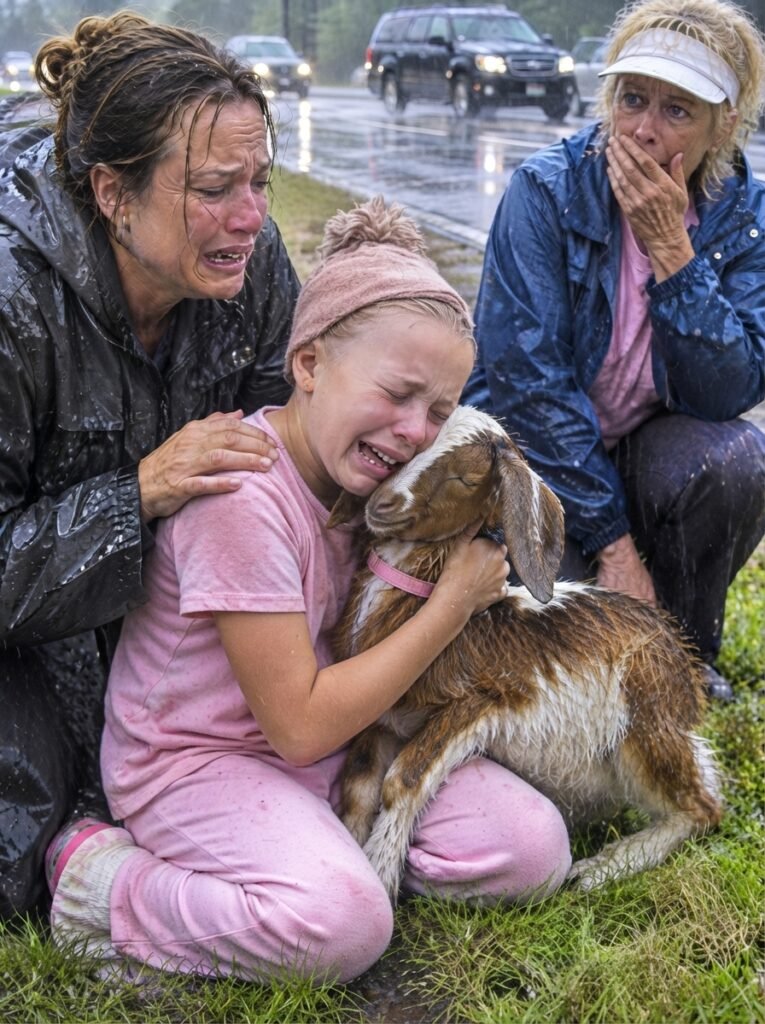
A little girl jumped out. She was maybe nine years old. She was wearing pajamas and a pink knitted hat. Underneath it, she had no hair at all. She had a hospital bracelet on her wrist.
“DUMPLING!” she screamed.
The goat’s head shot up. She dropped the carrot.
Then she ran, as fast as her little legs could go, straight into that girl’s arms.
The girl fell on her knees in the wet grass, sobbing, holding the goat around the neck.
A woman climbed out of the driver’s seat. She was crying too.
“We’ve been looking for her for a month,” she said. “She ran away the day my daughter started chemo. Mirna stopped talking after that. She hasn’t said a single word in four weeks. Until just now.”
Then the passenger door opened.
And out stepped Mrs. Ottoline Pemberton, in her visor, holding an umbrella.
She saw me. Her face went white.
“Grandma,” the little girl sobbed, “this man saved Dumpling.”
PART 2
For a long moment, nobody said anything. The rain kept falling. The trucks kept roaring past.
Mrs. Pemberton just stood there under her umbrella, staring at me.
Then her daughter, Mirna’s mother, came over and grabbed both of my hands.
“Did you really feed her? Every day?”
“Twenty-seven days,” I said. “I’m sorry I couldn’t catch her. I tried.”
“You kept her alive,” she said. “That’s all that matters.”
Her name was Waverly. She told me everything, right there on the side of the highway.
Dumpling was a therapy goat. They’d gotten her when Mirna was first diagnosed with leukemia, because Mirna was too scared to sleep, and the goat made her laugh. They went everywhere together.
On the day Mirna started chemotherapy, a neighbor left their gate open. Dumpling got out. They’d searched for weeks. Posters. Facebook. Animal shelters.
Mirna stopped eating. Stopped smiling. Stopped speaking.
“The doctors were worried,” Waverly said. “They said she’d lost her will to fight.”
That morning, they’d been driving home from the hospital after a treatment. Mirna had been staring out the window, like always.
Then she saw a pink collar in the median.
And she screamed for the first time in a month.
I looked over at Mirna. She was sitting in the wet grass with Dumpling in her lap, giggling, while the goat chewed on her hat.
“Thank you,” Mirna said to me shyly. “You’re Dumpling’s best friend now.”
Mrs. Pemberton hadn’t said a word.
Finally, she walked over to me. She closed her umbrella and stood in the rain.
“Mr. Fairchild,” she said quietly. “I told you I didn’t care if that animal had been out here for three years.”
“Yes, ma’am.”
“I told you it was somebody else’s problem.”
“Yes, ma’am.”
Her chin trembled.
“It was my granddaughter’s problem,” she said. “And you were the only person in this whole city who stopped.”
Then Ottoline Pemberton, president of the homeowners’ association, hugged me in the pouring rain on the side of a highway.
I didn’t know what to do. So I hugged her back.
Two weeks later, there was an emergency HOA meeting.
Mrs. Pemberton stood at the front of the room with her clipboard.
“I’d like to propose an amendment to section four,” she said. “Small therapy and rescue animals will be permitted. And a lifetime exemption from all fines for Mr. Tennyson Fairchild.”
It passed unanimously.
But that’s not the best part.
Mirna finished her chemotherapy in the spring. Her doctors say she’s in remission. Her hair has grown back in soft brown curls.
They live just three streets away from me. I’d never even met them.
Now, every Saturday morning, Mirna and Dumpling come to my house. We sit on my porch. I drink my coffee. Mirna reads me her library books. And Dumpling eats carrots out of my hand, just like she did on the median.
Last week, Mirna gave me a drawing.
It was a picture of an old man in a rain jacket, standing in the grass between two roads, holding out a carrot to a little goat.
At the top, in purple crayon, it said: “My hero. Mr. Ten.”
It’s hanging on my refrigerator.
Right where my wife used to put the grandkids’ drawings.
THE END.