The morning my father-in-law offered me twelve million dollars to walk away from my marriage, I remember noticing that someone had placed fresh white roses on the dining table, as though flowers could make what was about to happen seem civilized.
My husband, Grayson Ashford, sat beside his personal assistant, Brittany, whose pregnancy was already beginning to show, while his father, Walter Ashford, arranged a stack of documents in front of me with the practiced confidence of a man who had spent his entire career acquiring whatever he wanted.
Brittany was expecting three boys, and in the Ashford family, where fortunes and family names seemed to matter more than promises, those three unborn children had suddenly become the most important people in the room.
Walter pushed the papers closer and explained that the settlement would give me complete financial independence, provided I signed the divorce agreement and agreed not to interfere with Grayson’s future.
I barely heard him because I was watching the man I had married three years earlier, remembering how he had once promised that nothing would ever come between us.
“Grayson, please tell me you don’t want this,” I whispered.
He looked at me, and for one hopeful moment I believed he might stand up, take my hand, and admit that everything had gone too far.
Instead, Brittany began crying, and Grayson reached across the table to comfort her.
I picked up the pen.
By the time I signed the final page, I understood that the marriage I had believed in was already over, and that the money was simply his family’s way of making my departure convenient.
That evening, at my closest friend’s apartment in suburban Pennsylvania, I finally opened the pregnancy test I had been carrying in my handbag for several days.
Two pink lines appeared.
I sat on the bathroom floor for a long time, one hand resting against my stomach, wondering how I could possibly tell Grayson that the woman he had just abandoned was expecting his child.
A week later, an ultrasound revealed something neither my doctor nor I had anticipated.
There were four babies.
Two boys and two girls.
I cried all the way home, not because I didn’t want them, but because I suddenly understood how much courage the next chapter of my life would require.
And I made a decision that would change everything.
I would raise my children somewhere the Ashford family couldn’t turn them into another argument about inheritance.
PART 2
Four Children and a Quiet Beginning
Six weeks later, I moved to a small town outside Burlington, Vermont, where an old college friend helped me rent a modest house with a wide front porch and enough room for four cribs.
The settlement money remained mostly untouched, and although I knew it could provide every luxury imaginable, I wanted my children to grow up understanding that a family’s worth had nothing to do with its bank accounts.
When Jasper, Owen, Sophie, and Emmeline arrived several months later, I discovered that motherhood could be both more exhausting and more beautiful than anything I had ever imagined.
There were sleepless nights, endless bottles, mountains of laundry, and mornings when I wondered whether I would ever drink a cup of coffee while it was still warm.
But there were also four tiny hands reaching for mine, four sleepy faces waiting for bedtime kisses, and a kind of happiness that made the enormous house I had left behind seem strangely empty.
For nearly two years, I kept our lives private.
Then one afternoon, my friend sent me a photograph of an elegant wedding announcement.
Grayson was marrying Brittany.
The ceremony would take place at the Ashford estate in Connecticut, and Walter had reportedly begun restructuring the family’s investment holdings around Brittany’s three sons.
I stared at the announcement longer than I wanted to admit, not because I wished Grayson would come back, but because I remembered how easily everyone had decided those boys deserved a future while I deserved a check.
With the help of an attorney, I arranged legally documented parentage testing for my children.
The results confirmed what I already knew.
Grayson was their biological father.
Three weeks later, I returned to Connecticut with four toddlers, a folder of documents, and no intention of allowing anyone to decide their future without me.
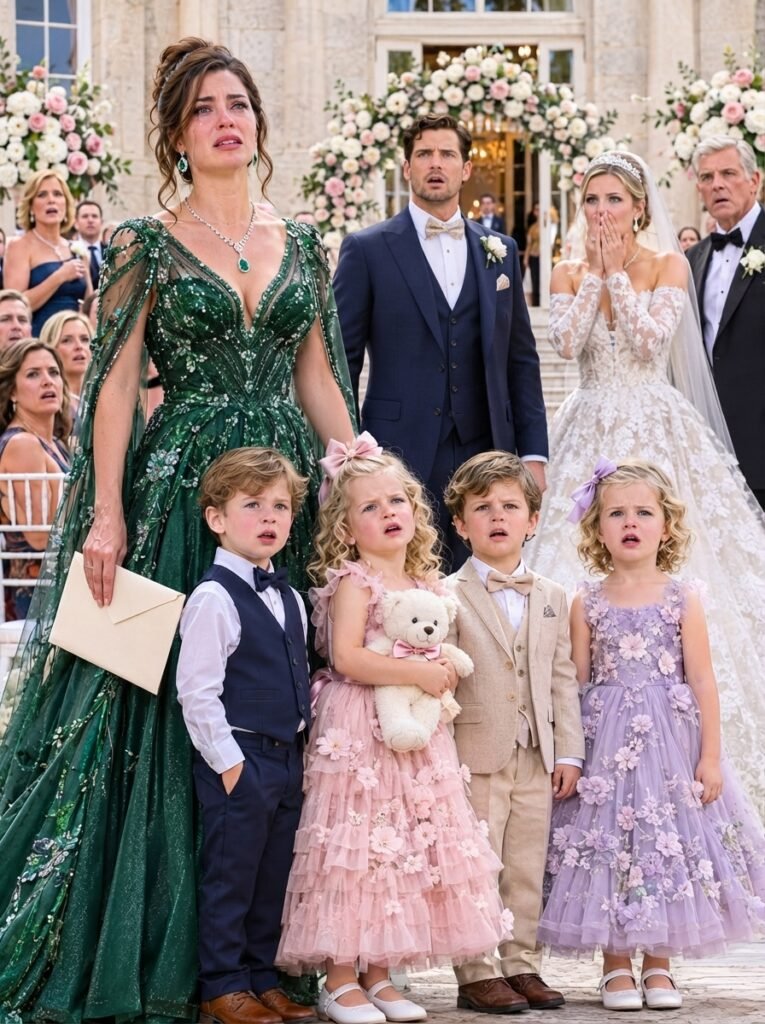
The wedding guests were gathering on the lawn when I walked through the garden entrance, holding Jasper’s hand while the other children followed close beside their nanny.
Grayson saw us first.
He looked from one child to another before turning toward me.
“Claire, whose children are these?”
I handed him the envelope.
“They’re yours, Grayson, and I thought you deserved to know before your family made any more decisions about who belongs here.”
His expression changed as he read the reports.
Across the terrace, Brittany stood motionless, her face revealing something I couldn’t immediately understand.
It wasn’t anger.
It was fear.
And within twenty-four hours, I would learn why.
PART 3
Grayson didn’t speak for a long time. The string quartet played on, oblivious, while he stood on the terrace with the papers shaking in his hand. Walter appeared at his shoulder, took one look at the four children, and went the color of old paper.
“This is a shakedown,” Walter said, too loudly. “Claire signed. She took twelve million dollars.”
“I took nothing I haven’t kept,” I said. “And I’m not asking for a dime, Walter. I’m asking that your son know his children exist.”
Jasper tugged my skirt. Sophie, who had Grayson’s gray eyes and his stubborn chin, stared up at him with open curiosity. Grayson crouched slowly in front of her. His hand trembled when he touched her cheek.
“Hi,” he whispered.
“Hi,” Sophie said gravely. “You have a funny tie.”
Someone behind us laughed, and then someone else gasped, and the wedding that was supposed to happen that afternoon quietly stopped happening.
The next morning, Grayson’s attorney called mine. He wanted a formal test, conducted by a court-approved clinic, with everyone present. I agreed at once. I had nothing to hide.
The clinic was in Hartford, a clean, quiet building with a waiting room full of magazines nobody read. Grayson arrived alone, unshaven, in yesterday’s shirt. Walter came with two lawyers. Brittany arrived last, with her three sons in a double stroller and a nanny, and she wouldn’t meet my eyes.
The doctor, a calm woman in her fifties named Dr. Eleanor Voss, took cheek swabs from the children, from Grayson, and from me. She explained that the lab would run a full analysis, and that results would take two days.
It took one.
She called us into a conference room the following afternoon. Grayson, Walter, the lawyers, Brittany, and me. Dr. Voss closed the door, folded her hands, and looked at a page of results for several seconds before speaking.
“I want to say first that the confirmation of paternity is clear,” she said. “Mr. Ashford is the biological father of all four of Claire’s children. There’s no ambiguity there.”
Walter exhaled, triumphant and furious.
“But,” Dr. Voss continued, “when we ran the comparison, I noticed something in Mr. Ashford’s genetic profile that I felt obligated to flag. It’s a marker associated with a very low sperm count, severe enough that natural conception would be extremely unlikely. It’s rare. Medically, it’s the kind of thing I’d expect to see documented in a man’s fertility history.”
Grayson frowned. “I’ve never had a fertility test.”
“That’s what I assumed,” she said. “But the three boys that Ms. Ward is carrying a claim for…”
She stopped. She turned to Brittany.
“Ms. Ward, I’m sorry, but I need to ask. Were your sons conceived naturally?”
The room went silent.
Brittany’s hands went white around her purse. She opened her mouth, and for a moment nothing came out.
“I’ll need a moment,” she said.
“Brittany,” Grayson said slowly. “What is she talking about?”
She looked at Walter.
It was a small movement. A flick of the eyes. But I saw it, and so did Grayson.
“Dad,” he said.
Walter’s lawyers shifted. One of them leaned over to whisper. Walter waved him away.
“Dad. What did you do?”
It came out in pieces, over the next hour, through a long, ugly conversation that Dr. Voss quietly excused herself from. Brittany, weeping, told the truth first.
Three years ago, before the marriage fell apart, Grayson and I had spent eight months trying to conceive. When nothing happened, we’d quietly gone to a specialist, a private clinic Walter had recommended. The tests had come back with a diagnosis: Grayson’s fertility was severely limited. The specialist had told Walter, because Walter had paid for everything, and Walter had decided Grayson shouldn’t know.
“He said it would crush you,” Brittany whispered. “He said an Ashford who couldn’t have children was an Ashford without a legacy.”
Instead, Walter had arranged for donor conception. Brittany, who had been Grayson’s assistant for two years and was desperate for money for her sick mother, had agreed to carry three children for the family in exchange for a large payment and a place in the Ashford household. Walter had told her it would be easier if Grayson believed the babies were his. He’d told her to let him believe it. He’d told her that if things went well, she might even marry him.
“I thought he was going to tell you,” she said, sobbing. “I thought it was all arranged. I didn’t know about…” She looked at me. “I didn’t know you were pregnant. I didn’t know it was possible.”
“It wasn’t supposed to be,” Dr. Voss said, when she came back in. “The marker Mr. Ashford carries is a significant barrier, but not an absolute one. In medical literature, there are documented cases of spontaneous conception in cases like his, though they’re exceptionally rare. Four children at once is rarer still.”
I looked at Grayson.
He was sitting very still, one hand on the table, staring at nothing.
“You told me the boys were mine,” he said, to Brittany, and his voice cracked. “You let me leave my wife for them.”
“Walter told me you knew.”
“I didn’t know anything.”
He turned to his father, and I’d never seen that look on his face before. It wasn’t rage. It was something more terrible, a man seeing his whole life from the outside.
“You took my marriage,” he said quietly. “You took my wife, and you took my children, and you handed me three more who aren’t even mine. For what? A name?”
“For the family,” Walter said hoarsely. “Grayson, I did it for the family. I couldn’t let it end.”
“It was never yours to end.”
Walter had no answer. For the first time in my life, I saw him look old.
The aftermath was not quick.
Grayson asked for a legal separation from Brittany that same week, though he insisted, to the lawyers and to her, that the three boys would be provided for. They had done nothing wrong. They were children, and they would always be able to count on him. Brittany, once the shock settled, agreed. She had never wanted to hurt anyone. She had been a frightened young woman with a sick mother and a powerful man’s promise. She cried when I told her I didn’t blame her, and then she asked, very quietly, if there was any way she could ever make it right.
“Be a good mother to them,” I said. “That’s all.”
Walter lost the family’s board seat within the year. The board, learning what he had arranged without his son’s knowledge, voted to remove him after an independent review. He retired to a house in Palm Beach, and he sent me three letters in two years. I didn’t answer the first two. I answered the third, a single sentence, and I won’t say what it was. Some things belong to me.
Grayson did not ask for me back.
I think that’s what finally made me trust him. He came to Vermont the first time on a gray March Saturday, alone, with a bag of children’s books and an expression like a man walking into a church he wasn’t sure he belonged in. He stood on my porch for a full minute before knocking.
“I don’t expect anything,” he said. “I just want to meet them. If you’ll let me. As slowly as you want.”
I let him in.
The twins, Sophie and Emmeline, studied him with the unnerving solemnity of three-year-olds. Jasper hid behind a couch. Owen, who had inherited his father’s curiosity, walked straight up and asked if he knew how to fix a toy train.
“I might,” Grayson said. “Can I see it?”
They spent the next two hours on the floor, in a tangle of wooden track, and I stood in the kitchen doorway pretending to dry a mug that was already dry.
He came every other weekend that spring. By summer, it was every weekend. He rented a small cottage on the edge of town, then bought it, then stopped pretending he was only visiting. He learned how to braid Emmeline’s hair, badly, and how to make Sophie’s favorite pancakes, which had to be shaped like animals. He learned that Jasper needed to be given room and would come to him when he was ready. He learned, slowly and humbly, that being a father wasn’t a title. It was a Tuesday afternoon with a scraped knee.
Brittany brought her boys to visit twice that summer. The seven children played in my yard like puppies, and nobody asked which ones were whose. Grayson carried Brittany’s youngest on his shoulders to the creek and set him down with the same care he gave to the others. When I watched him with all seven of them, I felt something I hadn’t expected: not jealousy, not bitterness, but a kind of quiet awe at how large a heart could turn out to be.
On a warm October evening, two years after the wedding that never happened, Grayson and I sat on my porch watching the leaves go copper over the Green Mountains. The children were inside, noisy and happy, arguing over a board game.
“I never said it properly,” Grayson said.
“Said what?”
“That I’m sorry. Not for what my father did. For what I did. I sat at that table, and I let you sign. I didn’t ask you to stay. I didn’t stand up.” His voice caught. “I’ve replayed that morning every night for three years. I wish I could go back and be the man you thought you married.”
I was quiet for a while.
“You can’t go back,” I said. “But you showed up. That’s different.”
“Is it enough?”
“It’s a start.”
He turned his face toward me. In the porch light, he looked tired and older and more real than he ever had in the big house in Connecticut.
“Claire. I’m not asking for anything tonight. But if someday…”
“Someday,” I said, and smiled. “Not tonight.”
“Not tonight,” he agreed, and laughed softly, and reached over to cover my hand with his.
Through the window, Sophie shouted, “Daddy! Emmeline is cheating!”
“I am not!” Emmeline shrieked.
We both stood, laughing, and went inside to referee.
The twelve million dollars is still in the bank, mostly untouched. I use it to fund a scholarship for single mothers who want to go back to school. It’s the only thing it was ever good for.
Everything I actually needed, I carried out of that dining room in my arms, long before I knew it was there.