For 34 mornings, I fed peanuts to a crow on my back porch. It started leaving me gifts. A bottle cap. A button. An earring. My HOA president fined me $500 for “feeding vermin.” On the afternoon my 6-year-old disappeared, the crow landed on my porch rail and dropped something at my feet. My daughter’s pink hair clip.
My name is Fiona Becker. I’m 36. I’m a graphic designer. I work from home in Bend, Oregon.
My daughter, Birdie, is six. Yes, her name is Birdie. She’s obsessed with every animal she’s ever seen.
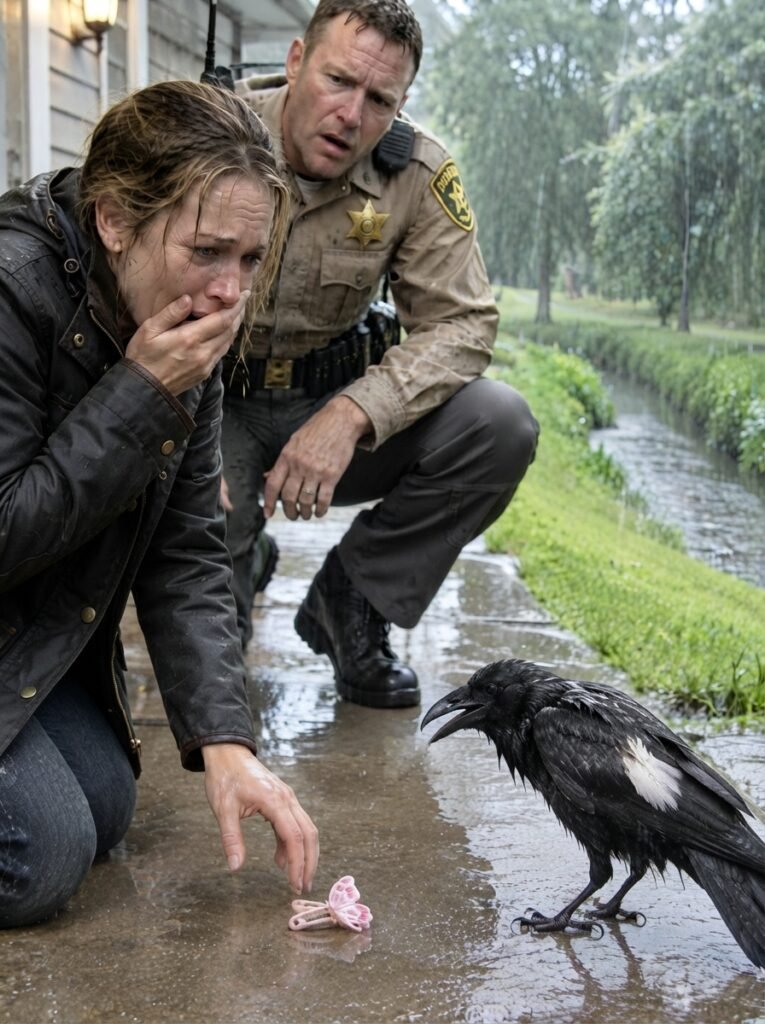
In September, a crow started showing up on our back porch railing every morning. Big. Glossy black feathers. One white feather on his left wing.
Birdie named him Edgar.
I started leaving a handful of unsalted peanuts on the railing. He’d wait until I went inside, then grab them and fly away.
Around the second week, he started leaving things behind.
A shiny blue bottle cap. A brass button. A tiny silver earring. A piece of green sea glass.
I looked it up. Crows do this. They recognize faces. They remember kindness. Some of them leave gifts for the people who feed them.
Birdie kept every gift in a jar on her windowsill.
Our HOA president, Mr. Dennison, did not think it was charming.
He lives three houses down. He measures people’s grass.
“Crows are vermin,” he told me over the fence. “They carry disease. They make noise. Stop feeding it, or I’ll fine you.”
He fined me. Five hundred dollars. A letter on official HOA paper.
Then he stopped me at the mailbox.
“If that bird keeps coming around,” he said, “I’ve got a pellet gun in my garage. Problem solved.”
I didn’t stop feeding Edgar. I just started doing it earlier.
On a Saturday afternoon in November, Birdie was playing in our backyard. The yard backs up to a wide green space with walking trails and an irrigation canal, fenced off from the houses.
I went inside to answer a work call. Six minutes.
When I came back out, Birdie was gone.
The back gate was open.
I screamed her name.
Within an hour, half the neighborhood was out searching. Then sheriff’s deputies. Then a search-and-rescue team with dogs. Then a helicopter.
Storm clouds were coming in over the mountains. It started to rain.
Mr. Dennison stood in the street with his arms crossed, watching the searchers walk through his lawn.
“Kids wander,” he said loudly to a deputy. “Maybe if she spent less time feeding birds and more time watching her daughter.”
I didn’t yell back at him.
I didn’t have room in me for anything except Birdie.
At 6:40 p.m., it was almost dark. The rain was getting heavier. A deputy had just told me they’d have to pause the ground search until morning if the storm got worse.
I went back to my porch to get a dry coat.
That’s when I heard wings.
Edgar landed on the porch railing three feet from me. He was soaking wet. He looked at me with one shiny black eye.
He dropped something on the wood at my feet.
A small pink plastic hair clip. Shaped like a butterfly.
Birdie’s.
She’d been wearing it that afternoon.
Edgar cawed. Loud. Once. Twice.
Then he flew off the railing, over the back fence, toward the green space. He landed on a fence post about fifty yards away.
He looked back at me.
And he cawed again.
I grabbed the deputy’s arm.
“He knows where she is,” I said.
The deputy looked at me like I was losing my mind.
Edgar flew to the next post. Toward the irrigation canal.
Waiting.
PART 2
“Ma’am, I don’t think—”
I was already running.
The deputy followed me. So did two search-and-rescue volunteers with flashlights.
Edgar flew from post to post ahead of us. Every time we got close, he flew to the next one. Every time, he looked back. Every time, he called.
He led us along the canal path, past the spot where the searchers had already looked. Down a steep embankment, into a gully thick with brush that nobody had searched, because it was outside the walking trails.
At the bottom of the gully, there was a big concrete drainage pipe. A culvert. Taller than a child, running under the road.
Edgar landed on top of it.
He cawed and cawed and wouldn’t stop.
I knelt down at the opening and shined my phone’s flashlight inside.
“Birdie? BIRDIE!”
From somewhere deep inside the pipe, a tiny voice.
“Mommy?”
Water was running along the bottom of the culvert. The rain was making it rise.
One of the rescue volunteers, a young man named Arlen, got down on his stomach and crawled into the pipe with a flashlight in his teeth.
Two minutes later, he backed out holding my daughter.
She was soaked and shivering, covered in mud, missing one shoe. Her lips were blue. But she was alive.
She’d followed a kitten through the back gate, she told us later. It ran into the gully and into the pipe. She crawled in after it to “rescue” it. Then she got scared and lost in the dark. She’d been sitting on a ledge of dry concrete inside, crying, for three hours.
“I heard everyone yelling,” she said. “But I was too scared to yell back. Edgar kept flying to the end of the pipe. He was talking to me.”
“He took your butterfly clip,” I said.
“It fell off when I was crawling,” she said. “He picked it up. I thought he was stealing it.”
He wasn’t stealing it.
He was bringing it home.
The paramedics treated Birdie for mild hypothermia. She spent one night in the hospital and came home with a stuffed crow from the gift shop.
The deputy who’d thought I was losing my mind came to our house the next day.
“Twenty-two years on the job,” he said. “I’ve never seen anything like that. That bird found her when our dogs couldn’t.”
The local news ran the story. Then a national news channel. Then a wildlife scientist from the university called me. She said crows can recognize individual human faces and remember people who are kind to them for years.
“Your crow knew your daughter,” she said. “And he knew you.”
Mr. Dennison came to my front door that week.
He had his hat in his hands.
“I owe you an apology,” he said. “And I’m canceling the fine.”
Then he held out a small paper bag.
Unsalted peanuts.
“For the bird,” he said. “From me.”
At the next HOA meeting, the board voted to install a locked grate over the culvert. They also voted to change one rule. Feeding wild birds is now allowed.
Edgar still comes every morning.
Birdie leaves the peanuts herself now. She talks to him while he eats.
Last week, he left one more gift on the porch railing.
A tiny pink plastic butterfly wing. The piece that had broken off her hair clip in the pipe.
Birdie put it in her jar, next to the bottle cap and the button and the earring.
“Now it’s complete,” she said.
THE END.