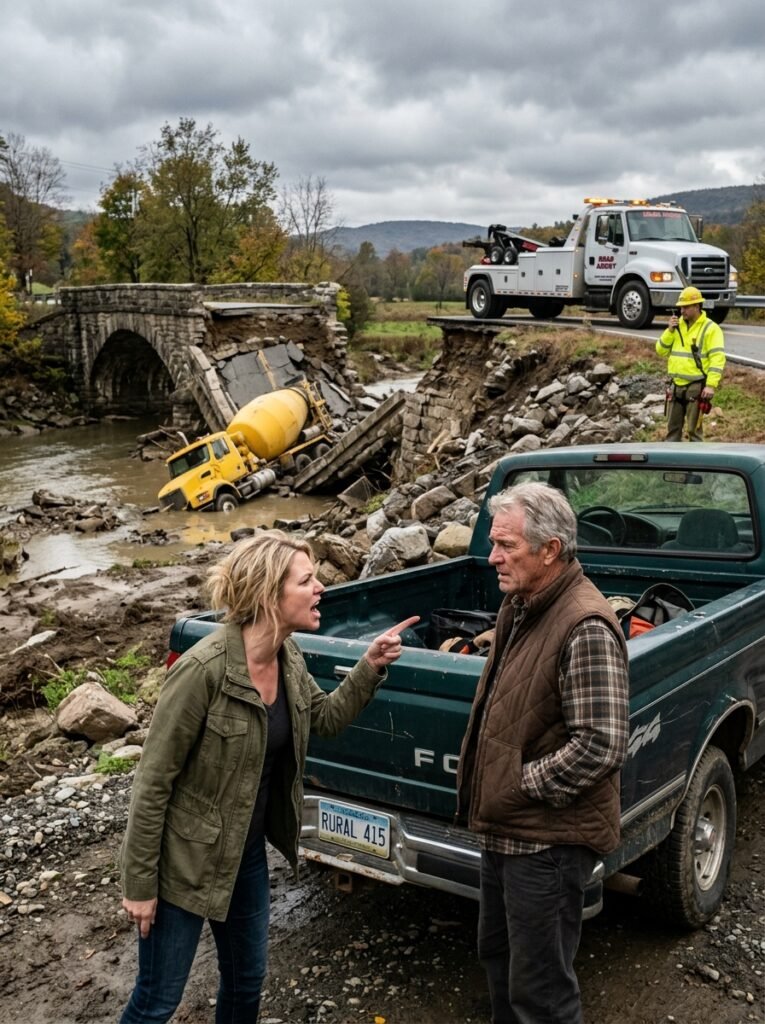
Tuesday morning, 6:30 a.m.
I was standing on my porch with a fresh cup of coffee when Derek’s first cement mixer of the day crested the hill.
The air brakes hissed like an angry snake.
The truck was fully loaded—easily 40 tons of wet concrete inside the spinning drum.
It hit the approach to my grandfather’s bridge going far too fast.
Rumble. Groan. CRACK.
The sound echoed across the water like a gunshot.
The center span of the 1923 fieldstone bridge finally gave way.
Fifteen tons of century-old masonry and 40 tons of spinning steel plummeted into Willow Creek.
Water exploded into the air as the truck slammed into the muddy bottom.
Instantly, the heavy mechanical silence was broken by a massive spark and the pop of severed conduit lines.
Across the creek, the streetlights in Millbrook Heights blinked out.
Forty-seven houses lost power, water, and internet simultaneously.
My phone erupted with automated alerts.
The weight sensors I’d installed were screaming, the HD cameras were recording, and emergency notifications were firing off to county services.
The trap I’d spent three months setting had just snapped shut with the precision of a Swiss watch.
I pulled out my phone and dialed 911 before the diesel smoke even cleared.
“County Emergency,” the dispatcher answered.
“Roman Kellerman reporting destruction of critical infrastructure by an unauthorized commercial vehicle,” I said calmly. “Bridge collapse has severed utilities for 47 residential properties. We need emergency services immediately.”
Within ten minutes, my driveway looked like a disaster movie set.
County vehicles, emergency utility crews, and environmental services flooded the property.
Inspector Bradley—the same inspector Marjorie had weaponized against me—stood on the bank, clutching his clipboard like a life preserver.
Derek was chest-deep in creek water beside his upended cement mixer, wet concrete hardening around his work boots.
That’s when Marjorie’s white BMW came screaming down the county road, parking haphazardly on the far side of the creek.
She jumped out, her crisp blazer already showing sweat stains, her perfectly styled hair falling out of place.
She took one look at the destruction, and her face cycled through shock, denial, and sheer terror.
“Derek, you absolute idiot!” she screamed across the gap. “I told you to be careful with that stupid bridge!”
“Aunt Marjorie, it just collapsed!” Derek yelled back. “Not my fault it couldn’t handle real trucks!”
Marjorie spotted me on my side of the creek, standing next to Inspector Bradley.
She immediately went into damage control.
“Inspector, this was clearly an accident!” she yelled. “Roman should have maintained his infrastructure better! The HOA will obviously contribute to reasonable repairs.”
Contribute to repairs.
After three months of systematic demolition, it was time to drop the bomb.
I stepped forward and opened my waterproof documentation case.
“Inspector Bradley,” I said, projecting my voice so Marjorie could hear every word. “Here is comprehensive documentation of systematic overloading beyond safe capacity. Derek’s trucks averaged 38 tons on a bridge rated for 15.”
Bradley’s hands shook as he flipped through my timestamped photographs, weight sensor data, and professional structural analysis.
“Mr. Kellerman,” Bradley muttered, wiping sweat from his forehead, “this is the most thorough property damage case I’ve ever seen.”
“It gets better,” I replied. “Environmental services will want the creek contamination evidence. And federal DOT investigators will love Derek’s falsified transportation weight reports.”
Derek went ghost white in the creek. “What falsified reports?”
“The ones claiming 15-ton loads while hauling 40-ton cement mixers across private property for twelve weeks,” I said. “That’s federal transportation fraud, Derek. That carries prison time.”
Marjorie’s mouth opened and closed like a landed fish.
“Now Roman, surely we can discuss reasonable compensation between neighbors,” she stammered.
Neighbors.
After threatening lawsuits, eminent domain, and systematically harassing me, she wanted to be neighbors.
The knockout punch arrived when County Commissioner Patricia Haynes pulled up with the emergency utilities team.
The Commissioner surveyed the severed infrastructure conduits sticking out of my destroyed bridge foundation.
Her expression shifted from professional concern to absolute horror.
“Mrs. Whitman,” the Commissioner shouted across the creek. “Do you understand that emergency utility rerouting will require environmental impact studies, historical preservation reviews, and creek diversion permits?”
Marjorie’s voice cracked. “How long?”
“Eighteen months of regulatory approvals. Minimum. Emergency temporary service alone will cost roughly $400,000, assuming no legal challenges.”
I watched Marjorie’s brain calculate the math of her own destruction.
Her Phase 2 development contracts required completion within 90 days.
Her entire multi-million dollar real estate empire had just drowned in Willow Creek.