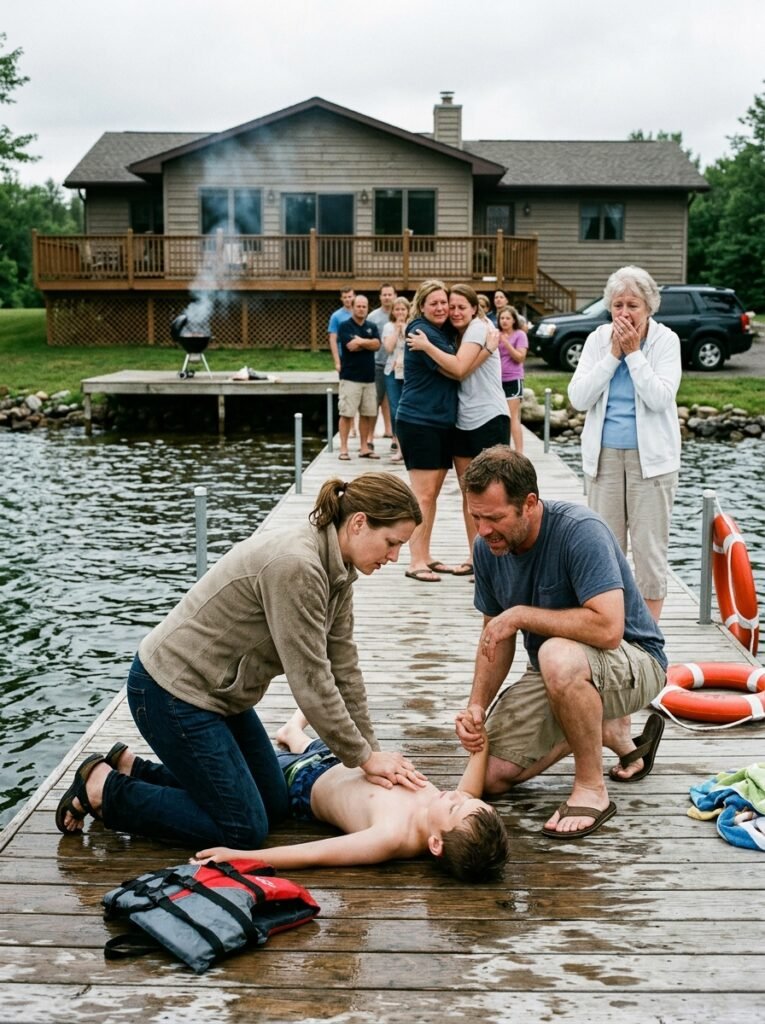
For several seconds after my brother told our mother to leave, nobody moved.
Mom remained in the middle of the waiting room with her purse clutched against her chest.
Her face had gone pale.
“You can’t seriously be blaming me for this.”
My brother looked at her.
“I’m blaming you for lying to us about Piper for years.”
“I never lied.”
“You told everyone she was pretending to be something she wasn’t.”
Mom looked toward me.
“Well, she never explained it properly.”
I almost laughed.
Not because anything was funny.
Because that sentence explained almost everything.
“I explained it for years.”
Mom frowned.
“I told you when I entered surgical residency.”
Silence.
“I told you when I completed my trauma fellowship.”
Her eyes moved away.
“I told you when I became an attending surgeon.”
I continued.
“I told you when I was promoted.”
My brother lowered his head.
“You didn’t misunderstand my career, Mom.”
She looked at me again.
“You preferred the version that made me smaller.”
The waiting room became painfully quiet.
For years, I had tried to understand why.
Maybe she thought my career made me arrogant.
Maybe my success made her uncomfortable.
Maybe reducing me to a punchline allowed her to keep the family hierarchy exactly where she wanted it.
I no longer cared enough to solve that puzzle for her.
The chief was still standing beside the emergency-department doors.
I turned toward him.
“Sorry.”
“You don’t owe me an apology.”
Then he quietly motioned for me to follow.
I looked toward my brother.
His face was still pale.
“Stay with your wife.”
He nodded.
“What about Colton?”
“The team will tell you everything they can as soon as they can.”
I paused.
“And whatever happens, what happened on that dock was not your fault alone.”
His eyes filled.
“We should’ve been watching him.”
“Yes.”
I wasn’t going to lie because he was hurting.
“There were a lot of adults there. Someone should have noticed.”
He nodded.
Then whispered:
“You did.”
I looked at him.
“You noticed.”
His voice broke.
“And I was standing twenty feet away.”
There was nothing useful I could say to erase that.
So I touched his shoulder once.
Then followed the chief into the corridor.
He waited until the doors closed behind us.
“What happened out there?”
“Possible drowning. I found him unresponsive in the lake and started resuscitation on the dock.”
“I heard.”
He studied my soaked clothes.
“Fourteen minutes?”
“Approximately.”
“You kept him going until EMS arrived.”
“Yes.”
The chief nodded slowly.
“Then you gave that boy the best possible chance before he ever reached us.”
I looked through the small window toward the treatment area.
“He’s my nephew.”
“I know.”
That was why he did not ask me to treat Colton directly.
I was family.
Too close.
Too frightened.
No amount of training turned me into a neutral physician while my nephew was behind those doors.
The chief had called me in because another critical patient had arrived unexpectedly and the department needed my expertise.
For a moment, I hesitated.
Part of me wanted to stay in the waiting room.
Then I remembered something medicine had taught me long before my family ever believed I practiced it.
You cannot control every outcome.
You can only do the next necessary thing.
So I changed into hospital scrubs.
Washed the lake water from my hands.
And went to work.
For the next stretch of time, I was not the sister whose family mocked her.
Not the aunt waiting for news.
Not the daughter who had spent years defending herself.
I was simply Dr. Piper.
The same person I had always been inside those walls.
When I eventually returned to the waiting room, my mother was gone.
My brother had moved his chair beside his wife.
He stood the moment he saw me.
“Anything?”
“Not from me.”
I sat across from him.
“His team will speak with you.”
He nodded.
Then:
“I’m sorry.”
I looked at him.
“For today?”
“For all of it.”
He rubbed his hands over his face.
“The nurse jokes. The clinic jokes. Acting like you exaggerated everything.”
I said nothing.
“I should’ve asked.”
“Yes.”
“I should’ve believed you.”
“Yes.”
He almost smiled through the shame.
“You’re not making this easy.”
“I’m not trying to.”
He nodded.
“That’s fair.”
A few minutes later, the physician caring for Colton came through the doors.
My sister-in-law stood so quickly her chair nearly fell.
The doctor explained that Colton had responded to treatment and would need continued monitoring after the drowning event.
There were still things they would watch carefully.
Nobody in that room treated the news as a guarantee.
But Colton was alive.
Breathing.
Receiving care.
My brother began crying.
His wife collapsed against him.
And for the first time since I had seen that small body floating on the lake—
I allowed myself to cry too.
Not because my family finally knew I was a doctor.
Not because my mother had been embarrassed.
Because Colton was still there.
That was the only victory I had wanted.
Colton was moved to the pediatric ICU two hours later, still sedated, a tube taped carefully at the corner of his mouth, monitors tracking every breath his small chest managed on its own. My brother, Wes, stood at the glass for a long time before he could bring himself to go inside, and when he finally did, I stayed in the hallway, giving him and his wife, Marisol, the space to be with their son without an audience.
I didn’t go home that night. I sat in the family waiting area in borrowed scrub pants, my own clothes still damp in a plastic bag beside me, and let the adrenaline finally drain out of my body in slow, uneven waves.
Around midnight, Wes found me there.
“You should go home,” he said. “You’ve been awake for almost twenty hours.”
“So have you,” I said.
He sat down heavily beside me, rubbing his palms against his knees. “Marisol’s with him. I needed to walk for a minute.”
We sat in silence for a while, the hospital humming quietly around us, before he finally spoke again.
“I keep replaying it,” he said. “The lake. I was right there, Piper. I was talking to Uncle Ray about the grill, and I looked up, and you were already running.”
“I saw the water move wrong,” I said. “That’s all it was. A pattern I’ve learned to notice.”
“Because you’re a doctor,” he said. “Because you spent years training for exactly that kind of moment, and we spent years making fun of you for ‘playing nurse.'” His voice cracked on the last words. “I said that. At Thanksgiving. Two years ago. I actually said that to your face.”
“I remember,” I said.
“I’m not asking you to forgive me tonight,” he said. “I know that’s not fair to ask for, especially with Colton still in there. I just need you to know that I understand now what it actually cost you, being dismissed like that for so long, and I understand it because I almost lost my son standing twenty feet away from the one person in this family who actually knew what to do.”
I looked at him for a long moment, exhaustion and grief and something more complicated than forgiveness sitting heavily between us.
“I didn’t save him to prove anything to this family,” I said. “I saved him because he’s my nephew, and because it’s what I would have done for any stranger on that dock. But I won’t pretend it doesn’t mean something, you finally seeing it.”
“What do you need from me?” he asked. “Genuinely. Not to make myself feel better. What do you actually need?”
I thought about it honestly before answering. “I need you to say something the next time Mom does it again. Not to me. To her. In the moment, not after, when it’s safe and the damage is already done.”
“I can do that,” he said.
“I hope so,” I said. “Because I’m tired of being the only one defending my own life’s work at family dinners.”
He nodded, and for the first time in years, I believed he actually understood what that sentence had cost me to say out loud.
Colton’s recovery over the following days was slow but steady. The pediatric team monitored him closely for any signs of secondary complications from the near-drowning, a real and serious risk in the hours and days after an incident like his, but by the third day, he was breathing entirely on his own, and by the fifth, he was well enough to ask, groggily, whether he’d missed the rest of the barbecue.
Marisol laughed and cried at the same time when he asked that, and Wes had to leave the room for a moment to collect himself in the hallway.
My mother didn’t come to the hospital again after that first day. She called Wes twice, asking for updates, but made no effort to reach out to me directly, no acknowledgment of what had happened in that waiting room, no attempt to address the years of dismissal she’d built into a kind of family folklore.
I wasn’t surprised. Some people, faced with an inconvenient truth, simply wait for everyone else to stop talking about it rather than actually reckoning with it.
Colton was discharged nine days after the incident, thinner and quieter than the boy who’d run laughing toward the lake at that barbecue, but alive, stable, and cleared by every specialist who’d monitored his recovery. Marisol cried again in the hospital lobby, this time from relief instead of fear, and Wes carried his son out to the car like he was made of glass, though the pediatrician had assured them Colton could resume normal activity within a few weeks.
Three weeks later, my parents hosted what they called a “family dinner,” though everyone who received the invitation understood it was really an attempt to smooth over what had happened at the hospital without actually addressing any of it directly. I almost didn’t go. Wes called me the night before, asking if I’d come, admitting he suspected our mother was planning to treat the entire incident as something the family could quietly move past without discussion.
“I told her that’s not happening,” he said. “But I think you should be there when I say it to her face.”
I went, mostly for Wes, and partly because some stubborn part of me refused to let my mother rewrite the narrative in my absence, the way she’d been doing for years every time I wasn’t in the room to correct her.
Dinner started the way these dinners always did, my mother directing conversation with practiced control, steering carefully around any mention of the lake, of Colton’s hospitalization, of what had actually happened in that emergency room waiting area three weeks earlier. She asked about Wes’s work, complimented Marisol’s dress, and mentioned, almost as an aside, that she’d been “so relieved everything worked out fine” with Colton, phrasing it as though the outcome had simply happened rather than being the direct result of fourteen minutes of CPR performed by the daughter she’d spent years dismissing.
Wes set down his fork.
“Mom,” he said. “We need to talk about what happened at the hospital.”
My mother’s smile tightened. “Everything worked out. I don’t see the need to relitigate a stressful day.”
“Piper saved Colton’s life,” Wes said. “And you told her to leave the waiting room because you were embarrassed that your accusation about her lying about her career turned out to be wrong.”
The table went quiet. My father, who had spent most of these family conflicts over the years staying carefully neutral, glanced between my mother and Wes with visible discomfort.
“I never said she was lying,” my mother said. “I simply said she exaggerated—”
“She’s a trauma surgeon, Mom,” Wes said, his voice rising slightly. “She has been for years. You’ve told people at church she works as a receptionist. You told Aunt Denise she ‘plays doctor’ on the weekends. You’ve spent a decade making her accomplishments into a joke, and three weeks ago, those exact accomplishments are the only reason my son is alive.”
My mother’s composure finally cracked, though not into the apology I suspected Wes was hoping for. “I don’t understand why everyone is suddenly ganging up on me. I raised both of you. I don’t deserve to be attacked at my own dinner table.”
“No one’s attacking you,” I said quietly, the first thing I’d said since the conversation started. “Wes is asking you to acknowledge something true. That’s different from an attack.”
My mother turned to me, something brittle and defensive in her expression. “I suppose you think you’re better than the rest of us now. With your fancy title.”
“I don’t think I’m better than anyone,” I said. “I think I’m tired of defending a career I’ve spent fifteen years building, at every single family gathering, because acknowledging it honestly seems to threaten something in you that I’ve never fully understood.”
The silence that followed stretched long enough that Marisol quietly excused herself to check on Colton, who was napping in the guest room, clearly unwilling to referee a conflict that had nothing to do with her.
My father finally spoke, his voice quiet but firm in a way I rarely heard from him. “Elaine, they’re right. I’ve watched you do this for years, and I never said anything, because it was easier not to. But Piper saved our grandson’s life three weeks ago, and the first thing you did was ask her to leave the room. I’m ashamed I never stopped you from treating her that way sooner.”
My mother stared at her plate for a long moment, and when she finally looked up, something in her face had shifted, not quite remorse, but perhaps the first real crack in a defense she’d been maintaining for years.
“I don’t know why I did it,” she admitted quietly. “Maybe I was jealous. Maybe I never understood how someone like Piper came from someone like me. I don’t have a good explanation, and I’m sorry that’s the best I can offer right now.”
It wasn’t the full apology I’d waited years to hear, but it was, for the first time, an honest admission rather than a deflection, and I found myself surprised by how much that small shift actually mattered.
The months following that dinner didn’t transform my mother into a different person overnight, and I’d learned enough about human nature, both from my training and from thirty-six years of being her daughter, to know that expecting a sudden, complete reversal would only set me up for disappointment. What changed instead was smaller, quieter, and in some ways more meaningful than a dramatic apology ever could have been: she stopped.
She stopped making the joke about me “playing doctor.” She stopped introducing me at gatherings as someone who “does something in a hospital.” When my aunt Denise asked, at a cousin’s baby shower two months later, what exactly I did for work, my mother answered before I could, her voice steady and, for the first time in my memory, accurate.
“Piper’s a trauma surgeon,” she said. “She’s been an attending for three years now. She’s very good at what she does.”
It was such a small sentence, five words of simple, factual description, and it landed in my chest with a weight I hadn’t expected. I caught her eye across the room, and neither of us said anything about it, but something passed between us that felt, for the first time in longer than I could remember, like an actual acknowledgment rather than a performance.
That didn’t mean everything was suddenly resolved. There were still moments, smaller ones, where old patterns tried to reassert themselves. A comment at Christmas about how I “must be too busy for a real relationship” that carried the faint echo of old dismissiveness. A tendency to ask Wes more questions about his sales job than she ever asked me about my cases, though I noticed, each time, that she caught herself a beat sooner than she used to, sometimes circling back with an actual question about my work that she clearly didn’t know how to ask but was trying to learn.
I didn’t rush to forgive her fully, and I didn’t pretend the years of dismissal hadn’t left real scars. In my own therapy, which I’d started attending regularly after Colton’s incident, once I recognized how much of my own perfectionism and difficulty accepting praise traced directly back to a childhood spent constantly defending my own reality against a parent who preferred a smaller version of me, I worked through what it actually meant to have a relationship with someone who had caused real harm and was only now, slowly, beginning to reckon with it.
“You don’t owe her instant forgiveness,” my therapist told me during one of our sessions. “But you also don’t have to hold the door permanently shut if she’s genuinely trying to walk through it differently this time. Those two things can coexist. Boundaries and openness aren’t opposites.”
Colton, for his part, made a full recovery, the kind of resilient, complete healing that pediatric specialists had cautiously hoped for but hadn’t wanted to promise in those early, uncertain days. He returned to school within a month, back to swim lessons within three, his parents watching him in the water now with a vigilance that never fully relaxed but no longer carried the sharp edge of terror it once had.
He became, in an unexpected way, one of my favorite people to spend time with. Something about nearly losing him had deepened my relationship with my nephew beyond the usual aunt-and-nephew dynamic, and he’d taken to calling me, with the particular seriousness eight-year-olds bring to important declarations, “the doctor who fixed my breathing.” I never corrected the slightly oversimplified version of events, understanding that a child’s need to make sense of trauma often required a story simpler than the full, complicated truth.
Wes, true to his word, became the family member who actually intervened when old patterns threatened to resurface. At a family reunion the following summer, when a distant cousin made an offhand joke about doctors who “think they’re better than everyone else,” Wes cut in immediately, his voice firm in a way I’d never heard him use with extended family before.
“My sister saved my son’s life,” he said. “I don’t find jokes about her career very funny anymore.”
The cousin, embarrassed, apologized and quickly changed the subject, but I caught my mother’s eye across the picnic table in that moment, and for once, she didn’t look defensive or dismissive. She looked, instead, like someone quietly proud of a decision that had nothing to do with her own actions, watching her son do the thing she herself had failed to do for years.
I continued working at the hospital with the same intensity I always had, though something about that dock, those fourteen minutes of counting compressions while my own family stood twenty feet away unaware, had changed how I approached certain parts of my work. I started volunteering with a local water safety education program, teaching parents and caregivers the exact signs I’d noticed that afternoon, the quiet, unremarkable stillness of a child in genuine distress in the water, so different from the splashing, noisy struggle most people imagined drowning looked like.
“Most people picture screaming and flailing,” I told one group of parents during an evening session at the community pool. “Real drowning is often silent. The body focuses entirely on trying to breathe. There’s no energy left for waving or yelling. If a child suddenly goes quiet and still in the water, that’s often the moment that matters most, not the loud moments everyone expects to notice.”
I thought, every time I taught that session, about the specific stillness that had caught my attention at that barbecue, the pattern I’d trained years to recognize almost unconsciously, and about how differently that afternoon could have ended if I hadn’t happened to be standing close enough, looking in the right direction, carrying knowledge my own family had spent years pretending didn’t exist.
A year after the incident, my mother asked if she could come to the hospital and see where I worked, an offer she’d never once made in the fifteen years I’d been in medicine. I gave her a careful, limited tour, mindful of patient privacy, showing her the trauma bay, the OR observation deck, the small on-call room where I’d spent countless overnight shifts building the career she’d spent years minimizing.
She was quiet for most of the tour, absorbing details I suspected she’d never actually considered in any real way before, the equipment, the pace, the constant low hum of controlled urgency that defined the environment I’d chosen for my life’s work.
“I had no idea,” she said finally, standing in the doorway of the trauma bay where I’d once, years earlier, worked my first solo case as an attending. “I don’t think I ever let myself understand what this actually was. It was easier to imagine something smaller.”
“Why?” I finally asked her directly, a question I’d carried for years but never had the right moment to voice.
She was quiet for a long time before answering. “Because if I let myself see how remarkable you actually became, I would have had to admit how small I made myself feel by comparison. It was never really about you, Piper. It was about my own fears about what I never did with my own life. I’m sorry it took nearly losing Colton for me to finally say that honestly.”
It wasn’t a complete resolution, and I understood that some of the damage from those years would likely never fully heal, certain reflexes of self-doubt and the need to over-prove myself that I still caught myself falling into, even now, even with a career full of concrete, undeniable evidence of my own competence. But it was, finally, an honest answer to a question I’d wondered about for most of my adult life, and something about hearing it, even years too late, allowed a part of me to finally exhale.
Two years after that afternoon on the dock, our family gathered again for another barbecue, the same lake, the same house, though this time every adult present had internalized, without needing to discuss it explicitly, a level of vigilance around the water that hadn’t existed before. Colton, now ten, swam confidently and happily, occasionally glancing toward the shore to find an adult watching, a habit he’d developed himself in the aftermath, needing that reassurance in a way none of us questioned or discouraged.
I sat on the dock that afternoon, watching him swim, my mother beside me in a folding chair, the two of us settled into a comfortable, unhurried silence that would have been unimaginable a few years earlier.
“You still watch the water differently than the rest of us,” she observed.
“I probably always will,” I said. “Some things you can’t unlearn once you’ve seen how quickly they can go wrong.”
She nodded, watching Colton dive under and resurface, laughing at something one of his cousins had said.
“I’m glad you were the one who noticed,” she said quietly. “I know I don’t get to say that without acknowledging everything that came before it. But I am glad, Piper. More than I’ve ever properly told you.”
I looked at her, searching for the old defensiveness, the reflexive need to minimize, and found, for once, something that looked like genuine, uncomplicated gratitude instead.
“Thank you for saying that,” I said. “It means more than you probably realize.”
We sat together for a while longer, watching the water, watching Colton and his cousins splash and laugh in the late afternoon sun, two women who had spent years locked in a quiet, painful misunderstanding finally finding a small, imperfect peace in the aftermath of nearly losing something neither of us could have survived losing.
I thought, watching the water settle into stillness after Colton’s latest dive, about the particular alchemy of crisis, how it strips away the performances people build over years and forces, sometimes, an honesty that comfort never demands. I hadn’t wanted that lesson delivered the way it had been delivered. I would have traded every ounce of vindication I’d felt in that hospital waiting room for Colton to have never needed saving at all.
But given that the crisis had happened, given that fourteen minutes on a dock had changed the entire trajectory of my family’s relationship with the truth, I found myself grateful, in the quiet, complicated way survivors of hard things often are, for whatever fragile, hard-won understanding had managed to grow out of it.
My mother reached over and took my hand, an unfamiliar gesture between us, and we sat there together, watching the boy I’d saved swim happily in the water that had once nearly taken him, finally, imperfectly, at peace.