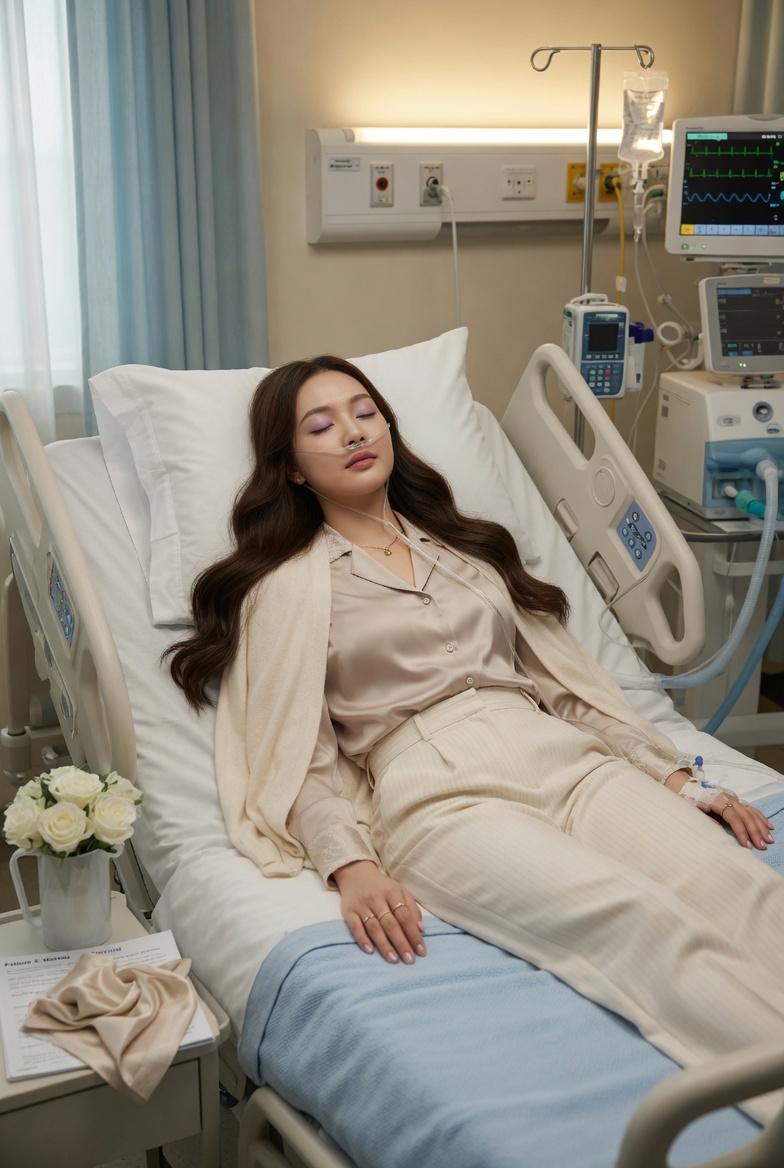
By morning, I hadn’t slept at all.
The sky turned from black to slate to that pale Maine winter blue that makes everything look washed out. I made coffee I didn’t drink. I stood in Bree’s doorway and watched her chest rise and fall like it was the only proof the world still worked.
Mrs. Powell arrived at nine, took one look at me, and sighed.
“You look like you got hit by a truck,” she said.
“I need to ask you something,” I replied.
She set her tote bag down slowly. “Okay.”
I shut Bree’s bedroom door behind us and lowered my voice like the walls had ears. “Do you recognize this medication?” I slid my phone across the nightstand. On the screen was a paused frame from the video: Alyssa’s gloved hand holding the syringe. The label on the vial was blurred, but the cap color was distinct—bright orange.
Mrs. Powell frowned, leaned closer. “That looks like midazolam,” she said after a moment. “A benzodiazepine. Sedative. Why?”
My mouth tasted like pennies. “Because someone’s been giving it to her at night.”
Mrs. Powell’s face went still in a way that made her look older. “Who?”
I didn’t say Alyssa. Saying it felt like making it real.
Instead, I asked, “Would it show up in her chart?”
“It should,” she said sharply. “If it’s prescribed.”
“And if it’s not?”
She stared at me, and I could see her mind rearranging the last few months—Alyssa’s “questions,” my fatigue, the subtle changes she must’ve noticed and dismissed.
Mrs. Powell straightened her shoulders. “Matthew, if someone is sedating your wife without a physician’s order, that is criminal.”
I let out a shaky breath. “I have proof. Video.”
For a second, something like relief flickered across her face—relief that I wasn’t imagining it. Then her jaw tightened.
“Call her neurologist,” she said. “Right now.”
Bree’s neurologist is Dr. Ellison, a man with careful hair and careful words. He’s the kind of doctor who always sounds like he’s reading from a brochure.
When his office picked up, I didn’t introduce myself politely. I said, “My wife is being sedated at home without my consent. I need her medication list and refill history.”
There was a pause—paper shuffling, a muffled voice asking who was on the line.
Then Dr. Ellison came on, voice smooth. “Mr. Rourke, it’s unusual to discuss—”
“I’m not discussing,” I snapped. “I’m telling you. Someone is administering midazolam through her feeding line at night. If your office ordered it, I’ll know. If you didn’t, I’m calling the police.”
Silence again. Longer this time.
“Mr. Rourke,” he said finally, and the carefulness in his tone slipped just enough for me to hear strain, “midazolam is not on her current regimen.”
Mrs. Powell, standing beside me, mouthed, Thank God.
“Then how is it getting into my house?” I demanded.
“I… don’t know,” Dr. Ellison said. “But if you suspect misuse, you need to bring her in. Immediately.”
Bring her in. To the hospital. Back into their system. Back into the place where she became a case number.
My hand clenched around my phone. “I’ll bring her in,” I said, “after I understand how my wife’s meds are being altered.”
Dr. Ellison exhaled. “I can print her prescription history. Pick it up today.”
After I hung up, Mrs. Powell looked at Bree, then at me.
“I’m going to stay late,” she said. “I don’t care what my schedule says.”
That should’ve comforted me. Instead, dread pooled in my stomach like cold water.
Because Mrs. Powell could stay late, but she couldn’t stay forever. And Alyssa had a key.
That afternoon, I drove to Dr. Ellison’s office and picked up the printout. The paper felt too light for how much it mattered.
Bree’s medications were listed in neat columns. Feeding formula. Anti-seizure meds. Muscle relaxants. All expected.
Then, in smaller type, there it was: “PRN sedation—midazolam.” Prescribed six months ago. The prescribing physician wasn’t Dr. Ellison.
It was Dr. Kent Marlowe.
The name made my skin prickle because I recognized it the way you recognize a face you’ve seen once in a grocery store aisle.
Dr. Marlowe ran a private “recovery clinic” thirty miles south—one of those glossy places with calming fonts and vague promises. Alyssa’s friend group talked about it sometimes, like it was a miracle factory.
I stared at the paper until the words blurred.
Alyssa hadn’t just decided to drug Bree. She’d gotten a doctor involved. A prescription. A paper trail.
My sister wasn’t improvising. She was executing a plan.
On the drive home, my phone buzzed.
Alyssa: Hey! Just checking in. How was Boston? Want me to swing by tonight?
My hands tightened on the steering wheel so hard my knuckles ached.
I texted back: Sure. Come by around 8.
It was a lie. A trap. I didn’t know which.
That evening, I made spaghetti because I needed something normal to do with my hands. The sauce simmered and smelled like garlic and tomatoes, and for a minute I remembered Bree leaning over the stove, tasting, adding salt like it was a secret ingredient.
At 7:55, Alyssa knocked, bright and casual, carrying a bag of cookies like she was a neighbor, not a thief.
“Look at you,” she said, stepping inside. “You look wiped.”
“Yeah,” I said, forcing a smile that felt like cracked glass. “It’s been a week.”
Alyssa’s eyes flicked toward Bree’s hallway. “How’s she doing?”
“Same.”
She nodded like that was expected, then flashed me a grin. “I brought snickerdoodles. Because you eat like garbage when you’re stressed.”
We ate dinner at the table like siblings who hadn’t been at war for six years. Alyssa talked about her job, her dating life, the new brewery downtown. I listened, answered in short phrases, my mind tracking every movement of her hands.
After dinner, she stood and stretched. “I should say hi to Bree,” she said lightly, like it was a sweet thought.
My pulse jumped. “Sure,” I said. “Go ahead.”
Alyssa walked down the hall without hesitation. Like she owned the place.
I followed a few steps behind, quiet. I watched her pause in Bree’s doorway, her face softening.
“Hey, babe,” Alyssa murmured, stepping in. “It’s me.”
She leaned over Bree’s bed and brushed hair off Bree’s forehead. The gesture was almost convincing.
Then Alyssa’s gaze drifted to the nightstand drawer. The one with the TRUST folder. Her eyes lingered there for half a second too long.
My throat tightened.
Alyssa turned back to Bree, voice low. “You doing okay in there? You being good?”
Bree’s face didn’t change.
Alyssa smiled anyway, then looked over her shoulder at me. “You’re doing an amazing job, Matt. Seriously.”
The words hit like a slap. Amazing job. At being played.
I forced myself to nod. “Thanks.”
Alyssa lingered another moment, then left the room and headed for the front door.
“Text me if you need anything,” she said, slipping on her shoes.
“I will,” I replied, my voice steady despite the earthquake inside me.
After she left, I locked the door. Then I went back to Bree’s room and sat beside her bed, staring at her closed eyes.
“Bree,” I whispered, my voice rough. “Can you hear me?”
Her breathing stayed even. The monitor blinked. The pump clicked.
I pulled a notepad from the drawer and a marker. My hands shook as I wrote the alphabet in big block letters.
“This is going to sound insane,” I murmured, “but if you can… if you can, blink when I get to the right letter.”
I started. A… B… C…
Nothing.
D… E… F…
Nothing.
I swallowed hard, trying to keep my voice steady. “Bree, please.”
G… H… I…
Her eyelid fluttered.
It could’ve been a reflex. It could’ve been a twitch.
But it happened again when I reached L.
My heart slammed against my ribs.
I kept going slowly, my mouth dry, my entire world narrowed to her lashes.
At M, her eyelid fluttered again.
At A, again.
At R—
Her lips moved, and this time there was sound. A breathy scrape of voice against air.
“He… knows.”
My stomach dropped so hard it felt like falling.
Who was “he,” and what did he know about me finding out?