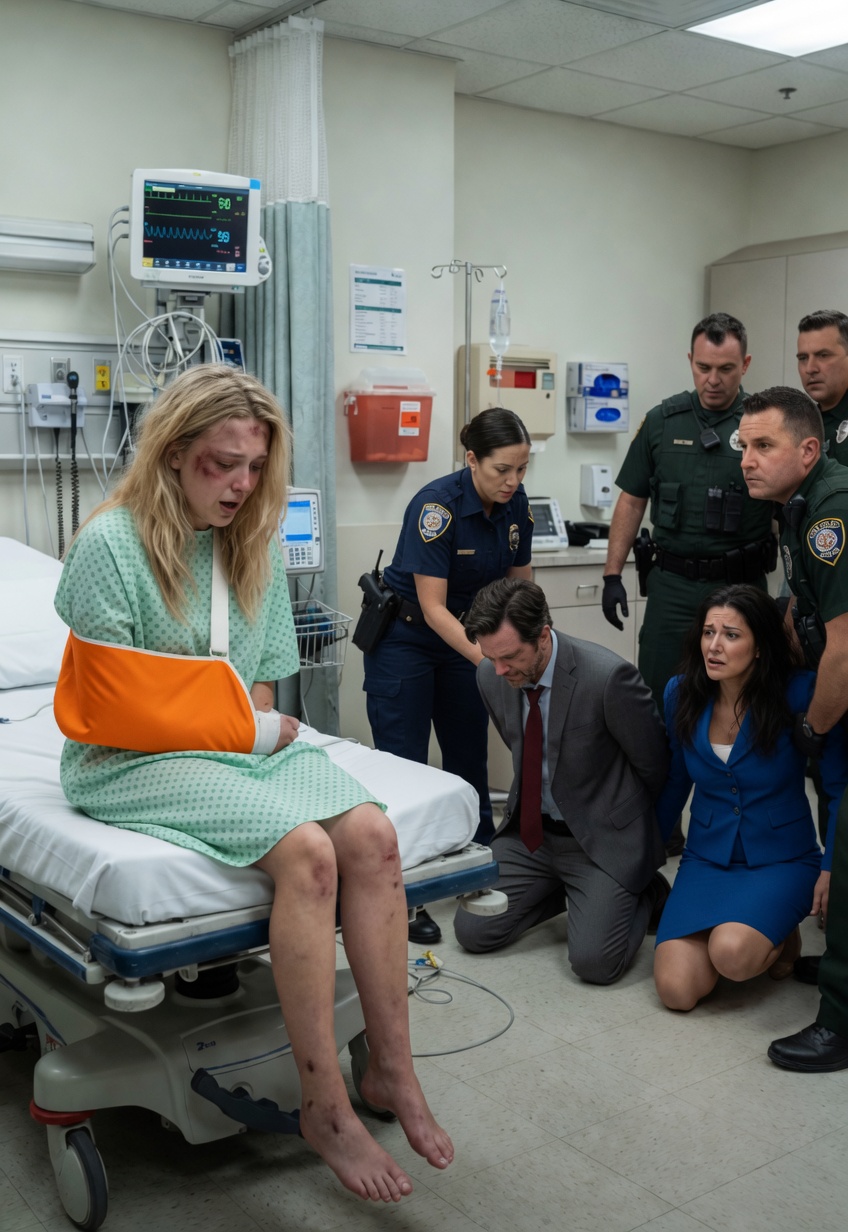
Six months later, the justice system, usually a sluggish, bureaucratic beast, moved with terrifying, unprecedented speed.
When faced with sixty high-definition videos and over a hundred crystal-clear audio recordings, the defense strategy for Victor Hale completely collapsed. There were no plea deals offered. There was no sympathy from the judge. The trial lasted less than three days.
Victor was sentenced to fifteen years in a maximum-security state penitentiary, without the possibility of parole, for multiple counts of aggravated child abuse and felony assault. His construction company, already drowning in debt, was immediately liquidated. The heavy leather chair in the dining room, his throne of cheap whiskey and tyranny, was repossessed and sold at auction to pay his mounting legal fees.
Elaine Hale did not escape the blast radius. Confronted with undeniable video evidence of her complicity and active cover-ups, she was stripped permanently of her parental rights. She avoided prison time by testifying against Victor, but she was handed a five-year suspended sentence and a thousand hours of community service. Her country club friends abandoned her. Her neighbors shunned her. She was forced to move into a tiny, dilapidated apartment on the wrong side of the city, living the rest of her days in the very isolation and poverty she had sacrificed her daughter to avoid.
But for Mara, the world had fundamentally shifted on its axis.
It was a bright, unusually warm Saturday morning in early May. The air smelled of blooming jasmine and freshly cut grass.
Mara stood on the wide, wrap-around wooden porch of a sprawling Victorian house in the countryside. It was a specialized, highly vetted foster home run by a retired trauma nurse and her husband. The house was filled with light, the sound of dogs barking in the yard, and the chaotic, wonderful noise of safety.
Mara was wearing a simple, oversized yellow sundress. Her right arm, freed from the heavy fiberglass cast just two weeks prior, hung comfortably at her side. A long, faint, silvery scar ran down her forearm where the orthopedic surgeons had inserted a titanium plate to fuse the spiral fracture. She didn’t hide it. It wasn’t a mark of shame; it was a battle scar. It was the physical receipt for her freedom.
She no longer walked with her shoulders hunched forward, trying to make herself invisible. She no longer hid her face behind a curtain of long, unkempt hair. She stood tall, her posture relaxed, her eyes bright and clear.
In her hands, she held a heavy, professional-grade DSLR camera. It was a gift from Sarah Hayes, the lawyer who had fought so fiercely for her in court.
Mara raised the heavy camera, her fingers adjusting the focus ring with practiced, deliberate precision. She aimed the lens out over the rolling green hills, past the wooden fence, aiming directly up into the vast, endless expanse of the cloudless blue sky.
She closed one eye, peering through the viewfinder, framing the golden, blinding light of the morning sun.
As she adjusted the aperture, allowing the light to flood the sensor, a quiet, profound realization settled deep within her chest.
He used to call me his cheap entertainment, Mara thought, a soft, genuine smile touching her lips. He thought he was the master of the house, the director of a play where I was just a prop to be broken for his amusement. He thought that because I was silent, I was participating in his script.
She adjusted the shutter speed, perfectly balancing the exposure.
But he forgot the most fundamental, ancient rule of the theater, she mused, the warmth of the sun kissing her unbruised cheeks. The monster stomping around on the stage isn’t the one in control. The person sitting in the dark, quietly holding the camera, framing the shots, and deciding exactly what the audience will see… that is the person who truly owns the narrative.
Mara took a deep, unrestricted breath of the clean spring air. She pressed her finger down on the shutter button.
The mechanical sound was sharp, crisp, and permanent. She lowered the camera, looking at the glowing digital screen. The image was perfect. It was a picture of pure, unfiltered light, captured and contained entirely on her terms.
There were no shadows left to hide in. There was no roof to trap her screams.
Mara slung the camera strap over her shoulder, turned her back on the shadows of the porch, and walked down the wooden steps, stepping forward into the brilliant, boundless light of her new life.