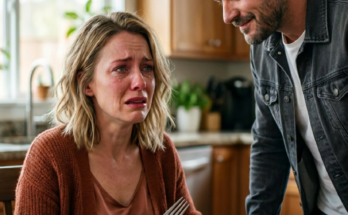
Tyler came in wearing gym shorts and the confidence of a man who thought paperwork was just another form of bluff.
Dana poured herself coffee like she’d lived there for years.
My mother set out sliced strawberries with the kind of overcare she always used when she was frightened. My father remained standing instead of sitting, one hand braced on the back of a chair. That told me something too. He needed to feel mobile.
I laid the manila folder on the table and opened it.
“We need to clear something up,” I said.
Tyler leaned back. “You make everything sound like a deposition.”
“That’s because facts hold up better than feelings.”
Dana exhaled hard through her nose. “Oh my God.”
I slid the deed copy across the table first. Then the certificate of trust. Then the occupancy terms.
“The cottage is held by the Morrison Family Trust,” I said. “My parents have lifetime residential rights. I’m trustee. Nobody else has authority to live here, make changes here, transfer title, lease it, sell it, borrow against it, or represent themselves as decision-makers on this property.”
Tyler snorted. “Trusts get changed all the time.”
“Not this one.”
I placed the screenshots beside the trust papers.
The kitchen seemed to contract around the sound of paper touching wood.
Tyler’s face lost color in a visible wave. First the mouth. Then the cheeks. Dana leaned forward and stopped filing her nails.
“What is that?” my mother whispered.
I didn’t take my eyes off Tyler. “That is an email drafted on your husband’s tablet asking a real estate attorney how to remove my parents’ names from this property and replace them with yours.”
Dana shot upright. “You went through his tablet?”
“You left it unlocked on the counter. Carelessness is not a constitutional right.”
Tyler reached for the papers. I put my hand flat over them.
“Don’t.”
He looked at me then the way men look when charm has failed them and they have to decide whether intimidation will do better. “I was asking a legal question.”
“You were asking how to steal a retirement home from two elderly people.”
“It’s not stealing if it stays in the family.”
My father made a sound I had never heard from him before. It wasn’t a word. It was something older than language. Disgust with a spine.
Dana’s eyes filled instantly. Dana could cry faster than anyone I had ever known, as if tears waited right under the surface for any occasion that required a reroute of blame.
“You are twisting everything,” she said. “We were trying to make sure Mom and Dad had support.”
“By downloading power of attorney templates?”
Nobody spoke.
That landed.
My mother looked at Tyler with confusion first, then horror, then the kind of dawning grief that changes a person’s whole posture. She sank into a chair. My father stayed standing, but the hand on the chair tightened until his knuckles went pale.
“I didn’t agree to that,” he said.
Tyler turned to him too quickly. “Tom, come on. We talked about—”
“We did not.”
The room went perfectly still.
I looked at Jaden. He was staring into his cereal. Sophie had gone very quiet, sensing she should.
I lowered my voice because children hear tone before words. “Here’s what happens next. You pack your things. You leave. You do not come back to this property without my written permission. If you contact any attorney, lender, title company, realtor, or county office claiming authority over this house, I will refer everything I have to law enforcement and adult protective services.”
Dana laughed once, sharp and unbelieving. “Adult protective services? For family?”
“For people exploiting vulnerable adults, yes.”
Tyler shoved back his chair so hard it scraped across the floor. “You can’t throw us out.”
“You’re guests. Bad ones.”
My mother surprised all of us then.
She looked at Dana—really looked at her, maybe for the first time without maternal haze—and said, in a shaking but steady voice, “Pack your bags.”
Dana stared as if she’d been slapped.
“Mom.”
“Pack them.”
My sister’s face crumpled. Not gracefully. Not heartbreakingly. It went ugly with outrage. “You’re choosing her.”
My father spoke before my mother could cave. “We’re choosing our house.”
The next forty-seven minutes felt longer than some entire years of my life.
Tyler slammed cabinet doors. Dana cried loudly and continuously, the performative kind meant to make every witness complicit. Sophie sobbed because her mother was sobbing. Jaden moved like a kid in a smoke-filled room, quick and silent, carrying a backpack, then a pillow, then a plastic grocery bag full of chargers. I helped him load a bin into the truck and he would not meet my eyes.
“I’m sorry,” I said quietly.
He shrugged, but his jaw jumped once.
When Dana came back in for a second armload, she hissed at me, “You always needed to win.”
“No,” I said. “I just finally stopped volunteering to lose.”
Tyler tried one last flourish at the doorway. He held up the house keys he’d been waving around earlier. “You’ll hear from a lawyer.”
I held out my hand.
After a beat, my father said, “Those are mine.”
Tyler dropped them on the counter so hard they bounced.
The truck fishtailed leaving the driveway, spitting gravel against the mailbox.
And then the silence came down.
It wasn’t empty silence. It was full silence. The kind that feels like your lungs after a deep dive when you finally break the surface. My mother leaned against the counter and started crying without sound, tears slipping down into the corners of her mouth. My father sat in the porch chair and stared at the marsh.
“I should’ve stopped it before you got here,” he said.
“You called me,” I said. “That counts.”
That evening we ate canned green beans, baked chicken, and boxed rice on the porch while the sky drained itself into purple. Nobody said Dana’s name. My father bowed his head over grace and had to start twice.
Later, when my mother had gone to bed and Dad had fallen asleep with a paperback open on his chest, I sat at the kitchen table with my laptop to lock down everything I could think of.
That was when my father’s bank texted.
Password reset requested. If this was not you, contact fraud services immediately.
They were gone from the driveway.
But Tyler’s hands were still all over my parents’ lives.
Fraud has a smell to me.
Not literally. More like a feeling with edges. Something slightly chemical in the back of your throat. The sense that a room has been disturbed, not because a lamp is broken or a drawer is open, but because the wrong person has touched the wiring behind the wall.
That bank alert gave me that feeling all over.
I called the fraud number immediately, sitting at my mother’s kitchen table with the under-cabinet lights throwing a warm stripe across the wood. Outside, rain had started, soft at first and then steadier, tapping the porch roof like impatient fingers.
The customer service woman had a tired voice and long pauses while she typed. “There were three unsuccessful attempts to reset online access,” she said. “One from an unfamiliar device. One from a Jacksonville IP address. Then someone called asking security questions.”
My stomach tightened.
“Were they answered correctly?”
“Enough correctly to concern us, ma’am.”
Of course they were. Dana knew every family birthday, every old address, my mother’s maiden name, the first street we ever lived on. She knew the raw material of identity the way some people know hymns.
By morning I had frozen both my parents’ credit with all three bureaus, changed their banking passwords, moved their email accounts behind two-factor authentication, and set a fraud alert on anything tied to their Social Security numbers. I drove my father to the bank myself because he still trusted in-person conversations more than portals and alerts and security questions. The branch smelled like carpet cleaner and stale air-conditioning. An older teller with silver eyeliner knew my parents by name and called my mother “Miss Linda” in a voice that sounded almost churchy.
When she printed the recent account activity, I saw two small test deposits from an external account that had been initiated but blocked.
Tyler had been trying to link my father’s checking account to something else.
“What does that mean?” my mother asked, staring at the page.
“It means he was testing the fence before he climbed it.”
My mother pressed her lips together so hard they disappeared. My father just stared straight ahead, not moving.
On the way back to the cottage, nobody spoke. The car filled with the smell of rain-wet coats and the paper sack of biscuits my mother had bought from a drive-thru because that was how she handled nerves—by feeding whoever was in range.
When we got home, my phone was lighting up with texts.
Cousin Elise: Is Dana okay? She says you threw her out?
Aunt Marie: Honey, family misunderstandings don’t need legal threats.
Unknown number: Tyler says you’re controlling your parents with money. That true?
Dana had gone to social media.
Her Facebook post was exactly the kind of thing she’d always been good at: half confession, half performance, no useful nouns. She wrote about being “cut off from the people we love” by a “cold, wealthy sister who believes money gives her power over human hearts.” Tyler had shared it with a caption about “praying for families damaged by pride.” The comments were a swamp of sympathy from people who loved vague suffering when it came in flattering light.
I did not comment. I do not wrestle in public with people who survive by theater.
Instead I drafted one email and sent it to Dana, Tyler, my parents, the financial adviser who handled the trust administration paperwork, and the attorney whose name was on Tyler’s draft reply.
Attached:
The trust terms.
The screenshots from Tyler’s tablet.
The fraudulent account attempts flagged by the bank.
And then, in one clean paragraph: All future communication regarding my parents’ residence, finances, and trust-held property will go through me in my capacity as trustee and authorized representative. Any misrepresentation of ownership, authority, or occupancy, whether online or through third parties, will be documented and referred to counsel.
The Facebook post was gone in two hours.
Tyler’s post disappeared thirty minutes after that.
Silence returned, but it was tense silence now. The kind that means the other side is regrouping.
That afternoon I went through the cottage room by room the way I would sweep a compromised office. Desk drawers. Medicine cabinet. File box. Welcome binder. The little basket on the entry table where I’d left spare batteries and takeout menus. In the guest room closet, tucked behind a pile of crumpled pool towels, I found an empty manila envelope with a title company logo from Jacksonville. It smelled faintly of Tyler’s cologne—cheap cedar trying too hard.
Inside the envelope was nothing.
But the date stamp on the back was from three weeks earlier.
Three weeks before Dana ever “visited.”
I sat on the edge of the bed and let that sink in.
They had been planning long before the Facebook post. The cottage hadn’t created the greed. It had just given it a destination.
I drove into town before dinner and spoke with a deputy at the sheriff’s substation, a square cinderblock building that smelled like coffee and printer ink. He was a broad man with patient eyes named Deputy Ruiz. I explained the trust, the unwanted relatives, the email, the attempted financial access. He listened without interrupting and asked for copies.
“You want a formal trespass warning on file?” he asked.
“Yes.”
“You think they’ll come back?”
I thought about Tyler’s face when he realized I had screenshots. Not ashamed. Cornered. A man like that didn’t accept closed doors. He looked for side windows.
“Yes,” I said. “I do.”
Back at the cottage, my father was sitting in the shed on an overturned bucket, running sandpaper over a board he’d found. The smell of raw wood and dust hung in the warm air.
“I’m sorry,” he said without looking up.
“For what?”
“For making you carry things I should’ve carried.”
I leaned against the doorway. “You carried enough. That’s kind of the whole problem.”
He gave a tired laugh at that, but his eyes stayed on the board. “Your mother always thought helping Dana meant loving her.”
“And what did you think?”
He blew wood dust off the edge. “I thought keeping the peace counted as help.” Then he finally looked up at me. “Turns out peace and surrender are not the same thing.”
That was the closest either of us had ever come to naming the family disease.
That night I installed two extra cameras—one overlooking the driveway, one on the shed. I changed the keypad code. I moved my parents’ important documents into a temporary lockbox I kept in my car.
At 2:07 a.m., my phone vibrated on the nightstand.
Motion detected: shed exterior.
I rolled over, opened the security app, and saw the grainy black-and-white outline of a figure near the shed door.
Then the feed flickered.
Then another camera went dark.
Then another.
One square at a time, the whole property went black.
The road to the cottage looks different at two in the morning.