PART 2
His fingers touched the brim.
“Good morning, General Adams.”
Nobody moved.
Brennan’s mouth stayed open, but whatever explanation he had prepared never came out.
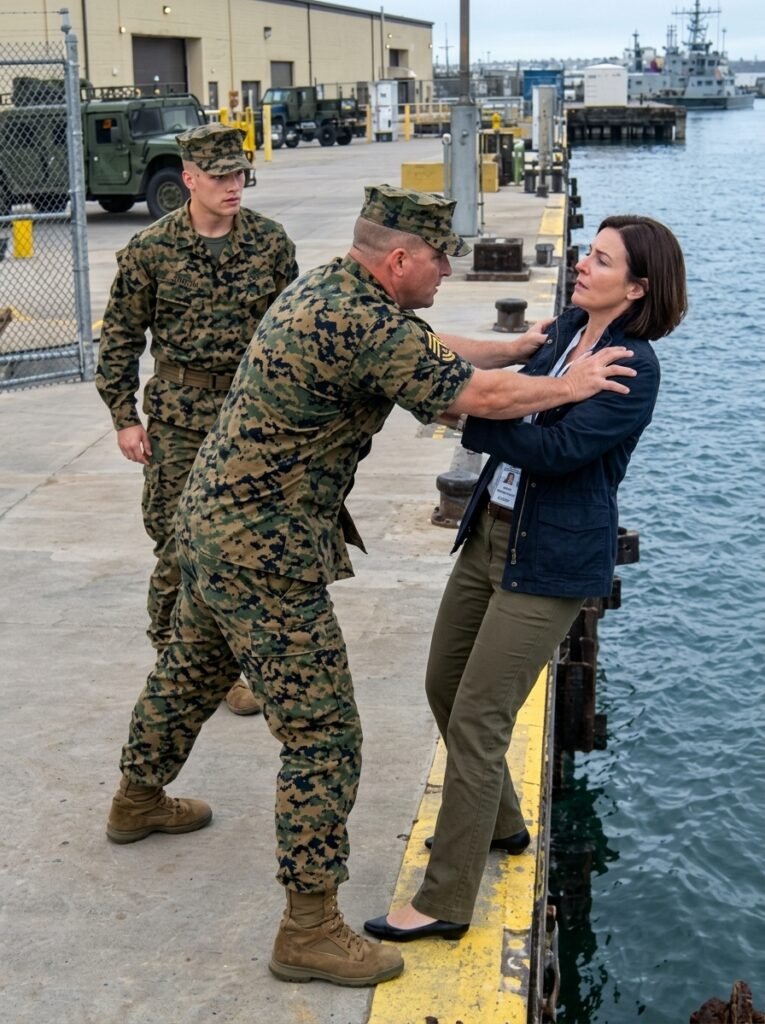
I returned Mercer’s salute, then looked toward the south gate as the NCIS team spread across the waterfront.
“Colonel, secure this pier. Nobody deletes a log, moves a vehicle, or touches a radio.”
Brennan finally found his voice. “General, this is a misunderstanding.”
“Then the records will help you.”
Granger stepped forward before Brennan could answer.
“Ma’am, there’s something you need to hear.”
He held up the duty radio.
At 5:41, eight minutes before Brennan shoved me into the harbor, someone had used an unauthorized channel from his assigned handset.
An NCIS technician connected the radio to a portable unit and found the cached transmission.
Brennan saw the waveform appear on the screen.
Then he lunged toward the table.
The technician hit PLAY.
“Delete the original before the board arrives.”
The room went silent.
The technician looked at the screen, then at Colonel Mercer.
Nobody spoke for several seconds.
The voice coming through the radio was unmistakable.
It belonged to Sergeant Tyler Brennan.
But the words were not an order to secure the pier.
They were instructions.
Instructions given twenty-three minutes before he pushed me into the harbor.
The technician replayed the transmission.
“South storage route is clear. Move the replacement units before morning inventory. The camera gap will cover the transfer.”
Brennan stepped forward.
“That’s edited.”
The technician did not look up.
“It’s from the cached memory on your assigned handset.”
Brennan turned toward Granger.
“You accessed my equipment?”
Granger’s expression did not change.
“No. NCIS did.”
That distinction mattered.
Brennan had spent the morning trying to control the story by making me the problem.
A civilian who entered a restricted area.
A visitor who supposedly ignored instructions.
A person who supposedly needed to be removed.
But the same timeline he created to protect himself had placed him directly inside the investigation.
Colonel Mercer held out his hand.
The technician passed him a printed access report.
Mercer read it quietly.
Then he looked at Brennan.
“Explain the eight-minute gap.”
Brennan’s confidence returned for a moment.
“Sir, I was responding to an unauthorized person on the pier.”
“That doesn’t answer the question.”
Brennan glanced at me.
“She was interfering with operations.”
I stepped forward.
“Colonel, the camera system near Warehouse Three recorded the pier entrance. The blind spot only covered the maintenance ramp. The vehicle movement at 6:08 was outside the approved schedule.”
Mercer looked at the report again.
“Who approved the vehicle?”
Nobody answered.
That was the moment Brennan realized his problem was larger than one recording.
For fourteen months, the missing equipment reports had been treated as isolated mistakes.
A damaged component here.
A misplaced shipment there.
A paperwork error somewhere else.
But investigators had noticed a pattern.
Every disappearance involved the same storage area, the same maintenance route, and the same person assigned nearby.
Brennan.
The question was no longer whether equipment was missing.
The question was how many people had helped make it disappear.
Brennan changed tactics.
“Sir, this is a setup. She arrived already accusing me.”
Mercer looked at me.
I nodded toward my soaked visitor badge on the desk.
“I arrived because I was following a security review request. I did not identify myself because I needed to observe normal procedures.”
Brennan laughed once.
“You let yourself get pushed into the water for that?”
“No,” I said.
“I let you show me what you do when nobody thinks they are watching.”
Granger looked away.
Brennan’s face tightened.
That sentence bothered him because it was true.
The investigation had not started with the harbor incident.
The harbor incident simply gave me something I could not get from paperwork alone.
A live demonstration.
A person willing to misuse authority in public.
A person confident enough to believe nobody would challenge him.
NCIS agents moved toward the office.
One carried a sealed evidence bag.
Inside was the visitor badge Brennan had removed from my neck.
He looked confused.
“Why are you taking that?”
The agent answered calmly.
“Because you touched it.”
Brennan stared.
“The badge?”
“The badge, the suspension notice, and the incident report you created.”
The agent placed the items beside the radio records.
“Your actions after the contact are part of the timeline.”
That was the mistake Brennan had not considered.
He thought the shove was the event.
Investigators saw everything after it.
The altered time.
The false description.
The missing minutes.
The attempt to isolate me.
The chair labeled TOURIST.
The phone recording from the younger Marine.
The humiliation was not just cruelty.
It was evidence.
The younger Marine who had filmed my fall stood near the doorway.
His face had changed completely.
“Sir,” he said quietly.
Mercer turned.
The Marine swallowed.
“I need to report something.”
Brennan looked at him.
“Think carefully.”
The warning was soft.
Almost polite.
But everyone heard it.
The Marine looked down.
“I was told to delete the video.”
Mercer held out his hand.
“Did you?”
“No, sir.”
“Why not?”
The Marine looked at me.
“Because she wrote everything down before anyone knew it mattered.”
That was the first moment the room shifted.
Not because of my rank.
Not because Colonel Mercer recognized me.
Because someone who had been standing on the sidelines decided the truth mattered more than staying comfortable.
The investigation expanded that afternoon.
NCIS recovered inventory records, maintenance schedules, vehicle logs, and communication history.
The missing equipment had not vanished randomly.
Small shipments had been diverted through routine replacement requests.
The quantities were intentionally kept low.
Low enough to avoid immediate attention.
Brennan had not built the operation alone.
Two contractors had helped move items through the waterfront route.
A civilian employee had altered several maintenance entries.
The evidence showed a chain of decisions, not one bad night.
Brennan tried to argue that he was only protecting the installation.
His attorney later claimed the radio message was taken out of context.
But context became difficult to defend when every piece matched.
The timing.
The route.
The inventory losses.
The camera blind spot.
The unauthorized vehicle movement.
The false incident report.
Months later, I returned to that same pier.
Not as a visitor.
Not as someone trying to prove she belonged.
I was there to review the completed security changes.
The south access gate had new controls.
The maintenance ramp had additional monitoring.
The reporting system had been redesigned so one person could no longer quietly approve and move replacement equipment.
Master Gunnery Sergeant Granger met me near the water.
He smiled when he saw me looking at the old ladder.
“Still avoiding the harbor?” he asked.
I looked at the gray water below.
“Only when someone else pushes me.”
He laughed.
Then he became serious.
“I owe you an apology.”
“For what?”
“For seeing the uniform before seeing the person.”
I understood what he meant.
Brennan had done the same thing.
He saw a civilian badge.
A wet cardigan.
A person standing alone on a military pier.
He assumed he already knew the entire story.
That assumption was what exposed him.
Before I left, I stopped beside the office window.
The chair with the handwritten TOURIST sign was gone.
The wall had a new framed notice about reporting misconduct.
Small change.
Important change.
Because institutions do not improve when everyone agrees there is no problem.
They improve when someone documents the problem clearly enough that nobody can pretend it never happened.
Brennan wanted that morning remembered as the day he removed a trespassing civilian.
Instead, it became the day he revealed how badly he needed people to believe that version.
And the lesson I carried away from that pier was not about rank or recognition.
It was about preparation.
The person who looks powerless in the moment may be the person paying the closest attention.
Sometimes the smallest detail is the one that changes everything.
PART 3
The investigation should have ended with Sergeant Tyler Brennan.
It didn’t.
Three days after the harbor incident, Colonel Mercer called me into his office.
A thick evidence folder sat on his desk.
He didn’t ask me to sit.
He simply pushed the folder toward me.
“General Adams, we found something.”
I opened it.
The first page was a list of equipment reported missing over the previous fourteen months.
The second was a contractor access log.
The third contained names.
I recognized two immediately.
One belonged to a civilian logistics supervisor.
The other belonged to a senior contractor who had been working on the waterfront for nearly six years.
I looked up.
“How far does this go?”
Mercer folded his hands.
“We don’t know yet.”
Then he added quietly,
“But Brennan wasn’t the beginning.”
My eyes returned to the folder.
“And he wasn’t the end.”
That sentence changed everything.
For the next forty-eight hours, investigators worked around the clock.
Every access badge was reviewed.
Every vehicle entry was reconstructed.
Every inventory adjustment was compared with surveillance footage.
And then they found the connection.
The missing equipment wasn’t being sold randomly.
It was being moved through a shell company that had been submitting legitimate-looking maintenance contracts to several military installations.
The company didn’t exist for the purpose of maintenance.
It existed to create paperwork.
Paperwork that made stolen equipment look like authorized replacement inventory.
Brennan had been one piece of the operation.
The civilian logistics supervisor approved the paperwork.
The contractor arranged transportation.
And someone much higher had been protecting the entire system from inside.
That person was Lieutenant Colonel Richard Hale.
Hale had spent twenty-two years in uniform.
He had impeccable evaluations.
Commendations.
Awards.
Photographs with senior officers.
He was exactly the kind of person nobody wanted to suspect.
When NCIS questioned him, he remained calm.
Too calm.
He denied everything.
“I have never authorized unauthorized movement of government property.”
The investigator placed a photograph on the table.
It showed Hale standing beside the same contractor van that had arrived at the warehouse at 6:08 that morning.
Hale looked at it.
“That proves nothing.”
Another photograph appeared.
Then another.
Then a bank transaction.
Then a company ownership document.
Hale’s expression finally changed.
The money had not gone directly to him.
It had gone through his brother’s consulting company.
But investigators had traced the payments.
Six transfers.
Fourteen months.
Almost $480,000.
And every payment followed a shipment discrepancy.
Hale leaned back.
“You’re making a mistake.”
The investigator closed the folder.
“No, sir.”
“We’re correcting one.”
When I heard about the arrest, I wasn’t there.
I didn’t need to be.
For the first time since the harbor incident, I allowed myself to stop thinking about Brennan.
I thought about something else.
The young Marine who had filmed my fall.
His name was Private First Class Daniel Ortiz.
He had been terrified when he told the truth.
He had every reason to stay silent.
Instead, he handed over his phone.
The video showed everything.
Brennan approaching me.
His insults.
The laughter.
The shove.
My body hitting the water.
And, most importantly, the exact time displayed on the phone.
5:49:17.
The incident report said 5:57.
Eight minutes.
Eight minutes that could have destroyed the entire investigation.
Instead, they became one of the strongest pieces of evidence against Brennan.
I requested that Ortiz be brought to my office.
When he entered, he looked nervous.
He stopped several feet away.
“Ma’am.”
“At ease.”
He relaxed slightly.
I gestured toward the chair.
He sat.
For a moment neither of us spoke.
Then I said,
“You did the right thing.”
His eyes dropped.
“I almost didn’t.”
“But you did.”
He nodded.
“I thought Sergeant Brennan would destroy my career.”
“He might have tried.”
Ortiz looked at me.
“Was I wrong to be afraid?”
“No.”
He seemed surprised by the answer.
I continued.
“Courage isn’t the absence of fear. It’s deciding that fear doesn’t get to make every decision for you.”
He nodded slowly.
Then he stood.
Before leaving, he turned back.
“General?”
“Yes?”
“I’m sorry nobody stopped him sooner.”
I looked at him for a long moment.
“Don’t carry that.”
He nodded.
Then he left.
The hearing against Brennan began six weeks later.
I wasn’t required to attend.
But I went anyway.
Not because I wanted revenge.
Because I wanted him to see that the woman he had treated like she didn’t belong had never needed his permission to belong anywhere.
The courtroom was quiet when Brennan entered.
He looked different.
No swagger.
No grin.
No group of Marines laughing behind him.
Just a man sitting beside his attorney while the evidence was read aloud.
Unauthorized radio transmission.
False incident report.
Misuse of authority.
Attempted interference with an investigation.
Participation in the unauthorized movement of government property.
And then came the video.
The courtroom watched in silence as the footage played.
There I was.
Walking along the pier.
Brennan approaching.
His hand reaching for my shoulder.
The shove.
The water.
The laughter.
Then the timestamp.
5:49:17.
Nobody looked at me.
They looked at Brennan.
His attorney tried to argue that the video did not prove his involvement in the theft operation.
The prosecutor didn’t disagree.
Instead, she said,
“No single piece of evidence proves everything.”
Then she placed the radio transcript on the screen.
“That’s why the government isn’t relying on one piece.”
The next exhibit showed the vehicle movement.
Then the inventory records.
Then the communication logs.
Then the financial transfers connected to Hale.
One piece after another.
Like stones forming a wall.
Brennan sat completely still.
When the hearing recessed, he passed me in the hallway.
For a second, I thought he would keep walking.
Instead, he stopped.
“You knew who you were when I pushed you.”
It wasn’t a question.
“Yes.”
“You could have stopped me.”
“Yes.”
He stared at me.
“Then why didn’t you?”
I looked at him.
“Because I needed to know what you would do when you thought I had no power.”
His jaw tightened.
“You set me up.”
“No.”
I shook my head.
“You made your own choices.”
He looked away.
For the first time, he had nothing to say.
Then he walked away.
I never saw him again.
Months later, Colonel Mercer invited me back to the installation.
The harbor looked different.
New surveillance equipment covered the blind spots.
The access system had been completely redesigned.
No single individual could authorize movement, approve a maintenance request, and release equipment anymore.
There were additional checks.
Independent audits.
Automatic alerts.
The old warehouse had been renovated.
The south access gate had new cameras.
Even the narrow passage where someone had placed that ridiculous chair was gone.
I stood beside the railing overlooking the water.
Mercer joined me.
“Quite a morning the first time you were here.”
I smiled faintly.
“That’s one way to describe it.”
He laughed.
Then his expression became serious.
“You know what bothers me most?”
“What?”
“We had warning signs.”
I looked at him.
“Everyone does.”
He nodded.
“Small discrepancies. Delayed reports. Missing components. Vehicles arriving early. People assuming nobody would notice.”
He stared across the harbor.
“It’s easy to ignore one strange thing.”
“And harder to ignore twenty.”
“Exactly.”
We stood in silence.
Then Mercer said something I hadn’t expected.
“You changed how this installation investigates misconduct.”
I shook my head.
“No.”
He looked at me.
“The people who finally listened did.”
He smiled.
“Maybe.”
The wind moved across the water.
For a moment, I remembered the cold.
The shock of hitting the harbor.
The laughter above me.
The humiliation.
But I also remembered what happened afterward.
Nobody had rescued me with a dramatic speech.
Nobody had magically appeared to make everything right.
I had climbed the ladder myself.
I had documented every detail.
I had stayed calm.
And I had allowed the truth to speak louder than my anger.
That mattered.
Because sometimes people think power looks like shouting.
Sometimes they think authority means making everyone afraid of you.
It doesn’t.
Real authority can be quiet.
It can sit in a notebook.
A timestamp.
A recording.
A document.
A photograph.
A single sentence written down when everyone else is laughing.
Before I left, Mercer handed me a small envelope.
Inside was a photograph.
It showed the entire waterfront from the morning of the incident.
I looked at it.
There I was in the distance, climbing out of the water.
Brennan stood above me.
And behind him, barely visible, was the contractor van.
The exact vehicle investigators later connected to the stolen equipment.
I studied the photograph for several seconds.
Then I smiled.
Not because I enjoyed what had happened.
Because I finally understood something.
Brennan had spent that morning believing he was humiliating me.
He thought I was powerless.
He thought my wet clothes made me smaller.
He thought my silence meant fear.
He thought my refusal to argue meant weakness.
And he never noticed that I was watching.
That was his mistake.
Not the shove.
Not the false report.
Not even the radio transmission.
His biggest mistake was believing that the person standing in front of him had nothing to lose.
He was wrong.
I had the truth.
And the truth had a timestamp.
I slipped the photograph back into the envelope.
Then I walked toward the exit.
As I reached the gate, I looked back one last time at the harbor.
The water was calm now.
Nothing like that morning.
No shouting.
No laughter.
No humiliation.
Just the quiet movement of the tide.
I took one final breath and continued walking.
Behind me, the gate closed.
And this time, nobody told me I didn’t belong there.
Because they finally understood what Brennan never did:
You should never judge the power of a person by the authority you think you have over them.
Sometimes the quietest person in the room is the one who has already documented everything.
And sometimes the person you push into the water is the person who comes back holding the evidence that brings your entire world down.