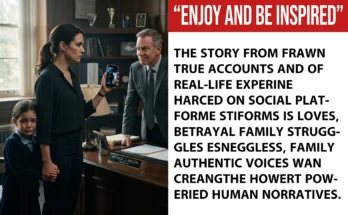
My ten-year-old daughter said she had a toothache, so I planned to take her to the dentist. Suddenly, my husband insisted on coming. The dentist slipped a note into my coat pocket. I read seven words that sent me straight to the police.
My ten-year-old daughter said she had a toothache, so I planned to take her to the dentist. Suddenly, my husband insisted on coming with us. When the dentist kept staring at my husband and secretly slipped a note into my coat pocket, I read seven words that sent me straight to the police.
The first time Lily mentioned the toothache it sounded ordinary. She was ten, dramatic about math homework, brave about pain only when bravery helped her avoid appointments. But when she mentioned it a second time that week, I called Dr. Harris and booked the earliest Saturday appointment.
The moment I told my husband Daniel, he looked up from his phone too fast.
“I’m coming with you,” he said.
“You don’t have to.”
“I want to.”
Daniel had never cared about dentist appointments. He went years without cleanings and once joked he would rather pull his own tooth with pliers than sit in a waiting room. Now, suddenly, he wanted to come.
“It’s just a checkup,” I said.
“Exactly. No reason I shouldn’t be there.”
I told myself not to overthink it. I had become very good at that.
For two years I had found harmless explanations for everything. The way Lily stopped running into the living room when Daniel came home. The way she kept her bedroom door half closed. The way she no longer asked him to help with homework. The way she locked the bathroom door completely, even just to brush her teeth. The way she sometimes watched him from under her lashes, measuring the space between them.
Adjustment. Preteen moods. New family dynamics.
Those were the words I used. They sounded reasonable. Much easier than fear.
Lily’s father Mark had died when she was six. Sudden heart attack. For almost three years it was just the two of us. Then Daniel appeared. Patient. Polite. He fixed the loose cabinet door before I asked. He remembered Lily’s teacher’s name. He brought soup when I had the flu.
I thought his carefulness meant he understood that loving a widow meant loving someone who already knew how quickly life could collapse.
Maybe it meant something else entirely.
Saturday morning, Lily sat in the back seat clutching her stuffed rabbit even though she claimed she was too old for it. Daniel drove. He had insisted.
Dr. Harris had treated Lily since kindergarten. Gentle, soft-spoken, patient in the rare way that doesn’t feel fake. Lily usually relaxed as soon as she saw him.
This time she didn’t. She sat pressed against my side, flipping through a puzzle book without solving anything. Daniel stood by the fish tank, watching the hallway. Not the fish. The hallway.
In the exam room, Lily climbed into the chair. Dr. Harris entered with his usual calm smile.
“How long has the tooth been hurting?”
“A few days,” Lily said.
He asked standard questions. Then he leaned in to examine her and stopped. Not dramatically. Just a pause. He adjusted the light and looked again. His jaw tightened.
“Lily, did you bump your mouth recently?”
Daniel answered before she could. “She probably did at school.”
Dr. Harris did not look at him. “I asked Lily.”
Silence.
Lily’s eyes flicked toward Daniel. Then down. “I don’t know,” she whispered.
“She’s clumsy,” Daniel said. “Kids fall.”
Dr. Harris stood slowly. He looked at Daniel with a kind of recognition that was not personal. Professional. The kind doctors develop when they have seen a pattern before.
“We’ll take an X-ray.”
“For a toothache?”
“Yes.”
“Parents usually wait outside during imaging,” Dr. Harris said.
Daniel’s smile thinned. “I’ll stay.”
“It’s clinic policy.”
“No one mentioned that before.”
“It’s standard.”
They looked at each other. I felt the old pressure of Daniel’s gaze. The silent instruction: smooth this over, don’t embarrass me.
I almost did.
Then I looked at Lily.
She was staring at me with wide, pleading eyes.
“We’ll wait outside,” I said.
In the hallway, Daniel leaned close. “You made me look like a problem.”
“She’s getting an X-ray. That’s all.”
“You’ve been strange lately.”
I almost laughed. I had been strange. Lily had been quiet. But I was the strange one.
Dr. Harris called us back in. He stood at the counter looking at the X-ray.
“The tooth itself looks healthy. No cavity. There may be trauma to the tissue.”
Daniel spoke quickly. “So she hit her mouth.”
Dr. Harris turned slowly toward Lily. “Can you tell me if anyone touched your face or mouth recently?”
The room disappeared around me. All I heard was that question.
Daniel went very still.
Lily’s fingers tightened around mine.
“I don’t remember,” she whispered.
That was not no.
Dr. Harris nodded as if that answer meant something specific. He removed his gloves and explained a rinse and a follow-up appointment. His manner was careful, measuring. Before we left he shook my hand and I felt paper folded into my palm.
In the parking lot I told Daniel I needed to get Lily a drink from the machine inside and walked back alone. In the bathroom I unfolded the note.
Seven words.
“I believe your daughter is not safe.”
I stood there for a long time.
When I came out, I told Daniel I needed to run a quick errand with Lily before we drove home. He said fine. He got in his car. I watched him leave, then I drove in the opposite direction.
To the police station.
The officer who took my report was a woman named Torres. She listened without interrupting. When I finished she said they would need Dr. Harris to file a formal report before they could move forward. She gave me the number for a child protective services liaison.
Dr. Harris had already called them.
That was what she said. He had called them before we even left his parking lot.
The investigation began that afternoon. I took Lily to my sister’s house. I called a lawyer. I answered every question they asked me, including the ones I had been asking myself for two years and answering with harmless explanations.
Lily was interviewed by a specialist in a child-friendly room. She talked for an hour.
The specialist told me afterward that children often protect the adults around them, that they find ways to describe wrong things in vague language because they don’t know how to name what has happened or don’t believe they will be believed.
Lily had said enough.
Daniel was arrested three days later.
The charge was child abuse. The investigation found evidence of a pattern that had begun eighteen months after he moved into our house.
I thought of all the times Lily had gone quiet when he came home. All the locked bathroom doors I called preteen moods. All the closed bedroom doors. All the times she watched him from under her lashes.
She had been protecting me too. From knowing something that would break me.
A child, protecting her mother from grief while carrying her own.
The trial took eight months. I sat through every day of it. Lily did not testify in open court. Her recorded interview was played instead. Her small careful voice filling a room full of adults who had failed to see what Dr. Harris saw in six minutes of examination.
Daniel was convicted.
After the verdict, Lily and I sat in the car in the courthouse parking garage. The engine was off. The garage was quiet.
“Are you okay?” I asked her.
She looked at her hands. “I think so.”
“You were very brave.”
“I wasn’t brave,” she said. “I was just tired of being scared.”
She said it so simply. As if it were the most obvious thing in the world.
I reached over and held her hand.
She let me.
We sat there until the parking garage lights clicked on automatically in the dimming afternoon, and then I started the car and drove us home, which was still her home, which was still safe, which would stay that way.
The red toy car was still on her nightstand. The one from her father. The one she had always kept.
That night she picked it up and held it in both hands for a while.
Then she set it down and went to sleep.
I stood in her doorway for a long time.
Watching her breathe.
Not because I was afraid anymore.
Because she was there. Because she was mine. Because a dentist had seen something in six minutes that I had spent two years learning not to see.
Because sometimes protection doesn’t look like strength. Sometimes it looks like a man who asks a child a careful question and folds a piece of paper into a mother’s hand.
Seven words.
That was all it took.