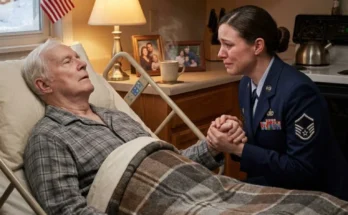
I drove back to the hospital with the documents locked securely in my trunk and noticed how my grandfather’s eyes sharpened when I told him what I had found. “Good, now we do it the right way,” he whispered while closing his eyes to rest against the white pillows.
That was the moment I realized the note on the kitchen counter was not the beginning of this story at all. It was actually the moment my parents finally became careless enough to be caught in their own cruel game.
For a long time after that, I sat beside Samuel Stone’s hospital bed and listened to the machines do what my family had refused to do for him. “The nurses are coming back soon, Grandpa,” I said while adjusting the thin hospital blanket over his legs.
“They are much kinder than your father,” Samuel replied with a tired voice that broke my heart into a million pieces. There was a steady rhythm to the room consisting of the hiss from the oxygen line and the low, rhythmic beeping of the heart monitor.
Every time a nurse checked his temperature or adjusted his blankets, I felt something hard and hot twist inside my chest. It was not only anger because anger felt too clean for a situation this messy and painful.
It was grief with teeth that bit into my soul as I remembered the neat handwriting on that kitchen counter. “We traveled on a cruise and you should take care of Grandpa,” the note had said in my mother’s cheerful script.
She had placed it exactly where she knew I would find it when I returned from my deployment. Then she and my father had walked out of the house and left an eighty one year old man in a freezing room with no phone and no way to call for help.
“How could they just leave you like that?” I asked while holding his cold, thin hand in mine. Samuel sighed and looked toward the window, saying that some people see a person as a burden instead of a father.
People often think that cruelty announces itself with shouting or slamming doors, but I had learned that night that some cruelty wears a soft sweater. It books a cruise months in advance and turns the thermostat down to save money before driving to the airport.
Samuel slept for most of the afternoon while his color slowly returned to a more natural shade. His face still looked smaller than I remembered as if the cold had taken something vital from him and tucked it away.
I watched his chest rise and fall beneath the heated blanket and tried not to imagine what would have happened if my flight had been delayed. “Just a few more hours,” I whispered to the empty room while shivering at the thought of a funeral home.
At around four thirty, the door opened and the social worker named Rebecca Thompson entered the room with a look of quiet concern. “Maddie, can we speak in the consultation room down the hall for a moment?” she asked while checking the monitors.
I followed her with the envelope from Josephine’s Bible tucked under my arm like it was evidence in a war crimes trial. We sat in a small room with two chairs and a fake plant that looked as tired as I felt.
“Maddie, I need to ask you some very direct questions about your parents,” Rebecca said while folding her hands on the table. “I am used to direct questions, so please do not hold back,” I replied while staring at a framed print of a sailboat.
“Do you believe your parents intentionally left your grandfather without any care or resources?” she asked while watching my face closely. I slid the note across the table and told her that they left him in a forty eight degree house with no working phone line.
“They were supposed to be his primary caregivers while I was stationed out of state,” I explained while my voice shook with suppressed rage. Rebecca read the note twice and I noticed her jaw tighten as she processed the coldness of the instructions.
“And what about these financial documents you mentioned earlier?” she asked while opening her notebook to take official notes. I showed her the bank transfers and the handwritten letter from my grandmother, Josephine, who had seen this coming.
“The hospital will document his condition and the doctor will note the suspected neglect,” Rebecca stated while looking at the evidence. She told me that Samuel could revoke any power of attorney if he was competent, and I insisted that his mind was still sharp.
“Capacity can fluctuate after a medical event, but he knew enough to find these papers,” she noted while looking at me gently. She asked if I had a safe place to stay, and I told her that I would stay right there in the hospital.
“Home is not safe because my parents turned it into a crime scene,” I said while thinking of the cold hallways of my childhood. Rebecca warned me that my parents might try to make this about me when they finally returned from their vacation.
“They will say you overreacted, but documentation will be what protects him in the end,” she advised while standing up to leave. Those words became my new orders, so I decided to return to the house to gather every bit of proof.
I drove back to the house in Pine Ridge after the nurse promised to call me if Samuel woke up again. I met a police officer named David Rivera and a woman from protective services named Maria in the snowy driveway.
“The house looks so normal from the outside,” Officer Rivera remarked while looking at the quiet blue siding and white shutters. I unlocked the front door and let them in, and the freezing air hit us like a physical blow to the chest.
“It is only forty eight degrees in here,” Officer Rivera said while holding up a digital thermometer for Maria to see. Maria wrote it down while I pointed toward the kitchen counter where the note was still sitting in plain sight.
The officer photographed the note from several angles before sliding it carefully into a plastic evidence bag. “This is my mother’s handwriting,” I stated for the record while watching him seal the bag shut.
We moved through the house slowly and found the guest room where Samuel had been lying in the dark. The bed was rumpled and a glass of water on the nightstand had a thin skin of dust on the surface.
“Look at the pill organizer,” Maria noted while pointing to the plastic container that still held several days of medication. “He hasn’t had his heart medicine in three days,” I said while feeling a fresh wave of nausea hit me.
In the bathroom, we found the towel rack pulled halfway from the wall where Samuel must have tried to grab it. “He was trying to reach the sink,” I whispered while looking at a dark smear on the counter where his hand had slipped.
Officer Rivera asked if I was okay, and I told him that I was fine while trying to keep my breathing steady. We moved to the kitchen where Maria opened the refrigerator to find expired milk and a loaf of bread as hard as a stone.
“Did they know he used a walker to get around?” Maria asked while finding the device folded up in the mudroom. “They knew he couldn’t walk ten feet without it,” I replied while pointing to where they had hidden it behind a laundry basket.
Upstairs, my parents’ bedroom looked like a hotel suite that had been abandoned after a very quick checkout. There was a cruise brochure on the dresser and a printed itinerary lay in the trash can near the bed.
“Caribbean Holiday Cruise, Miami departure, seven nights,” Maria read aloud while photographing the evidence of their luxury trip. In my father’s office, we found a folder labeled Care for Samuel that contained unpaid bills and warning letters.
“They were transferring thousands of dollars into their own joint account,” I said while showing the officer the bank confirmations. One transfer was for eight thousand dollars and was labeled as a home repair that clearly never happened.
Officer Rivera told us not to touch anything else and called for a detective to come to the scene immediately. I realized then that my parents had been draining Samuel’s life in pieces while telling me that he was fine.
Detective Mike Logan arrived an hour later and walked through the house with a look of quiet intensity. “Financial exploitation cases can be complicated, but the neglect here is very clear,” he noted while taking my statement.
I showed him the metal tin from the den, and he put on gloves to look through the documents one by one. “Your grandmother was a very smart woman to hide these papers,” he said while looking at the deed to the house.
He asked if Samuel had a lawyer, and I gave him the number for Victoria Knight from the letter I had found. By then it was after nine at night and the house felt colder than ever because the spirit of it had been killed.
I packed a bag for Samuel with clean pajamas and his old Navy sweatshirt and a photo of Josephine from the mantel. “I am taking this evidence box with me,” Detective Logan said while sealing it with yellow tape.
Before I left, I stood in the den and looked at the chair where my grandmother used to spend her afternoons. I picked up a ceramic angel I had painted as a child and found another piece of paper hidden underneath it.
“Madison, if you found this, then you are thinking clearly,” the letter began in her elegant and familiar handwriting. She warned me that my father believed love was measured by what he was owed and that my mother would always look away.
“Sometimes loyalty means standing between the innocent and the people who share your blood,” she wrote with such wisdom. She told me to trust Victoria Knight and to make the truth so clear that lies would have nowhere to stand.
I sat in her chair and cried for a long time because I finally had to admit that my parents were monsters. Then my phone buzzed with a call from the hospital telling me that Samuel was awake and asking for his granddaughter.
I drove back through the snow with the second letter tucked inside my jacket for strength and comfort. When I entered the room, Samuel whispered that I had found her, and I knew he was talking about the letter from Josephine.
“She always knew before I did,” he said with a sad smile that reached his tired eyes. I told him that the police were involved and that Victoria Knight would be there in the morning to handle the legal side.
I asked him if my father had power of attorney, and he admitted that he had signed it for convenience after the funeral. “He told me I was confused when I questioned the bank transfers,” Samuel whispered while looking ashamed of his own son.
“I heard them talking about the cruise,” he added while his voice trembled with a memory he couldn’t erase. “Your father said that if you didn’t get here in time, it would be God’s decision,” he told me with tears in his eyes.
That sentence made the room disappear for a moment because it was the ultimate proof of their calculated coldness. “I need a minute, Grandpa,” I said while standing up and walking toward the door to catch my breath.
“Come back here and sit down, Maddie,” he commanded with the voice of a man who still had a mission to complete. He told me that Josephine wanted truth and not rage because rage is a driver that will put you in a ditch.
“I want them held accountable for every hour they left me in that cold room,” he said while squeezing my hand. I promised him that I would handle everything without becoming the monster my parents had turned into.
Victoria Knight arrived on Christmas morning wearing a gray coat and carrying a briefcase that looked like it held a thousand secrets. “Samuel, I told Josephine that you would wait too long to call me,” she said while taking his hand in hers.
“Is it still going to cost me a fortune to hire you?” Samuel joked with a weak laugh that made us all smile. Victoria asked everyone else to leave the room so she could speak with him privately about his legal capacity.
After twenty minutes, she waved me back in and announced that Samuel was fully competent to make his own decisions. “We are revoking the power of attorney immediately and appointing Maddie as the healthcare proxy,” she stated firmly.
She also told me that the house was held in a trust and that my father would inherit nothing if he was found guilty of neglect. “Josephine called it the Judas clause,” Samuel noted while a spark of dark humor returned to his eyes.
Victoria played a video that Josephine had recorded where she explained that she had seen the greed in my father’s eyes. “The betrayal happened long before Maddie arrived at the house,” she said from the screen with a calm and steady voice.
By noon on Christmas Day, Victoria was filing emergency motions while Detective Logan began the criminal investigation. At three o’clock, my mother called me from a port in the Caribbean while the wind whipped in the background.
“Maddie, why is my credit card declined at the gift shop?” she asked with a tone of pure irritation. I told her that Samuel was in the hospital because they had left him to freeze in a house with no heat or phone.
“Oh, is he being dramatic again?” she snapped while I put the call on speaker so Samuel could hear the truth. “He was hypothermic and barely responsive when I found him,” I replied while my heart hammered against my ribs.
“We were only gone for a few days,” she argued while my father shouted in the background about the frozen bank accounts. “Give me the phone, Patricia!” my father barked before he started yelling at me through the speaker.
“You better fix this right now or you will regret it,” he threatened while I looked at the recording device Victoria was holding. I told him that the power of attorney was revoked and that an investigation into elder neglect had officially begun.
“He doesn’t know what he’s doing!” my father screamed while Samuel looked at the phone with a face of stone. “I know what you did, Robert,” Samuel said into the phone, and the line went completely silent for several seconds.
“I heard what you said about God’s decision,” he added before Victoria reached over and ended the call for good. No one spoke for a while because the machines kept beeping while the weight of the betrayal settled in the room.
The emergency protective order was granted that evening and my parents were barred from contacting Samuel or entering the house. They left dozens of voicemails that shifted from anger to pleading as the reality of their situation sank in.
By the end of the week, Samuel was sitting up and complaining about the hospital coffee being too weak for a veteran. He felt a deep sense of shame about raising a son who could be so cruel, but I told him that he wasn’t responsible for Robert’s choices.
On the day my parents returned to Pine Ridge, I was at the house with Officer Rivera and a locksmith to change the locks. Their car pulled into the driveway and my mother got out wearing expensive sunglasses and a white resort jacket.
“What the hell is going on here?” my father shouted while marching up the driveway toward the police car. Officer Rivera informed them that they were served with a protective order and were not allowed on the property at all.
“You think you won?” my father sneered while looking at me with eyes full of pure hatred. “I just made sure Grandpa is safe,” I replied while the locksmith finished his work on the front door.
My mother started crying and claimed they were just tired and needed a vacation after years of taking care of him. “You asked what would happen if I didn’t get here in time,” I reminded her, and her face went white as she realized I knew.
The hearing took place in January in a small courtroom where the lights were too bright and the benches were too hard. My parents sat with their lawyer while Victoria presented the evidence of neglect and financial exploitation.
The social worker testified about the temperature of the house and the medical records that proved Samuel was dying. When Victoria played the voicemail from the cruise ship, my mother buried her face in her hands and sobbed.
“I just wanted one week where no one needed anything from me,” she whispered when we were in the hallway during a break. “You could have had that without leaving him to die in the cold,” I replied while walking away from her.
The judge ruled that the protective order would stay and that my parents were barred from the house and the trust forever. My father was arrested in the parking lot for felony financial exploitation while my mother watched from the sidewalk.
I stayed in Pine Ridge for several months to help Samuel recover and to make sure the house was warm and full of life again. We hired a woman named Maria to help during the day, and Samuel spent his afternoons watching the birds at the feeder.
In May, my father and mother took plea deals to avoid a long trial, though they still had to pay back every cent they stole. Their luxury house was sold and their social standing in the town was destroyed by the truth of what they had done.
I found a final letter from Josephine in the garage where she told me to keep living my own life after saving Samuel. She had left me a savings bond for my future because she knew I was the one who would always notice who was cold.
“She worried about you being too useful,” Samuel said while we sat on the porch and watched the spring flowers bloom. “Then we will learn how to just be happy together,” I promised while holding his hand in the warm afternoon sun.
Samuel grew stronger every day and eventually started going back to his morning coffee club with the other veterans. I realized that healing was not about erasing the past but about making sure the worst thing was no longer the only thing.
By the time Christmas came again, the house was full of the smell of cinnamon and the sound of laughter from our new friends. I turned the thermostat up one degree higher than Samuel liked and waited for him to notice.
“Maddie, that is financial recklessness!” he shouted from the kitchen with a wide and genuine smile on his face. I laughed and told him he would survive while we looked at the photo of our family on the counter where the note once sat.