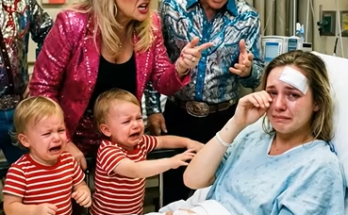
The police called while I was whispering to the baby inside me. They said my husband had been found unconscious in a hotel bathroom. Then they said he had not been alone.
At thirty-three weeks pregnant, a woman learns the exact weight of fear. It sits low in the body, beneath the ribs, behind the navel, wrapped around the child she has not yet held. That Friday night, I was sitting alone on the edge of our bed in South Boston, one hand resting on my stomach, the other holding a half-folded onesie against my thigh. The room smelled faintly of clean cotton, cocoa butter, and the lavender detergent I had started buying after the doctor told me strong scents might make my nausea worse. Outside the windows, the city was dark and wet, the kind of Boston night where headlights smear across pavement and harbor wind gets into every crack of an old house.
I was talking to my son.
Not in a sentimental way, though maybe all mothers become sentimental in private. I was telling him ordinary things because ordinary things had begun to feel like promises. I told him his crib was ready. I told him the blue blanket on the rocking chair had been knitted by a nurse who worked with my mother years ago. I told him I had finally stopped being afraid to wash his tiny clothes, even though part of me still believed that preparing too much might tempt fate.
“Stay with me,” I whispered, rubbing slow circles over the place where his heel pressed against my side. “Just a little longer.”
The phone rang.
The sound tore through the room so sharply that my whole body jerked. The onesie slipped from my lap. My first thought was the doctor. My second was my husband, Gabriel, though he had texted earlier saying he had a late client dinner near the Financial District and not to wait up. The screen said Boston Police Department.
My mouth went dry before I answered.
“Mrs. Peterson?”
The voice was male, steady, professional, too calm for anything good.
“Yes.”
“This is Officer Daniel Reaves with Boston Police. We’re calling from Massachusetts General Hospital. Your husband, Gabriel Peterson, has been brought in for emergency care following an incident at the Liberty Hotel.”
For a second, the room tilted.
“What happened?”
“There was a fall in a hotel bathroom. He is conscious intermittently. Medical staff are evaluating him.”
I tried to stand, but my knees did not cooperate. I grabbed the nightstand.
“Is he okay?”
A pause. Small. Careful.
“Mrs. Peterson, he was not alone.”
Every sound in the bedroom sharpened: the hum of the ceiling vent, the soft tick of the wall clock, my own breathing turning shallow and fast.
“What does that mean?”
“The responding officers found him with a woman. She was also transported for treatment.”
My hand went to my stomach.
The baby shifted once, a slow internal roll, as if even he had sensed the air change.
“Who?” I asked.
“I don’t have permission to release full details over the phone until you arrive, but you are listed as next of kin. You should come as soon as you safely can.”
Safely.
I was eight months pregnant, barefoot in a bedroom full of folded baby clothes, hearing that my husband had been found unconscious in a hotel bathroom with another woman, and the officer was telling me to come safely.
I do not remember putting on my coat. I remember one shoe being difficult because my ankle had swollen that week and the heel would not slide in. I remember grabbing my keys from the dresser and seeing Gabriel’s cufflinks beside them, the silver ones I had given him for our fifth anniversary. I remember my reflection in the hallway mirror: pale face, loose hair, black leggings, gray maternity sweater pulled tight over my stomach, eyes wide with a terror I recognized too well.
Hospital terror.
I had lived inside it twice before.
The first time, I lost a baby at nine weeks. The second, at fourteen. Both losses had taken place under fluorescent lights, with paper bracelets around my wrist, nurses speaking gently, doctors moving with that careful efficiency that tells you something has already happened and everyone is waiting for your heart to catch up.
Gabriel had missed most of both.
Not because he did not care, I had told myself then. Because his job demanded him. Because stock brokerage was brutal. Because clients needed him. Because somebody had to keep earning. Because grief, for men like Gabriel, looked more like late meetings and unopened whiskey than hospital chairs and hand-holding.
I forgave what I did not want to name.
That is how a marriage begins lying to itself.
The drive to Mass General should have taken fifteen minutes. It felt like an hour. Rain spit against the windshield in thin, nervous lines. The streets were slick and nearly empty, the city reduced to traffic lights, gas stations, dark restaurant windows, and the occasional bright blur of someone running under an umbrella. I kept one hand on the steering wheel and the other on my stomach, murmuring, “We’re okay. We’re okay. We’re okay,” though I did not know who I was trying to convince.
At a red light near Cambridge Street, a thought flashed through me so quickly I tried to push it away.
Jennifer.
Earlier that night, before the call, I had opened TikTok to distract myself from the ache in my lower back. The first video on my feed had been Jennifer Ramirez, my best friend of thirteen years, standing in front of a hotel window overlooking Boston Harbor. She wore satin pajamas, dark hair loose over one shoulder, face bright with the effortless confidence that made strangers trust her through screens.
Quick layover in Beantown before NYFW, she had captioned it, with two little heart emojis.
Jennifer lived in Detroit. She was an influencer, a lifestyle creator, the sort of woman who could turn a latte, a suitcase, and a hotel robe into content about healing, friendship, and feminine power. She had flown to Boston after both of my miscarriages. She had slept beside me in a hospital chair, held my hand so tightly her nails left crescent marks in my skin, cried when I cried, and promised, “Next time, you’ll keep the baby. I’ll be here. I swear.”
I had almost texted her after seeing the video.
Want to go baby shopping tomorrow?
Then fear stopped me. I was still superstitious about joy.
At the hospital parking garage, I nearly hit the curb turning in. My hands were shaking so hard I had to sit in the car for three full breaths before opening the door. The elevator smelled like wet wool, old coffee, and metal. When the doors opened into the emergency entrance, the smell of antiseptic hit me like a hand over my mouth.
My body remembered before I did.
I stopped just inside the sliding doors.
Monitors beeped somewhere behind a wall. A child cried in short, exhausted bursts. Nurses moved quickly in blue scrubs, shoes squeaking against polished floor. A man in a Red Sox hoodie held a bloodied towel to his forehead. A woman whispered into her phone near a vending machine.
Everything was normal.
Everything was unbearable.
At the desk, I gave Gabriel’s name.
“My husband,” I said. “Gabriel Peterson. The police called.”
The nurse looked at her screen, then at my stomach, then back at the screen. Her face changed almost imperceptibly. Professional sympathy is a terrible thing to witness when you already know the news is not clean.
“Please confirm some information for me.”
She handed me a clipboard.
There were two names printed near the top of the intake sheet.
Patient One: Gabriel Peterson. Boston, Massachusetts.
Patient Two: Jennifer Ramirez. Detroit, Michigan.
My vision narrowed until the letters seemed to float above the page.
Jennifer.
Not a colleague.
Not a stranger.
Not some woman I could hate simply because I had never loved her.
Jennifer.
My best friend. My bridesmaid. My emergency contact for years when Gabriel traveled. The woman who knew exactly how my voice sounded after loss. The woman who once put her palm on my flat, empty stomach and said, “Your body didn’t fail you. Don’t ever believe that.”
The clipboard bent under my fingers.
“Ma’am,” the nurse said softly. “You’re pregnant. Please breathe.”
I tried.
The air burned.
A police officer approached, the same calm voice from the phone now attached to a tired-looking man in his forties with rain on the shoulders of his uniform.
“Mrs. Peterson?”
I nodded.
“I’m sorry. I need to clarify a few things. Hotel staff reported a disturbance in room 2418 at the Liberty Hotel. Security heard glass break and forced entry after no one responded. Your husband was found on the bathroom floor. Ms. Ramirez was beside him. Both were unclothed. There was water on the tile, broken glass, and blood from a scalp laceration. Medical staff believe your husband slipped and struck his head.”
Unclothed.
The word did not enter me all at once.
It kept entering.
Layer by layer.
The nurse led me down the hall. Each step felt both too fast and impossibly slow. Curtains hung around treatment bays in pale blue strips. The air was cold enough to raise goose bumps on my arms. Somewhere, someone was vomiting. Somewhere else, a doctor said, “Pressure’s dropping,” in a voice that made every person nearby move faster.
Then the nurse pulled back a curtain.
Gabriel lay on a narrow hospital bed, neck braced, one shoulder scraped raw, dark hair damp at the temples. Less than three feet away, Jennifer sat on another bed wrapped in a hospital blanket, her face bruised, wet hair clinging to her cheek, mascara running in black lines toward her jaw.
She saw me first.
“Camila,” she whispered.
Her voice cracked on my name.
Gabriel stirred. His eyes opened halfway, unfocused, then found movement beside him. He turned toward Jennifer.
“Baby,” he rasped. “Are you okay?”
Baby.
I was standing right there.
Eight months pregnant with his son, one hand clutched around the metal rail to keep myself upright, and the first word my husband spoke was not my name.
It was hers.
Something inside me did not break.
It clarified.
Jennifer began crying immediately.
“It’s not what you think,” she said.
I almost laughed then, but there was no air for it. That phrase, so worn from every cheap betrayal ever filmed, sounded obscene coming from her mouth. From Jennifer, who had made herself the saint of my suffering online. Jennifer, who had posted videos about “showing up for women in grief.” Jennifer, whose followers called her an angel for holding my hand in a hospital bed while I lost my child.
Gabriel tried to sit up and groaned.
“Camila,” he said then, finally noticing me fully. “I can explain.”
I looked at him.
Then at her.
Then down at my stomach.
My son moved again, a small hard push beneath my palm.
“No,” I said quietly. “You can’t.”
I stepped out before either of them could speak again.
In the hallway, I leaned against the wall, closing my eyes as a contraction-like tightening crossed my abdomen. Not labor, I told myself. Stress. Fear. Body memory. I breathed the way the childbirth instructor had taught us, though Gabriel had missed that class because of a “client emergency.”
My phone felt slippery in my hand.
I called David Ramirez.
Jennifer’s husband answered on the fourth ring.
“Camila?”
His voice was low, tired, cautious in a way I understood too quickly.
“David,” I said, and my voice came out like it had been scraped raw. “You need to come to Boston.”
Silence.
“Why?”
“Jennifer is at Mass General with Gabriel. There was an accident at the Liberty Hotel.”
Another silence, longer this time.
When he spoke again, the surprise was not in his voice.
Only confirmation.
“I’m two hours away,” he said. “Business trip in Providence. Send the address.”
He did not ask if I was sure.
That told me something.
While I waited, I sat in a plastic chair near the vending machines and watched people move through their own emergencies. No one knew my life had detonated. No one knew that down the hall, the woman I had trusted more than my own sisters was lying under a hospital blanket after being found naked with my husband. No one knew that my baby’s college fund, though I did not yet know it, had already been drained month by month into the machinery of their lies.
At 9:27 p.m., David arrived.
His shirt was wrinkled, his coat damp, his face pale in a way that made him look older than forty. He did not stop to greet me properly. He touched my shoulder once, briefly, then walked into the treatment bay.
I followed but stayed near the opening.
Jennifer saw him and began sobbing harder.
David stood at the foot of her bed.
“How long?”
His voice was so calm the room seemed to tighten around it.
“David,” she cried. “Please. I was going to tell you. I came here to end it.”
“How long?”
Gabriel closed his eyes.
Jennifer slid off the bed, clutching the blanket around herself. She reached for David’s pants like a drowning person grabbing a rope.
“I’m pregnant,” she said.
The words struck the room like glass hitting tile.
David did not move.
“I found out last week,” she said, voice breaking. “Eleven weeks. I didn’t know how to tell you. I came to Boston to end things with Gabriel before anyone got hurt.”
Anyone.
I gripped the curtain edge so tightly my fingernails hurt.
Before anyone got hurt.
I was thirty-three weeks pregnant. I had lost two children. She had been sleeping with my husband for months, maybe years, and she still thought harm was something that had not yet arrived because it had not yet arrived for her.
David looked down at her.
“Is it mine?”
Jennifer covered her face.
“I don’t know.”
Gabriel made a sound from his bed, not quite a groan, not quite a protest.
David looked at him then for the first time.
Not with rage.
With disgust so quiet it felt surgical.
Then he turned back to Jennifer.
“One more question,” he said. “And you will answer it without performing.”
She froze.
“You loved Gabriel before you married me, didn’t you?”
The hospital bay became impossibly still.
Jennifer lowered her hands.
Her face, stripped of makeup and performance, looked almost young.
“Yes,” she whispered. “Since college. But he loved Camila. I kept quiet because I didn’t want to lose either of you.”
My knees weakened.
There are betrayals that happen in the present, and there are betrayals that reach backward, touching every photograph, every laugh, every toast, every memory you thought was safe.
David closed his eyes briefly.
“When did the affair start?”
Jennifer’s answer came in fragments.
Two years ago.
After my second miscarriage.
Gabriel had gotten drunk in our garage after the memorial service we held for a baby who never got a name. Jennifer found him there. She had meant to comfort him. Things went too far.
Things went too far.
That phrase did something to me.
Because I remembered that night.
I remembered lying in bed after coming home from the hospital, still cramping, still bleeding, still wearing the loose gray sweatpants my mother had bought me because everything else hurt my stomach. Gabriel said he was going out to get soup. He kissed my forehead and told me he would be right back. I waited for hours. I thought he was crying somewhere alone because grief had made him unreachable.
Now I knew.
He had not been unreachable.
He had been inside my best friend.
A sharp pain moved across my lower abdomen. I pressed my hand there and stepped back.
David saw.
His whole expression changed.
“Camila,” he said, walking toward me. “Sit down.”
“I can’t.”
“Then breathe.”
“I can’t stay here.”
He looked past me toward the hallway, then back into the room at Jennifer.
Something in his face closed.
He turned away from her completely.
“Protect your child,” he said to me.
Then he pulled out his phone and spoke three clear words.
“Call family lawyer.”
That was the moment the night changed.
Not because the pain lessened. It did not. It grew teeth. But David’s voice, flat and controlled, gave form to the chaos. There would be lawyers. Records. Timelines. Proof. Consequences. The truth would not remain a hospital whisper between blue curtains and beeping machines.
I left before Gabriel could call my name again.
Outside, Boston wind cut across my face so sharply I welcomed it. I stood under the hospital awning with one hand on my belly and one on the cold metal rail, breathing through the ache in my body until it passed. Cars came and went. A couple rushed through the automatic doors with a child wrapped in a blanket. Somewhere above me, lives were being saved or changed or lost under bright lights.
I drove home slowly.
The house on East Sixth Street was dark when I arrived. Our house. The one we had bought after the first miscarriage because Gabriel said a new place might give us new luck. Three bedrooms, narrow staircase, patched brick, a nursery painted pale blue before I had allowed myself to tell anyone besides the doctor that this pregnancy might make it.
The key turning in the lock sounded like a gunshot.
Inside, everything waited exactly as I had left it: folded baby clothes, a glass of water on the nightstand, Gabriel’s laptop half-closed in his office, our framed wedding photo on the hallway wall. In it, Jennifer stood beside me in a champagne bridesmaid dress, eyes bright, one hand on my arm. David stood beside Gabriel, smiling with the open trust of a man who believed his life had not yet begun to betray him.
I walked to Gabriel’s office.
His laptop opened without a password.
Of course it did. He had grown careless because my trust had made him lazy.
The calendar told the story first.
Liberty Hotel. Room 2418. Last Friday of every month. Fourteen months in a row. Notes disguised as work: J content shoot. Client social. Harbor meeting.
Then the bank records.
Seven thousand dollars per month.
Fourteen transfers.
Jennifer Ramirez.
Content retainer. Media consulting. Shoot prep. Support during tough time.
Support during tough time.
The room seemed to narrow around me.
The money had come from our joint savings, then from the account we had created after the first miscarriage and called, half tenderly, half fearfully, the baby fund. Later, when pregnancy became too painful to discuss, Gabriel renamed it “future education” in the banking app. I used to look at it after doctor appointments, not because the balance mattered most, but because it told me we still believed in a child.
He had used it to pay her.
Nearly $100,000.
For hotel rooms, flights, clothes, content invoices, lies.
My hands were shaking now, but not uselessly. I began taking screenshots. Downloading statements. Forwarding files to myself. Naming folders by date. The part of me that worked in marketing for a real estate firm—the part that managed budgets, proofread contracts, built campaign timelines, caught discrepancies in vendor invoices—rose through the devastation and began doing what she knew how to do.
Organize the truth.
In the documents folder, I found the contract.
A media collaboration agreement between Jennifer Ramirez and Gabriel’s brokerage firm. Company logo. Scope of services. Monthly retainer. Deliverables.
At the bottom was a signature.
Laura Peterson.
My hand went cold.
Not Camila, as the officer had called me mistakenly because Gabriel’s old emergency form still had my middle name listed first.
Laura.
My legal first name.
It was not my signature.
But it was close.
Close enough that someone who did not know the pressure of my hand, the angle of my L, the way I never connected the final a, might believe it.
Gabriel had forged my signature to legitimize payments to my best friend.
Not only had he betrayed me as a husband.
He had used me as paperwork.
I sat back in his chair.
For a long moment, I stared at the framed ultrasound on his desk. Our son’s profile, grainy and miraculous, floating in black and white. Gabriel had placed it there after the twenty-week scan. I had found it sweet then. Proof he was finally ready. Proof this baby had softened something in him.
Now it looked like a prop.
At 2:06 a.m., I drafted an email to the CEO of Gabriel’s brokerage firm.
Subject: Regarding VP Gabriel Peterson
I have documents. We need to talk.
My thumb hovered over send.
Then I stopped.
Not because I doubted.
Because anger was still driving my fingers, and anger, no matter how righteous, is not always the safest driver.
I saved it as a draft.
Then I opened Jennifer’s TikTok.
Every video that once comforted me now looked staged beneath new light. Jennifer hugging me in a hospital bed after my second miscarriage. Jennifer wiping tears from my face with a caption about chosen sisters. Jennifer in my kitchen making tea after saying she had flown in because “no woman should grieve alone.” Jennifer’s followers praising her compassion.
I checked timestamps.
One video had been recorded during the exact two-hour window Gabriel claimed he had gone out for food.
I took screenshots.
Not to ruin her.
To preserve what she had already ruined.
By morning, I had a folder titled Evidence.
By noon, I had called a family lawyer.
By dusk, I had decided not to be in that house when Gabriel came home.
The next week moved with the cold efficiency of survival. David and I spoke twice. Not emotionally, not intimately, but like two people standing on opposite sides of the same collapsed bridge, passing tools across the gap. He had already retained counsel in Michigan. He had requested a paternity test when Jennifer’s child was born. He had recovered records from their accounts showing Gabriel’s transfers had been hidden through invoices Jennifer called business revenue.
“I can return the money,” he told me over the phone.
“You don’t have to fix their theft.”
“No,” he said. “But I can refuse to profit from it.”
That sentence stayed with me.
I found an apartment in the Seaport District, smaller than the house but bright, with wide windows and pale wood floors. I hired movers while Gabriel was still recovering from his concussion at a short-term medical facility, using the same organizational calm that had once built nursery lists and marketing launches. I took the crib. The rocking chair. My clothes. The documents. The baby clothes. The kitchen table my grandmother had left me. I left the sofa because it had been ours, and I could not imagine nursing my son on it without seeing Gabriel’s hands on Jennifer’s waist in some hotel bathroom I would never enter.
On the kitchen table, I left three things.
The ultrasound photo.
Divorce papers signed by me.
Two strips of extended-cycle birth control pills Jennifer had once left in our guest bathroom, which I had found months earlier and explained away because she traveled often and women forget things.
Beside them, I left a note.
You left me alone through two miscarriages. This time, I will give birth, but not with you.
When Gabriel came home, he found silence.
I know because the voicemails began at 4:18 p.m.
Camila, where are you?
Then:
Please don’t do this.
Then:
You took the crib?
Then:
That money was business. You don’t understand.
Then:
I was confused. Jennifer manipulated me.
Then, after midnight:
I’m sorry. I’m so sorry. Please let me be there when he’s born.
I did not respond.
Sorry is not a key.
It does not unlock the house after you burn it down.
Five weeks later, under warm yellow lights at Brigham and Women’s Hospital, my son was born.
Labor was long but not dramatic. Pain came in waves that made everything else disappear, even betrayal. My body, which I had spent years fearing would fail me, became the strongest thing in the room. The nurses spoke softly. My doctor told me I was doing beautifully. David was not in the delivery room; I had asked my cousin Marisol to come instead, a practical, hilarious woman who fed me ice chips and threatened to haunt me if I named the baby anything boring.
When he cried, the sound split me open.
The nurse placed him on my chest, slick and warm and furious with life. His tiny mouth opened. His hands flexed. I stared down at him, waiting for the sobbing I had seen in birth videos, but what came was deeper than tears.
Stillness.
Peace so complete it felt almost holy.
“Hello,” I whispered. “You stayed.”
I named him Ethan David Peterson.
Ethan because I had always loved the steadiness of it.
David because my son deserved to carry the name of the first man who had chosen his future without needing blood to justify decency.
After Ethan was born, I sent the full file to Gabriel’s company.
Not the emotional email from the draft.
A complete, organized report: forged signature, hotel charges, false invoices, company contract misuse, bank transfers, screenshots, timelines.
The CEO, Margaret Winslow, a sixty-year-old woman known in Boston finance for dismantling excuses with the calm of a surgeon, responded with one sentence.
Thank you. We will take it from here.
And they did.
Gabriel was terminated quietly within days. No public memo. No farewell lunch. No LinkedIn statement about new opportunities. His company access disappeared. His professional accounts locked. Compliance opened an internal review. Then legal. Then regulators. He had stolen from his employer, forged my name, misused corporate funds, and involved an outside contractor with whom he had an undisclosed relationship.
Consequences came not as a scream, but as a sealed door.
Jennifer’s fall was louder because she had built her life on being watched.
Her old videos resurfaced. The supportive best friend clips. The hospital footage. The captions about sisterhood and showing up. People connected them to the Liberty Hotel incident, the money, the affair. Sponsors withdrew. Her follower count collapsed. The internet, which had once rewarded her tears, turned those same tears into evidence.
I did not participate.
I did not comment.
I did not expose what was not already visible through her own choices.
Still, I heard things.
Six months after the hospital, Jennifer gave birth to a baby girl in Detroit. She named her Lisa. There were no public birth announcements, no curated newborn shoot, no emotional captions about motherhood. By then, no one trusted her performance enough to applaud it.
I thought that would satisfy me.
It did not.
Holding Ethan in my apartment at 3 a.m., his small body tucked against my chest, I discovered something about revenge that people rarely admit: once the truth is out, you still have to wake for feedings. You still have to heal from stitches. You still have to cry in the shower because your milk came in and your mother is dead and the man who should have been there is calling from an unknown number you have to block again.
Justice does not rock the baby for you.
But peace helps you do it yourself.
David came to Boston three weeks after Ethan was born.
He stood in my apartment doorway holding a thick envelope. He looked thinner, older, but clearer. Behind him, late afternoon light spilled through the windows, turning the pale wood floor gold.
He placed the envelope on my table.
Nearly $100,000 in certified checks and recovered funds.
“Every dollar Gabriel sent Jennifer that touched our marital accounts,” he said. “My lawyer traced what he could. Some of it was spent. This is what could be recovered. It belongs to Ethan.”
I stared at the envelope.
“You didn’t have to bring it yourself.”
“Yes,” he said. “I did.”
He sat across from me, hands clasped.
Then he looked at Ethan asleep in the bassinet beside the window.
“If you allow it,” he said carefully, “I would like to be part of his life. Not as a replacement for anything. Not as a claim. Just as someone who chooses him.”
My throat tightened.
“David—”
“I know what it sounds like. I know it’s soon. I’m not asking anything from you. I’m saying that when I saw you at that hospital, holding your stomach while both of them lied with their bodies still wet from the shower, I understood something. That baby deserved better before he ever took his first breath.”
He swallowed.
“I have wanted to be a father for seven years. I thought I was waiting with Jennifer. I was wrong. But I can still be useful. If you let me.”
Ethan made a small sound in his sleep.
I looked at him.
Then at David.
“His middle name is David,” I said.
His face changed.
Not pride.
Not victory.
Something gentler.
“Then I’ll try to deserve that.”
I believed him.
Not completely. Trust, once shattered, does not rebuild in one conversation. But I believed the direction of him. That was enough for the beginning.
Months later, another truth arrived.
Jennifer left baby Lisa in a cardboard box on David’s doorstep during the first heavy snow in Detroit.
That sentence sounds impossible, even now. Like something from an old cautionary tale. But real life is often most unbelievable when people stop performing and simply reveal themselves.
David had returned from work after dark and heard a faint cry near the door. Lisa was six weeks old, wrapped in a thin blanket, cheeks cold, tiny hands purple at the edges. Beside her were diapers, an unopened bottle, and a note written in Jennifer’s shaky hand.
I can’t do this. She’ll be better with you.
David called child protective services immediately. Then he called an ambulance. Then he held his daughter against his chest under his coat until help arrived, whispering, “Your father’s here,” over and over as if saying it could warm her faster.
The DNA test confirmed Lisa was his.
Ninety-nine point ninety-seven percent.
A family court in Michigan granted emergency custody. Jennifer did not appear. She signed away parental rights through a lawyer and vanished from the United States. Someone later told me she had gone to Thailand to teach English at a soft skills center, off social media, off the grid of her former life.
I felt no triumph.
Only the heavy ache of knowing that children are sometimes born into the wreckage adults create and must be carried out by whoever still has clean hands.
A year after Ethan’s birth, David moved to Boston.
Not into my apartment. Not into my life with entitlement. Into the building across the street, on the same floor, close enough that when I opened my curtains in the morning, I could sometimes see him in his kitchen holding Lisa while warming a bottle. He said Boston had better opportunities, better schools, and fewer ghosts. I understood that last part best.
The first morning after he moved in, I stepped into the hallway with Ethan on my hip just as David came out of the elevator pushing Lisa’s stroller.
Ethan leaned forward immediately.
Lisa looked up.
The two of them stared at each other with the solemn curiosity of small children encountering a possible co-conspirator. Then Ethan slapped both hands against the stroller tray and laughed. Lisa grabbed his sleeve and shrieked with delight.
David froze.
Then Ethan, who had been babbling sounds for weeks but no clear words, looked up at him and said, “Da.”
Not perfect.
Not deliberate, maybe.
But close enough to break something open.
David crouched in the hallway, eyes red, and touched Ethan’s cheek.
“Dad’s here,” he whispered.
I turned away because I did not want him to see me cry.
But he probably knew.
We did not become a family all at once. Real families do not form like movie endings. They form through schedules, diapers, pediatric appointments, grocery lists, stomach bugs, daycare pickups, car seats installed incorrectly and then corrected, support group meetings where adults learn to say painful things without drowning in them.
We attended a single-parent group near South Boston on Wednesday nights. At first, we sat apart. Then beside each other. Then coffee afterward. Then playgrounds. Then shared dinners where Ethan threw peas and Lisa refused anything green unless David pretended it was dinosaur food.
Slowly, the shape of our lives changed.
Not romantic at first.
Something sturdier.
Trust built through showing up.
Gabriel became a legal obligation, not an emotional presence. Court-ordered child support. Supervised visitation he missed more often than he attended. Compliance hearings. Investigations into misuse of corporate funds. Articles that appeared occasionally in financial news, reducing him to phrases like former brokerage manager and Liberty Hotel scandal.
The first time I saw one of those headlines, my hand trembled.
The last time, I felt nothing.
That was healing, I think.
Not joy at his ruin.
Absence of ache.
On an autumn afternoon two years after the call from the police, I stood along the Seaport railing while wind came off Boston Harbor carrying salt, diesel, and the buttery smell of a food truck nearby. Ethan and Lisa ran ahead chasing bubbles from a machine David had bought at a street market. The bubbles lifted into the golden light, trembling, shining, then vanishing one by one.
David sat on the grass trying to retie Lisa’s shoe while she twisted away from him, laughing. Ethan ran back to me, cheeks flushed, curls damp with sweat, arms raised.
“Up, Mama.”
I lifted him.
His body was solid and warm against mine.
Across the grass, David looked up, Lisa tucked against his side, both of them smiling. For one quiet second, the four of us existed inside a kind of peace I had once believed was impossible for people like us—people betrayed not by strangers, but by the ones who had been closest to the wound.
My phone buzzed.
An old acquaintance had sent me a link.
Gabriel Peterson under investigation for misuse of corporate funds.
I opened it out of reflex, read three lines, and closed it.
There was nothing there for me.
Not anymore.
Ethan rested his head on my shoulder. He smelled like sunscreen, grass, and baby shampoo. Lisa toddled toward us holding a bubble wand like a trophy. David followed behind her, one hand out in case she fell, his face relaxed in the late light.
I thought about Jennifer’s satin pajamas in that hotel video. Gabriel’s voice saying baby to the wrong woman. The hospital form with two names side by side. The forged signature. The empty house. The note on the kitchen table. The first cry in the delivery room. David’s envelope of returned money. Lisa in a cardboard box. All the brutal, impossible pieces of the story that somehow led to this ordinary afternoon by the water.
I lost a husband.
I lost a best friend.
I lost the version of my past I had trusted.
But I gained a son who stayed. A daughter not born from my body but folded into my heart by circumstance and choice. A man who understood that fatherhood was not biology performed for applause, but responsibility repeated until a child believed it.
Most of all, I gained myself back.
Not the untouched self from before betrayal. She was gone. But someone steadier stood in her place. Someone who knew that love without truth is only decoration. Someone who knew that silence can be grief, but it can also be strategy. Someone who knew that the future is not always built from what survives.
Sometimes it is built from what you refuse to carry any farther.
That night, after the children fell asleep, I stood by the window of my apartment and looked across the street. David was in his kitchen washing bottles, sleeves rolled to his elbows, Lisa’s pink blanket thrown over one shoulder. He looked up and saw me. Neither of us waved.
We did not need to.
The harbor lights flickered between our buildings. Behind me, Ethan sighed in his crib. Somewhere below, a car door closed, then laughter rose from the sidewalk and faded into the city.
I placed my hand over my heart, then over the faint scar below my abdomen where the doctors had once monitored my losses and later guided my son safely into the world.
For years, I thought survival meant enduring what people did to me.
I know better now.
Survival is not endurance.
Survival is choosing the truth while your hands are shaking. It is driving yourself to the hospital and still remembering to protect the baby. It is gathering documents at two in the morning because grief needs structure. It is leaving the house before betrayal can become another conversation. It is accepting help without mistaking it for weakness. It is building a life so honest that the people who lied to you can no longer find a place inside it.
The police call that night was supposed to break me.
Instead, it brought me the truth.
And the truth, once it arrived, did not destroy my life.
It cleared the wreckage so I could finally build one.