Veronica thought she had learned to live with loss until a letter from her late husband shatters her fragile peace. As impossible answers begin to surface, she must face the truth about Gerard’s final plan and the love he refused to leave unsaid.
My husband died three years ago.
Even now, writing that feels strange.
Some sentences never stop sounding wrong, no matter how many times you say them in your head.
Gerard’s death was one of those things my mind never fully accepted, even after I signed papers, thanked people for casseroles I could not eat, and stood beside a grave with my hands locked so tightly together that my nails left half-moons in my skin.
He had not been taken from me in one cruel instant.
It wasn’t sudden. It was slow, painful, and left me with more unanswered questions than I could ever process.
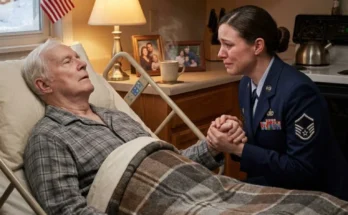
There were hospital rooms with stale air and beige walls, quiet talks with doctors who wore practiced sympathy on their faces, and nights when I sat beside his bed pretending I was strong because he was the one who needed comfort.
Gerard had always been the steady one in our marriage.
He was the kind of man who folded his shirts neatly, paid bills the day they arrived, and kissed me on the forehead whenever he passed behind my chair.
He noticed small things. When my shoulders tensed, he would rest his hands on them without a word. When I forgot to eat, he would place a plate in front of me and give me that look that said he knew me better than I knew myself.
Watching a man like that fade away did something terrible to me.
It made me angry at how helpless love could be.
For months after, I kept expecting to hear his voice in the house, to see him walk through the door like nothing had happened.
I would look up from the sink at the sound of tires in the driveway, my heart lifting before my mind caught up. I would wake in the middle of the night and reach across the bed, still warm from sleep, only to touch cold sheets.
I left some of his things where they were for far too long.
His gray sweater remained on the hook by the laundry room. His favorite mug sat in the cabinet, untouched. I even caught myself speaking out loud once while folding towels.
“Gerard, did you move the…” I had started, then stopped with a towel in my hands and tears stinging my eyes because there was no answer. There would never be an answer.
But time passed.
And eventually, I learned to live with the silence.
Not peacefully. Not gracefully. I just learned how to carry it. I went back to work. I smiled when people expected me to. I stopped crying in the grocery store parking lot.
I began making dinner for one without staring at the empty chair across from me for half an hour. It was not healing the way people make it sound. It was more like scar tissue. Tender in some places, numb in others.
Yesterday started like any other day.
I left work tired and distracted, with an ache behind my eyes from staring at spreadsheets and answering emails I barely cared about.
The sky was turning that soft gray-blue that comes before evening, and the wind had picked up just enough to send dry leaves scratching across the sidewalk. I remember thinking only of changing into sweatpants and reheating leftovers.
I came home from work, checked the mailbox, and almost didn’t notice it.
A single envelope.
No return address.
Just my name, written in handwriting that made my heart stop.
I knew that handwriting.
I froze right there on the porch.
At first, I could not breathe. The world narrowed to that envelope in my hand, to the slant of the letters, to the way my name curved exactly as he used to write it when he left me notes on the kitchen counter.
Veronica.
The handwriting was neat and unhurried, so familiar it felt intimate. And yet, in that moment, it looked impossible.
Slowly, I turned the envelope over.
The postmark was from my city.
Dated yesterday.
My hands started shaking as I opened it.
Inside was a single sheet of paper.
I recognized the way it was folded. The way he always folded his letters.
I unfolded it carefully.
The first line made the world around me disappear.
“If you’re reading this, something went wrong.”
I felt my breath catch.
My eyes moved down the page, trying to make sense of the words, of the impossible reality in my hands.
And then I reached the last line.
That’s when I dropped the letter.
Behind me, I suddenly heard the front door slowly unlock.
I spun around so fast my heel slipped against the porch.
The front door opened with a slow, familiar creak, and for one wild, broken second, I thought I was about to see Gerard standing there.
Instead, three men stepped into the entryway, all of them frozen by the look on my face.
I knew them instantly.
Owen, Gerard’s oldest friend, broad-shouldered and graying at the temples. Victor, quieter, with anxious eyes behind thin glasses. And Lionel, who had once made Gerard laugh so hard at a barbecue that he nearly dropped an entire plate of ribs.
Owen lifted both hands. “Veronica, wait. Please.”
I could barely get the words out. “Why do you have a key to my house?”
My voice came out thin and sharp. My chest was rising too fast, and I could still hear my pulse pounding in my ears.
Lionel looked sick with guilt.
“Gerard gave it to us,” he said softly.
I stared at them. “What?”
Victor swallowed. “We know how this looks.”
“How this looks?” I repeated. “I just got a letter in Gerard’s handwriting dated yesterday, and now you’re walking into my house like ghosts. Tell me what’s happening right now.”
Owen took one careful step forward, then stopped when he saw me flinch. “It was us,” he admitted. “We left the letter in your mailbox. Gerard asked us to.”
For a moment, none of it made sense.
The words floated around me without landing.
I looked down at the paper on the porch, then back at them. “That’s not funny.”
“No,” Owen said, his voice rough. “It isn’t.”
Lionel rubbed the back of his neck. “He made us promise. Years ago.”
Victor held up a small black flash drive between two trembling fingers. “There’s more. He recorded something for you before he… before the end.”
I could not speak.
I simply moved aside.
They entered slowly, like men stepping into a church after a long absence. I led them into the living room on numb legs.
My hands would not stop shaking, so I clasped them together in my lap while Victor plugged the drive into my old laptop. Nobody said a word while the screen flickered to life.
Then Gerard appeared.
The recording quality was not perfect.
The light was too dim, and the angle was awkward, but it was him. Thinner than I remembered, pale, tired, wearing the navy sweater I used to tease him about because he refused to throw it away. His eyes found the camera, and then he smiled.
My whole body folded in on itself.
“Hi, Ronnie,” he said gently.
I let out a sound that was half sob, half gasp.
He had always called me Ronnie when it was just us.
“If you’re watching this,” he continued, “then Owen actually followed instructions for once, which means I may be sicker than I thought, because apparently miracles do happen.”
Lionel barked out a tearful laugh. Owen looked down and wiped at his eyes.
Gerard’s smile faded into something softer. “I’m guessing this is hard to watch. I’m sorry for that. I’m sorry for a lot of things.”
I pressed my fist to my mouth.
“I know you, Veronica. You’ll want answers, and I may not have all of them. But I do know this. If this reaches you after I’m gone, then something went wrong. Not with my plan. With time. With life. With all the years I thought we’d still have.”
His voice shook, but he kept going.
“I asked the guys to wait. I did not want this delivered right after I died. You would have been drowning already. I hoped that by the time you saw this, the worst of the storm would have passed. Not because I wanted you to miss me less. Just because I wanted you to be able to breathe.”
Tears rolled down my face unchecked.
He leaned closer to the camera, as if he could cross the space between us through sheer will. “I need you to hear me clearly. None of this was your fault. Not the pain. Not the treatments. Not the days I gave up too easily. You loved me through all of it, even when I was not easy to love. Especially then.”
I remembered the hospital nights, my own exhaustion, and the guilt I had dragged behind me for three long years. Gerard had seen it.
He had carried it with him.
“I also know you,” he said with the faintest smile. “So you’ve probably kept too much inside. You’ve probably survived instead of lived. Don’t do that forever, Ronnie.”
The room was silent except for my crying.
“Laugh again. Let people in. Be stubborn about joy. And when you’re ready, forgive me for leaving you with this message instead of more time.”
He took a breath. His eyes shone.
“You were the best part of my life. Loving you was the easiest thing I ever did.”
The screen went black.
I bowed my head and wept the kind of tears that had been waiting years for permission. Not the raw, violent grief from the beginning, but something deeper and stranger. Relief. Ache. Love with nowhere to go and everywhere to land.
After a while, Owen placed the letter on the coffee table and said quietly, “He wanted you to have this when you were strong enough.”
I looked at Gerard’s friends, at their grief and patience, at the burden they had carried for him, and then back at the dark screen.
For the first time in three years, the silence in the house did not feel empty.
It felt like a goodbye.
And somehow, at last, it also felt like peace.
But here is the real question: when love reaches for you from beyond loss, carrying old pain, unanswered questions, and one final act of devotion, what do you do with it?
Do you cling to the grief that has defined you for years, or do you let the truth soften what was broken and find the strength to say goodbye finally?