The headlights of my military-issue sedan cut through the heavy North Carolina mist like twin bayonets.
I was still wearing my Class A dress uniform when I cleared the security gates of Fort Liberty that evening. The dark, midnight-blue wool of the jacket felt unusually stiff against my shoulders, ironed to razor perfection, decorated with four rows of service ribbons, two Bronze Stars, and the jump wings of a Master Parachutist. The gold oak-leaf insignia on my shoulder boards gleamed beneath the passing streetlamps as I navigated the winding, manicured boulevards of south Charlotte—an enclave where old money, political grease, and corporate pedigree insulated the state’s elite from the grit of the rest of the world.
My hands gripped the steering wheel with such sustained violence that the black leather groaned beneath my gloves. The dashboard clock clicked over with cold, mocking precision: 2142 hours.
Forty-seven minutes earlier, a scrambled, fourteen-second voicemail had arrived on my encrypted line. There had been no greeting. No context. Only the sound of shattering porcelain, a wet gasp, and my daughter’s voice—thin, reedy, stripped of air: “Mom… gatehouse… they’re taking the files… Richard found out—”
The line had gone dead with the blunt, unmistakable sound of a phone being stomped beneath a boot heel.
I didn’t call the local police. When an heiress marries into the Sterling empire, the local police are not a neutral shield; they are an extended wing of the Sterling estate’s private security apparatus. I called the only people whose oaths had not been bought on the private stock exchange.
I parked the sedan across two spaces in the ambulance bay of Mercy General Hospital, letting the engine idle hot. The hospital was a private, limestone-fronted medical pavilion subsidized heavily by the Sterling Family Foundation. Above the automatic glass entrance, brass letters announced the Sterling Pavilion of Surgical Excellence. A grim monument to private philanthropy masking generational rot.
The sliding doors parted with a soft hiss, admitting me into an expanse that smelled of high-grade surgical disinfectant, ozone, and cold terror.
A young triage nurse stepped into the corridor, her plastic clipboard held against her chest like an improvised breastplate. “Ma’am, restricted area. Emergency intake is down the eastern vestibule. If you’re here for visiting hours, they closed at eight—”
I didn’t break stride. I didn’t reach for credentials. I let my boots strike the linoleum with the measured, resonant cadence of a garrison commander taking the parade grounds. My gaze pinned her to the spot.
“My daughter,” I said. My voice was pitched at that terrifying, sub-audible hum that field officers use right before an artillery strike is cleared. “Where is Chloe Sterling?”
The nurse took in the brass. She took in the combat patches, the combat infantryman badge, and the gold plate pinned meticulously above my left pocket: COLONEL SARAH MILLER. The color drained from her cheeks. She was twenty-two, working the graveyard shift, and suddenly finding herself standing in the path of a Category Five hurricane in service dress.
“Room… Room 104-B,” she stammered, stepping backward until her hip hit the counter. “Ma’am, wait, the physician hasn’t signed off—”
I rounded the corner of the surgical observation wing. My blood turned into liquid nitrogen.
I wasn’t just late. They were already executing the extraction.
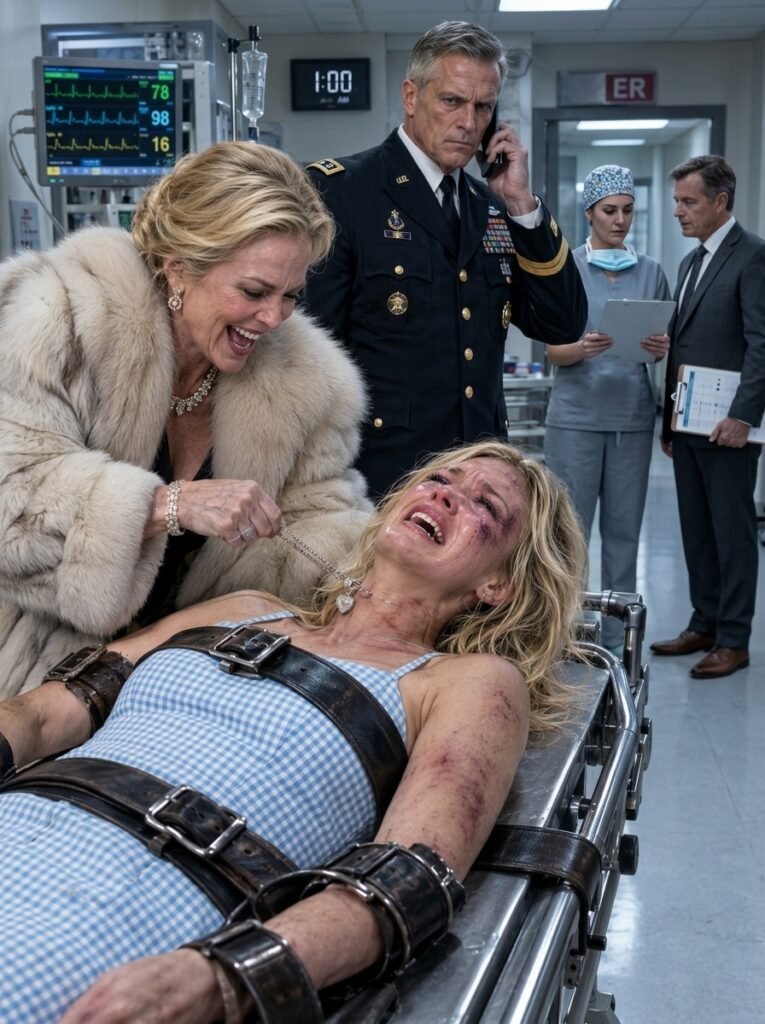
Two men in dark navy scrubs—men whose necks were as thick as telegraph poles and whose broad, scarred knuckles belonged on an offshore oil rig rather than in a postoperative ward—were wheeling a heavy steel transport gurney toward the rear freight elevator.
Strapped to the gurney was my daughter.
Canvas restraints, thick and olive-drab, were cinched tightly around her slender wrists and ankles, bolted to the tubular steel framework. Her right eye was swollen shut, surrounded by a ring of blackened, necrotic purple. Dried blood tracked from her lower lip across her chin, crusting against the torn collar of an ivory silk blouse—an expensive, bespoke piece meant for country-club dinners, now shredded across her collarbone.
She was thrashing with whatever fading adrenaline she had left, her heels kicking the foot of the gurney, making the metal casters shriek against the tile floor.
“Mom!” she screamed, the sound splintering into a broken wheeze. “Mom, don’t let them—”
The orderly at the front of the gurney stepped forward, extending an arm the size of a ham to bar my way. “Stand back, lady. Authorized patient transport. Step aside or security will remove you.”
I didn’t reach for a weapon. Twenty-six years in the infantry teaches you that the human body itself is an inventory of levers and fulcrums.
I caught his outstretched wrist with my left hand, stepped across his lead foot, and drove the heel of my right hand upward into his radial nerve while twisting his arm clockwise. The joint lock was clean, silent, and mathematically absolute. The man dropped instantly to his knees with a choked groan, his elbow locked at an angle that promised a compound fracture if he twitched a single muscle fiber.
The second orderly froze, his fingers twitching away from the gurney handles, his eyes widening as he recognized the predatory ease with which I had neutralized his partner.
“Get your hands off my daughter,” I said, barely raising my voice above a whisper.
I released the man’s arm, stepping past his kneeling form to the bedside. Chloe’s skin was radiating a dry, burning heat. Her breath came in shallow, panicked bursts that smelled faintly of iron and medicinal sedatives.
“Chloe,” I murmured, my gloved fingers touching her unbruised cheek. “Look at me. Eyes on me, soldier. I’m here.”
Her good eye focused on my face, the pupil dilated and glassy. “The… the necklace, Mom,” she whispered through split lips, her voice barely carrying over the hum of the fluorescent lights. “Don’t let her… don’t let her touch the locket…”
“Well, isn’t this an extraordinarily violent display of maternal hysteria?”
The voice behind me was like chilled vermouth: dry, sharp, and entirely devoid of human warmth.
I didn’t jump. I rose slowly, turning my back to the gurney so that my body formed an unbroken wall of wool and bone between my daughter and the people walking down the hall.
Standing five yards away was Beatrice Sterling, the matriarch of the family, wrapped in an ankle-length cashmere coat the color of dried bone. Flanking her were her two sons: Carter, the elder, sporting the bloated, red-faced look of a man whose liver had spent twenty years processing expensive bourbon, and Richard, my daughter’s husband.
Richard’s silk tie was slightly skewed. His knuckles were raw, the skin split across his index finger. He kept his hands stuffed deep into his slacks, his chin lifted at that familiar, rehearsed angle of juvenile defiance.
Beatrice held a manila legal folder in her manicured hands, her large solitaire diamond catching the harsh hospital light.
“Colonel Miller,” Beatrice said, offering an arched, theatrical smile. “Assaulting private hospital staff while in uniform. I imagine the Department of the Army has explicit regulations regarding field officers terrorizing civilian medical wards.”
“Step back, Beatrice,” I warned, my muscles coiled. “Before I forget this uniform is dry-clean only.”
“You have no authority here, Sarah,” Beatrice replied smoothly, tapping the folder with a fingernail polished in glossy crimson. “This is a private family matter. Chloe suffered a catastrophic nervous breakdown at the manor tonight. She became violent, threw herself down the terrace stairs, and attacked Richard with a pair of shears. We had her evaluated by our family physician. Dr. Evans signed the provisional 72-hour psychiatric hold twenty minutes ago.”
Richard shifted his weight, his eyes flickering toward Chloe with a venomous disgust that made my skin crawl. “She’s lost her mind, Sarah. We’re doing what’s best. We’re moving her to Oakridge Institute where she can be properly stabilized. You should be thanking us.”
Oakridge was a private, gated psychiatric fortress in the mountains near Asheville, entirely funded by the Sterling family trust. A place where troublesome wives, inconvenient whistleblowers, and family embarrassments were checked in and rarely, if ever, checked out.
“A closed facility,” I said, the realization settling into my gut like lead. “You’re trying to bury her.”
“We are managing a domestic crisis with discretion,” Beatrice countered, stepping forward until her jasmine perfume overpowered the chemical scent of the floor polish. “The transport papers are processed. Her husband has executed the medical power of attorney. If you interfere any further, Colonel, I will have the hospital administrator call the state police, and I will personally phone the Secretary of the Army before sunrise.”
She smiled, that serene, untouchable grin of a woman who had never once in her life faced a consequence that money couldn’t rewrite.
“Step away from the gurney, Sarah. Or your career ends tonight on this floor.”
I looked at Richard’s split knuckles. I looked at the legal papers in Beatrice’s hands. And for one terrifying heartbeat, the crushing weight of their institutional power pressed down on my chest, leaving me to wonder if my badge and my ribbons were enough to stop the machinery of a billion-dollar dynasty from grinding my child into dust.