For 180 school mornings, I waited 3 extra minutes for a little boy who was always late. My supervisor wrote me up twice. “Wait for that kid one more time, Bettie, and you’re fired.” On morning 181, I waited anyway. Then the boy came running down the driveway in his socks, screaming.
My name is Bettie Mapes. I’m sixty-one years old, and I’ve been driving a school bus in Covington, Kentucky, for twenty-two years.
I know every kid on my route. I know who’s allergic to peanuts, who gets carsick, and who needs a “good morning” more than anybody else.
Two years ago, a new boy joined my route. His name was Caspian. He was six years old, with a cowlick and a backpack bigger than he was.
He lived in a small gray house at the end of Linden Street with his mother, Abilene.
The first morning I picked him up, he was late. He came running out of the house with one shoe untied and toast in his mouth.
“Sorry, Miss Bettie! Mom was sick.”
The next morning, he was late again. And the next.
Every day, I pulled up to his stop at 7:12. And every day, he came running out around 7:15.
Three minutes.
I could have driven away. That’s the rule. Stop, wait thirty seconds, go.
But I’d seen him through the window one morning. Standing on a chair in the kitchen, making his own breakfast. Packing his own lunch. Putting a glass of water next to his mother on the couch.
His mom had some kind of illness. I never knew what. Some days I’d see her waving from the porch. Most days, I didn’t see her at all.
That little boy was taking care of his mother before school.
So I waited. Three minutes. Every single day.
The other kids on the bus got used to it. Sometimes they’d cheer when he came running out. “Go, Caspian, go!”
But my new supervisor didn’t like it.
His name was Mr. Vandermeer. He started at the transportation office last spring. He’s thirty-eight, and he tracks every bus with GPS.
In October, he called me into his office.
“Mrs. Mapes, your bus is three minutes late at every stop after Linden Street. Every single day.”
“There’s a little boy who needs a few extra minutes. His mother is sick.”
“That’s not our problem. We have a schedule. Do you know how many parents complain when the bus is late?”
He wrote me up.
In January, he wrote me up again.
In March, he called me into his office one more time. He didn’t ask me to sit down.
“This is your final warning, Bettie. Wait for that kid one more time, and you’re fired. I don’t care how many years you’ve been here. I can replace you by Monday.”
“He’s eight years old,” I said.
“Then he can learn to set an alarm clock.”
I walked out of that office with my hands shaking.
I needed that job. My husband had a stroke three years ago. My paycheck is what keeps our lights on.
So I said, “Okay.”
The next morning, I pulled up to Linden Street at 7:12. I waited thirty seconds. Caspian wasn’t there.
I closed the door. I drove away.
In my mirror, I saw him come running out of the house a minute later, waving his arms, watching my bus disappear around the corner.
I cried at the next stop.
I did it for two weeks. It was the hardest two weeks of my career.
Then came morning 181.
It was a cold, gray Tuesday. I pulled up to Linden Street at 7:12.
No Caspian.
Thirty seconds passed. The kids were quiet.
My hand was on the lever to close the door.
But something felt wrong. The house was completely dark. The curtains were closed. Usually, the kitchen light was on.
I waited one minute.
Then two.
Then three.
My radio crackled.
“Bus 14, this is dispatch. GPS shows you stopped on Linden. Mr. Vandermeer wants to know why you’re not moving.”
I didn’t answer.
At 7:16, the front door burst open.
Caspian came running down the driveway in his socks and pajamas. No coat. No backpack. His face was white, and he was screaming.
“Miss Bettie! Miss Bettie! My mom won’t wake up!”
I put the bus in park and turned on the flashers.
“Kids, stay in your seats. Dante, you’re in charge.”
I ran into that house.
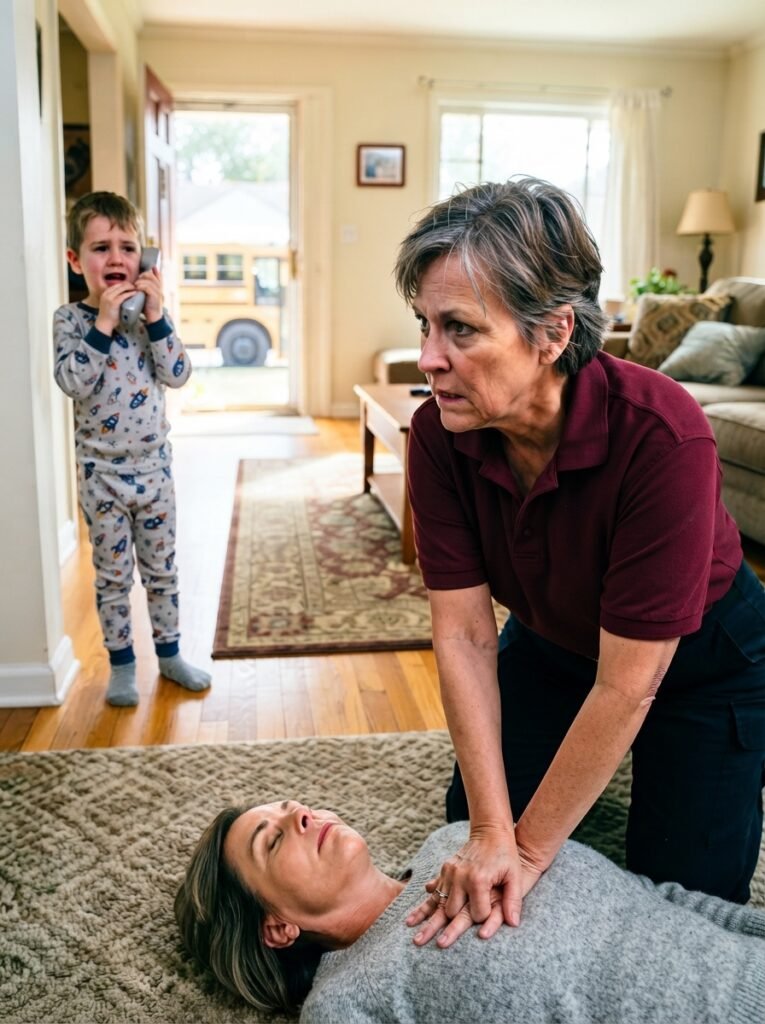
Abilene was lying on the kitchen floor. Her lips were blue. She wasn’t breathing.
I dropped to my knees and started CPR, the way they teach us every year in bus driver training. I’d never done it on a real person before.
“Caspian, baby, take my phone. Call 911. Tell them the address.”
He did. His voice was shaking, but he did it.
Behind me, my radio was still crackling on my belt.
“Bus 14, this is Mr. Vandermeer. If that bus isn’t moving in sixty seconds, you’re terminated. Do you copy?”
I kept pushing on Abilene’s chest. One, two, three, four.
I didn’t answer him.
The paramedics arrived six minutes later. I was still doing CPR. My arms were burning. My knees were bleeding through my pants from the kitchen tiles.
One of them gently moved my hands away.
“We’ve got her, ma’am. You can stop now.”
They worked on Abilene for what felt like forever. Caspian stood in the corner of the kitchen, holding my hand so tightly my fingers went numb.
Then one of the paramedics said the words I’ll never forget.
“I’ve got a pulse.”
Caspian collapsed against me, sobbing.
Abilene had a rare heart condition. That morning, her heart had stopped in her sleep. She had gotten up to get water and fallen in the kitchen.
The doctors said later that she’d been without a heartbeat for several minutes before I started CPR.
“Another three minutes,” the cardiologist told me, “and she wouldn’t have made it.”
Three minutes.
The same three minutes I’d been waiting for her son every morning for two years.
When I finally drove the bus to school, an hour and a half late, every kid on that bus was silent. Dante had kept everyone in their seats the whole time.
When I parked, Mr. Vandermeer was standing in the parking lot with his arms crossed.
“Mrs. Mapes, you ignored a direct order. You held up twenty children for ninety minutes. You’re done. Clear out your locker.”
I didn’t argue. I was too tired. I just handed him my keys.
That’s when the kids started getting off the bus.
Twenty-three of them.
And every single one of them walked past Mr. Vandermeer and hugged me first.
One of the third-grade boys stopped right in front of him.
“Miss Bettie saved Caspian’s mom,” he said. “She did CPR on the floor. You told her to drive away.”
The story was all over Covington by lunchtime. Parents posted about it. The local news showed up at the school.
The superintendent called me that night.
“Mrs. Mapes,” she said, “you’re not fired. And you’ll never be written up for waiting for a child again. Ever.”
Mr. Vandermeer was moved to a different department two weeks later. The new transportation rule is posted in every bus garage in the district now.
“If something feels wrong at a stop, wait. A schedule can be late. A child cannot.”
They call it Bettie’s Rule.
Abilene got a pacemaker. She’s healthy now. She walks Caspian to the bus stop herself every morning.
And somehow, he’s never late anymore.
Twelve years later, I retired.
The district threw me a party in the bus garage. Cake. Balloons. Old students I hadn’t seen in years.
Near the end, a tall young man in a blue uniform walked up to me.
He had a cowlick.
“Hi, Miss Bettie,” he said.
It was Caspian. Twenty years old. A brand-new paramedic.
“You waited for me,” he said. “Every single day. So now I’m the one who shows up when someone’s heart stops.”
He pulled me into a hug.
“Thank you for those three minutes.”
THE END.