For 31 mornings, I sneaked apples to a starving donkey chained behind my neighbor’s barn. On the 31st, he caught me and pointed a shotgun at my chest. “Touch my animal again, old woman, and I’ll bury you both.” At 2 a.m. the next night, that donkey started screaming outside my bedroom window.
My name is Bev Loomis. I’m sixty-seven, and I live alone on twelve acres in the Missouri Ozarks.
My husband, Lyman, passed three winters ago. We had apple trees, a vegetable garden, and two old cats. Now it’s just me and the cats.
My nearest neighbor is Vernon Crisp. His farm is a quarter mile down the gravel road.
Vernon is seventy. He’s a hard man. He doesn’t wave. He doesn’t go to church. When Lyman died, everybody on our road brought a casserole. Vernon didn’t even send a card.
This past summer, his daughter went overseas with the Army. She left her two kids with him. Abel is seven. Sunny is four.
I’d see them sometimes, playing in the dirt by his porch. Barefoot. Dirty. Nobody watching.
In September, I was walking the fence line and saw something behind Vernon’s barn.
A donkey.
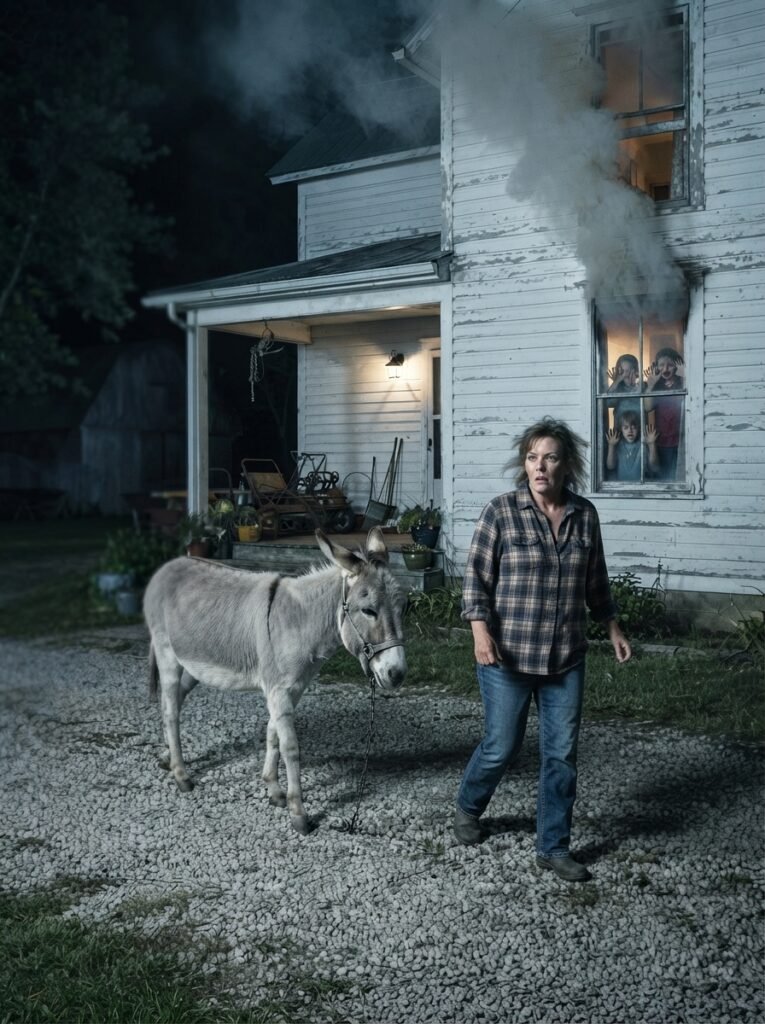
A gray donkey with a white nose, chained to a post with a short, rusty chain. He couldn’t reach the shade. He couldn’t reach the grass. His water bucket was empty and tipped over. His hooves were so overgrown, they curled up like slippers.
He was so thin, I could count every rib.
When he saw me, he made a soft, sad sound. Like a question.
I went home and cried. Then I filled a bucket with water and picked a bag of apples from Lyman’s trees.
I slipped through the fence and gave them to him.
He ate them so gently. He pressed his nose against my hand when he finished.
I named him Moses.
Every morning after that, before the sun came up, I walked down the fence line with water and apples. Every morning, Moses was waiting. As soon as he saw me, he’d start making that soft little sound.
He started gaining weight. His eyes got brighter.
On the thirty-first morning, Vernon caught me.
I heard the screen door slam. I turned around, and he was standing there in his boots and undershirt, holding a shotgun.
He pointed it at my chest.
“What do you think you’re doing on my land?”
“Vernon, he’s starving. He doesn’t have water.”
“He’s my animal. I’ll take care of him how I want.”
“You’re not taking care of him at all.”
His face went dark red.
“You think you’re better than me? You and your dead husband, with your church and your casseroles. You’ve always looked down on me.”
“I’ve never looked down on you, Vernon.”
“Touch my animal again, old woman,” he said, “and I’ll bury you both.”
Abel and Sunny were standing on the porch behind him in their pajamas, watching.
Sunny was crying.
I looked at those kids. I looked at that gun. And I decided not to fight.
I just said, “Okay.”
I put down my bucket of apples, walked back through the fence, and went home.
I didn’t call the sheriff that day. Maybe I should have. But I was scared. And I was thinking about those kids. If Vernon got arrested, who would take care of them?
I didn’t sleep well that night. I kept thinking about Moses, waiting for me in the dark.
At 2:07 a.m., I woke up to the most terrible sound I’ve ever heard.
A donkey’s bray. Loud. Desperate. Over and over. Like a siren.
It was right outside my bedroom window.
I grabbed my flashlight and ran to the porch.
Moses was standing in my front yard. A broken piece of rusty chain was hanging from his neck. He’d snapped it. His sides were heaving. His eyes were wild.
When he saw me, he turned around and ran back toward Vernon’s farm. Then he stopped and looked back at me. Braying.
He wanted me to follow him.
I pulled on my boots and ran down the gravel road in my nightgown.
Halfway there, I smelled it.
Smoke.
When I came around the bend, I saw orange light flickering through Vernon’s downstairs windows. Smoke was pouring out from under the eaves.
His truck was in the driveway. The lights were off.
Nobody was coming out.
And upstairs, behind the bedroom window, I saw two tiny hands pressed against the glass.
PART 2
I called 911 while I ran. The nearest fire station was fourteen miles away.
Fourteen miles. On gravel roads. In the middle of the night.
Those babies didn’t have that long.
I ran up the porch steps and pulled on the front door. Locked. Vernon always locked it.
I beat on it with my fists.
“Vernon! VERNON! Wake up!”
Nothing.
I ran around to the back of the house. The kitchen door was locked too. Old, heavy oak. I threw my shoulder against it. It didn’t move. I’m sixty-seven years old. I didn’t have the strength.
Then Moses pushed past me.
He walked right up to that back door, turned around, and kicked it with both of his back legs.
Once. The frame cracked.
Twice. The door flew open and crashed against the wall.
I’ll never forget it as long as I live.
Smoke poured out. I pulled my nightgown over my mouth and went in.
The fire was in the living room. An old extension cord behind the TV had sparked and caught the curtains. Vernon was in his recliner, right next to it. He wasn’t moving.
I grabbed him under the arms and pulled. He’s a big man. I don’t know how I did it. I dragged him through the kitchen and out onto the grass.
He started coughing. He was alive.
Then I ran back in and up the stairs.
Abel and Sunny were in the back bedroom, hiding under the bed, holding each other. Abel had put a wet T-shirt over his little sister’s face, just like they taught him at school.
“Come on, babies. Hold my hand. Don’t let go.”
We made it down the stairs and out the back door just as the living room ceiling started to fall.
The fire trucks arrived twenty minutes later.
By then, the downstairs was gone.
We sat on the grass in the dark, watching. Me, in my sooty nightgown. Vernon, wrapped in a blanket, with an oxygen mask over his face. The kids in my lap.
And Moses, standing right next to us, his broken chain still hanging from his neck.
When the paramedics finished checking him, Vernon pulled off the oxygen mask.
He looked at me for a long time. Then at the donkey.
“I left him with no water,” he whispered. “I put a gun on you. And you both came back for me.”
He started to cry. A seventy-year-old man who never waved at anybody, crying on the grass.
“I’m sorry, Bev,” he said. “I’m so sorry.”
Vernon and the kids stayed with me while his house was rebuilt. Four months.
It turned out he wasn’t cruel. He was drowning. His wife had died four years earlier. His daughter was overseas. He didn’t know how to take care of two children and a farm by himself, and he was too proud to ask anyone for help.
So the church ladies brought casseroles. And this time, he said thank you.
When his new house was finished, Vernon walked over to my porch with a piece of paper.
It was Moses’s bill of sale.
He’d signed it over to me.
“He’s yours,” Vernon said. “He always was, really.”
Then he and Abel built a gate in the fence between our two farms.
Now Abel and Sunny come through it every morning before school.
They bring a bag of apples.
And Moses is always waiting.
THE END.