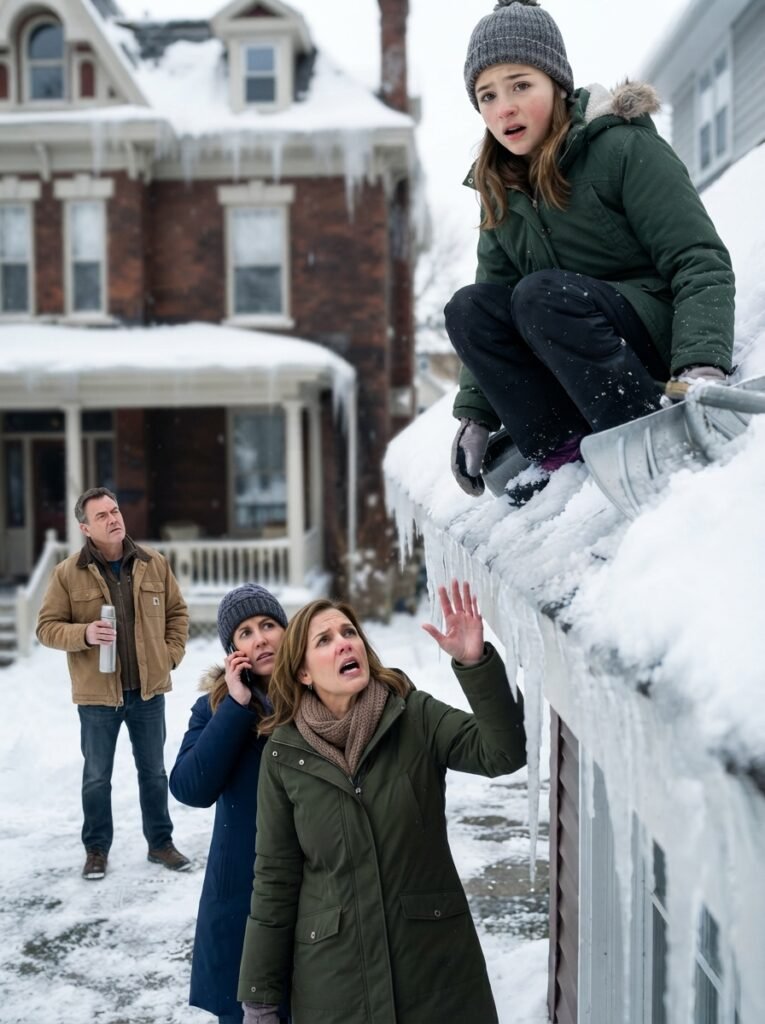
I came home 9 days early from a stem cell transplant in Houston and found my 13-year-old daughter on our roof. Three stories up. In the snow. No rope. Shoveling ice off the shingles. “Kent says the roof will cave in if I don’t,” she called down. “He says it’s my job now.” Then her boot slipped.
My name is Mara Bishop. I’m 41. I’m an insurance underwriter in Buffalo, New York.
Last year, I was diagnosed with a blood cancer. My doctors said my best chance was a stem cell transplant at a hospital in Houston. Ten weeks. Isolation. No visitors under eighteen.
I married Kent three years ago. My daughter, Remy, is from my first marriage. Her father passed away when she was six.
Kent promised he’d take care of her.
“Go get better,” he said. “Remy and I will be fine. I’ve got this.”
I called every night. Kent always answered.
“She’s doing homework.” “She’s in the shower.” “She’s already asleep.”
When I did get Remy on the phone, she sounded tired. Flat. “I’m fine, Mom. Just get better.”
My transplant went better than anyone expected. My doctors cleared me to go home early. I flew back on a Saturday morning without telling anyone. I wanted to surprise Remy.
My sister picked me up from the airport.
We pulled onto my street at 10 a.m. There had been a huge lake-effect storm two days before. Three feet of snow.
As we turned into the driveway, my sister slammed on the brakes.
“Mara. Look up.”
On the roof of our tall old Victorian, three stories above the ground, a small figure in a purple coat was crouched near the edge. Holding a snow shovel. Pushing heavy, wet snow and chunks of ice over the gutter.
No harness. No rope. No ladder at the edge. Just a steep, icy slope.
My daughter.
I got out of the car on legs that barely worked. I was still weak from treatment.
“Remy!” I screamed. “Remy, stop! Don’t move!”
She looked down. Her face lit up.
“Mom?”
Then she looked toward the house. Toward the front window. Her smile disappeared.
“I can’t stop,” she called down. “Kent says the roof will cave in if I don’t get all the snow off. He says it’s my job now. He says if I don’t finish, I don’t eat dinner.”
The front door opened. Kent stepped out onto the porch holding a mug of coffee.
“Mara! What are you doing home?”
“Why is my daughter on the roof?”
He shrugged.
“Somebody had to do it. I’ve got a bad back. She’s young. She’s light. She does a good job.”
“She’s thirteen. It’s three stories.”
“Oh, relax. She’s done it twice already this winter.” His voice got sharper. “You’ve been gone ten weeks, Mara. You don’t get to show up and tell me how to run this house. I’ve been raising your kid while you were lying in a hospital bed.”
“Get her down. Now.”
“She’ll come down when she’s finished,” Kent said. “That’s how she learns responsibility.”
I didn’t scream at him again.
Because I knew something Kent didn’t know I knew.
I’m an insurance underwriter. From my hospital bed, out of boredom, I’d logged into our homeowner’s insurance account. Two weeks earlier, Kent had filed a claim for $2,400.
“Professional roof snow removal. Licensed contractor.”
The licensed contractor was my thirteen-year-old.
My sister was already on the phone with 911. I kept my eyes on my daughter.
“Remy, baby,” I called up, as calmly as I could. “I need you to listen to me. Put the shovel down. Sit down right where you are. Don’t stand up. Don’t walk. Just sit.”
She started to lower the shovel.
That’s when the snow under her left boot broke loose.
It slid in a big wet sheet toward the edge.
Remy’s foot went with it.
She fell onto her back on the steep, icy roof and started to slide.
Toward the edge.
Toward three stories of empty air.
My sister screamed.
PART 2
For one second, I thought I was going to watch my daughter die.
Remy’s foot caught on one.
She stopped sliding. Two feet from the edge.
She lay there on her back, frozen, clutching the shingles.
“Don’t move!” I screamed. “Baby, don’t move!”
Our neighbor, Mr. Ostrowski, a retired roofer in his seventies, came running across the street with an extension ladder. My sister held the bottom. He climbed up and talked to Remy the whole time.
“You’re okay, kiddo. Don’t look down. Look at me. I’ve got you.”
The fire truck arrived four minutes later. Two firefighters climbed up with harnesses and brought Remy down in one.
When her feet touched the snow, she ran straight into my arms.
I was so weak from treatment that I fell over. We sat in the snowbank together, holding each other, crying.
“I’m sorry, Mom,” she sobbed. “I’m sorry. I tried to do everything he said so he wouldn’t call you. He said you’d get sicker if I complained.”
The police arrived right behind the firefighters.
Kent was still standing on the porch with his coffee.
“It was an accident,” he told them. “She slipped. Kids slip.”
I showed the officer the insurance claim on my phone.
“Professional roof snow removal. Licensed contractor. $2,400.”
Then I pointed at my daughter.
“That’s the contractor.”
The officer read the claim. Then he looked at Kent.
The investigation found the rest.
Kent had filed three claims that winter. Snow removal. Gutter repair. “Ice dam prevention.” All done by Remy. All paid to him.
He’d also kept her home from school eleven days. To shovel. To clean. To cook for him.
Her school had called the house five times. Kent told them she had the flu.
He was charged with child endangerment and insurance fraud. The insurance company pressed charges too.
I filed for divorce from my hospital follow-up appointment the next week. My oncologist signed my paperwork as a witness. She said it was the best thing she’d seen all month.
Kent pleaded guilty in the summer. He went to jail for eighteen months.
Remy went back to school. She caught up on everything. Her teachers said she’s one of the hardest workers they’ve ever had.
I already knew that.
My scans have been clear for a year now.
This winter, after the first big storm, I hired a real roofing company to clear the snow. Mr. Ostrowski supervised from his front yard with a cup of cocoa.
Remy and I stayed inside. Under a blanket. Watching movies.
When the roofers finished, she looked out the window at the clean shingles.
“Mom,” she said. “That’s not my job anymore, right?”
“Baby,” I said, “your only job is being thirteen.”
THE END.