For 11 winters, I secretly shoveled the grumpiest old man’s driveway before dawn. Two winters ago, I found him at 5 a.m. at the bottom of his steps on the ice, lips blue. When he died, his lawyer handed me an envelope. “I always knew it was you,” it said. “And I never told you what I did either.”
My name is Maggie Fennimore. I’m 52. I work as a cashier at a pharmacy in Eau Claire, Wisconsin.
Eleven years ago, my husband, Conrad, died in a logging accident. He was forty-one. We had two kids, eight and ten, and a mortgage I couldn’t pay on a cashier’s salary.
That first winter, I was barely holding on.
Across the street lived Mr. Horace Pickett. Eighty-one at the time. A retired railroad man. A widower. Everyone on the street called him “the Grinch.”
He yelled at kids who cut across his lawn. He called the city when my trash cans were out too long. He called the police on my dog, twice, for barking.
He never waved. He never smiled.
That December, we had a huge storm. Two feet of snow. I was out shoveling my driveway at 5 a.m. before work, crying, because Conrad had always done it.
I looked across the street.
Mr. Pickett was standing in his doorway in his bathrobe, staring at his own driveway. Buried. He was holding a shovel he could barely lift.
He went back inside and closed the door.
So I walked across the street and shoveled it.
I didn’t knock. I didn’t tell him. I just did it, and went back home before the sun came up.
The next storm, I did it again.
And the next.
For eleven winters.
He never said a word about it. Not once. He still yelled at my kids. He still complained about my mailbox. Once, at a neighborhood meeting, he called me “the woman with the yappy dog.”
I kept shoveling.
Two winters ago, I went over at 5 a.m. after an ice storm. His porch light was on. His front door was open.
Mr. Pickett was lying at the bottom of his front steps on the ice. He’d gone out to get his newspaper and slipped.
His lips were blue. He’d been out there almost an hour.
I called 911 and lay down next to him on the ice and wrapped him in my coat until the ambulance came.
At the hospital, the doctor said he had a broken hip and hypothermia. “Another thirty minutes,” she said, “and he wouldn’t have survived.”
When he woke up, I was sitting by his bed.
He looked at me for a long time.
“You,” he said.
“Me,” I said.
That was the whole conversation.
He went home three weeks later with a walker. I kept shoveling. He kept not saying thank you. But sometimes now, when I came home from work, there’d be a bag of oranges on my porch. Or a bone for the dog.
This October, Mr. Pickett died in his sleep. He was ninety-two.
His nephew, Lyndon, flew in from Phoenix for the funeral. He’d visited maybe twice in ten years. He told everyone at the funeral that he’d be “taking care of the house.”
A week later, a lawyer called me. Ms. Castellanos.
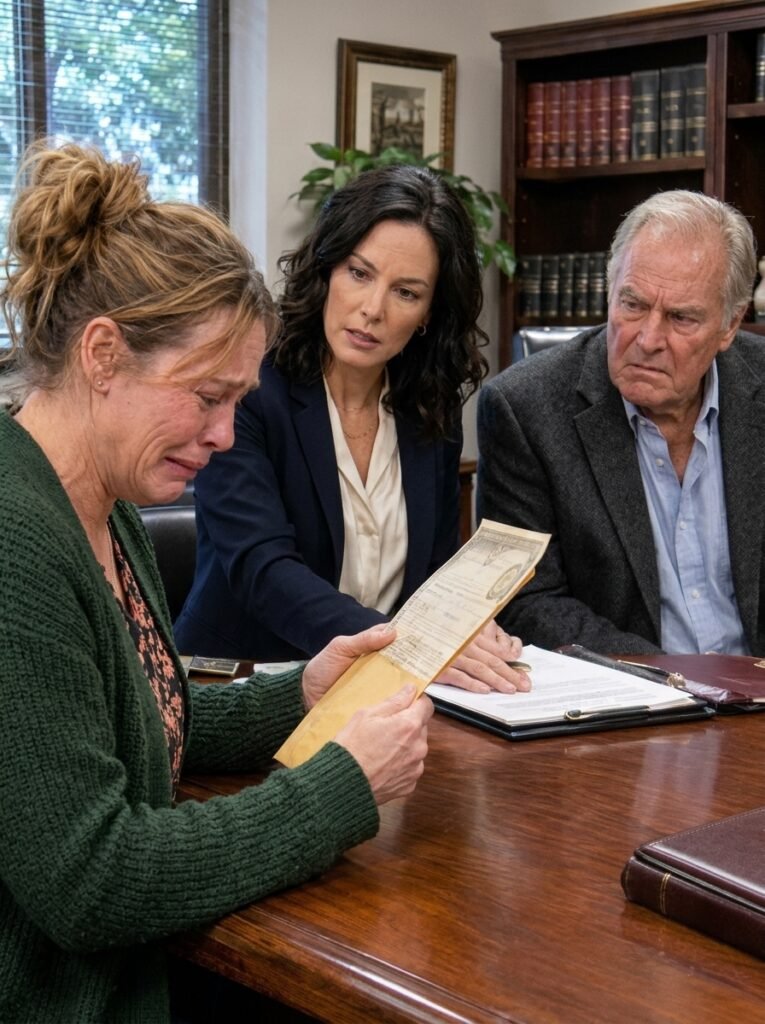
“Mrs. Fennimore? Mr. Pickett left something for you. He asked that it be opened in my office, with his nephew present.”
When I walked into her office, Lyndon was already sitting at the table, tapping his foot.
“What could he possibly leave you?” he asked. “You’re the lady across the street.”
“I shoveled his driveway,” I said.
He laughed out loud.
“So that’s how it works. You buttered up a lonely old man for a few years and figured you’d get the house. Let me be very clear. Whatever he left you, I’ll fight it. He was ninety-two. He was senile. I’ll sue you for every dime you’ve got.”
Ms. Castellanos handed me a sealed envelope with my name on it in shaky handwriting.
Inside was one folded sheet of paper. One line.
“Maggie. I always knew it was you. And I never told you what I did either.”
And underneath it, stapled to the letter, was an old bank document.
From eleven years ago.
With my name on it.
PART 2
I read the bank document twice before I understood it.
It was a mortgage payoff letter. For my house. Dated January, eleven years ago. Six weeks after Conrad died.
“Paid in full. $61,800. Payment received from: anonymous third party.”
I’d always thought the bank had made a mistake.
That January, I’d gotten a letter saying my mortgage was paid off. I called the bank three times. They said the payment was legitimate, the sender wished to remain anonymous, and there was nothing more they could tell me.
I’d thought maybe Conrad had some insurance I didn’t know about. Or a guardian angel at the bank.
It was Mr. Pickett.
The grumpy old man across the street who called the police on my dog.
Ms. Castellanos handed me a second, longer letter. This one was four pages.
“Maggie,
I’m not a nice man. I know what people call me. I earned it.
But I knew your husband. Conrad. You didn’t know that. Fifteen years ago, my truck went off the road into the river on County Road T. In February. Conrad was driving behind me on his way to the logging site. He went into that water in his work clothes and pulled me out through the window.
He never told anyone. He told me not to make a fuss.
When he died, I watched you from my window trying to shovel your driveway at 5 a.m., crying. I knew you couldn’t keep that house. So I paid it. It was the only way I knew to pay him back.
Then you walked across the street and shoveled mine.
I never thanked you because if I thanked you, I’d have to tell you why. And I couldn’t. I’m a stubborn old fool.
Thank you, Maggie. For eleven winters. And for lying on the ice with me.
Horace”
I couldn’t stop crying.
Lyndon cleared his throat.
“Okay. That’s very touching. But what about the house? The house is mine, right?”
Ms. Castellanos opened his will.
Mr. Pickett had left his house to the city. To be turned into a small community center for the neighborhood kids. The same kids he used to yell at for cutting across his lawn.
His savings went to the fire department’s rescue team. The ones who’d come for him on the ice.
Lyndon got Mr. Pickett’s old railroad pocket watch.
He left without saying goodbye.
This winter, the Horace Pickett Community Room opened. There’s a homework table. A hot chocolate machine. A big window that looks out at the street.
And a brass plaque by the door, which his lawyer said he chose himself.
“For the kids who cut across my lawn. Come inside where it’s warm.”
The first snowstorm of the year came last week.
At 5 a.m., I went outside with my shovel.
Across the street, at the community room, three teenagers from our block were already out there. Shoveling the walk.
I don’t know who told them.
Maybe nobody did.
THE END.