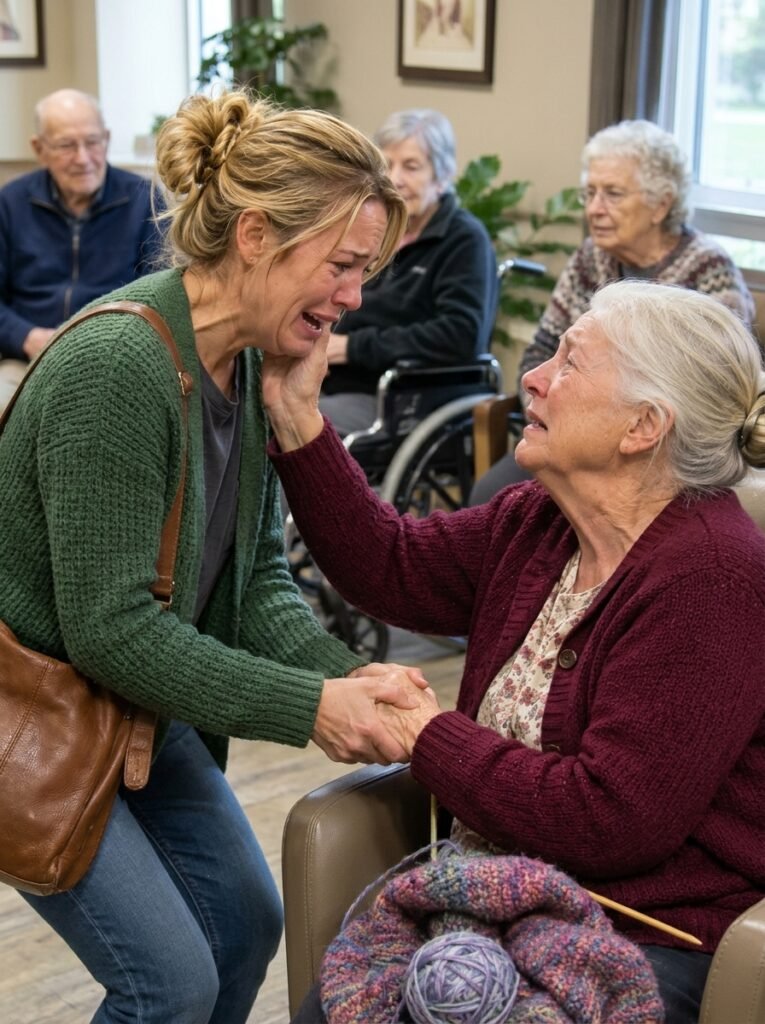
My sister called me crying: “Mom died last night. Heart attack. She wanted no funeral. I already had her cremated.” I grieved my mother for 6 months. Then a nursing home 200 miles from my sister’s house called me. “Ms. Mulligan? Your mother has been asking for you every day. Could you please come?”
My name is Tracy Mulligan. I’m 47. I work in the vital records office for the city of Denver, Colorado. Birth certificates. Death certificates. Marriage licenses.
My mother, Evelyn, raised my sister and me alone in Rockford, Illinois. She worked two jobs. She never missed a school play.
I moved to Denver twenty years ago. My older sister, Lorna, stayed in Rockford, near Mom.
Two years ago, Mom started getting forgetful. Lorna got power of attorney. She took over the bank accounts and the bills.
“I’ve got it handled,” she told me. “You’re so far away. Let me do this.”
Last April, Lorna called at 6 a.m.
She was sobbing.
“Mom’s gone, Tracy. Heart attack in her sleep. She always said she didn’t want a funeral. No fuss. I already had her cremated. I’m so sorry. I tried to call you.”
I sat on my kitchen floor and cried for an hour.
“Can I come? Can I see her ashes?”
“There’s nothing to see,” Lorna said. “Just a box. Stay home, Tracy. Grieve in your own way. I’ll mail you a picture.”
She mailed me a picture. A wooden box on her mantel.
She also told me Mom’s house had to be sold to pay off “her debts.” There was nothing left for either of us.
I believed every word.
Six months later, on a Tuesday afternoon, my phone rang. A number from southern Illinois.
“Hello, is this Tracy Mulligan? My name is Femi Ade. I’m a nurse at Willow Bend Care Center in Carbondale.”
“I think you have the wrong number.”
“Your mother, Evelyn Mulligan, has your name and number written inside the cover of her Bible. She’s been asking for you every single day. We finally found it. Could you please come see her? She’s been very sad.”
I couldn’t speak.
“My mother died in April.”
The nurse paused.
“Ma’am, I’m looking at her right now. She’s sitting by the window. She’s wearing a blue sweater. She asked me to tell you she made you a scarf.”
I hung up and called Lorna.
“Lorna. A nursing home in Carbondale just called me. They say Mom is alive.”
Lorna laughed. Too fast.
“That’s a scam, Tracy. They do that. They find obituaries and call grieving families for money. Don’t give them anything.”
“There was no obituary, Lorna.”
Silence.
Then her voice turned to ice.
“Mom’s ashes are on my mantel. You saw the picture. Stay in Denver. You abandoned her twenty years ago. You don’t get to show up now and confuse some poor old woman who isn’t even her.”
She hung up.
I didn’t panic.
I work with death records every single day. I know exactly where to look.
I logged into the statewide system from my desk. I searched the Illinois death index for Evelyn Mulligan. Date of birth: March 2nd, 1949.
No results.
No death certificate. No funeral home record. No cremation permit.
Nothing.
In Illinois, you cannot legally cremate someone without a death certificate.
Then I checked one more thing. The property records for Mom’s house in Rockford.
Sold in May. One month after she “died.”
The seller’s signature: Lorna Mulligan, power of attorney for Evelyn Mulligan.
You can’t use a power of attorney for someone who’s dead.
Lorna knew Mom was alive. She’d sold the house. Moved Mom two hundred miles away to a state-funded nursing home. And told me she was dead, so I’d never come looking.
I booked a flight that night.
At Willow Bend Care Center, the nurse walked me down the hall.
My mother was sitting by the window in a blue sweater. Thinner. Grayer. A half-finished scarf in her lap.
She looked up at me.
Her eyes filled with tears.
“Tracy?” she whispered. “Oh, my girl. Lorna told me you died.”
PART 2
I fell to my knees in front of her wheelchair.
“She said a car accident,” Mom whispered. “In April. She said you were gone and there wasn’t a funeral because Denver was too far. I cried every night. I made you a scarf anyway. I didn’t know why. I just kept making it.”
She’d been knitting a scarf for a daughter she thought was dead.
And I’d been grieving a mother who was knitting it.
I stayed with her all afternoon. She remembered everything about me. My first word. My prom dress. The name of my first dog.
The nurse, Femi, sat with us for a while.
“She talks about you every day,” he said. “She always says, ‘My Tracy would come if she could.’”
That night, from a hotel room in Carbondale, I called the Illinois Department on Aging. Then the police. Then a lawyer.
The investigation took two months.
Lorna had moved our mother out of her house in April. She’d told the staff at Willow Bend that Mom had “no other family.” She’d stopped visiting after the first week.
Then she’d sold Mom’s house for $168,000. She’d been collecting Mom’s Social Security and pension every month. More than $2,800 a month. She used the money for a new car and a kitchen remodel.
The wooden box on her mantel was empty. She’d bought it online for forty dollars.
When the detective asked her why she told each of us the other one was dead, she said:
“So they’d stop asking questions.”
Lorna was charged with financial exploitation of an elderly person and theft. She lost her power of attorney. A judge appointed me as my mother’s guardian instead.
She pleaded guilty in the fall. She was ordered to pay back every dollar. She didn’t go to prison. She did lose the right to ever see our mother without supervision.
She hasn’t asked to.
I moved my mother to Denver in October. She lives in a small assisted living apartment fifteen minutes from my house. Her window looks out at the mountains.
I visit every day after work.
Last week, she finished the scarf.
It’s blue and lumpy and much too long. Some of the rows are uneven where her hands shook.
She wrapped it around my neck three times and laughed.
“There,” she said. “Now you’re really here.”
I wear it every day.
It’s not even that cold yet.
THE END.